PUSHKAR (RAJASTHAN) – ONLY BRAHMA TEMPLE
Pushkar is one of the oldest and most sacred towns in India, located in the Ajmer district of Rajasthan. Surrounded by the Aravalli hills, this spiritual town is famous for its serene lake, vibrant culture, and deep mythological significance. Among all its attractions, the most unique and globally recognized landmark is the Brahma Temple Pushkar, which is widely known as the only dedicated temple in the world devoted to Lord Brahma, the creator in Hindu mythology.
Pushkar holds a special place in Indian religious traditions, as it is believed to be one of the oldest existing pilgrimage sites. The town is mentioned in ancient scriptures and has been a center of devotion for centuries. Pilgrims from across India and the world visit Pushkar not only for spiritual reasons but also to experience its peaceful environment and cultural richness.
The Brahma Temple in Pushkar stands as a symbol of rarity and devotion. While temples dedicated to Lord Shiva and Vishnu are found in abundance across India, temples dedicated to Brahma are extremely rare, making this site exceptionally significant. The architecture of the temple reflects traditional Rajasthani design with red spires, marble flooring, and intricate carvings that enhance its spiritual aura.
Pushkar is also famous for the annual Pushkar Camel Fair, which attracts thousands of visitors, blending spirituality with cultural celebration. The presence of the holy Pushkar Lake further enhances the town’s importance, as it is believed that taking a dip in its waters purifies the soul.
Overall, Pushkar and its Brahma Temple together represent a unique combination of mythology devotion, architecture, and cultural heritage making it one of the most remarkable spiritual destinations in India.
What Is Pushkar (Rajasthan) – Only Brahma Temple ?
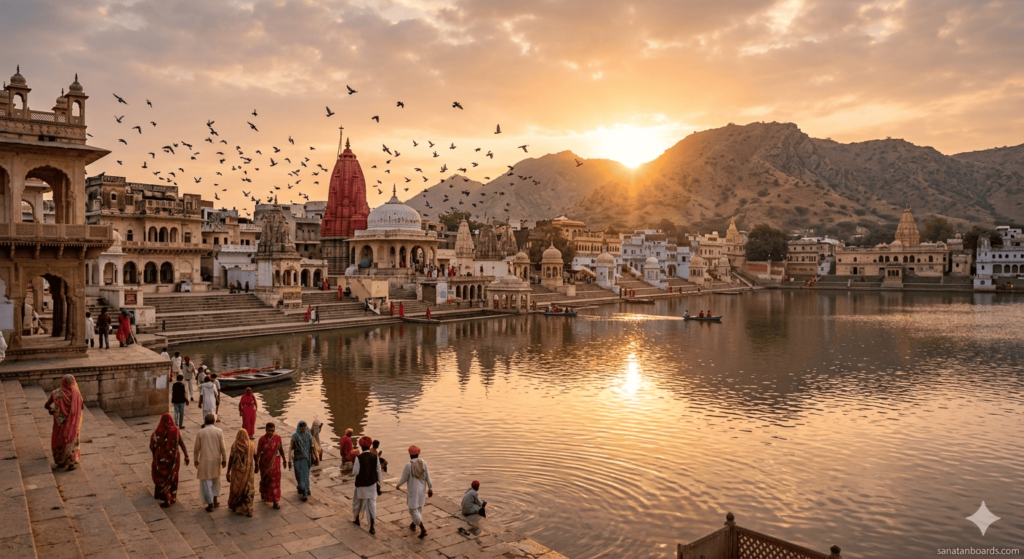
Pushkar is a sacred town located in Rajasthan that is globally recognized for its deep religious importance and historical legacy. The identity of Pushkar is strongly connected with the Brahma Temple, which is the only prominent temple in the world dedicated to Lord Brahma.
The Brahma Temple Pushkar is a Hindu temple that honors Lord Brahma, who is considered the creator of the universe according to Hindu belief. This temple is unique because, despite Brahma being part of the holy Hindu trinity (Brahma, Vishnu, and Shiva), he is rarely worshipped independently. This makes the temple in Pushkar exceptionally rare and spiritually important.
The temple structure is built using marble and stone, featuring a distinctive red pinnacle (shikhara) and a silver turtle motif inside the sanctum. It is believed that the temple dates back several centuries, although it has undergone renovations over time. The atmosphere of the temple is peaceful, filled with chants, rituals, and the aroma of incense, creating a strong spiritual experience for devotees.
Pushkar itself is considered a sacred pilgrimage site, and the temple plays a central role in this identity. According to Hindu mythology, Pushkar was created when a lotus flower dropped from the hands of Lord Brahma, forming the Pushkar Lake. This legend adds to the divine importance of the region.
The town is also known for its spiritual energy, attracting saints, pilgrims, tourists, and scholars. It serves as a center for religious learning and cultural exchange, making it more than just a temple town.
Thus, Pushkar and its Brahma Temple together represent a rare spiritual concept where mythology, devotion, and cultural heritage merge into one sacred destination.
Who Is Required Pushkar (Rajasthan) – Only Brahma Temple ?
The Brahma Temple in Pushkar is required or significant for multiple groups of people, each connected to it in different ways—spiritual, cultural, historical, and educational.
Firstly, devotees of Hinduism, especially followers who worship Lord Brahma or seek blessings for creation, wisdom, and knowledge, find this temple highly important. Although Brahma worship is not common, those who visit believe that praying here brings spiritual fulfillment and a sense of divine connection.
Secondly, pilgrims visiting sacred Hindu sites consider Pushkar an essential stop in their religious journey. The presence of the Brahma Temple Pushkar makes Pushkar one of the most important pilgrimage destinations in India, especially for those completing spiritual circuits in Rajasthan.
Thirdly, historians, archaeologists, and researchers require this site for understanding ancient Indian culture, temple architecture, and mythological traditions. The temple provides insight into how rare deities were worshipped and how religious practices evolved over centuries.
Fourthly, tourists and cultural explorers visit the temple to experience its uniqueness. Since it is considered the only major Brahma temple in the world, it becomes a must-visit destination for international travelers interested in spirituality and heritage.
Fifthly, students and learners of mythology and religious studies require knowledge of Pushkar and its temple to understand Hindu cosmology, particularly the role of the creator deity Brahma.
Lastly, local communities depend on the temple for economic and cultural sustainability. Tourism generated by the temple supports livelihoods, including guides, shopkeepers, priests, and hospitality services.
Thus, the Brahma Temple in Pushkar is required not just for worship, but also for cultural preservation, education, tourism, and local development.
When Pushkar (Rajasthan) – Only Brahma Temple Is Required ?
The importance of the Brahma Temple in Pushkar is not limited to a specific time; rather, it is required across different periods, occasions, and life situations, making it timeless in its significance.
Historically, the temple has been required since ancient times when Pushkar emerged as a sacred pilgrimage site. Kings, sages, and devotees visited it during important religious journeys, especially during auspicious Hindu calendar dates. Over centuries, it has remained a constant center of worship.
In the present day, the temple is required during daily worship practices performed by priests and devotees. Morning and evening aartis (prayer ceremonies) are conducted regularly, attracting pilgrims who seek blessings and peace of mind. The temple becomes especially significant during religious festivals and fairs.
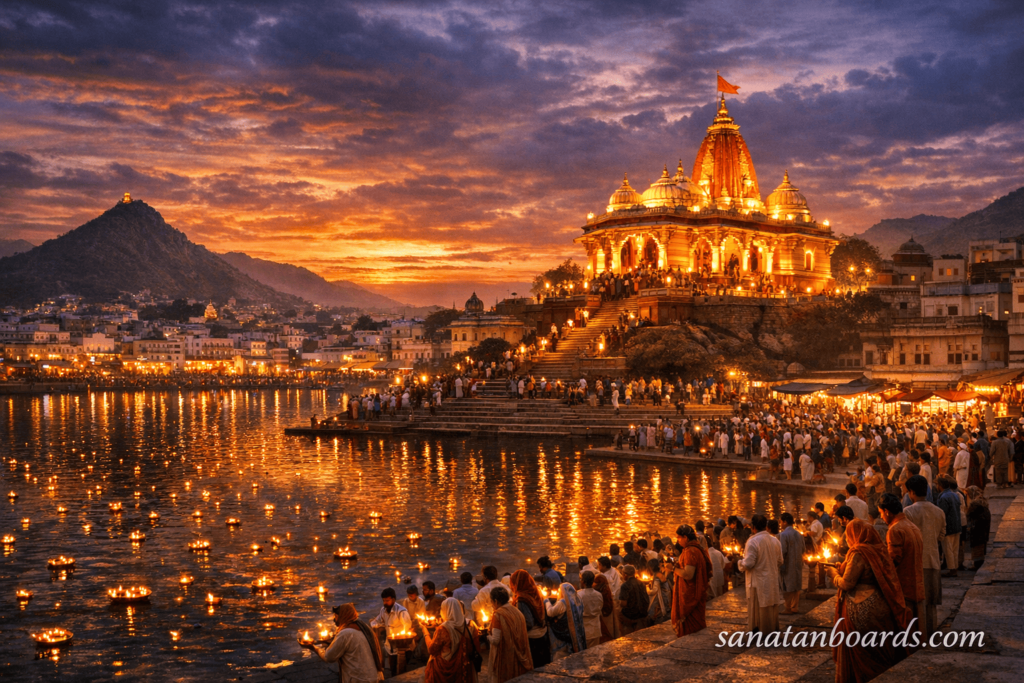
One of the most important times when the Brahma Temple Pushkar is required is during the annual Pushkar Camel Fair and Kartik Purnima. During Kartik Purnima, thousands of devotees take a holy dip in Pushkar Lake and visit the temple to complete their spiritual journey. This period transforms Pushkar into a major pilgrimage hub.
The temple is also required during personal life milestones such as weddings, spiritual vows, and religious ceremonies. Many people visit Pushkar seeking blessings for creation, family prosperity, and new beginnings, as Lord Brahma symbolizes creation and origin.
From a cultural tourism perspective, the temple is required throughout the year, especially during peak tourist seasons from October to March, when the weather is favorable and cultural events are active.
Academically, it is required whenever studies are conducted on Indian mythology, temple architecture, or cultural anthropology. Researchers often refer to Pushkar as a key example of rare Brahma worship traditions.
Thus, the Brahma Temple in Pushkar is required continuously—historically, spiritually, culturally, and socially—making it a timeless sacred destination.
Where Pushkar (Rajasthan) – Only Brahma Temple Is Required ?
The Brahma Temple is located in the sacred town of Pushkar in the Ajmer district of the Indian state of Rajasthan. This geographical location plays a crucial role in its spiritual and cultural importance.
Pushkar is situated on the edge of the Thar Desert and is surrounded by the Aravalli mountain range. The temple is positioned near the famous Pushkar Lake, which is considered one of the most sacred lakes in India. According to mythology, this lake was created by Lord Brahma himself, making the entire region divine.
The Brahma Temple Pushkar is located on a hilltop area near the lake, accessible through narrow lanes and steps. Its location enhances its spiritual ambiance, as devotees experience a gradual transition from the busy town to a peaceful sacred space.
Pushkar is located approximately 14 kilometers from Ajmer city and is well connected by road and rail. The nearest major railway station is Ajmer Junction, while the nearest airport is in Kishangarh and Jaipur. This accessibility makes the temple reachable for both domestic and international visitors.
The temple’s location within Pushkar is also significant because the town itself is considered one of the few Brahma-created pilgrimage sites in Hindu tradition. It is believed that visiting this place is equivalent to visiting multiple sacred sites across India.
Surrounding the temple are markets, ghats, and cultural spaces where pilgrims can experience traditional Rajasthani life. The combination of natural beauty, religious importance, and cultural vibrancy makes the location unique.
Thus, the Brahma Temple’s location in Pushkar is not just geographical but deeply spiritual, forming the core identity of this sacred destination.
How Pushkar (Rajasthan) – Only Brahma Temple Is Required ?
The significance of the Brahma Temple in Pushkar can be understood through how it is required in spiritual practice, cultural tradition, and daily life activities.
Devotees approach the Brahma Temple Pushkar through a structured spiritual process. Visitors first take a holy dip in Pushkar Lake, which is believed to cleanse sins and prepare the mind for worship. After purification, they proceed to the temple for darshan (viewing of the deity).
Inside the temple, rituals are performed by priests using traditional Vedic chants, incense, and offerings such as flowers and prasad. Devotees offer prayers seeking blessings for creation, wisdom, and new beginnings. The temple follows ancient Hindu rituals that have been preserved over centuries.
Culturally, the temple is required through festivals, fairs, and religious gatherings. During events like Kartik Purnima, thousands of lamps are lit around Pushkar Lake, and the temple becomes the focal point of celebration and devotion.
From a tourism perspective, visitors explore the temple through guided tours or independent travel. They walk through the narrow streets of Pushkar, interact with local vendors, and experience Rajasthani culture before reaching the temple.
Academically, the temple is studied through architectural analysis, mythological texts, and cultural research. Scholars examine how Brahma worship is rare and how Pushkar became the only major center for it.
Economically, the temple supports local livelihoods. Shops, hotels, guides, and transport services operate because of the steady flow of pilgrims and tourists.
Thus, the Brahma Temple in Pushkar is required through a combination of ritual practice, cultural participation, tourism activity, and economic support systems.
Case Study On Pushkar (Rajasthan) – Only Brahma Temple
The Brahma Temple in Pushkar serves as a unique case study in religious geography, cultural sustainability, and heritage tourism. Located in the sacred town of Pushkar, this temple is globally recognized as the only major shrine dedicated to Lord Brahma.
Background Context
Historically, Pushkar evolved as a pilgrimage center due to its association with Hindu mythology. The presence of the Brahma Temple Pushkar elevated its importance, making it a rare site of Brahma worship. Over centuries, it attracted sages, rulers, and pilgrims.
Religious Significance
The temple represents the concept of creation in Hindu cosmology. Lord Brahma is considered the creator, and although temples dedicated to him are rare, Pushkar stands as the primary center of his worship. This makes it a unique case in global religious studies.
Cultural Impact
Pushkar is not just a religious site but also a cultural hub. Festivals like the Pushkar Camel Fair and Kartik Purnima attract global attention. The temple becomes the focal point of these cultural expressions, blending spirituality with local traditions.
Economic Influence
The temple significantly contributes to the local economy. Tourism driven by the temple supports hotels, transportation, handicrafts, and food industries. Thousands of local residents depend directly or indirectly on temple-based tourism.
Challenges
Despite its importance, the temple faces challenges such as overcrowding during peak seasons, environmental pressure on Pushkar Lake, and preservation concerns for ancient structures. Managing sustainable tourism is a key issue.
Management and Preservation
Local authorities and religious committees work together to maintain the temple’s structure and spiritual environment. Efforts include crowd management during festivals and conservation of surrounding heritage sites.
Visitor Experience
Visitors experience a journey that begins with Pushkar Lake and ends at the temple. This spiritual route enhances emotional and religious engagement. International tourists often describe it as a deeply immersive cultural experience.
Conclusion of Case Study
The Brahma Temple in Pushkar is a rare example of how mythology, religion, and economy intersect. It demonstrates how a single religious site can shape the identity of an entire town.
White Paper On Pushkar (Rajasthan) – Only Brahma Temple
Executive Overview
The Brahma Temple in Pushkar represents a unique religious and cultural asset located in Pushkar. It is widely acknowledged as the only major temple dedicated to Lord Brahma. This white paper examines its religious importance, tourism impact, socio-economic contributions, and preservation needs.
Strategic Importance
The Brahma Temple Pushkar holds strategic importance in India’s cultural heritage map. It attracts both domestic and international visitors, contributing to Rajasthan’s identity as a spiritual tourism hub.
Cultural and Religious Framework
The temple is embedded in Hindu cosmology, representing creation and origin. It plays a critical role in preserving ancient rituals and traditions that are rarely practiced elsewhere. Its existence ensures continuity of Brahma worship traditions.
Tourism and Economic Development
The temple is a major driver of tourism in Pushkar. Seasonal peaks during festivals generate significant revenue for the local economy. Hospitality, transport, retail, and cultural industries benefit directly from temple-driven tourism.
Infrastructure Requirements
To support growing visitor numbers, infrastructure development is essential. This includes improved roads, crowd management systems, sanitation facilities, and preservation of Pushkar Lake’s ecosystem.
Sustainability Concerns
Environmental sustainability is a key concern. Increased tourism places pressure on water resources, waste management systems, and heritage conservation. Sustainable tourism models are required to maintain ecological balance.
Stakeholder Roles
Multiple stakeholders are involved:
- Local government bodies manage infrastructure and regulations
- Religious authorities oversee rituals and temple activities
- Tourism boards promote cultural heritage
- Local communities support and benefit from economic activity
Risk Assessment
Risks include overcrowding, environmental degradation, and loss of cultural authenticity due to commercialization. Strategic planning is required to mitigate these risks.
Future Outlook
With proper management, the temple can continue to serve as a global spiritual destination while maintaining cultural integrity. Digital tourism initiatives and heritage conservation programs can enhance its sustainability.
Conclusion of White Paper
The Brahma Temple in Pushkar is not only a religious site #Sanatanboardsinvasai but also a socio-economic and cultural engine. Its preservation is essential for maintaining India’s intangible heritage.
Industry Application On Pushkar (Rajasthan) – Only Brahma Temple
The Pushkar and the Brahma Temple Pushkar together play an important role across multiple industries. The temple is not only a religious site but also a major driver of economic, cultural, and service-based sectors.
1. Tourism Industry
The temple is one of the key attractions in Rajasthan’s spiritual tourism circuit. It brings domestic and international visitors throughout the year. Travel agencies, tour guides, and packaged pilgrimage tours depend heavily on Pushkar as a destination.
2. Hospitality Industry
Hotels, guest houses, dharamshalas, and homestays in Pushkar operate largely due to temple visitors. During peak seasons like festivals, occupancy rates rise significantly, supporting local businesses and employment.
3. Transportation Industry
The movement of pilgrims from nearby cities such as Ajmer supports taxis, buses, auto-rickshaws, and private transport services. The temple indirectly sustains daily income for transport workers.
4. Retail and Handicrafts Industry
Local markets around the temple sell religious items, souvenirs, clothing, jewelry, and handicrafts. This boosts small-scale artisans and traditional Rajasthani craft industries.
5. Cultural and Event Industry
Festivals like Kartik Purnima and the Pushkar Camel Fair create large-scale cultural events. Event organizers, performers, and cultural groups benefit from these gatherings.
6. Media and Digital Content Industry
The temple attracts travel vloggers, documentary filmmakers, photographers, and social media creators. It generates content for global audiences interested in spirituality and heritage tourism.
7. Academic and Research Industry
Historians, archaeologists, and scholars study Pushkar for its rare Brahma worship tradition, temple architecture, and mythological importance. It contributes to research publications and cultural studies.
8. Government and Infrastructure Development
Local and state governments invest in roads, sanitation, crowd management, and lake conservation due to the temple’s importance. It also influences tourism policy planning in Rajasthan.
Conclusion
The Brahma Temple in Pushkar is not only a #Sanatanboardsinmumbai spiritual landmark but also a multi-industry contributor influencing tourism, economy, culture, research, and public infrastructure.
source : Geethanjali – Travel Saga
ASK FAQ
1. What is Pushkar famous for?
Pushkar in Rajasthan is famous for the sacred Brahma Temple, which is the only major temple in the world dedicated to Lord Brahma, along with Pushkar Lake and religious festivals.
2. Why is Brahma Temple in Pushkar unique?
The Brahma Temple in Pushkar is unique because it is one of the very few temples dedicated to Lord Brahma, making it extremely rare and spiritually significant in Hinduism.
3. Where is Pushkar Brahma Temple located?
The Brahma Temple is located in Pushkar town in the Ajmer district of Rajasthan, India, near the holy Pushkar Lake.
4. When is the best time to visit Pushkar Temple?
The best time to visit Pushkar Brahma Temple is from October to March, especially during Kartik Purnima and the Pushkar Camel Fair.
5. How is Brahma Temple important for tourism?
The Brahma Temple boosts religious tourism in Rajasthan by attracting pilgrims, international tourists, and cultural travelers, supporting the local economy and hospitality industry.
Table of Contents
Disclaimer
This content is created for educational and informational purposes only and is based on general cultural, historical, and traditional references related to Pushkar and the Brahma Temple. It does not claim absolute historical accuracy or official religious interpretation, and readers are advised to verify details from authentic sources for academic, research, or professional use.