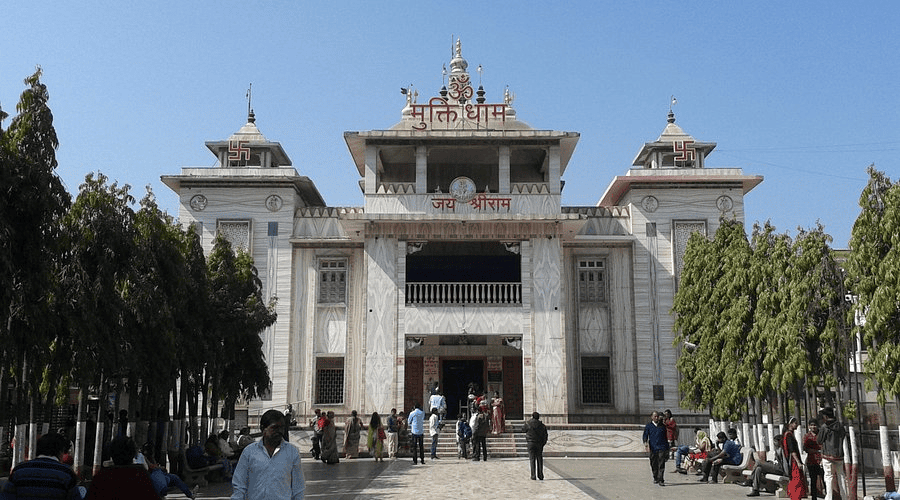
Sanatan Dharma Mukti Dham
A Conceptual Exploration of the Abode of Liberation in Eternal Dharma
Abstract
Sanatan Dharma, often translated as the “eternal order” or “perennial philosophy,” represents one of the world’s most ancient and complex spiritual traditions. At its heart lies the ultimate human goal: Mukti (liberation) or Moksha—freedom from the endless cycle of birth, death, and rebirth (samsara), and the realization of one’s true nature as identical with the ultimate reality, Brahman.
The concept of Mukti Dham—the “Abode of Liberation”—is not merely a physical location but a profound, multi-layered metaphysical, ontological, and experiential reality within this framework. This essay delves into the concept of Sanatan Dharma Mukti Dham, exploring its philosophical foundations, its varied descriptions across scriptures, the paths leading to it, its ontological status, and its enduring significance for the spiritual seeker.
I. Philosophical Foundations: The Why and Wherefore of Liberation
To understand Mukti Dham, one must first grasp the problem it solves. Sanatan Dharma diagnoses the human condition as one of avidya (ignorance or misapprehension). The individual soul (jiva), under the spell of avidya, misidentifies with the temporary body-mind complex, its desires, pains, and limited ego. This false identification leads to karma (action with its binding consequences) and perpetuates samsara, a cycle characterized by duhkha (suffering, dissatisfaction).
Liberation, therefore, is the complete eradication of this ignorance. It is not a post-mortem reward but a living realization (jivanmukti) of the following truths:
- The Nature of the Self (Atman): The true self is Atman, which is eternal, conscious, and blissful (sat-chit-ananda). It is uncaused, unchanging, and indivisible.
- The Nature of Ultimate Reality (Brahman): Brahman is the non-dual, infinite, ground of all existence. As stated in the Chandogya Upanishad, “Tat Tvam Asi” (Thou art That).
- The Identity of Atman and Brahman: The core realization of Advaita (non-dual) Vedanta is that the individual Atman is not separate from the universal Brahman. The wave is not other than the ocean. Mukti is the direct knowledge (jnana) of this non-difference.
Thus, Mukti Dham is the state of being established in this knowledge. It is not a place one goes to, but the reality one awakens to. It is the “abode” of the liberated consciousness.
II. The Panorama of Descriptions: Diverse Portrayals of the Indescribable
Sanatan Dharma, with its rich tapestry of philosophical schools (darshanas) and devotional traditions, offers varied descriptions of Mukti Dham, reflecting different levels of understanding and emphasis.
1. The Negative (Neti, Neti) Description:
In the highest non-dualistic approach, particularly in Advaita Vedanta and the Jnana Yoga tradition, the liberated state is beyond all attributes (nirguna) and forms. It is Nirvana (extinction of the finite ego and its cravings) in the Buddhist context, closely aligned with this view. The Mandukya Upanishad speaks of Turiya, the fourth state of consciousness beyond waking, dreaming, and deep sleep—pure, non-dual awareness. Here, Mukti Dham is not a location but the very substratum of all existence. It is described via negation: not this, not that (neti, neti), as it is beyond space, time, and causation.
2. The Positive (Saguna) Descriptions:
For theistic schools like Vishishtadvaita (qualified non-dualism) and Dvaita (dualism), and in the Bhakti Yoga tradition, the liberated soul retains its individuality in a relationship of loving servitude or blissful proximity to the Divine.
- Vaikuntha: The celestial abode of Lord Vishnu/Narayana, described in the Puranas and texts like the Bhagavata Purana as a realm of everlasting peace, beauty, and devotion, free from the cycles of time and the three gunas (qualities of material nature).
- Goloka Vrindavan: The highest, most intimate spiritual planet of Lord Krishna, conceived as the realm of eternal divine love (prema) and pastimes (lila).
- Shiva Loka/Kailash: The abode of Lord Shiva, often portrayed as the mount Kailash, representing transcendental consciousness, ascetic perfection, and dissolution of the universe.
- Brahmaloka/Satyaloka: In the cosmological ladder, this is the highest plane of the manifested universe, presided over by Brahma, where sages reside for vast cosmic periods. However, even this is sometimes seen as a temporary, albeit immensely long, liberation (krama mukti), with final liberation occurring at the end of the cosmic cycle.
These “abodes” are not geographical places in the material universe but transcendental realms existing in a spiritual dimension. They are Saguna Brahman (Brahman with attributes) manifested as a perfected, conscious environment for divine communion.
3. The State of Absolute Freedom:
Common across descriptions is the idea of supreme freedom:
- Freedom from Birth and Death (Janma-Mrityu): The cycle of samsara ends.
- Freedom from Suffering (Duhkha): Transcendence of all physical, mental, and existential pain.
- Freedom from Limitation (Bandhana): Release from the constraints of a single body, identity, and location. The Jivanmukta (liberated while living) acts in the world without being bound by it.
- Attainment of Supreme Bliss (Ananda): Not mundane pleasure, but the innate, unconditional bliss of the Self.
III. The Pathways to the Abode: Yogas as the Roads to Mukti Dham
Sanatan Dharma prescribes various paths (margas) suitable for different human temperaments to realize this abode.
- Jnana Yoga (The Path of Knowledge): The path of discrimination (viveka) between the real (Atman) and the unreal (body-mind-world). Through study (shravana), reflection (manana), and deep meditation (nididhyasana) on the Mahavakyas (great utterances of the Upanishads), the aspirant directly realizes the non-dual truth. Here, Mukti Dham is uncovered within as one’s own nature.
- Bhakti Yoga (The Path of Devotion): Through self-surrendering love (sharanagati) for a personal deity (Ishvara), the devotee’s heart is purified of ego. The intense love for God (bhava) matures into divine love (prema), leading the soul, upon leaving the body, to the divine abode of that chosen form (ista-deva). The Bhagavad Gita (Chapter 12) emphasizes the accessibility of this path.
- Karma Yoga (The Path of Selfless Action): By performing one’s prescribed duties (svadharma) without attachment to the fruits of action, the mind is purified of desire and ego. This leads to a state of equanimity and prepares the ground for either Jnana or Bhakti. The Gita’s central teaching is the yoga of action as a means to liberation.
- Raja Yoga (The Royal Path of Meditation): Systematized by Patanjali in the Yoga Sutras, this eight-limbed path (Ashtanga Yoga) culminates in Samadhi—a state of meditative absorption where the meditator, meditation, and object of meditation become one. Different levels of Samadhi (samprajnata, asamprajnata) represent progressive entry into the state of liberation.
- Other Paths: Hatha Yoga prepares the body and nervous system for higher meditation. Tantra views the entire universe as the play of consciousness and seeks to realize the divine within the matrix of the material world.
These paths are not mutually exclusive; they often intertwine. A Karma Yogi may be a Bhakta, and a Jnana Yogi must have purified the mind through Karma and Bhakti.
IV. Ontological and Cosmological Status: Where is Mukti Dham?
This is a central philosophical question. The answer varies by school:
- Non-Dualistic View (Advaita): Mukti Dham is not a separate “where.” It is the foundational reality (Brahman) here and now, veiled by ignorance. Liberation is the dissolution of the veil, not a movement in space. The famous analogy: Ten fools cross a river. Each counts and finds only nine, missing themselves. Liberation is the realization “I am the tenth.” The “abode” was never elsewhere.
- Theistic View (Dvaita/Vishishtadvaita): Mukti Dham is a transcendent, eternal realm distinct from the material universe (prakriti). It is the creation of God for the enjoyment of liberated souls who retain their individuality. It has a definite ontological reality as a divine plane.
- Integral View: A synthesized understanding might see the positive descriptions (Vaikuntha, etc.) as pedagogical devices—conceptual maps for the journey of consciousness. They provide the devotee with a tangible goal. The highest truth, however, is that all such “abodes” are manifestations within consciousness itself. The “location” is a state of being, a dimension of existence accessible only through purified consciousness.
In the cosmic model, the material universe is just one layer. Beyond it lie subtle realms (lokas), with the abodes of liberation existing in the pure spiritual domain, untouched by the gunas.
V. Jivanmukti vs. Videhamukti: The Abode Here or Hereafter?
- Jivanmukti: The state of being liberated while still embodied. The Jivanmukta, having realized the Self, resides in the “abode of liberation” even as they interact with the world. Their body continues due to prarabdha karma (karma that has begun to fructify), but they are untouched by it, like a potter’s wheel that continues to spin after the pot is finished. They dwell in constant awareness of Brahman. For them, Mukti Dham is an ever-present reality.
- Videhamukti: Liberation upon the death of the body. For the non-realized, death leads to another birth. For the realized soul, the final dissolution of the body marks the end of all subtle karmic traces (vasanas) and a final merging or eternal communion, depending on the school. The “abode” is then entered in its fullest sense, free from any physical vestige.
VI. Contemporary Relevance and Conclusion
In the modern world, characterized by existential anxiety, materialism, and a search for meaning, the concept of Sanatan Dharma Mukti Dham offers profound insights:
- The Goal of Human Life: It posits that the purpose of life is not mere material accumulation but transcendence and self-realization. It provides a telos that elevates human aspiration.
- A Framework for Inner Peace: The idea that the ultimate abode of peace is within (antaratman) is a powerful antidote to external seeking. Practices like meditation and mindfulness, derived from these traditions, are globally embraced for mental well-being.
- Ethical Foundation: The journey to Mukti Dham necessitates ethical purity (yamas and niyamas), selflessness, and compassion, providing a robust moral compass.
- Inclusivity of Paths: The multiplicity of yogas acknowledges diverse human psychologies, allowing for a personalized spiritual journey.
- A Vision of Ultimate Freedom: In an age of various societal and psychological bondings, the promise of absolute freedom (kaivalya) remains a potent and inspiring ideal.
Conclusion
Sanatan Dharma Mukti Dham is far more than a heavenly paradise. It is the ultimate resolution of the human spiritual quest. It is simultaneously:
- The Absolute Reality (Brahman) realized through knowledge.
- The Divine Domain attained through love.
- The State of Supreme Freedom achieved through selfless action and meditation.
Whether conceived as the non-dual ocean of consciousness, the loving court of Krishna, or the solitary peak of Shiva’s awareness, it represents the final homecoming of the soul. It is the dham (abode) where all seeking ceases, all duality dissolves, and the eternal (sanatan) truth of one’s own nature shines forth, unobscured and complete. It is not a distant destination to be reached in a future time, but the ever-present ground of being, awaiting discovery in the sacred depths of the here and now. The journey to Mukti Dham, therefore, is the journey from the periphery of existence to its silent, blissful center—a journey from the temporal to the eternal.
Top 100 name of Sanatan Dharma Mukti Dham
Top 100 Mukti Dham (Sacred Liberation Sites) in Sanatan Dharma
Mukti Dham (मुक्ति धाम) refers to the sacred places where attaining Moksha (liberation) is believed to be easier in Sanatan Dharma. These places are associated with Lord Vishnu, Lord Shiva, and Goddess Shakti, where devotees seek freedom from the cycle of birth and death.
🛕 The 7 Moksha Puri (Sapta Moksha Puris)
These seven sacred cities are considered the holiest places where liberation (moksha) can be attained:
- Kashi (Varanasi, Uttar Pradesh) → Vishwanath Jyotirlinga, Manikarnika Ghat
- Ayodhya (Uttar Pradesh) → Birthplace of Lord Rama
- Mathura (Uttar Pradesh) → Birthplace of Lord Krishna
- Haridwar (Uttarakhand) → Gateway to the Himalayas, Ganga River
- Kanchi (Tamil Nadu) → Kamakshi Devi, Ekambareswarar Temple
- Avantika (Ujjain, Madhya Pradesh) → Mahakaleshwar Jyotirlinga
- Dwaraka (Gujarat) → Dwarkadhish Temple, Krishna’s kingdom
Courtesy: Desi Wanderer
🔱 The 12 Jyotirlingas (Sacred Shiva Mukti Dhams)
Shiva’s twelve Jyotirlingas are considered powerful Mukti Dhams:
- Somnath (Gujarat)
- Mallikarjuna (Andhra Pradesh)
- Mahakaleshwar (Ujjain, Madhya Pradesh)
- Omkareshwar (Madhya Pradesh)
- Kedarnath (Uttarakhand)
- Bhimashankar (Maharashtra)
- Kashi Vishwanath (Varanasi, Uttar Pradesh)
- Trimbakeshwar (Maharashtra)
- Vaidyanath (Jharkhand)
- Nageshwar (Gujarat)
- Ramanathaswamy (Rameswaram, Tamil Nadu)
- Grishneshwar (Maharashtra)
🌿 The 4 Dham (Moksha Dhams Established by Adi Shankaracharya)
The Char Dham are believed to be gates to ultimate salvation:
- Badrinath (Uttarakhand)
- Dwarka (Gujarat)
- Puri (Odisha)
- Rameswaram (Tamil Nadu)
🏔️ The Chhota Char Dham (Sacred Mukti Dhams in the Himalayas)
- Yamunotri (Uttarakhand)
- Gangotri (Uttarakhand)
- Kedarnath (Uttarakhand)
- Badrinath (Uttarakhand)
🌊 The 5 Prayags (Sacred River Confluences for Liberation)
- Vishnuprayag (Alaknanda & Dhauliganga)
- Nandprayag (Alaknanda & Nandakini)
- Karnaprayag (Alaknanda & Pindar)
- Rudraprayag (Alaknanda & Mandakini)
- Devprayag (Alaknanda & Bhagirathi → Ganga begins here)
🕉️ Pancha Badri (Sacred Vishnu Temples in Uttarakhand)
- Badrinath
- Adi Badri
- Bhavishya Badri
- Vridha Badri
- Yogadhyan Badri
🔱 Pancha Kedar (Sacred Shiva Temples in Uttarakhand)
- Kedarnath
- Tungnath
- Rudranath
- Madhyamaheshwar
- Kalpeshwar
🔥 Pancha Mahabhoota Sthalas (Shiva Temples Representing 5 Elements)
- Ekambareswarar (Earth – Kanchipuram, Tamil Nadu)
- Thiruvanaikaval (Water – Tamil Nadu)
- Arunachaleswarar (Fire – Tiruvannamalai, Tamil Nadu)
- Kalahasti (Air – Andhra Pradesh)
- Chidambaram (Space – Tamil Nadu)
Courtesy: Bablu72
🛕 Other Important Mukti Dhams
- Gaya (Bihar) – Pind Daan, Vishnupad Temple
- Prayagraj (Allahabad, UP) – Sangam (Ganga-Yamuna-Saraswati)
- Rishikesh (Uttarakhand) – Gateway to the Himalayas
- Pushkar (Rajasthan) – Brahma Temple, Pushkar Lake
- Vaishno Devi (Jammu & Kashmir) – Shakti Peetha
- Kanchipuram (Tamil Nadu) – Vishnu & Shiva Temples
- Tirupati (Andhra Pradesh) – Balaji Temple
- Gokarna (Karnataka) – Mahabaleshwar Shiva Temple
- Mayapur (West Bengal) – ISKCON Headquarters
- Sabarimala (Kerala) – Ayyappa Swamy
- Madurai (Tamil Nadu) – Meenakshi Temple
- Panchavati (Nashik, Maharashtra) – Lord Rama’s exile place
- Pandharpur (Maharashtra) – Vithoba Temple
- Chitrakoot (UP-MP) – Lord Rama’s forest exile site
- Bhimashankar (Maharashtra) – Shiva Jyotirlinga
- Muktinath (Nepal) – Vishnu Mukti Kshetra
- Udupi (Karnataka) – Krishna Temple
- Kumbakonam (Tamil Nadu) – Navagraha Temples
🛕 Shakti Peethas (Where Goddess Sati’s Body Parts Fell)
- Kamakhya Devi (Assam)
- Vaishno Devi (Jammu)
- Kalighat (Kolkata, West Bengal)
- Vibhas Devi (West Bengal)
- Jwala Devi (Himachal Pradesh)
- Ambaji (Gujarat)
- Mahalaxmi Kolhapur (Maharashtra)
- Hinglaj Mata (Pakistan)
🌊 Sacred Rivers for Mukti
- Ganga (Haridwar, Varanasi, Prayagraj)
- Yamuna (Mathura, Vrindavan, Prayagraj)
- Saraswati (Prayagraj, Gujarat – Invisible River)
- Godavari (Nashik, Trimbakeshwar)
- Krishna (Andhra, Karnataka, Maharashtra)
- Kaveri (Tamil Nadu, Karnataka)
- Narmada (Madhya Pradesh, Gujarat)
🕉️ Special Mukti Dhams
- Shirdi (Sai Baba Temple, Maharashtra)
- Dakshineswar (West Bengal)
- Rameswaram Dhanushkodi (Tamil Nadu)
- Mannargudi Rajagopalaswamy Temple (Tamil Nadu)
- Srirangam Ranganathaswamy (Tamil Nadu)
- Thiruvannamalai (Tamil Nadu, Shiva & Fire Element)
- Ujjain Kumbh Mela Spot
- Naimisharanya (UP, Vedic Learning Center)
- Dwarka Bet (Gujarat, Lord Krishna’s Kingdom)
- Ganga Sagar (West Bengal, River Ganga Meets Ocean)
🌿 Lesser-Known Mukti Dhams
- Tiruvallur (Tamil Nadu, Vishnu Temple)
- Shukratal (Uttar Pradesh, Bhagavata Katha Site)
- Mahur (Maharashtra, Dattatreya Temple)
- Siddheshwar (Solapur, Maharashtra)
- Lepakshi (Andhra Pradesh, Veerabhadra Temple)
- Devghat (Nepal, Holy Site for Saints)
- Hanuman Garhi (Ayodhya)
- Lingaraja Temple (Bhubaneswar, Odisha)
- Kartik Swami Temple (Uttarakhand)
- Kumbh Mela Sites (Haridwar, Prayagraj, Ujjain, Nashik)

Table of Contents