
RAMESHWARAM DHANUSHKODI (TAMIL NADU) – SETU BRIDGE REMAINS
Located at the southeastern tip of Tamil Nadu, the region of Rameshwaram and Dhanushkodi holds immense historical, cultural, and geographical significance. Among its many intriguing features are the remains associated with the legendary Setu Bridge, often linked to the mythological Ram Setu. These remnants, stretching across the shallow waters between India and Sri Lanka have fascinated historians, scientists, and spiritual seekers for generations.
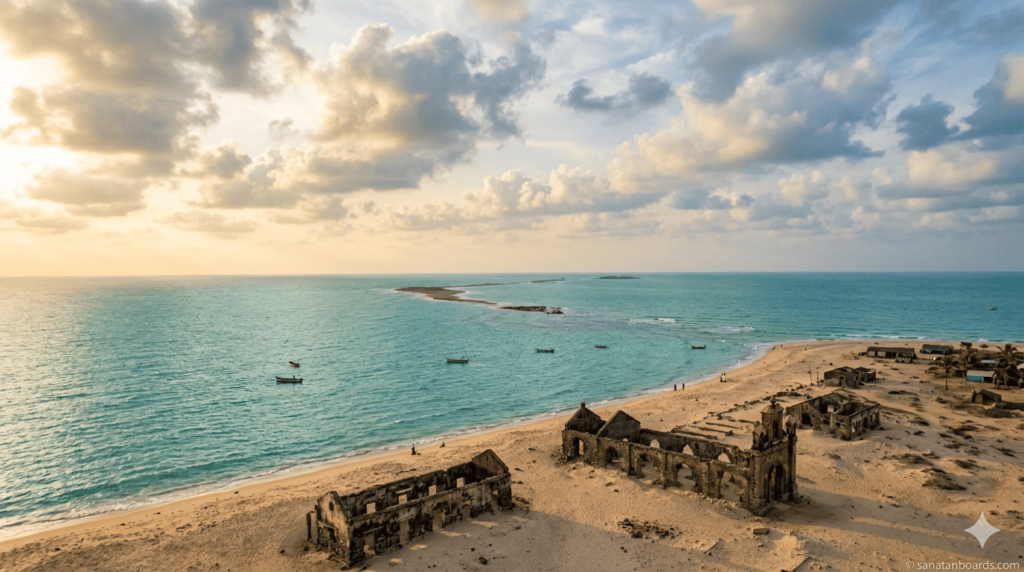
Dhanushkodi, once a thriving town, was devastated by a cyclone in 1964, leaving behind ruins that silently narrate tales of destruction and resilience. Today, it stands as a hauntingly beautiful ghost town, attracting visitors interested in history, mythology, and natural landscapes. The Setu Bridge remains, often visible as a chain of limestone shoals, are believed by many to be part of the ancient bridge described in the epic Ramayana.
The region is not only a site of religious importance but also a subject of scientific curiosity. Researchers have studied the geological formation of these structures, debating whether they are natural or man-made. This blend of mythology history, and science makes Rameshwaram and Dhanushkodi a unique destination for learning and exploration.
In recent years, the area has gained attention for tourism and heritage conservation. Visitors are drawn to its serene beaches, spiritual atmosphere, and the mystery surrounding the Setu Bridge remains. As a result, it serves as an important case for understanding how cultural narratives and natural formations can coexist and influence public perception.
What Is Rameshwaram Dhanushkodi (Tamil Nadu) – Setu Bridge Remains ?
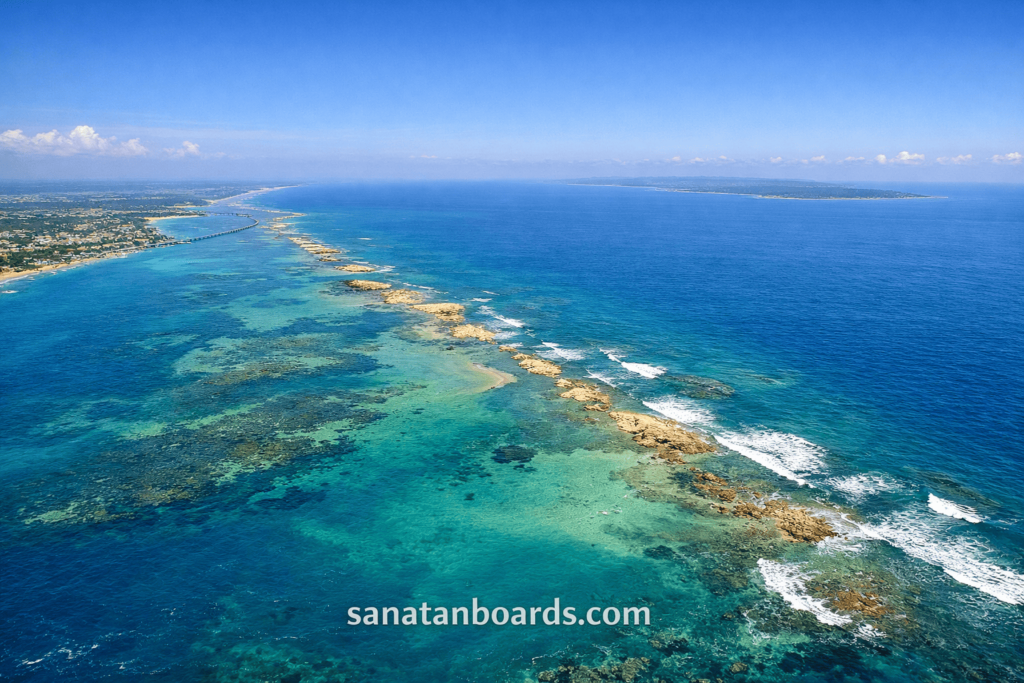
The Setu Bridge remains refer to a chain of limestone shoals and sandbanks that stretch between Rameshwaram in India and Sri Lanka. This formation lies across the Palk Strait and is often identified with the legendary Ram Setu described in ancient texts.
Geographically, these remains are a natural formation consisting of coral reefs, sandbanks, and limestone deposits. Satellite imagery has shown a distinct linear pattern, which has fueled debates about its origin. Some scientists argue that it is a result of natural sedimentation processes, while others believe it may have been modified or utilized by ancient civilizations.
Culturally and religiously, the Setu Bridge remains are deeply significant. According to the Ramayana, the bridge was constructed by Lord Rama and his army to reach Lanka. This belief has made the site sacred for many devotees, especially those visiting the famous Ramanathaswamy Temple.
The remains are partially submerged and visible in certain areas, particularly during low tide. The surrounding waters are shallow, which historically made navigation difficult for large ships. This has also contributed to discussions about environmental and economic impacts, especially in relation to development projects like the Sethusamudram Shipping Canal.
Overall, the Setu Bridge remains represent a fascinating intersection of myth, science, and geography. They continue to inspire curiosity and research, making them an important subject for educational and exploratory purposes.
Who Is Required Rameshwaram Dhanushkodi (Tamil Nadu) – Setu Bridge Remains ?
The relevance of the Setu Bridge remains extends to a wide range of individuals and groups, each with unique interests and objectives. Scholars and researchers in fields such as archaeology, geology, and history find the site particularly valuable for studying natural formations and their possible connections to ancient narratives. The debate over whether the structure is natural or man-made continues to attract academic attention.
Religious pilgrims form another major group connected to the region. Devotees visiting Rameshwaram consider the Setu Bridge remains sacred due to their association with Lord Rama. For them, the site is not just a geographical formation but a symbol of faith and devotion.
Tourists and travel enthusiasts are also drawn to Dhanushkodi and its surroundings. The ghost town, scenic coastline, and mysterious ruins offer a unique travel experience. Photographers and nature lovers find the landscape especially appealing due to its untouched beauty and dramatic history.
Environmentalists and policymakers are increasingly interested in the region as well. The fragile ecosystem of the Palk Strait requires careful management, especially in light of proposed development projects. Understanding the ecological significance of the Setu Bridge remains is crucial for sustainable planning.
Educators and students benefit from studying this topic as it provides insights into the intersection of mythology, science, and environmental studies. It serves as a case study for how cultural beliefs can influence scientific discourse and vice versa.
Thus, the Setu Bridge remains are relevant to a diverse audience, making them an important subject for interdisciplinary learning and exploration.
When Rameshwaram Dhanushkodi (Tamil Nadu) – Setu Bridge Remains Is Required ?
The significance of the Setu Bridge remains becomes particularly relevant in various contexts and timeframes. One important instance is during religious festivals and pilgrimages. Events associated with Hindu traditions often see an influx of visitors to Rameshwaram, where the Setu Bridge holds symbolic importance. During such times, the site becomes a focal point for spiritual activities and cultural gatherings.
Another context where these remains are important is during environmental assessments and policy discussions. Whenever development projects such as shipping canals or coastal infrastructure are proposed, the Setu Bridge region comes under scrutiny. Authorities and experts evaluate the potential impact on marine biodiversity, sediment patterns, and coastal stability.
The remains are also significant in academic and research timelines. Geological surveys, archaeological studies, and satellite imaging projects frequently revisit the area to gather data and analyze findings. Advances in technology have enabled more detailed exploration, making the site relevant for ongoing scientific inquiry.
Seasonal changes also influence when the Setu Bridge remains are most observable. During low tide or certain weather conditions, parts of the formation become more visible, attracting tourists and researchers alike. These periods provide opportunities for closer examination and documentation.
In addition, the site becomes relevant during discussions on cultural heritage preservation. As interest in historical and mythological sites grows, the Setu Bridge remains are often highlighted in debates about conservation and tourism management.
Media coverage and public interest also play a role in determining when the site gains attention. Documentaries, news reports, and online discussions periodically bring the Setu Bridge back into focus, influencing public perception and awareness.
Overall, the relevance of the Setu Bridge remains is not limited to a single moment but spans across religious, environmental, scientific, and cultural timelines. Its importance emerges whenever there is a need to understand the connection between nature, history, and human belief systems.
Where Rameshwaram Dhanushkodi (Tamil Nadu) – Setu Bridge Remains Is Required ?
The Setu Bridge remains are located in a geographically strategic and culturally rich region. They extend from the southeastern coast of India, specifically from Rameshwaram Island in Tamil Nadu, toward the northwestern coast of Sri Lanka. This area lies within the Palk Strait, a shallow body of water that separates the two countries.
Within India, the primary access point to the Setu Bridge remains is through Rameshwaram, which is well connected by road and rail. The town itself is situated on Pamban Island and is linked to the mainland by the famous Pamban Bridge. From there, travelers can proceed to Dhanushkodi, located at the southeastern tip of the island.
Dhanushkodi serves as the closest land point to the visible portions of the Setu Bridge remains. The area is characterized by sandy terrain, clear waters, and remnants of structures destroyed in the 1964 cyclone. It provides a vantage point for observing the chain of shoals that form the bridge-like structure.
The location is also significant in a broader regional context. The Palk Strait is an important ecological zone, home to diverse marine life and coral reefs. This makes the Setu Bridge remains relevant not only geographically but also environmentally.
Internationally, the proximity to Sri Lanka adds another dimension to the site’s importance. The remains are part of a natural formation that connects two nations, making them relevant in discussions of cross-border environmental management and heritage studies.
In terms of accessibility, the area has seen improvements in infrastructure to support tourism. However, its remote and fragile nature requires careful planning and responsible travel practices.
Thus, the Setu Bridge remains are situated in a location that is both geographically unique and culturally significant, making them an important point of interest for multiple disciplines.
How Rameshwaram Dhanushkodi (Tamil Nadu) – Setu Bridge Remains Is Required ?
The importance of the Setu Bridge remains can be understood through various functional and conceptual perspectives. One key aspect is their role in bridging mythology and scientific inquiry. The site serves as a platform where ancient narratives and modern research intersect, encouraging a multidisciplinary approach to understanding history and nature.
From a cultural standpoint, the remains are used as a symbol of faith and heritage. Pilgrims visiting Rameshwaram often include Dhanushkodi in their journey, viewing the Setu Bridge as a sacred connection described in religious texts. This cultural usage reinforces the importance of preserving the site.
Scientifically, the remains are utilized for research in geology, oceanography, and environmental science. Studies conducted in the region help in understanding sedimentation patterns, coral reef formation, and coastal dynamics. These insights are valuable for broader applications in marine science.
Economically, the site contributes to tourism development. The unique combination of natural beauty, historical ruins, and mythological significance attracts visitors from across the world. This creates opportunities for local businesses and supports the regional economy.
In policy-making, the Setu Bridge remains play a role in decision-making processes related to coastal development. Any proposed project in the region must consider its ecological sensitivity and cultural importance. This makes the site a key factor in sustainable planning.
Educationally, the remains are used as a case study in various disciplines. Students and educators explore the site to understand how different fields of knowledge can converge around a single subject.
Overall, the Setu Bridge remains are required as a multifaceted resource that contributes to cultural identity, scientific research, economic activity, and environmental awareness.
Case Study On Rameshwaram Dhanushkodi (Tamil Nadu) – Setu Bridge Remains
The Setu Bridge remains in the Rameshwaram-Dhanushkodi region provide a compelling case study that illustrates the intersection of mythology, science, environmental concerns, and socio-economic factors. This case study examines the historical background, scientific investigations, and contemporary relevance of the site.
Historically, the region gained prominence through its association with the Ramayana. The narrative of a bridge constructed to connect India and Lanka has been passed down through generations, embedding the site deeply in cultural consciousness. This has made Rameshwaram one of the most important pilgrimage destinations in India.
The 1964 cyclone that destroyed Dhanushkodi marked a turning point in the region’s history. The devastation led to the abandonment of the town, leaving behind ruins that now serve as a reminder of nature’s power. Despite this, the area has gradually regained attention due to its historical and mythological significance.
Scientific studies have played a crucial role in understanding the Setu Bridge remains. Satellite imagery has revealed a chain of limestone shoals that align in a manner resembling a bridge. Researchers have debated whether these formations are purely natural or have been influenced by human activity. While there is no definitive conclusion, the ongoing research highlights the complexity of the site.
Environmental considerations are a major aspect of this case study. The Palk Strait is a sensitive ecological zone with diverse marine life. Any intervention in the area, such as dredging for shipping channels, poses potential risks to the ecosystem. This has led to debates between development advocates and environmentalists.
Tourism has emerged as a significant factor in the region’s development. The unique combination of a ghost town, religious importance, and natural formations attracts a wide range of visitors. This has led to improvements in infrastructure but also raises concerns about sustainability and environmental impact.
The case study also highlights the role of government and policy-making. Decisions regarding projects like the Sethusamudram Canal have been influenced by both economic considerations and cultural sentiments. Balancing these factors remains a challenge.
In conclusion, the Setu Bridge remains serve as a multifaceted case study that demonstrates the interplay between tradition, science, and modern development. It underscores the importance of adopting a balanced approach that respects cultural heritage while promoting sustainable progress.
White Paper On Rameshwaram Dhanushkodi (Tamil Nadu) – Setu Bridge Remains
The Setu Bridge remains located between Rameshwaram and Dhanushkodi represent a unique convergence of geological formations, cultural heritage, and environmental significance. This white paper aims to provide a comprehensive overview of the site, focusing on its importance, challenges, and future prospects.
The geological structure of the Setu Bridge consists of limestone shoals, sandbanks, and coral formations. These features indicate a complex history of sedimentation and marine activity. Scientific studies suggest that the formation may have evolved over thousands of years, shaped by natural processes such as wave action and sea-level changes.
Culturally, the site holds immense importance due to its association with the Ramayana. This has led to its recognition as a sacred landmark, attracting millions of pilgrims annually. The cultural value of the site necessitates careful consideration in any development or conservation efforts.
One of the key challenges facing the Setu Bridge remains is environmental preservation. The Palk Strait is home to a rich diversity of marine species, including coral reefs and seagrass beds. Any disruption to this ecosystem could have far-reaching consequences. Therefore, environmental impact assessments are crucial before undertaking any projects in the region.
Another challenge is balancing tourism with sustainability. While tourism provides economic benefits, it also places pressure on local resources and ecosystems. Effective management strategies are needed to ensure that tourism does not compromise the integrity of the site.
Policy considerations play a significant role in shaping the future of the Setu Bridge remains. Projects like the Sethusamudram Shipping Canal have sparked debates over economic benefits versus environmental and cultural concerns. Policymakers must adopt a holistic approach that takes into account all stakeholders.
Technological advancements offer opportunities for better understanding and preserving the site. Remote sensing, satellite imaging, and marine research can provide valuable data for informed decision-making.
In conclusion, the Setu Bridge remains are a site of global #Sanatanboardsinvasai significance that requires a balanced approach to management. By integrating scientific research, cultural preservation, and sustainable development, it is possible to ensure the long-term protection and relevance of this unique region.
Industry Application On Rameshwaram Dhanushkodi (Tamil Nadu) – Setu Bridge Remains
The region of Rameshwaram and Dhanushkodi, along with the Setu Bridge remains (commonly associated with Ram Setu), holds significant value across multiple industries. Its unique blend of geography, mythology, and ecological importance makes it relevant for diverse practical applications.
1. Tourism and Hospitality Industry
One of the most prominent applications is in tourism. The spiritual importance of the region, combined with the scenic beauty of the coastline and the mystery of the Setu Bridge remains, attracts a large number of visitors. Travel companies, hotels, local guides, and transport services benefit from this steady flow of tourists. The site supports pilgrimage tourism due to its connection with the Ramayana, as well as adventure and heritage tourism because of the abandoned town of Dhanushkodi.
2. Environmental and Marine Research Industry
The Setu Bridge remains are located in the ecologically sensitive Palk Strait, making the area highly valuable for environmental studies. Marine biologists, oceanographers, and environmental scientists use this region to study coral reefs, sedimentation, and biodiversity. Research conducted here contributes to global understanding of coastal ecosystems and climate change impacts.
3. Maritime and Shipping Industry
The shallow waters and chain of limestone shoals have direct implications for maritime navigation. The region has been central to discussions around shipping routes, particularly projects like the Sethusamudram Shipping Canal. The presence of the Setu Bridge remains influences route planning, dredging activities, and maritime safety considerations.
4. Education and Academic Industry
Educational institutions use this region as a real-world case study for interdisciplinary learning. It is relevant in subjects such as geography, geology, history, archaeology, and environmental science. Field visits, research projects, and academic papers often focus on the site to explore the intersection of natural formations and cultural narratives.
5. Media, Film, and Content Industry
The mysterious and historical nature of the Setu Bridge remains makes it a compelling subject for documentaries, films, and digital content. Media production houses create educational programs and travel features that highlight the region’s uniqueness, thereby increasing awareness and interest.
6. Infrastructure and Policy Planning Sector
Government bodies and policy planners consider the region in coastal development and conservation strategies. Any infrastructure project in this area must account for environmental sustainability and cultural sensitivity, making the Setu Bridge remains an important factor in decision-making.
Overall, the Setu Bridge remains are not just a historical or #Sanatanboardsinmumbai mythological subject but a resource with wide-ranging industrial applications, contributing to economic development, scientific research, and cultural preservation.
source : visa2explore
ASK FAQ
1. What are the Setu Bridge remains in Rameshwaram Dhanushkodi?
The Setu Bridge remains, also known as Ram Setu, are a chain of limestone shoals located between Rameshwaram and Sri Lanka. They are believed to be linked to ancient mythology and are also studied as natural geological formations.
2. Why is Dhanushkodi famous for Setu Bridge remains?
Dhanushkodi is famous because it is the closest accessible point to view the Setu Bridge remains. It is also known for its historical significance as a ghost town destroyed in 1964 and its connection to the Ramayana.
3. Where is the Setu Bridge located in India?
The Setu Bridge remains are located in the Palk Strait, starting from Tamil Nadu near Rameshwaram and extending toward Sri Lanka.
4. Is Ram Setu natural or man-made?
The origin of Ram Setu is debated. Scientists consider it a natural formation of sandbanks and coral reefs, while religious beliefs describe it as a man-made bridge mentioned in ancient texts.
5. How can tourists visit Setu Bridge remains in Rameshwaram?
Tourists can reach Rameshwaram by road or rail and then travel to Dhanushkodi. From there, they can view the nearby Setu Bridge remains, especially during clear weather and low tide conditions.
Table of Contents
Disclaimer
This content is intended solely for informational, educational, and knowledge-sharing purposes. The interpretations of historical, cultural, and scientific aspects are based on publicly available information and general understanding. No claims are made regarding the absolute accuracy or authenticity of mythological or historical references, and readers are encouraged to conduct further research for deeper insights.