
UJJAIN (MADHYA PRADESH)
Ujjain is one of the most ancient and spiritually significant cities in India, located on the banks of the sacred Kshipra River. It is widely known as a major center of Hindu pilgrimage, astronomy, culture, and heritage. Among its most revered spiritual landmarks is the famous Mahakaleshwar Jyotirlinga, which holds a special place in Hindu devotion as one of the twelve Jyotirlingas dedicated to Lord Shiva.
This temple is not just a religious structure but a powerful spiritual energy center that attracts millions of devotees, saints, and travelers from across the world. The divine presence of Lord Mahakal is believed to represent the eternal power of time, destruction of evil, and transformation of life. The temple is uniquely known for its south-facing idol of Lord Shiva, which is rare among Jyotirlingas and considered highly significant in tantric traditions.
Ujjain itself has been a hub of learning since ancient times, especially in astronomy and mathematics, and is also one of the locations of the Kumbh Mela, one of the largest spiritual gatherings in the world. The presence of Mahakaleshwar Jyotirlinga enhances the city’s spiritual importance, making it a focal point of devotion, meditation, and religious studies.
The temple architecture reflects Maratha, Bhumija, and Hindu styles blending historical craftsmanship with deep spiritual symbolism. Daily rituals, especially the famous Bhasma Aarti performed in the early morning hours, make this temple globally recognized.
Overall, Ujjain and Mahakaleshwar Jyotirlinga together form a powerful spiritual identity that connects faith, history, culture, and divine tradition, making it one of the most important pilgrimage destinations in India.
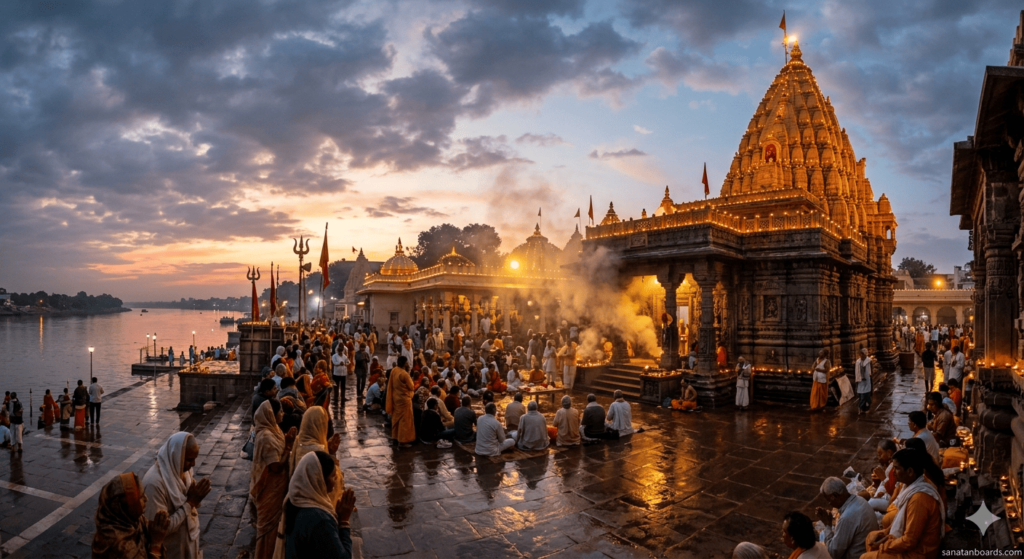
What Is Ujjain (Madhya Pradesh) – Mahakaleshwar Jyotirlinga ?
Ujjain is a historic city that represents one of the oldest continuously inhabited cultural regions in India. It is known for its deep connection with Hindu mythology, especially related to Lord Shiva and cosmic time cycles. Within this sacred city lies the renowned Mahakaleshwar Jyotirlinga, which is one of the twelve Jyotirlingas, considered the most sacred abodes of Lord Shiva.
Mahakaleshwar Jyotirlinga is a highly revered temple where Lord Shiva is worshipped in the form of “Mahakal,” meaning the ruler of time and death. It symbolizes the concept that time is eternal and everything in the universe is governed by divine cosmic energy. The temple is located underground in a sanctum, making it unique compared to other Shiva temples.
This temple is especially famous for its Bhasma Aarti, a ritual performed early in the morning where sacred ash is offered to the deity. It represents the cycle of creation and destruction, reminding devotees of the impermanence of life. The temple complex also includes shrines of other deities like Goddess Parvati, Lord Ganesh, and Lord Kartikeya.
Ujjain’s identity is deeply connected with this Jyotirlinga, as it is believed that visiting Mahakaleshwar helps devotees attain spiritual liberation and inner peace. The city itself has been a center of religious education, astrology, and pilgrimage for centuries.
Thus, Ujjain and Mahakaleshwar Jyotirlinga together represent not just a place of worship but a complete spiritual philosophy rooted in devotion, time, and cosmic balance.
Who Is Required Ujjain (Madhya Pradesh) – Mahakaleshwar Jyotirlinga ?
Ujjain and Mahakaleshwar Jyotirlinga are required and significant for a wide range of individuals, including spiritual seekers, devotees of Lord Shiva, scholars, historians, and cultural researchers.
Devotees who follow Shaivism consider this Jyotirlinga essential for their spiritual journey. It is believed that visiting the temple helps in removing negative karma, overcoming fear of death, and achieving spiritual liberation. People seeking peace of mind, emotional healing, and divine blessings often visit this sacred place.
Spiritual practitioners and yogis also find this site important due to its strong energetic vibrations and association with Lord Mahakal, who represents time and transformation. Many believe that meditation in this temple area enhances spiritual awareness and inner strength.
Historians and archaeologists require this location for studying ancient Indian civilization, temple architecture, and cultural evolution. The city of Ujjain has references in ancient scriptures like the Puranas and has been a major center of learning in astronomy and mathematics.
Tourists and cultural explorers also find the temple essential as it provides insight into India’s rich heritage, rituals, and traditions. The temple rituals, especially Bhasma Aarti, attract global attention.
Astrologers and scholars of time science also connect Ujjain with planetary studies, as the city has historically been a center for astronomical calculations.
Thus, Mahakaleshwar Jyotirlinga is required not only for religious purposes but also for cultural, academic, and spiritual enrichment.
When Ujjain (Madhya Pradesh) – Mahakaleshwar Jyotirlinga Is Required ?
Ujjain and Mahakaleshwar Jyotirlinga are considered important at various times in a person’s life, especially during moments of spiritual need, personal crisis, festivals, and religious observances.
People often visit this sacred Jyotirlinga during major Hindu festivals such as Mahashivratri, Shravan month, and Kartik Purnima. These periods are believed to be highly auspicious for worshipping Lord Shiva, as spiritual energy is considered to be at its peak. Devotees also visit during Mondays, which are dedicated to Lord Shiva, to perform special prayers and rituals.
In personal life, individuals may feel the need to visit Mahakaleshwar during difficult times such as health issues, emotional stress, financial problems, or family challenges. It is believed that praying at this Jyotirlinga helps in removing obstacles and bringing clarity and strength.
Many pilgrims also plan visits during pilgrimage tours like the Kumbh Mela, which is held in Ujjain once every twelve years. This event is one of the largest spiritual gatherings in the world and is considered a highly powerful time for purification and spiritual awakening.
Astrologically, people visit during specific planetary transitions or doshas in their horoscope, seeking remedies and blessings from Lord Mahakal, who is believed to control time and destiny.
Students of spirituality and seekers of inner peace may visit at any time of life when they feel disconnected or in search of purpose. The temple’s rituals, especially early morning aarti, are believed to be most powerful at dawn, making early hours an important time for worship.
Thus, Mahakaleshwar Jyotirlinga is not limited to a specific time but is relevant throughout life whenever spiritual guidance, protection, and transformation are needed.
Where Ujjain (Madhya Pradesh) – Mahakaleshwar Jyotirlinga Is Required ?
Ujjain is located in the Malwa region of Madhya Pradesh, India, on the banks of the sacred Kshipra River. Within this ancient city lies the highly revered Mahakaleshwar Jyotirlinga, situated in the heart of the old city area, surrounded by traditional streets, ghats, and spiritual centers.
This temple is required and significant in a geographical, cultural, and spiritual sense. Geographically, it serves as a major pilgrimage destination in central India, easily accessible from cities like Indore, Bhopal, and other parts of the country. Its location in Ujjain makes it part of one of the Sapta Puri (seven sacred cities in Hinduism).
Culturally, the temple is located in an area rich with heritage structures, traditional markets, and ancient learning centers. The surrounding environment reflects centuries of continuous worship and cultural development. The proximity to the Kshipra River also enhances its spiritual importance, as river bathing is considered purifying before temple visits.
Spiritually, Mahakaleshwar Jyotirlinga is required wherever devotees seek divine connection with Lord Shiva. It is believed that the spiritual energy of this place extends beyond physical boundaries, influencing devotees even after they return home.
Administratively, the temple is managed as one of the most important religious sites in India, attracting government attention, tourism development, and cultural preservation efforts.
Thus, the “where” of Mahakaleshwar Jyotirlinga is not just a physical location but a sacred space embedded within the spiritual geography of India.
How Ujjain (Madhya Pradesh) – Mahakaleshwar Jyotirlinga Is Required ?
Ujjain and Mahakaleshwar Jyotirlinga are required through specific rituals, traditions, and spiritual practices that define its religious importance.
Devotees access the temple through disciplined worship methods that include early morning visits, chanting of mantras like “Om Namah Shivaya,” and participation in special rituals. One of the most important practices is the Bhasma Aarti, performed before sunrise, where sacred ash is offered to Lord Mahakal. This ritual represents detachment from material life and acceptance of spiritual truth.
The temple is also required through pilgrimage journeys. Devotees often travel long distances on foot, by road, or by train to reach Ujjain. Upon arrival, they follow traditional customs such as bathing in the Kshipra River before entering the temple.
Spiritually, Mahakaleshwar is required through meditation and prayer. Many devotees sit in silence within the temple premises to experience inner peace and divine connection. The temple environment is designed to enhance concentration and devotion.
Culturally, the temple functions through organized festivals, priestly traditions, and ancient Hindu rituals that have been preserved for centuries. The system of worship follows Agamic and Vedic traditions, ensuring continuity of ancient practices.
Administratively, the temple is managed with structured schedules for darshan, aarti, and crowd management, especially during festivals like Mahashivratri when large numbers of devotees visit.
Thus, Mahakaleshwar Jyotirlinga is required through a combination of devotion, ritual discipline, cultural heritage, and spiritual practice that connects humans with divine energy.
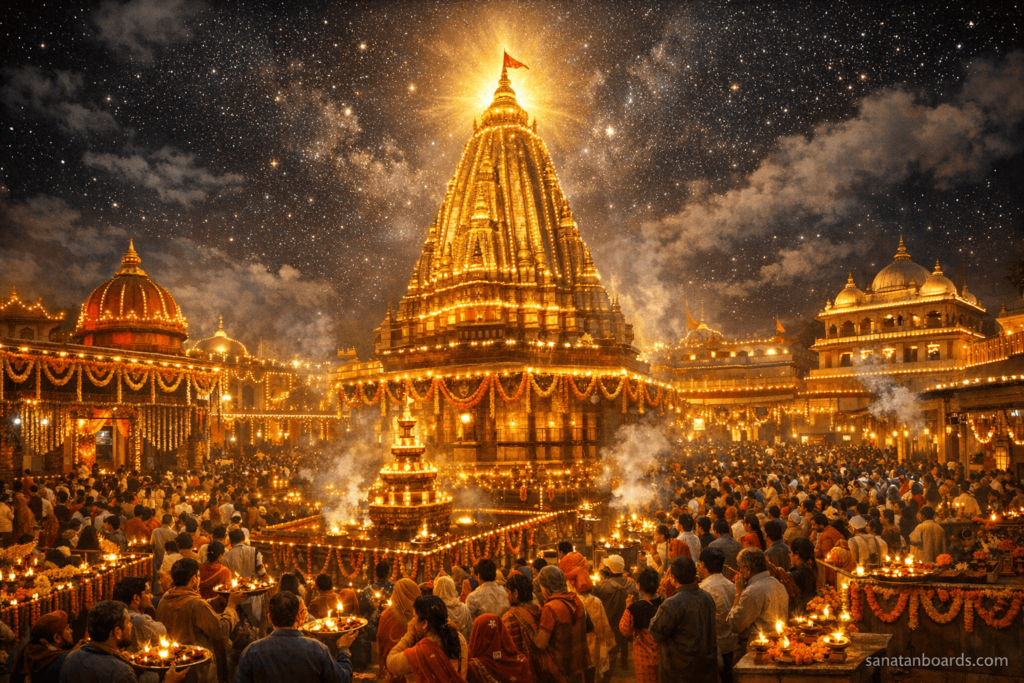
Case Study On Ujjain (Madhya Pradesh) – Mahakaleshwar Jyotirlinga
Ujjain and Mahakaleshwar Jyotirlinga represent one of the most influential spiritual ecosystems in India. This case study explores its religious, cultural, economic, and social impact.
Historically, Ujjain has been a center of learning and spirituality since ancient times. It is referenced in Hindu scriptures as Avantika and has long been associated with astronomical studies and Vedic traditions. The establishment of Mahakaleshwar Jyotirlinga strengthened its position as a major pilgrimage hub.
From a religious perspective, the temple serves as a powerful center of Shaivism. Millions of devotees visit annually to seek blessings, spiritual purification, and relief from suffering. The Bhasma Aarti ritual is a unique case of ritual continuity that has been preserved for generations.
Socially, the temple influences community life in Ujjain. Local economies depend heavily on pilgrimage tourism. Hotels, transport services, priests, vendors, and guides all benefit from the influx of visitors. This creates employment and sustains livelihoods.
Economically, the temple contributes significantly to regional tourism revenue. Festivals like Mahashivratri and Kumbh Mela generate massive economic activity. Infrastructure development such as roads, sanitation, and public facilities has improved due to the temple’s importance.
Culturally, Mahakaleshwar Jyotirlinga preserves ancient Hindu traditions. Rituals, music, chants, and temple architecture reflect centuries-old practices. This continuity provides cultural identity to the region.
From a governance perspective, managing such a large pilgrimage site requires coordination between temple authorities, local administration, and tourism departments. Crowd control, safety measures, and cleanliness are key operational challenges.
A case example can be seen during Mahashivratri when millions of devotees gather. Despite the massive crowd, organized systems ensure smooth darshan. This demonstrates effective management of large-scale religious tourism.
Another example is the Kumbh Mela, where Ujjain becomes one of the largest spiritual gathering sites in the world. The temple plays a central role in this event, attracting global attention.
In conclusion, Mahakaleshwar Jyotirlinga is not only a religious structure but also a driver of cultural preservation, economic growth, and social development in Ujjain.
White Paper On Ujjain (Madhya Pradesh) – Mahakaleshwar Jyotirlinga
Ujjain and Mahakaleshwar Jyotirlinga constitute a significant religious and cultural heritage system that requires structured preservation, sustainable management, and strategic development.
The temple is one of the twelve Jyotirlingas of Lord Shiva and holds immense spiritual significance. It attracts millions of pilgrims annually, making it a critical node in India’s religious tourism network.
This white paper identifies key pillars: heritage preservation, pilgrimage management, infrastructure development, environmental sustainability, and cultural continuity.
Heritage preservation involves maintaining the ancient architecture, rituals, and cultural practices of the temple. Restoration efforts must ensure that modernization does not disrupt traditional values.
Pilgrimage management focuses on handling large crowds efficiently. This includes queue systems, digital darshan facilities, and security arrangements to ensure safety and smooth visitor flow.
Infrastructure development is essential in Ujjain due to increasing tourism demand. Improvements in transportation, sanitation, accommodation, and public services are necessary to support pilgrims.
Environmental sustainability is another key concern. The Kshipra River and surrounding areas must be protected from pollution caused by mass gatherings. Waste management systems and eco-friendly practices are required.
Cultural continuity ensures that rituals such as Bhasma Aarti remain unchanged while being adapted to modern safety standards. This balance between tradition and modernization is critical.
Technology integration plays a growing role. Digital booking systems, online donations, and virtual darshan services help manage crowds and expand accessibility.
Economic impact analysis shows that the temple contributes significantly to local and regional economies through tourism, hospitality, and related industries.
Policy recommendations include strengthening temple governance, improving disaster management systems, and promoting sustainable tourism practices.
In conclusion, Mahakaleshwar Jyotirlinga represents a #Sanatanboardsinvasai living heritage system that requires coordinated efforts between government, temple authorities, and society to ensure its preservation for future generations.
Industry Application On Ujjain (Madhya Pradesh) – Mahakaleshwar Jyotirlinga
Ujjain and Mahakaleshwar Jyotirlinga have significant applications across multiple industries including tourism, hospitality, transportation, cultural management, and digital services.
In the tourism industry, the temple acts as a major pilgrimage destination attracting domestic and international visitors. Travel agencies design special religious tour packages centered around Ujjain, often combining nearby spiritual destinations.
In hospitality, hotels, guest houses, and dharamshalas experience high demand throughout the year, especially during festivals. This drives investment in accommodation infrastructure and service quality improvements.
The transportation industry benefits significantly through railways, buses, taxis, and private travel services. Special arrangements are made during large events like Mahashivratri and Kumbh Mela to handle increased passenger flow.
In the event management industry, large-scale coordination is required for festivals and pilgrimages. Crowd control, security arrangements, lighting, and cultural programs are organized systematically.
The digital technology sector is also increasingly involved. Online booking systems for darshan, digital donation platforms, and virtual temple tours are examples of technological integration.
The media and broadcasting industry plays a role in live telecasts of major rituals such as Bhasma Aarti, reaching global audiences and increasing cultural awareness.
Retail and handicraft industries benefit from souvenir sales, religious items, and local crafts purchased by pilgrims.
Urban development and infrastructure industries are engaged in improving roads, sanitation systems, and public utilities in Ujjain due to high visitor inflow.
In education and research, universities and cultural institutions study the temple’s architecture, history, and religious significance.
Thus, Mahakaleshwar Jyotirlinga #Sanatanboardsinmumbai influences multiple industries by driving economic activity, cultural engagement, and technological innovation.
source : Traveller Dilkhush
ASK FAQ
1. What is Mahakaleshwar Jyotirlinga in Ujjain famous for?
It is one of the 12 Jyotirlingas of Lord Shiva, famous for the unique Bhasma Aarti and its spiritual belief as the protector of time and destruction of evil.
2. Where is Mahakaleshwar Jyotirlinga located?
It is located in Ujjain, India, near the sacred Kshipra River in the Mahakal area of the city.
3. Why is Mahakaleshwar Jyotirlinga important for devotees?
It is believed that visiting the temple helps remove negative energy, reduce fear of death, and bring peace, blessings, and spiritual liberation.
4. When is the best time to visit Mahakaleshwar Jyotirlinga?
The best time is during Mahashivratri, Shravan month, and early morning Bhasma Aarti, which are considered highly auspicious for worship.
5. How can devotees experience Mahakaleshwar Jyotirlinga rituals?
Devotees can attend darshan, participate in Bhasma Aarti, chant Shiva mantras, and perform traditional rituals inside the temple complex.
Table of Contents
Disclaimer
This content is prepared solely for informational, educational, and general knowledge purposes. It is based on cultural, historical, and traditional references and is not intended to promote, oppose, or critique any religion, belief system, or practice. The information provided should not be considered as professional, spiritual, legal, or authoritative advice. Readers are encouraged to verify details from authentic and official sources if required. The views expressed are for learning purposes only, and no claims of personal experience, miracles, or guaranteed outcomes are made.