
PRAMBANAN TEMPLE (INDONESIA)
The Prambanan Temple stands as one of Southeast Asia’s most remarkable cultural and architectural treasures. Located in Central Java, Indonesia, this grand Hindu temple complex reflects the artistic brilliance, spiritual depth, and engineering sophistication of ancient Javanese civilization. Built in the 9th century during the Mataram Kingdom, Prambanan is dedicated primarily to the Hindu Trimurti—Brahma Vishnu, and Shiva—symbolizing creation, preservation, and destruction.
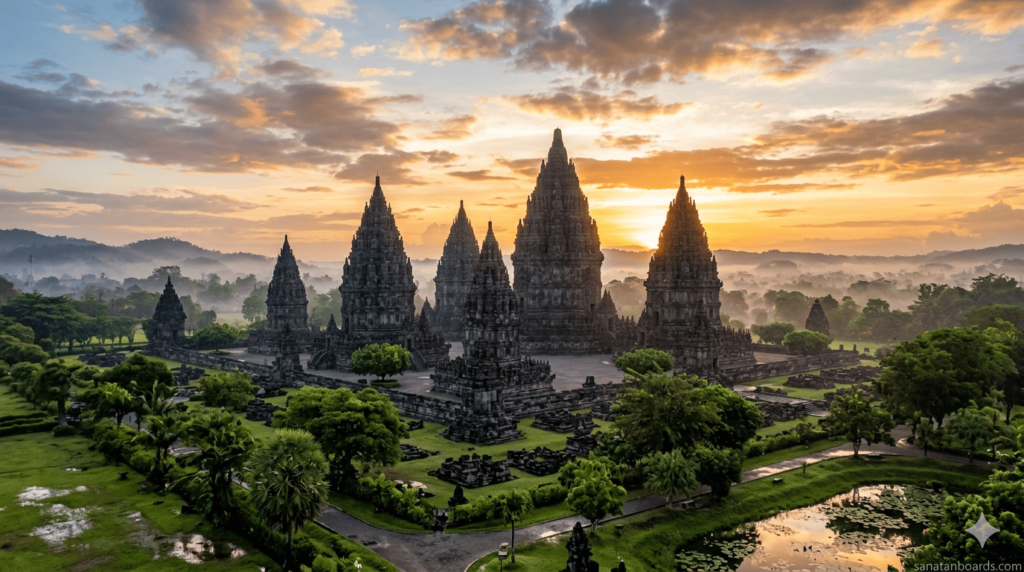
The temple complex is not just a religious site but a visual narrative carved in stone. Its towering structures, intricate bas-reliefs, and symmetrical layout represent cosmic order and divine harmony. The central temple dedicated to Shiva rises to about 47 meters, making it the tallest and most prominent structure in the complex. Surrounding it are numerous smaller temples, each contributing to the overall spiritual and architectural unity.
Over centuries, Prambanan experienced periods of abandonment due to natural disasters such as earthquakes and volcanic eruptions. However, restoration efforts in the 20th century brought it back to life, allowing visitors and scholars to appreciate its grandeur once again. Today, it is recognized as a UNESCO World Heritage Site and serves as a major cultural landmark in Indonesia.
Prambanan continues to attract tourists, historians, architects, and spiritual seekers from around the world. Its significance extends beyond religion, offering insights into ancient governance, craftsmanship, and cultural exchange. The temple complex also hosts traditional dance performances, such as the Ramayana Ballet, blending history with living cultural expression.
What Is Prambanan Temple (Indonesia) ?
The Prambanan Temple is the largest Hindu temple complex in Indonesia and one of the most significant in Southeast Asia. It is a UNESCO World Heritage Site renowned for its towering architecture and detailed stone carvings that depict stories from ancient Hindu epics like the Ramayana and Bhagavata Purana.
Constructed in the 9th century under the rule of the Sanjaya Dynasty, Prambanan was designed as a grand religious center dedicated to the Trimurti gods—Shiva, Vishnu, and Brahma. The temple complex originally consisted of over 200 individual structures, although many have been reduced to ruins over time. The layout follows a mandala pattern, symbolizing the universe in Hindu cosmology.
The main compound contains three large temples dedicated to the Trimurti, with the Shiva temple being the tallest and most central. Inside these temples are statues representing the deities, each intricately crafted to reflect divine attributes. Surrounding these main temples are smaller shrines known as “perwara” temples, which add to the sacred geometry of the complex.
Prambanan is also known for its exquisite bas-reliefs that narrate mythological stories. These carvings serve both decorative and educational purposes, illustrating religious teachings and cultural values of the time. The artistic style reflects a high level of craftsmanship and attention to detail, showcasing the advanced skills of ancient Javanese artisans.
Despite suffering damage from earthquakes and neglect over centuries, the temple has undergone extensive restoration. Today, it stands as a symbol of Indonesia’s historical resilience and cultural richness. Visitors can explore the site, admire its architecture, and attend cultural performances that bring ancient stories to life.
Who Is Required Prambanan Temple (Indonesia)
The Prambanan Temple is closely associated with several groups and historical figures, both from the past and present. Primarily, it is linked to the Sanjaya Dynasty of the Mataram Kingdom, which ruled Central Java during the 8th and 9th centuries. King Rakai Pikatan is often credited with initiating the construction of the temple complex, marking a period of strong Hindu influence in the region.
Religiously, the temple is associated with followers of Hinduism, particularly those who worship the Trimurti gods—Shiva, Vishnu, and Brahma. Priests and scholars in ancient times would have conducted rituals and ceremonies within the temple, making it a vital center for spiritual activities.
In modern times, the temple is managed and preserved by the Indonesian government, particularly through cultural and heritage organizations. Archaeologists, historians, and conservationists play a significant role in maintaining the structure and studying its historical context. Their efforts ensure that the temple remains intact for future generations.
Tourists and visitors from around the world are also closely associated with Prambanan today. The site serves as an educational and cultural destination, attracting people interested in history, architecture, and religion. Cultural performers, especially those involved in the Ramayana Ballet, contribute to keeping the temple’s stories alive through artistic expression.
Local communities around the temple are another important group connected to Prambanan. They benefit economically from tourism and often participate in cultural preservation activities. Their involvement helps sustain the temple’s relevance in contemporary society.
Thus, Prambanan Temple is not tied to a single individual or group but represents a collective heritage involving ancient rulers, religious practitioners, modern experts, and global visitors.
When Prambanan Temple (Indonesia) Is Required ?
The Prambanan Temple holds importance across multiple time periods—historical, cultural, and contemporary. Its origins date back to the 9th century, a time when Hinduism flourished in Java under the Mataram Kingdom. During this era, the temple served as a major religious center, hosting rituals, ceremonies, and gatherings that reinforced spiritual beliefs and social structures.
Over time, the temple’s importance shifted due to natural disasters and political changes. By the 10th century, volcanic eruptions and earthquakes led to its gradual abandonment. For centuries, it remained in ruins, overshadowed by the rise of other kingdoms and the spread of different religions in the region.
The rediscovery of Prambanan in the 18th century marked a new phase of importance. Restoration efforts began in the early 20th century, bringing the temple back into public awareness. This period highlighted its value as a historical and archaeological site.
In modern times, Prambanan is important as a UNESCO World Heritage Site, recognized for its cultural and architectural significance. It plays a key role in Indonesia’s tourism industry, attracting millions of visitors annually. The temple is also significant during cultural events, especially performances of the Ramayana Ballet, which are often held during evenings under the open sky.
Educationally, the temple is important for students, researchers, and historians studying Southeast Asian history, Hindu architecture, and ancient civilizations. It provides real-world insights into past societies and their beliefs.
Thus, Prambanan Temple remains important across different eras—not only as a relic of the past but as a living symbol of cultural continuity and national identity.
Where Prambanan Temple (Indonesia) Is Required ?
The Prambanan Temple is located in Central Java, Indonesia, near the border with the Special Region of Yogyakarta. Specifically, it lies approximately 17 kilometers northeast of Yogyakarta city, making it easily accessible for tourists and travelers.
Geographically, the temple is situated on a fertile plain surrounded by volcanic landscapes, including Mount Merapi, one of Indonesia’s most active volcanoes. This location contributes to both the historical significance and the challenges faced by the temple, as volcanic activity and earthquakes have influenced its preservation.
The temple complex is part of a larger archaeological area that includes other historical sites such as Sewu Temple and Plaosan Temple. Together, these sites form a rich cultural landscape that reflects the religious diversity and architectural innovation of ancient Java.
The accessibility of Prambanan is one of its advantages. It is well connected by road and public transportation from major cities like Yogyakarta and Solo. Visitors can reach the site via buses, taxis, or private vehicles. The nearby Adisucipto International Airport also provides convenient access for international tourists.
The surrounding area is developed with visitor facilities, including information centers, museums, and guided tours. These amenities enhance the visitor experience and provide educational context about the temple’s history and significance.
How Prambanan Temple (Indonesia) Is Required ?
The construction of the Prambanan Temple reflects advanced engineering and architectural techniques of ancient Java. Built in the 9th century, the temple complex was constructed using volcanic stone, carefully cut and assembled without the use of modern cement or adhesives.
The builders employed an interlocking system, where stones were shaped to fit precisely together, ensuring stability and durability. This technique allowed the structures to withstand the test of time, despite natural disasters such as earthquakes.
The design of the temple follows Hindu cosmology, with a hierarchical layout representing the universe. The central temples symbolize the divine realm, while the surrounding structures represent the human and earthly realms. This spatial arrangement required careful planning and a deep understanding of religious symbolism.
Labor for the construction likely came from local communities under royal supervision. Skilled artisans, sculptors, and architects worked together to create the intricate carvings and statues that adorn the temple walls. These carvings depict stories from Hindu epics, serving both artistic and educational purposes.
The construction process would have taken several decades, reflecting the scale and complexity of the project. It demonstrates the organizational capabilities of the Mataram Kingdom and their commitment to religious expression.
Modern restoration efforts have used similar techniques to preserve authenticity. Archaeologists carefully reconstruct fallen structures using original stones whenever possible.
Overall, the construction of Prambanan Temple showcases a blend of artistic creativity, religious devotion, and engineering expertise.

Case Study On Prambanan Temple (Indonesia)
The Prambanan Temple complex provides a compelling case study in heritage preservation, disaster management, and sustainable tourism development. Originally constructed in the 9th century during the Mataram Kingdom, the temple served as a major religious and cultural center dedicated to Hindu deities. However, over time, natural disasters such as earthquakes and volcanic eruptions—especially from nearby Mount Merapi—led to its gradual decline and abandonment. By the time it was rediscovered in the 18th century, much of the structure had collapsed, leaving behind scattered ruins.
The restoration of Prambanan represents one of the most ambitious archaeological efforts in Southeast Asia. A key methodology used was “anastylosis,” a reconstruction technique that involves reassembling original stones in their correct positions. This required meticulous documentation, classification, and engineering precision. One of the central challenges was the incomplete nature of the ruins; not all original stones were recoverable, which meant that reconstruction had to balance authenticity with structural stability.
Another dimension of this case study is disaster resilience. Even after restoration, Prambanan remains vulnerable to earthquakes, as seen in the 2006 Yogyakarta earthquake, which caused significant damage to several temple structures. This event prompted renewed focus on structural reinforcement and emergency response strategies. Conservation teams now continuously monitor the temple using modern technologies such as seismic sensors and digital mapping to mitigate future risks.
Tourism management is also central to the case study. As a globally recognized heritage site, Prambanan attracts millions of visitors annually. While this contributes to economic growth, it also creates pressure on the site’s physical integrity. Authorities have implemented controlled access zones, visitor pathways, and strict preservation rules to reduce wear and tear. These measures aim to strike a balance between accessibility and conservation.
Community involvement plays a vital role as well. Local populations benefit from tourism through employment and business opportunities, fostering a sense of shared responsibility for preserving the site. Cultural activities like the Ramayana Ballet further integrate heritage with contemporary cultural expression, enhancing visitor engagement.
Overall, Prambanan Temple demonstrates how historical monuments can be preserved through a combination of traditional methods, modern technology, and community participation. It highlights the importance of long-term planning, interdisciplinary collaboration, and adaptive strategies in managing cultural heritage sites in a dynamic environment.
White Paper On Prambanan Temple (Indonesia)
The Prambanan Temple complex represents a significant asset in the domain of global cultural heritage, requiring a structured approach to preservation, utilization, and long-term sustainability. This white paper explores the strategic importance of Prambanan, identifies key challenges, and outlines frameworks for its continued protection and relevance.
Prambanan holds international recognition as a UNESCO World Heritage Site, underscoring its universal cultural value. Architecturally, it reflects advanced knowledge of geometry, symbolism, and construction techniques from the 9th century. The temple’s bas-reliefs provide detailed insights into ancient Hindu epics and Javanese cultural practices, making it a vital resource for academic research in history, religion, and art.
From an economic perspective, Prambanan is a cornerstone of Indonesia’s tourism sector. It contributes significantly to regional and national income through ticket sales, guided tours, and associated hospitality services. However, increased visitor numbers introduce risks such as structural degradation, environmental strain, and cultural commodification. Therefore, sustainable tourism practices are essential.
Conservation strategies must integrate both traditional and modern approaches. Techniques such as anastylosis ensure historical authenticity, while digital technologies like 3D scanning and structural monitoring enhance preservation accuracy. These tools allow conservationists to detect early signs of damage and respond proactively.
Policy and governance play a crucial role in managing Prambanan. Collaboration between government agencies, international organizations, and local communities is necessary to ensure effective implementation of preservation measures. Regulatory frameworks should address issues such as visitor limits, environmental protection, and funding allocation.
Risk management is another critical component. The temple’s location in a geologically active region makes it susceptible to earthquakes and volcanic activity. Preparedness plans, including structural reinforcements and emergency protocols, are essential to minimize damage and ensure visitor safety.
Education and outreach initiatives further enhance the temple’s value. By promoting awareness of its historical and cultural significance, stakeholders can foster greater public engagement and support for preservation efforts. Programs involving schools, universities, and cultural institutions can help sustain interest across generations.
In conclusion, Prambanan Temple requires a holistic management approach that balances preservation, accessibility, and economic benefits. Strategic planning, technological #sanatanboardsinvasai integration, and collaborative governance are key to ensuring its continued relevance as a global heritage site.
Industry Application On Prambanan Temple (Indonesia)
Prambanan Temple serves as a valuable model across multiple industries, demonstrating how historical and cultural assets can be effectively integrated into modern economic and professional practices. Its influence extends beyond heritage conservation into tourism, education, architecture, technology, and local business development.
In the tourism industry, Prambanan exemplifies heritage-based destination management. It attracts both domestic and international visitors, making it a central component of Indonesia’s tourism strategy. Travel agencies incorporate the site into curated cultural tours, often pairing it with nearby attractions to enhance visitor experience. The temple’s success highlights the importance of storytelling, guided interpretation, and cultural programming in attracting and retaining tourist interest.
The education sector benefits significantly from Prambanan as a real-world learning environment. Students and researchers in fields such as archaeology, history, architecture, and cultural studies use the site for fieldwork and analysis. It provides tangible insights into ancient construction methods, religious practices, and socio-political structures. Academic collaborations and research initiatives further expand its educational impact.
Architecturally, Prambanan offers inspiration for modern design. Its symmetrical layout, vertical emphasis, and symbolic elements influence contemporary architects seeking to blend tradition with innovation. The temple demonstrates how cultural identity can be embedded into structural design, encouraging architects to incorporate local heritage into modern projects.
The technology industry also finds applications in Prambanan’s preservation and promotion. Digital tools such as virtual reality (VR) and augmented reality (AR) enable remote exploration of the site, making it accessible to a global audience. 3D modeling and scanning technologies assist in restoration and documentation, ensuring accuracy and efficiency in conservation efforts.
In the cultural and creative industries, Prambanan supports performances, exhibitions, and artistic productions. The Ramayana Ballet, performed near the temple, is a prime example of how historical narratives can be adapted into engaging cultural experiences. This integration of heritage and entertainment enhances cultural appreciation while generating revenue.
Local business ecosystems also thrive due to Prambanan’s presence. Small enterprises, including handicraft vendors, food stalls, and hospitality services, #sanatanboardsinmumbai benefit from the steady flow of tourists. This creates employment opportunities and stimulates regional economic growth. Importantly, it fosters community involvement in preserving and promoting cultural heritage.
source : The Travel Guide
ASK FAQ
1. What is Prambanan Temple famous for?
Prambanan Temple is famous for being the largest Hindu temple complex in Indonesia, known for its towering architecture and detailed carvings depicting Hindu epics like the Ramayana.
2. Where is Prambanan Temple located?
It is located in Central Java, Indonesia, near the city of Yogyakarta, making it a major cultural and tourist destination in Southeast Asia.
3. When was Prambanan Temple built?
Prambanan Temple was built in the 9th century during the rule of the Mataram Kingdom, reflecting ancient Hindu architectural and cultural influence.
4. Why is Prambanan Temple important?
It is important due to its historical, cultural, and religious significance, as well as its recognition as a UNESCO World Heritage Site.
5. How can tourists visit Prambanan Temple?
Tourists can visit by traveling to Yogyakarta and accessing the temple via road transport, with facilities like guided tours, entry tickets, and cultural performances available on-site.
Table of Contents
Disclaimer
This content is intended for educational and informational purposes only. While efforts have been made to ensure accuracy, some historical interpretations and details may vary based on sources and ongoing research. The information provided does not substitute professional academic or archaeological consultation. Readers are encouraged to explore additional verified resources for deeper understanding. The content does not promote any religious or cultural bias and is presented with respect to global heritage. Any resemblance to specific academic formats is coincidental. Use this material responsibly for learning, writing, or reference purposes, ensuring proper adaptation and originality where required.