
MEENAKSHI TEMPLE (MADURAI, TAMIL NADU)
Meenakshi Temple is one of the most iconic and historically significant temples in India, located in the ancient city of Madurai in the state of Tamil Nadu. It stands as a magnificent example of Dravidian architecture and is deeply connected with the cultural, religious, and social identity of South India. The temple is dedicated to Goddess Meenakshi, an incarnation of Goddess Parvati, and her consort Sundareswarar, a form of Lord Shiva.
The temple complex is not just a place of worship but also a symbol of architectural brilliance, spiritual devotion, and historical legacy. It is believed that the original structure dates back to ancient times, with major reconstruction and expansion carried out during the Nayak dynasty in the 16th and 17th centuries. The temple is famous for its towering gopurams (gateway towers), intricate stone carvings and thousands of sculpted figures that narrate stories from Hindu mythology.
Spanning a large area in the heart of Madurai, the temple serves as the spiritual center of the city. It attracts millions of devotees, pilgrims, historians, architects, and tourists every year. The vibrant rituals daily ceremonies, and annual festivals make it a living heritage site that continues to thrive even in modern times.
One of the most remarkable aspects of the temple is its layout, which represents cosmic symbolism and traditional temple planning principles. The sacred complex includes multiple shrines, mandapams (halls), sacred tanks, and corridors that reflect the depth of ancient Indian engineering and spiritual thought.
The temple is not only a religious landmark but also a cultural treasure that preserves centuries of tradition, art, and devotion. It stands as a testimony to the artistic excellence and spiritual depth of ancient Tamil civilization.
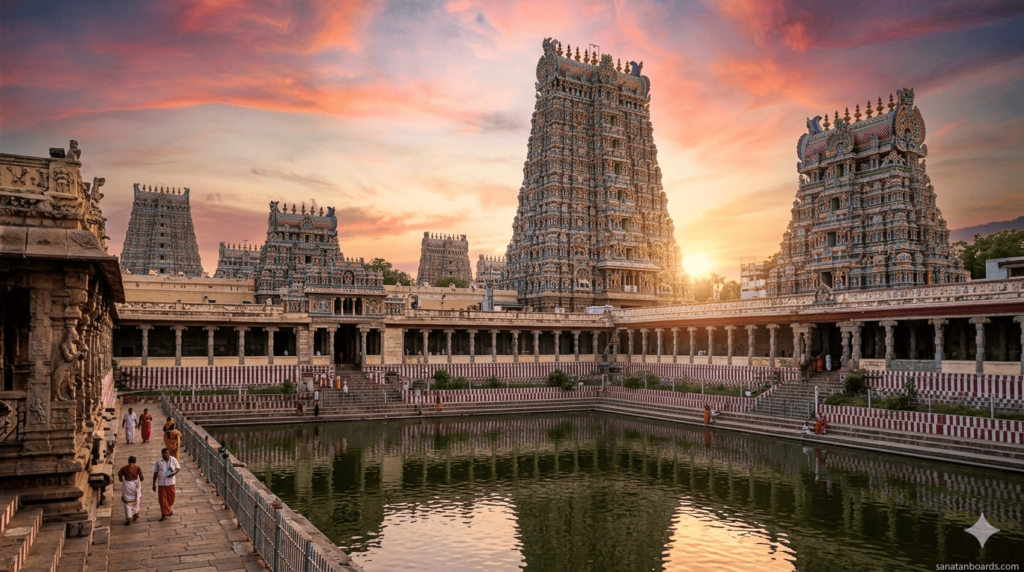
What Is Meenakshi Temple (Madurai, Tamil Nadu) ?
Meenakshi Temple is a grand Hindu temple complex that serves as a major center of worship dedicated to Goddess Meenakshi and Lord Sundareswarar. It is one of the most important pilgrimage destinations in India and represents the religious heritage of Tamil Nadu. The temple is structured as a vast complex with multiple shrines, halls, corridors, and towering entrances.
The temple is known for its Dravidian-style architecture, characterized by massive gopurams that are covered with thousands of colorful sculptures. Each sculpture depicts gods, goddesses, mythical creatures, and scenes from Hindu epics. The temple also includes sacred water tanks, with the most famous being the Golden Lotus Tank, which is used for ritual bathing and religious ceremonies.
At its core, the temple is a spiritual space where devotees come to offer prayers, perform rituals, and seek blessings. It plays a central role in Hindu religious practices, especially in Shaivism and Shaktism traditions. The temple is also a symbol of the divine marriage of Meenakshi and Sundareswarar, which is celebrated annually with great devotion.
Beyond its religious importance, the temple is a masterpiece of ancient engineering and architecture. The design follows traditional Vastu Shastra principles, ensuring balance, harmony, and spiritual energy flow within the complex. The corridors and halls are designed to accommodate large gatherings during festivals and rituals.
The temple is also a hub of cultural activities, including classical music, dance performances, and religious discourses. It represents the fusion of spirituality and art, making it a living cultural institution.
Overall, it is not just a temple but a complete ecosystem of faith, tradition, architecture, and history that continues to influence generations.
Who Is Required Meenakshi Temple (Madurai, Tamil Nadu) ?
Meenakshi Temple is required for a wide range of people, each connected to it in different ways—spiritually, culturally, academically, and socially. Primarily, it is essential for devotees of Hinduism, especially followers of Goddess Meenakshi and Lord Shiva. For them, the temple is a sacred space for worship, prayer, and spiritual fulfillment.
Pilgrims from across India and the world visit the temple seeking blessings, peace of mind, and spiritual guidance. For these individuals, the temple serves as a powerful center of faith and devotion, offering a deeply personal religious experience.
Historians and researchers also require the temple as it provides valuable insights into ancient South Indian history, architecture, and temple culture. The inscriptions, sculptures, and structural design help in understanding the evolution of Tamil civilization and Dravidian architectural styles.
Architects and students of design study the temple to learn about ancient engineering techniques, spatial planning, and symbolic construction methods. The temple’s layout and structural harmony serve as an important reference in architectural education.
Tourists and cultural enthusiasts are drawn to the temple for its artistic beauty and cultural richness. It offers them an opportunity to experience traditional Indian heritage in its most vibrant form.
Additionally, artists, photographers, and performers find inspiration in the temple’s sculptures, festivals, and rituals. It serves as a creative source for visual and performing arts.
Local communities also depend on the temple as it supports economic activity through tourism, festivals, and related services. Thus, the temple is required not only for religious purposes but also for cultural preservation, education, inspiration, and economic development.
When Meenakshi Temple (Madurai, Tamil Nadu) Is Required ?
Meenakshi Temple is required at multiple times throughout the year, depending on religious, cultural, and social needs. The temple is not limited to occasional use but functions continuously as a living spiritual center where daily worship, rituals, and ceremonies are conducted.
On a daily basis, the temple is required for morning and evening poojas (ritual worship), abhishekams (sacred bathing of deities), and other traditional offerings. Devotees visit during these times to participate in prayers and receive blessings. These daily rituals maintain the spiritual energy and religious continuity of the temple.
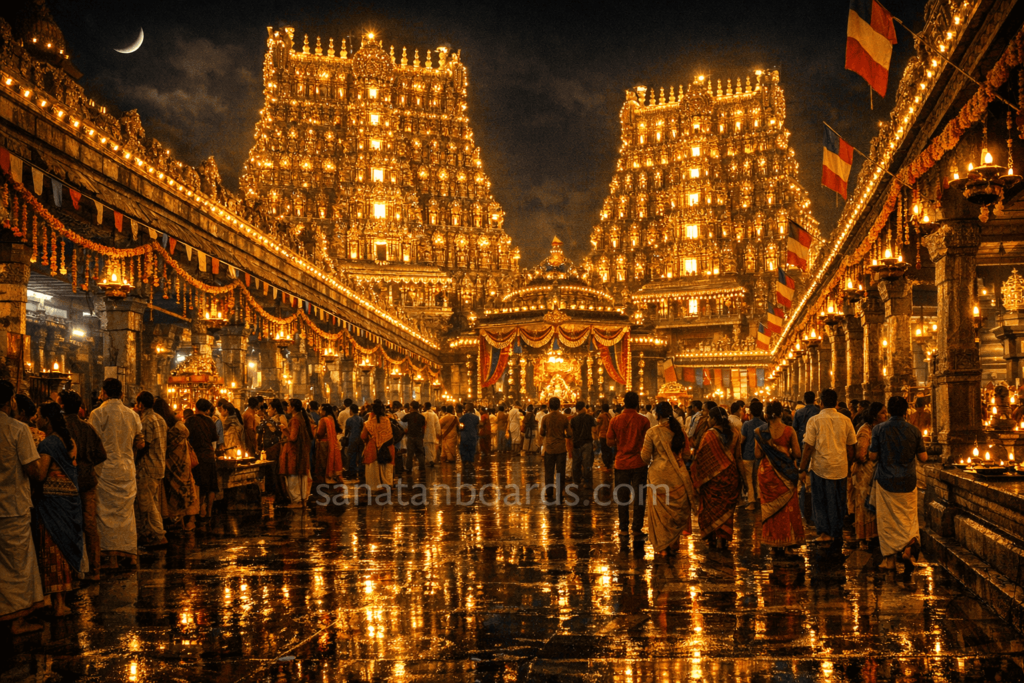
The temple is especially required during major Hindu festivals. One of the most important events is the Meenakshi Thirukalyanam, the divine marriage ceremony of Goddess Meenakshi and Lord Sundareswarar. This festival attracts thousands of devotees and is celebrated with grand rituals, processions, and cultural performances.
During Navaratri, Shivratri, and other religious festivals, the temple becomes a center of large-scale worship and celebration. These periods see increased devotional activities, special pujas, and community gatherings.
The temple is also required during life events such as weddings, naming ceremonies, and religious vows. Many devotees consider it auspicious to conduct significant life rituals within or near the temple premises.
Tourist seasons also influence when the temple is most required. During holidays and vacation periods, visitors from across the world arrive to explore its architecture and cultural heritage.
In addition, the temple is required during times of personal spiritual need. Individuals facing challenges or seeking peace often visit the temple for prayer and reflection.
Thus, the temple is required continuously—daily, seasonally, and spiritually—making it an ever-active center of devotion, culture, and tradition.
Where Meenakshi Temple (Madurai, Tamil Nadu) Is Required ?
Meenakshi Temple is required in the heart of Madurai city, which is one of the oldest continuously inhabited cities in India. Located in the southern state of Tamil Nadu, the temple occupies a central position both geographically and culturally within the urban landscape.
Within Madurai, the temple is situated in the old city area, surrounded by bustling markets, traditional streets, and residential zones. Its presence defines the city’s identity, with roads and neighborhoods developing around it in a radial pattern. The temple acts as the spiritual and cultural nucleus of the city.
On a broader scale, the temple is required in the state of Tamil Nadu as a symbol of Dravidian heritage and Tamil culture. It represents the architectural excellence and religious traditions of the region, making it a key landmark in South India.
Nationally, it is required as one of India’s most important religious and historical sites. It contributes to the country’s cultural tourism industry and attracts visitors from all states.
Globally, the temple is required as a representation of India’s ancient civilization and spiritual traditions. International tourists, researchers, and cultural scholars visit it to understand Indian temple architecture and religious practices.
Academically, the temple is required in universities and research institutions worldwide as a case study in architecture, history, anthropology, and religious studies. It provides real-world examples of ancient urban planning and sacred geometry.
Economically, it is required in the local tourism ecosystem, supporting hotels, transport services, artisans, and small businesses in Madurai.
Spiritually, it is required wherever devotees of Goddess Meenakshi and Lord Shiva seek connection through pilgrimage and prayer.
Thus, the temple is required not just in its physical location but across cultural, academic, spiritual, and economic spaces worldwide.
How Meenakshi Temple (Madurai, Tamil Nadu) Is Required ?
Meenakshi Temple is required through structured systems of worship, architecture, management, and cultural practices that ensure its continuous functioning as a living heritage site.
The temple is required through daily ritual systems, where trained priests perform ceremonies according to ancient Agamic traditions. These rituals maintain spiritual discipline and ensure the continuity of religious practices that have been followed for centuries.
Architecturally, the temple is required through its carefully designed layout. The gopurams, mandapams, and sanctum areas are constructed using traditional Dravidian methods, ensuring stability, symbolism, and aesthetic harmony. The structure is maintained through continuous restoration and conservation efforts.
Administratively, the temple is required through organized management systems that handle visitor flow, festival arrangements, security, and maintenance. These systems ensure that large crowds can be accommodated safely during peak religious seasons.
Culturally, the temple is required through festivals, music, dance, and religious gatherings. These activities preserve traditional art forms and promote cultural continuity. The temple acts as a stage for classical performances and spiritual storytelling.
Economically, the temple is required through tourism and pilgrimage networks. Local vendors, artisans, and service providers depend on the temple’s activities for their livelihood.
Technologically, modern systems like digital ticketing, crowd monitoring, and security surveillance are used to manage large gatherings efficiently while preserving traditional practices.
Spiritually, the temple is required through devotion and faith. Devotees engage in prayer, rituals, and offerings, making the temple a living center of spiritual energy.
Thus, the temple is required through a combination of tradition, management, culture, and modern systems that work together to sustain its relevance and functionality.
Case Study On Meenakshi Temple (Madurai, Tamil Nadu)
Meenakshi Temple serves as a significant case study in the fields of architecture, cultural heritage management, religious continuity, and urban development. Its long history and continuous usage make it one of the most studied temple complexes in South Asia.
From an architectural perspective, the temple demonstrates the excellence of Dravidian design principles. The towering gopurams, intricate carvings, and symmetrical layout reflect advanced engineering knowledge of ancient builders. Each structure is not only decorative but also symbolic, representing cosmological concepts and mythological narratives. The use of granite stone, precise sculpting, and layered construction techniques highlight a high level of craftsmanship.
Historically, the temple showcases the evolution of South Indian dynasties, particularly the Pandya and Nayak rulers. The temple underwent expansions and renovations over centuries, reflecting changing political and cultural influences. Inscriptions found within the temple provide valuable information about trade, governance, and religious practices of earlier civilizations.
From a cultural perspective, the temple functions as a living institution. Unlike many ancient monuments that are preserved as static heritage sites, this temple continues to host daily rituals and large festivals. The Meenakshi Thirukalyanam festival is a major cultural event that attracts thousands of participants, reinforcing community identity and religious unity.
In terms of heritage management, the temple presents both opportunities and challenges. The high volume of visitors requires efficient crowd control, conservation strategies, and infrastructure maintenance. Authorities must balance preservation of ancient structures with modern requirements such as safety, accessibility, and sanitation.
Economically, the temple plays a central role in Madurai’s tourism industry. It generates employment for priests, guides, artisans, vendors, and hospitality workers. The surrounding markets thrive due to the constant flow of pilgrims and tourists. This demonstrates how religious heritage can support sustainable local economies.
Urban development around the temple is another important aspect. Madurai’s city layout is influenced by the temple’s central position. Roads radiate outward, and commercial zones have developed around pilgrimage routes. This makes the temple not only a spiritual center but also an urban planning anchor.
Socially, the temple fosters community cohesion. It serves as a gathering place where people from different backgrounds come together during festivals and rituals. It strengthens cultural identity and continuity across generations.
Environmental considerations are also relevant. Managing waste, water usage, and preserving the temple tank system are essential for maintaining ecological balance in a densely populated urban area.
Overall, the temple represents a successful integration of spirituality, culture, economy, and urban life. It continues to function as a dynamic institution that adapts to modern needs while preserving ancient traditions.
White Paper On Meenakshi Temple (Madurai, Tamil Nadu)
Meenakshi Temple stands as a multidimensional heritage asset combining religious significance, architectural mastery, socio-economic influence, and cultural sustainability. This white paper examines its structural, functional, and strategic importance in contemporary society.
The temple’s architectural framework is based on Dravidian design principles, characterized by monumental gateways, axial symmetry, and sacred spatial organization. The engineering methods used in its construction demonstrate advanced understanding of stone masonry, load distribution, and aesthetic proportion. The gopurams serve both symbolic and practical purposes, acting as visual markers and entry points for large congregations.
From a heritage conservation standpoint, the temple requires continuous preservation efforts. Natural weathering, urban pollution, and high visitor traffic pose challenges to structural integrity. Conservation strategies include controlled restoration, documentation of carvings, and regulated access to sensitive areas. Maintaining authenticity while ensuring structural safety is a critical objective.
Religiously, the temple functions as an active center of worship rather than a static monument. Daily rituals, seasonal festivals, and special ceremonies ensure uninterrupted spiritual engagement. This continuous use distinguishes it from many heritage sites that are preserved solely for observation.
Economically, the temple contributes significantly to regional development. It drives tourism, supports local businesses, and sustains employment in hospitality, transport, handicrafts, and food services. The temple economy forms an ecosystem that benefits both formal and informal sectors.
Culturally, the temple plays a vital role in preserving traditional art forms such as classical music, Bharatanatyam dance, and temple sculpture traditions. Festivals provide platforms for cultural expression and intergenerational knowledge transfer.
From an urban planning perspective, the temple influences the spatial organization of Madurai. The city’s infrastructure, transport systems, and commercial hubs are shaped around the temple’s central location. This creates a unique model of temple-centered urban development.
Technological integration has become increasingly important. Modern systems such as digital crowd monitoring, security surveillance, and online donation platforms are used to enhance efficiency while maintaining traditional practices. These tools help manage large-scale pilgrim inflows, especially during festivals.
Socially, the temple promotes inclusivity and collective identity. It brings together people from diverse regions and backgrounds, fostering unity through shared rituals and cultural experiences.
Challenges include managing overcrowding, maintaining structural conservation, balancing commercialization with sanctity, and ensuring environmental sustainability within the temple precincts.
Strategically, the temple serves as a model for heritage management that combines tradition with modernization. It demonstrates how ancient institutions can remain relevant in contemporary society through adaptive management and cultural continuity.
Overall, the temple represents a living heritage #sanatanboardsinvasai system where spirituality, economy, culture, and governance intersect, creating a sustainable ecosystem that continues to evolve.
Industry Application On Meenakshi Temple (Madurai, Tamil Nadu)
Meenakshi Temple has significant applications across multiple modern industries due to its architectural excellence, cultural depth, and continuous socio-economic impact. It is not only a religious landmark but also a practical model used in various professional and commercial sectors.
In the tourism and hospitality industry, the temple is a major driver of heritage tourism in South India. It attracts millions of visitors every year, supporting hotels, restaurants, travel agencies, taxi services, and guided tour operations. This creates a strong local economy in Madurai and surrounding regions.
In the architecture and construction industry, the temple serves as a reference for Dravidian architectural design. Engineers and architects study its structural balance, stone carving techniques, gopuram construction, and spatial planning. It also inspires modern heritage-style buildings and restoration projects.
In the education and research sector, the temple is widely used as a case study in history, archaeology, anthropology, religious studies, and cultural heritage management. Researchers analyze its inscriptions, dynastic history, and temple economy systems to understand ancient South Indian civilization.
In the arts and entertainment industry, the temple influences classical dance forms like Bharatanatyam, Carnatic music compositions, sculpture, painting, and visual storytelling. It is frequently featured in documentaries, films, and digital media projects showcasing Indian heritage.
In the technology sector, the temple supports innovations such as 3D mapping, virtual reality tours, digital heritage preservation, AI-based crowd management, and online devotional platforms. These technologies help manage large pilgrim flows while improving visitor experience.
In the event management industry, its large-scale festival organization—especially during major celebrations—serves as a model for handling massive public gatherings with efficiency, security, and coordination.
In the economic development sector, the temple #sanatanboardsinmumbai demonstrates how cultural heritage sites can generate sustainable livelihoods for artisans, vendors, performers, and local businesses.
source : India To Bharat
ASK FAQ
1. What is Meenakshi Temple famous for?
Meenakshi Temple is famous for its Dravidian architecture, colorful gopurams, intricate sculptures, and its association with Goddess Meenakshi and Lord Shiva.
2. Where is Meenakshi Temple located?
It is located in the city of Madurai in the Indian state of Tamil Nadu, in the southern part of India.
3. Who built Meenakshi Temple?
The temple has ancient origins, but its major structure was expanded and renovated by the Nayak rulers during the 16th–17th centuries.
4. Why is Meenakshi Temple important?
It is an important religious, cultural, and historical site that represents Hindu devotion, Tamil heritage, and ancient architectural excellence.
5. When is Meenakshi Temple most visited?
It is most visited during festivals like Meenakshi Thirukalyanam, Navaratri, and Maha Shivaratri, when large celebrations take place.
Table of Contents
Disclaimer
This content is created for educational, informational, and general knowledge purposes only. It is intended to support learning and understanding of historical, cultural, architectural, and social aspects related to the subject. The information presented is based on commonly available references and interpretations and may not include every detail or recent development. Readers are advised to verify facts from authoritative and official sources if required for academic, professional, or research use.