
ERAWAN SHRINE (BANGKOK) – HINDU TEMPLE
Erawan Shrine in Bangkok is one of the most well-known spiritual landmarks in Thailand and is widely recognized for its deep religious, cultural, and tourism significance. Located at a major commercial intersection in the heart of the city, it is a sacred place where devotion, tradition, and modern urban life come together. The shrine is dedicated primarily to the Hindu deity Brahma, known locally as Phra Phrom, who represents creation, wisdom, and cosmic order. Although Thailand is predominantly a Buddhist country, the shrine reflects the strong historical influence of Hinduism in Southeast Asian culture.
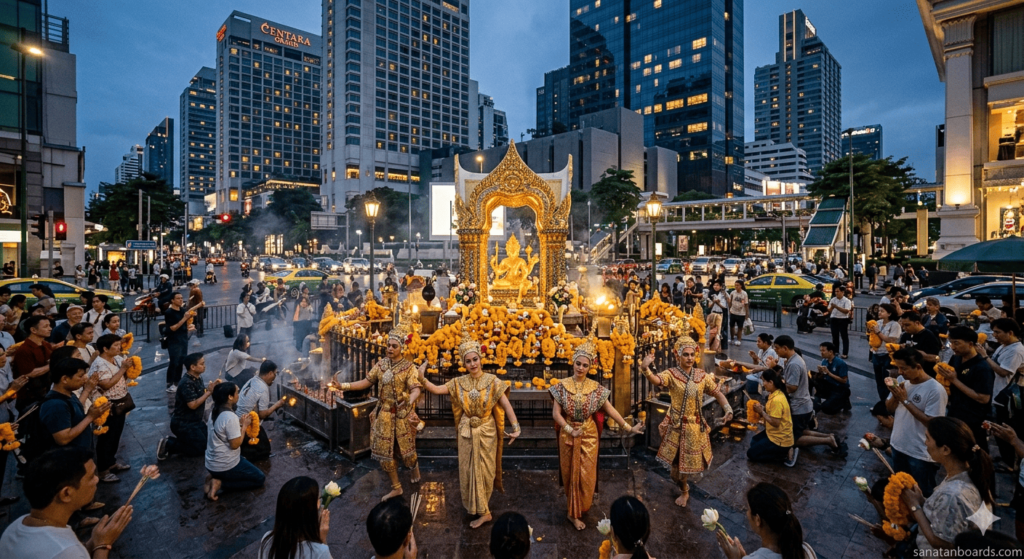
The shrine is visited daily by thousands of devotees, both locals and international tourists, who come to seek blessings, fulfill vows, and express gratitude for wishes believed to have been granted. It is especially known for its spiritual atmosphere, where rituals such as offering flowers, lighting incense and performing traditional Thai dance performances take place regularly. These cultural performances are often sponsored by devotees as a form of thanksgiving.
The location of the shrine in a busy commercial district adds to its uniqueness, as it stands amidst modern skyscrapers, shopping centers, and transport hubs. Despite the urban environment, it remains a peaceful spiritual space that attracts people from different religions and backgrounds. Over time, it has become not only a religious site but also a symbol of cultural harmony and faith in everyday life.
The shrine’s popularity has made it an important part of Bangkok’s identity, contributing to both religious tourism and cultural preservation. It continues to represent devotion, hope, and the belief in divine blessings in a fast-growing modern city.
What Is Erawan Shrine (Bangkok) – Hindu Temple ?
Erawan Shrine in Bangkok is a prominent religious site that represents a blend of Hindu belief systems and Thai cultural traditions. It is dedicated to the Hindu god Brahma, known in Thailand as Phra Phrom, who symbolizes creation, wisdom, and protection. The shrine is not a temple in the traditional architectural sense but functions as a sacred space for worship, prayer, and spiritual offerings.
The shrine was originally built in the 1950s during the construction of a major hotel project, after a series of setbacks were believed to be caused by spiritual imbalance. Following the installation of the shrine, the construction reportedly progressed smoothly, leading to the establishment of the site as a place of worship. Since then, it has become one of the most visited spiritual locations in Bangkok.
Visitors to the shrine engage in various religious practices such as offering jasmine garlands, incense sticks, candles, and gold leaf. One of its unique features is the presence of traditional Thai dance performances, which are offered as part of vows or gratitude rituals. These performances reflect the integration of cultural arts into religious devotion.
The shrine is located in a highly accessible area, making it a frequent stop for tourists and worshippers alike. It is surrounded by commercial buildings, hotels, and shopping complexes, which adds to its visibility and importance in the urban landscape. Despite its location in a busy city center, it maintains a peaceful and respectful environment.
Erawan Shrine is also considered a symbol of multicultural harmony, where Hindu beliefs are practiced within a Buddhist-majority country. It demonstrates how religious traditions can coexist and evolve within different cultural settings. Over time, it has become not only a place of worship but also a cultural landmark representing faith, gratitude, and spiritual connection.
Who Is Required Erawan Shrine (Bangkok) – Hindu Temple ?
The Erawan Shrine is required by a diverse group of individuals who seek spiritual guidance, blessings, and fulfillment of personal wishes. Devotees who believe in Hindu deities, especially Brahma, visit the shrine to pray for success, health, prosperity, and protection. These individuals often include business professionals, entrepreneurs, students, and families who are seeking positive outcomes in their personal and professional lives.
In addition to religious devotees, tourists are also drawn to the shrine due to its cultural and historical significance. Many visitors who are exploring Bangkok include the shrine in their itinerary as part of understanding local traditions and spiritual practices. For them, the shrine serves as a cultural learning experience and a representation of Thailand’s diverse religious landscape.
Local residents also frequent the shrine, especially those working in nearby commercial areas. For office workers and business owners, the shrine is often visited before starting important tasks or business ventures. It is believed that offering prayers and making vows can bring good fortune and success in competitive environments.
Spiritual practitioners and cultural performers are also involved in the shrine’s activities. Traditional dancers are often required to perform as part of rituals, especially when devotees fulfill vows. These performers play an essential role in maintaining the cultural and ceremonial aspects of the shrine.
Furthermore, the shrine is required in a symbolic sense for those studying religion, anthropology, and cultural studies. It provides insight into how different belief systems interact and coexist in a modern urban society.
Overall, the shrine is required by anyone seeking spiritual reassurance, cultural understanding, or participation in traditional rituals that blend faith and cultural expression in a unique environment.
When Erawan Shrine (Bangkok) – Hindu Temple Is Required ?
The Erawan Shrine is required at different times depending on the needs, beliefs, and intentions of individuals. One of the most common times people visit the shrine is during personal or professional challenges. When individuals face uncertainty in business, education, or health, they often seek spiritual support and guidance by offering prayers at the shrine.
It is also frequently required during important life events or decision-making moments. People may visit before starting a new job, launching a business, taking examinations, or making financial investments. These moments are considered critical, and devotees believe that seeking blessings at the shrine can influence positive outcomes.
Festive and religious occasions are another time when the shrine becomes highly significant. During cultural festivals, religious holidays, or special observance days, the shrine experiences increased activity as devotees gather to perform rituals and offer gratitude. These periods strengthen its role as a cultural and spiritual hub.
The shrine is also required when individuals feel gratitude for fulfilled wishes. Many people return to the shrine after their prayers have been answered to fulfill vows. This often includes offering flowers, lighting incense, or sponsoring traditional dance performances as a form of thanksgiving.
Tourists typically visit the shrine throughout the year, but peak times include holiday seasons and travel periods when cultural exploration is a priority. It becomes a regular stop for those exploring Bangkok’s spiritual and historical sites.
In a broader sense, the shrine is required continuously as it remains open and active every day. Its constant accessibility makes it a place where people can seek comfort, peace, and blessings at any time they feel the need for spiritual connection.
Where Erawan Shrine (Bangkok) – Hindu Temple Is Required ?
The Erawan Shrine is required in the heart of Bangkok, Thailand, specifically at one of the city’s busiest and most important commercial intersections. It is located in a central urban district surrounded by hotels, shopping malls, office buildings, and transportation networks, making it easily accessible to both locals and tourists.
Its location in a high-traffic area means it is naturally integrated into daily city life. Office workers passing through the area often stop by the shrine before or after work, while tourists visiting nearby attractions include it in their travel routes. The shrine’s position in such a central location enhances its visibility and significance.
It is also required in areas where cultural and religious tourism is promoted. Bangkok is known for its rich blend of traditions, and the shrine serves as an important stop for understanding the spiritual diversity of the city. Travel agencies, guides, and tourism planners often include it in cultural tours.
In a broader symbolic sense, the shrine is required in urban spaces where spiritual balance is needed amidst rapid modernization. It stands as a reminder of traditional beliefs within a highly developed commercial environment.
Additionally, it is required in educational and cultural contexts, as it serves as a case study for religion, architecture, and cultural integration. Students, researchers, and scholars visit the site to understand how religious practices adapt within modern cities.
Overall, the shrine’s requirement is not limited to its physical location but extends to its role as a cultural, spiritual, and educational landmark within Bangkok’s urban landscape.
How Erawan Shrine (Bangkok) – Hindu Temple Is Required ?
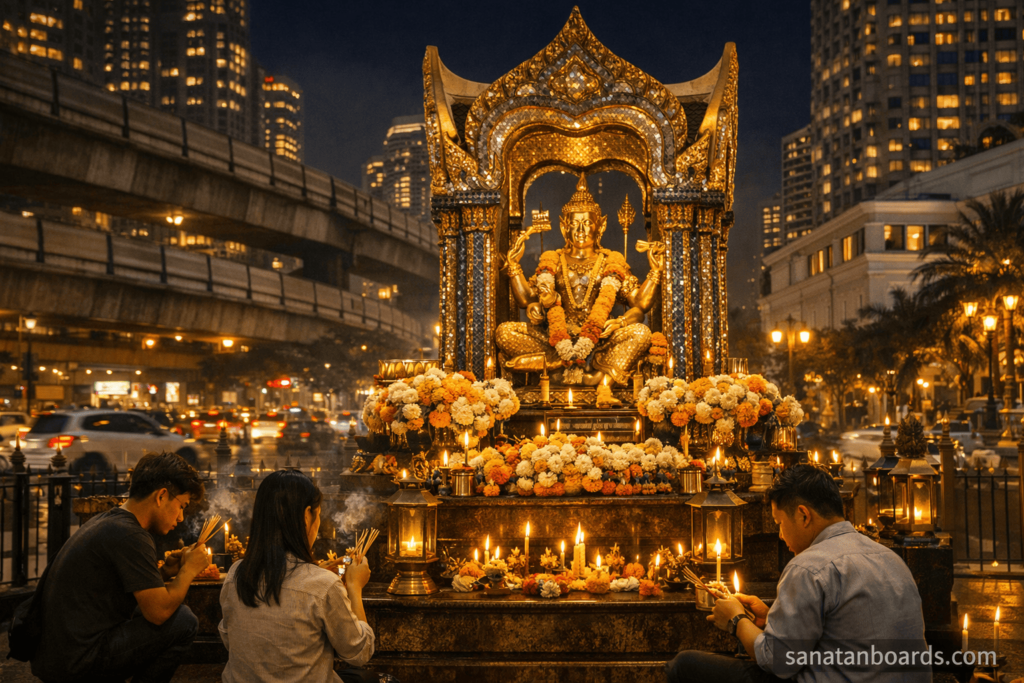
The Erawan Shrine is required through a combination of religious rituals, cultural practices, and community participation. Devotees engage with the shrine by performing structured offerings that typically include flowers, incense, candles, and symbolic items. These offerings are made as expressions of devotion, gratitude, or requests for blessings.
One of the key methods of interaction is prayer and vow-making. Individuals often pray for specific outcomes and make promises that they will return to fulfill a ritual or offering if their wishes are granted. This practice creates a cycle of devotion and gratitude.
Another important way the shrine is required is through cultural performances. Traditional Thai dance performances are an integral part of the shrine’s activities. These performances are often arranged by devotees as fulfillment of vows, adding a cultural dimension to spiritual practice.
The shrine also functions through continuous maintenance and participation by caretakers and religious attendants who ensure rituals are performed correctly and the space remains sacred. They guide visitors and help maintain the order of daily worship activities.
Tourists engage with the shrine by observing rituals, learning about cultural traditions, and participating respectfully in offerings. This passive yet meaningful engagement helps preserve cultural understanding.
In a broader sense, the shrine is required through media, tourism promotion, and educational discussions that highlight its cultural importance. It is often referenced in studies of religion, anthropology, and urban culture.
Overall, the shrine operates through a combination of personal devotion, cultural expression, and structured ritual practices that sustain its spiritual and social significance.
Case Study On Erawan Shrine (Bangkok) – Hindu Temple
The Erawan Shrine in Bangkok serves as a significant case study in understanding the interaction between religion, urban development, tourism, and cultural adaptation in a modern Southeast Asian city. Situated in one of the busiest commercial districts of Bangkok, the shrine represents a rare example of how sacred Hindu traditions have been seamlessly integrated into a predominantly Buddhist society while also becoming a global tourist attraction.
Historically, the shrine was established during the construction of a major hotel project in the 1950s. The project reportedly faced repeated delays, accidents, and setbacks, which led planners to consult spiritual advisors. Following the installation of a shrine dedicated to Brahma, the construction is believed to have proceeded without further issues. This event contributed to the shrine’s reputation as a powerful spiritual site capable of removing obstacles and ensuring success. Over time, it evolved from a construction remedy into a permanent place of worship.
From a religious perspective, the shrine is dedicated to Brahma, the Hindu god of creation, known in Thailand as Phra Phrom. However, its religious identity is not limited to orthodox Hinduism. Instead, it reflects a localized interpretation of spiritual belief systems, combining Hindu philosophy with Thai Buddhist cultural practices. This blending of traditions is a key aspect of the shrine’s significance and makes it an important subject of religious syncretism studies.
Culturally, the shrine is deeply embedded in Thai social practices. Devotees perform rituals such as offering flower garlands, lighting incense, and applying gold leaf to statues. One of the most distinctive cultural features is the traditional Thai dance performances offered as a form of gratitude when wishes are believed to be fulfilled. These performances are not merely artistic expressions but are deeply connected to spiritual devotion and ritual fulfillment.
Economically, the shrine plays a major role in supporting Bangkok’s tourism industry. It attracts millions of visitors annually, including local devotees and international tourists. Its central location near shopping malls and business centers increases foot traffic, benefiting nearby hotels, restaurants, and retail outlets. The shrine thus contributes significantly to the local economy, making it both a spiritual and economic asset.
Socially, the shrine functions as a multicultural meeting point. People from different countries, religions, and backgrounds gather to participate in or observe rituals. This creates a shared space of spiritual engagement that transcends religious boundaries. It also reflects Bangkok’s identity as a global city with diverse cultural influences.
However, the shrine also faces challenges such as overcrowding, commercialization, and maintaining religious sanctity in a highly urbanized environment. Managing large crowds while preserving respectful worship conditions requires continuous effort from authorities and caretakers.
In conclusion, the Erawan Shrine serves as a powerful case study in how religion, culture, and economics intersect in an urban setting. It highlights the adaptability of spiritual traditions and their ability to remain relevant in modern society while contributing to cultural identity and economic growth.
White Paper On Erawan Shrine (Bangkok) – Hindu Temple
The Erawan Shrine in Bangkok represents a unique convergence of religion, urban development, tourism, and cultural heritage. This white paper examines its multidimensional role as a spiritual landmark, economic contributor, and cultural symbol within a rapidly modernizing metropolitan environment.
At its foundation, the shrine is dedicated to Brahma, the Hindu god of creation. However, its religious practice in Thailand is shaped by local interpretations and Buddhist cultural influences. This blending of traditions demonstrates the adaptive nature of belief systems in Southeast Asia, where spiritual practices often evolve through cultural integration rather than strict doctrinal boundaries.
From a cultural heritage perspective, the shrine is an important repository of traditional Thai performing arts. The ritual dances performed as offerings are not merely entertainment but serve as sacred acts of devotion. These performances help preserve traditional dance forms while ensuring their continued relevance in contemporary society. The shrine thus acts as a living cultural institution.
Economically, the shrine is a significant driver of tourism in Bangkok. It attracts millions of visitors annually, contributing to revenue generation for multiple sectors, including hospitality, transportation, retail, and food services. Its strategic location in a central business district amplifies its economic impact, as visitors often engage in surrounding commercial activities. This demonstrates how religious sites can function as economic ecosystems within urban environments.
From an urban development standpoint, the shrine offers valuable insights into the integration of sacred spaces within modern infrastructure. Positioned amid skyscrapers, shopping malls, and transportation networks, it illustrates how spiritual landmarks can coexist with high-density urban development. This raises important considerations for city planners regarding the preservation of cultural identity in rapidly evolving cities.
Socially, the shrine fosters inclusivity by attracting individuals from diverse cultural and religious backgrounds. It serves as a shared space where devotion and cultural curiosity intersect. This inclusiveness enhances cross-cultural understanding and promotes peaceful coexistence in a globalized urban environment.
The shrine also plays a role in intangible heritage preservation. Ritual practices, prayer offerings, and traditional performances contribute to maintaining cultural continuity. These practices are passed down through generations, ensuring that cultural identity is preserved even in a modern city context.
However, the shrine faces several challenges. These include managing large tourist crowds, preventing over-commercialization, and maintaining the sanctity of religious practices. Balancing accessibility with spiritual integrity is an ongoing concern that requires careful governance.
In conclusion, the Erawan Shrine serves as a model for understanding how religious sites can function as cultural, economic, and urban assets. It demonstrates the #sanatanboardsinvasai importance of preserving spiritual heritage while adapting to modern urban demands.
Industry Application On Erawan Shrine (Bangkok) – Hindu Temple
The Erawan Shrine in Bangkok has wide-ranging applications across multiple industries, making it more than just a religious site. It functions as a cultural, economic, educational, and urban development asset that influences several sectors in Thailand and beyond.
In the tourism industry, the shrine is a major attraction that draws millions of visitors annually. It is commonly included in travel itineraries, cultural tours, and heritage exploration programs. Travel agencies and tour operators rely on the shrine as a key highlight when promoting Bangkok as a cultural destination. Its popularity significantly contributes to Thailand’s international tourism revenue.
In the hospitality sector, the shrine indirectly supports hotels, restaurants, and transport services located in its vicinity. Tourists visiting the shrine often stay in nearby accommodations and utilize local services, creating a ripple effect that benefits the entire hospitality ecosystem. This makes the shrine an important economic driver in urban commercial zones.
The cultural and creative industries also benefit from the shrine’s activities. Traditional Thai dance performances performed as part of rituals provide employment opportunities for artists and help preserve classical performing arts. These performances ensure that cultural traditions remain active and relevant in modern society.
In urban planning and development, the shrine serves as a case study for integrating cultural landmarks within high-density commercial environments. It demonstrates how sacred spaces can coexist with modern infrastructure while maintaining accessibility and relevance. Urban planners study such models to design cities that balance modernization with cultural preservation.
In the education and research sector, the shrine is widely used as a reference point in studies related to religion, anthropology, sociology, tourism management, and architecture. It provides real-world insights into how religious syncretism and cultural integration function in urban environments. Students and researchers analyze it to understand the relationship between belief systems and modern society.
In the media and communication industry, the shrine is frequently featured in documentaries, travel shows, and cultural programs. Its visual appeal and spiritual significance make it a popular subject for storytelling, enhancing global awareness of Thai culture and traditions.
In conclusion, the Erawan Shrine demonstrates strong multi-industry relevance. It supports economic growth, cultural preservation, tourism development, #sanatanboardsinindia and academic research while maintaining its spiritual importance. Its role extends far beyond religion, making it a valuable asset in multiple professional and industrial domains.
source : Thailand Guide
ASK FAQ
1. What is Erawan Shrine in Bangkok famous for?
Erawan Shrine is famous for being a sacred Hindu shrine dedicated to Brahma, known for granting wishes, spiritual rituals, and traditional Thai dance offerings performed by devotees as gratitude.
2. Where is Erawan Shrine located in Bangkok?
It is located in central Bangkok at Ratchaprasong intersection, a major commercial and tourist hub surrounded by hotels, shopping malls, and business centers.
3. Why do people visit Erawan Shrine?
People visit to pray for success, health, wealth, and good fortune. Many also go to fulfill vows after their wishes are believed to be granted.
4. What religion is Erawan Shrine associated with?
Erawan Shrine is associated with Hinduism, specifically dedicated to Lord Brahma (Phra Phrom), but it is widely respected in Thai Buddhist culture as well.
5. What rituals are performed at Erawan Shrine?
Visitors perform rituals like offering flower garlands, incense, candles, and gold leaf, along with sponsoring traditional Thai dance performances as acts of devotion.
Table of Contents
DISCLAIMER
The information provided is for educational and informational purposes only. It is based on general knowledge about cultural, religious, and historical aspects of the Erawan Shrine in Bangkok and should not be considered as religious guidance, factual certification, or official interpretation. Cultural practices, beliefs, and rituals may vary among individuals and communities. Readers are encouraged to verify details from authentic and official sources if required. The content does not intend to promote or discourage any religious belief. Any resemblance to personal interpretations or experiences is purely coincidental and meant solely for academic understanding and learning purposes.