
DWARKA (GUJARAT) – KINGDOM OF KRISHNA
Dwarka is one of the most sacred and historically significant cities in India, deeply connected with ancient mythology, spirituality, and cultural heritage. Known as the “Kingdom of Lord Krishna,” Dwarka holds a unique place in Indian tradition as one of the Char Dham pilgrimage sites. According to ancient texts, it is believed to have been the royal capital of Krishna after he left Mathura and established a prosperous kingdom on the western coast of India.
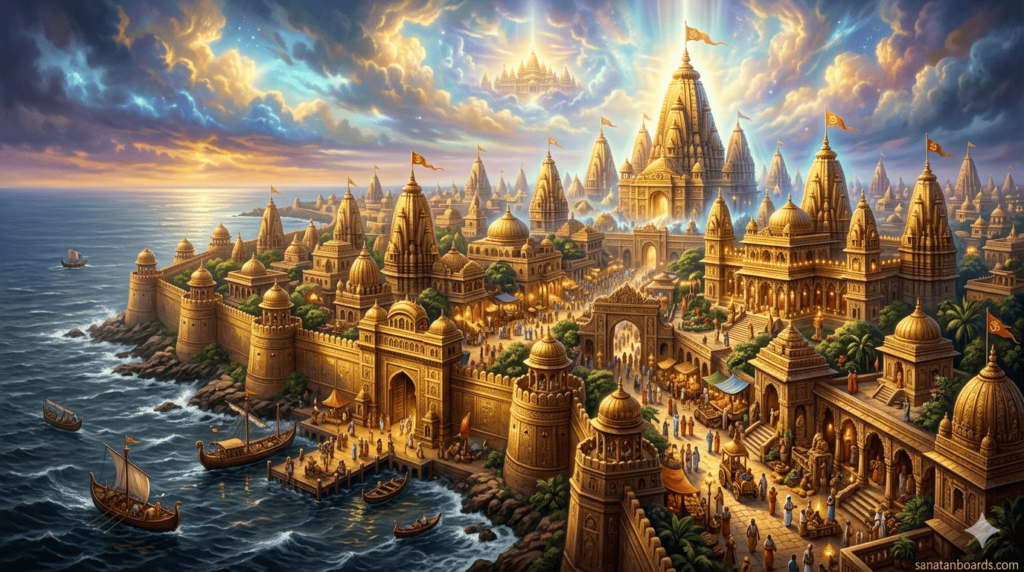
Dwarka is not only a religious destination but also a symbol of ancient urban planning, maritime trade, and cultural richness. The city is often described in scriptures as a grand, golden city built on the shores of the Arabian Sea, showcasing advanced architecture and divine presence. Over time it has become a powerful representation of devotion, faith, and heritage.
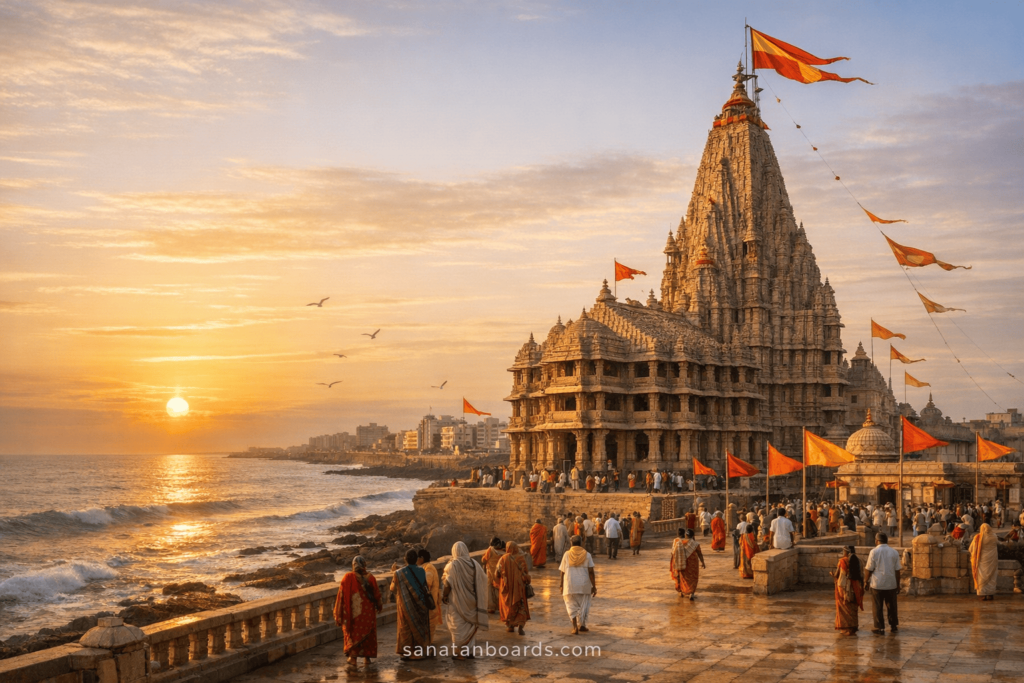
Today, Dwarka attracts millions of pilgrims and tourists from around the world who come to experience its spiritual energy and historical significance. The famous Dwarkadhish Temple stands as the central attraction, dedicated to Lord Krishna, and reflects centuries of devotion and architectural brilliance.
Beyond religion, Dwarka also represents a blend of mythology and archaeology. Many researchers and historians have explored underwater structures near the coast linking them to ancient settlements mentioned in sacred texts. This adds an additional layer of mystery and fascination to the city.
Thus, Dwarka is not just a geographical location but a living legacy of divine connection, cultural identity, and historical depth that continues to inspire generations.
What Is Dwarka (Gujarat) – Kingdom Of Krishna ?
Dwarka is an ancient coastal city located in the western state of Gujarat, India. It is widely recognized as one of the most important pilgrimage sites in Hinduism and is closely associated with the life of Krishna. According to mythology, Dwarka was established as a magnificent kingdom where Krishna ruled after leaving Mathura.
The name “Dwarka” is believed to mean “Gateway to Heaven,” symbolizing its spiritual importance. It is considered one of the Char Dham pilgrimage destinations, which are sacred sites that Hindus aspire to visit for spiritual liberation.
Historically, Dwarka is described in ancient scriptures as a highly developed city with strong fortifications, organized streets, palaces, and advanced infrastructure. It is also believed to have been partially submerged under the sea after Krishna’s departure from the earth, which adds to its mystical identity.
In modern times, Dwarka is a small yet spiritually vibrant city. The main attraction is the Dwarkadhish Temple, which is dedicated to Krishna and is a major center of devotion. Pilgrims gather here throughout the year, especially during festivals like Janmashtami, which celebrates Krishna’s birth.
Apart from its religious significance, Dwarka also holds archaeological interest. Studies and underwater explorations along the coastal region have revealed structures that some believe may be linked to ancient settlements described in mythology.
Thus, Dwarka represents a unique combination of faith, history, and cultural heritage. It is both a physical location and a spiritual concept that continues to influence religious beliefs, tourism, and historical research in India.
Who Is Required Dwarka (Gujarat) – Kingdom Of Krishna ?
Dwarka is required or significant for various groups of people depending on spiritual, cultural, academic, and personal interests. The most important group includes devotees of Krishna, who consider Dwarka a sacred pilgrimage destination. For them, visiting Dwarka is believed to bring spiritual peace, blessings, and a deeper connection with divine energy.
Religious pilgrims require Dwarka as part of their spiritual journey, especially those following the Char Dham tradition. It is seen as a place for prayer, reflection, and liberation from worldly attachments. Many devotees visit the Dwarkadhish Temple to offer prayers and participate in rituals.
Historians and archaeologists also require Dwarka as an important site for research. The city is linked to ancient texts and legends, making it a valuable location for studying early civilization, urban planning, and cultural development. Underwater explorations near Dwarka further increase its importance for scientific investigation.
Tourists and cultural explorers require Dwarka to experience India’s spiritual heritage and architectural beauty. The city offers insights into ancient traditions, temple architecture, and coastal geography.
Philosophers and spiritual seekers may also consider Dwarka essential for understanding deeper meanings of devotion, dharma, and mythology.
When Dwarka (Gujarat) – Kingdom Of Krishna Is Required ?
Dwarka becomes significant in both historical and spiritual timelines. According to ancient traditions, Dwarka rose to importance during the era of Krishna, which is believed to be part of the Dwapar Yuga in Hindu cosmology. This period is described as an age when divine beings interacted with humans and established great civilizations.
Dwarka is believed to have been founded when Krishna migrated from Mathura to the western coast to protect his people from repeated attacks. During this time, Dwarka became a thriving kingdom and a major center of governance, culture, and trade. It is said to have flourished for many years under Krishna’s leadership.
In spiritual terms, Dwarka is considered relevant at all times because it represents eternal devotion and divine presence. Pilgrims visit the city throughout the year, but certain periods hold special significance. Festivals like Janmashtami, which celebrates Krishna’s birth, make Dwarka especially important, attracting thousands of devotees.
Historically, Dwarka also gains importance during archaeological studies in modern times. Researchers and explorers focus on different time periods to understand the evolution of coastal civilizations and ancient maritime trade routes. Underwater investigations are conducted periodically, adding new interpretations of its timeline.
Seasonally, Dwarka experiences peak religious activity during winter months when weather conditions are favorable for travel and pilgrimage. This makes it a preferred time for visitors.
Thus, Dwarka is required and relevant across mythological time (ancient era), religious time (festival cycles), and modern time (tourism and research). Its significance is not limited to a single period but extends across history, spirituality, and contemporary exploration.
Where Dwarka (Gujarat) – Kingdom Of Krishna Is Required ?
Dwarka is located on the western coastline of India in the state of Gujarat, along the Arabian Sea. Its geographical position makes it both a coastal city and a spiritual destination. According to ancient belief, this coastal setting was chosen by Krishna to establish his kingdom due to its strategic and peaceful environment.
Dwarka is situated at the mouth of the Gomti River, which adds to its religious importance. The river meets the sea near the city, creating a sacred confluence that is visited by pilgrims for ritual bathing and prayers. The surrounding region includes temples, ghats, and coastal landscapes that enhance its spiritual atmosphere.
From a cultural geography perspective, Dwarka lies in the Saurashtra region of Gujarat, which has historically been an important hub for maritime trade and cultural exchange. Its coastal location allowed it to connect with ancient trade routes across the Arabian Sea.
In mythological descriptions, Dwarka is often portrayed as a grand city built on the shores, sometimes even extending into the sea. This has led to underwater explorations in nearby coastal waters, where structures believed by some to be ancient remnants have been discovered.
Today, Dwarka is well connected by road, rail, and sea routes, making it accessible to pilgrims and tourists. The Dwarkadhish Temple is located in the heart of the city and serves as the central point of attraction.
Thus, Dwarka’s location is not just geographical but also symbolic. It represents the meeting point of land and sea, history and mythology, and devotion and culture.
How Dwarka (Gujarat) – Kingdom Of Krishna Is Required ?
Dwarka is understood and experienced through its religious practices, historical interpretations, and cultural traditions. According to mythology, Dwarka was created by divine architectural planning under the guidance of Krishna. It is believed that the city was built with advanced techniques and organized design, making it one of the most sophisticated cities of its time.
Spiritually, Dwarka functions as a pilgrimage center where devotees follow rituals, prayers, and temple visits to connect with divine energy. The Dwarkadhish Temple plays a central role in this experience, where daily worship and ceremonies are performed.
Historically, Dwarka is studied through texts, archaeological findings, and underwater explorations. Researchers attempt to understand how ancient descriptions match physical evidence found along the coastline. This process helps in reconstructing the possible existence of an ancient civilization.
Culturally, Dwarka is preserved through traditions, festivals, and oral stories passed down through generations. Festivals like Janmashtami
are celebrated with great devotion, involving rituals, music, and processions.
From a tourism perspective, Dwarka is developed through infrastructure such as transport, accommodation, and guided tours, enabling visitors to explore its religious and historical sites.
Thus, Dwarka “works” as a combination of belief systems, historical inquiry, and cultural expression. It continues to function as a living heritage site that connects the past with the present.
Case Study On Dwarka (Gujarat) – Kingdom Of Krishna
Dwarka is one of the most significant cultural, religious, and historical case studies in India due to its deep association with mythology, archaeology, and modern development. The city is traditionally linked with Krishna, who is believed to have established it as his kingdom after leaving Mathura. This connection forms the foundation of its mythological importance and continues to influence religious practices today.
From a mythological perspective, Dwarka is described in ancient scriptures as a well-structured and prosperous city. It is said to have been built with advanced planning, strong defensive systems, organized residential areas, and impressive architecture. This portrayal makes Dwarka a symbol of ideal governance and divine urban design. The mythological narrative provides insights into how ancient societies envisioned perfect cities governed by divine leadership.
From an archaeological point of view, Dwarka has become an important site for marine exploration. Underwater studies conducted along the Gujarat coastline have revealed submerged structures, stone formations, and artifacts that some researchers associate with ancient settlements. While interpretations differ, these discoveries have strengthened interest in understanding whether the descriptions in ancient texts could have a historical basis. This makes Dwarka a key subject in marine archaeology and historical validation studies.
In terms of religious significance, Dwarka is one of the Char Dham pilgrimage sites, making it a major spiritual destination for Hindus. The Dwarkadhish Temple, dedicated to Krishna, serves as the central place of worship. Millions of devotees visit annually to participate in rituals, prayers, and festivals. This continuous flow of pilgrims has transformed Dwarka into a living religious ecosystem where tradition and devotion are actively practiced.
Economically, the city benefits significantly from pilgrimage tourism. Hotels, transportation services, local markets, and handicraft industries thrive due to the constant influx of visitors. This economic activity supports livelihoods and contributes to regional development.
Culturally, Dwarka acts as a repository of traditions, rituals, and oral storytelling. Festivals such as Janmashtami play a crucial role in preserving cultural identity and passing down religious narratives through generations. These celebrations strengthen community bonds and maintain continuity of heritage.
Environmentally, Dwarka presents a case of coastal vulnerability. Being located along the Arabian Sea, it faces challenges such as erosion, sea-level changes, and ecological pressure due to tourism. This makes sustainable planning essential for preserving both natural and cultural assets.
Overall, Dwarka serves as a multidimensional case study where mythology, history, economy, religion, and environmental science intersect. It continues to be a #Sanatanboardsingujrat subject of academic research, spiritual devotion, and cultural preservation, making it one of the most unique heritage sites in India.v
White Paper On Dwarka (Gujarat) – Kingdom Of Krishna
Dwarka represents a unique convergence of mythology, heritage conservation, tourism development, and scientific exploration. Its association with Krishna gives it immense cultural and spiritual importance, making it a focal point for both religious devotion and academic research.
The primary objective of studying Dwarka is to understand its dual identity as both a mythological kingdom and a potential historical settlement. Ancient texts describe Dwarka as a highly advanced coastal city with strong infrastructure, organized governance, and maritime trade connections. These descriptions have encouraged scholars to explore its historical authenticity using modern research methods.
From a heritage conservation perspective, Dwarka is a continuously active religious site. The Dwarkadhish Temple stands as a major monument reflecting centuries of architectural evolution and devotional practices. Preservation of such structures is crucial for maintaining continuity between past traditions and present-day worship. Conservation efforts focus on protecting temple architecture, managing pilgrim flow, and safeguarding cultural rituals.
Tourism plays a major role in Dwarka’s modern identity. As one of the Char Dham pilgrimage destinations, it attracts millions of visitors annually. This creates a strong economic ecosystem involving hospitality, transport, retail, and local services. However, this growth also demands structured management to ensure sustainability. Overcrowding, environmental stress, and infrastructure pressure require long-term planning.
Technological advancements have significantly enhanced research in Dwarka. Tools such as sonar scanning, underwater archaeology, satellite imaging, and coastal mapping are used to study submerged formations and geographical changes. These technologies help researchers analyze whether ancient descriptions correspond with physical evidence found near the coastline.
From a socio-cultural perspective, Dwarka serves as a unifying spiritual center. It strengthens cultural identity among devotees and preserves traditional values through rituals, storytelling, and festivals. Events like Janmashtami reinforce collective memory and maintain religious continuity.
Environmental sustainability is another key area of focus. Being a coastal city, Dwarka faces risks such as marine erosion, climate change impact, and biodiversity loss. Sustainable tourism practices and coastal conservation strategies are essential to protect its ecological balance.
Policy frameworks are required to manage Dwarka’s complex identity. These include heritage protection laws, tourism regulations, environmental safeguards, and community engagement initiatives. Collaboration between government bodies, researchers, and religious institutions is essential for balanced development.
In conclusion, Dwarka stands as a living heritage site that integrates spiritual belief, historical inquiry, technological research, and economic activity. #Sanatanboardsinvasai Its significance continues to evolve, making it a valuable subject for long-term academic, cultural, and policy-oriented studies.
Industry Application On Dwarka (Gujarat) – Kingdom Of Krishna
In the tourism industry, Dwarka functions as a major pilgrimage hub attracting millions of domestic and international visitors. This drives demand for hotels, transportation services, travel agencies, food businesses, and local markets. Pilgrimage tourism creates seasonal and year-round economic activity, supporting livelihoods and regional development. The hospitality sector benefits significantly from religious festivals and peak travel seasons.
In the heritage and archaeology industry, Dwarka is an important research site for underwater exploration and ancient civilization studies. Marine archaeologists use advanced technologies such as sonar imaging, seabed mapping, and excavation tools to analyze submerged structures. These studies contribute to understanding ancient coastal settlements and maritime history. Institutions involved in cultural preservation also focus on documenting and protecting heritage structures.
In the education sector, Dwarka is widely used as a case study in history, archaeology, religious studies, and cultural anthropology. It helps students understand ancient Indian civilization, mythological narratives, and the relationship between faith and historical evidence. Universities and research institutions often include Dwarka in their academic curriculum and field studies.
In the technology sector, Dwarka has become a testing ground for geospatial analysis, remote sensing, and digital mapping. Virtual reality (VR) and augmented reality (AR) applications are being developed to recreate ancient Dwarka for educational and tourism purposes. Digital heritage preservation projects also use 3D modeling to document temple architecture and underwater structures.
In the media and entertainment industry, Dwarka inspires documentaries, films, animations, and storytelling content. Its connection with Krishna and ancient mythology makes it a popular subject for cultural storytelling. Media coverage of festivals and archaeological discoveries further enhances its global visibility.
In environmental science, Dwarka is studied for coastal ecology, marine biodiversity, and climate impact assessment. Researchers analyze sea-level changes, erosion patterns, and environmental risks affecting coastal settlements. This helps in developing sustainable conservation strategies.
In the policy and governance sector, Dwarka influences heritage management laws, tourism regulations, and coastal protection policies. Authorities focus on balancing development with cultural preservation and environmental sustainability.
Thus, Dwarka serves as a multi-industry model where spirituality, heritage, science, and modern technology intersect. It demonstrates #Sanatanboardsinmumbai how ancient cultural sites can contribute to contemporary economic, educational, and technological ecosystems while preserving historical identity.
source : HISTORY TV18
ASK FAQ
1. What is Dwarka in Gujarat famous for?
Dwarka in Gujarat is famous as the sacred kingdom of Lord Krishna and one of the Char Dham pilgrimage sites in India, known for the Dwarkadhish Temple and its spiritual importance.
2. Why is Dwarka called Krishna’s kingdom?
Dwarka is called Krishna’s kingdom because ancient Hindu texts describe it as the city established and ruled by Lord Krishna after he left Mathura.
3. Where is Dwarka located in India?
Dwarka is located in the western state of Gujarat, India, along the Arabian Sea coast near the mouth of the Gomti River.
4. What is the importance of Dwarkadhish Temple?
Dwarkadhish Temple is the main temple in Dwarka dedicated to Lord Krishna and is a major pilgrimage site attracting millions of devotees every year.
5. Is Dwarka mentioned in ancient history or mythology?
Yes, Dwarka is mentioned in ancient Hindu scriptures as a divine city believed to have been built and ruled by Lord Krishna, making it both a spiritual and historical subject of interest.
Table of Contents
DISCLAIMER
This content is prepared purely for informational, educational, and knowledge purposes and is based on cultural, historical, and mythological interpretations related to Dwarka and its association with Krishna. The information may include traditional beliefs, ancient texts, and widely accepted narratives, which can differ across sources and should not be considered as scientifically proven facts or definitive historical conclusions. It is not intended to offend, challenge, or replace any religious beliefs, academic research, or archaeological studies. Readers are advised to use their own judgment and discretion while referring to this content for study, reference, or publication purposes.