
CHIDAMBARAM NATARAJA TEMPLE (TAMIL NADU) – COSMIC DANCE OF SHIVA
The CHIDAMBARAM NATARAJA TEMPLE (TAMIL NADU) – COSMIC DANCE OF SHIVA is one of the most sacred and philosophically rich temples in India, representing the divine expression of Lord Shiva as the cosmic dancer. Located in the historic town of Chidambaram in Tamil Nadu, this temple is not just a religious structure but a profound symbol of spiritual wisdom, art, science, and cosmic philosophy. It is dedicated to Lord Shiva in his form as “Nataraja,” the Lord of Dance, who performs the Ananda Tandava, the dance of bliss.
This temple is deeply connected to the concept of the universe being in constant motion, symbolized through Shiva’s rhythmic dance. Every movement represents creation, preservation, and destruction—the eternal cycle of existence. The temple is also unique because it blends spirituality with architectural brilliance, reflecting ancient Tamil culture and Dravidian craftsmanship.
The CHIDAMBARAM NATARAJA TEMPLE (TAMIL NADU) – COSMIC DANCE OF SHIVA is also associated with the concept of “space” (Akasha Lingam), one of the five elements of nature (Pancha Bhoota). Unlike other temples that house physical idols, this temple emphasizes the formless aspect of divinity, representing Shiva as infinite space.
Devotees, scholars, artists, and philosophers have been drawn to this sacred site for centuries. It is not only a place of worship but also a center of learning, meditation and cultural expression. The temple festivals, rituals, and sculptures reflect deep spiritual meanings and cosmic truths.
Thus, this temple stands as a living heritage of India, connecting mythology, philosophy, astronomy, and art in one divine space.
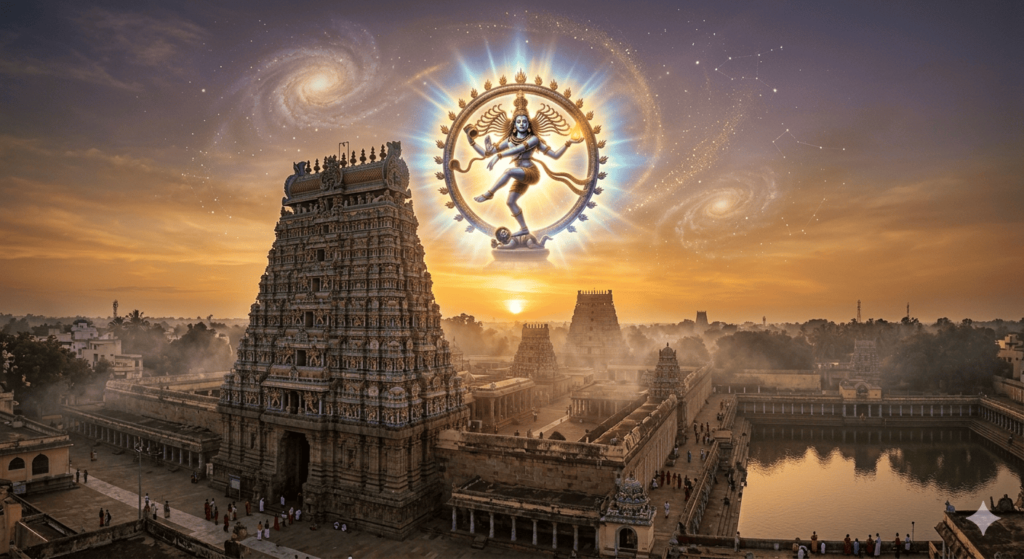
What Is Chidambaram Nataraja Temple (Tamil Nadu) – Cosmic Dance Of Shiva ?
The CHIDAMBARAM NATARAJA TEMPLE (TAMIL NADU) – COSMIC DANCE OF SHIVA is a Hindu temple dedicated to Lord Shiva in his Nataraja form, symbolizing the cosmic dance that governs the universe. It is one of the oldest and most important Shiva temples in South India and holds immense religious and philosophical significance.
This temple represents Shiva as the cosmic dancer performing the Ananda Tandava, which symbolizes the five essential activities of the universe: creation, preservation, destruction, illusion, and liberation. Each element of his dance posture carries deep symbolic meaning, reflecting the balance of cosmic forces.
The temple is also unique because it represents the concept of Akasha (space) among the Pancha Bhoota Sthalams, the five elemental temples of Shiva. Here, Shiva is worshipped in his formless aspect, emphasizing that divinity exists beyond physical representation.
Architecturally, the temple showcases classic Dravidian style with towering gopurams, intricate carvings, and sacred halls. The inner sanctum holds the idol of Nataraja, which is one of the most iconic representations of Indian art and spirituality.
The CHIDAMBARAM NATARAJA TEMPLE (TAMIL NADU) – COSMIC DANCE OF SHIVA is also known for its connection to ancient Tamil traditions, Saiva Siddhanta philosophy, and Vedic rituals. It is considered a place where spirituality and science meet, as the cosmic dance symbolizes the continuous vibration of the universe.
Devotees believe that visiting this temple brings spiritual awakening and liberation from the cycle of birth and rebirth. It is not only a religious center but also a symbol of universal harmony and cosmic rhythm.
Who Is Required Chidambaram Nataraja Temple (Tamil Nadu) – Cosmic Dance Of Shiva ?
The CHIDAMBARAM NATARAJA TEMPLE (TAMIL NADU) – COSMIC DANCE OF SHIVA is required for devotees, seekers, scholars, artists, and anyone who wishes to understand the deeper meaning of life, spirituality, and the universe.
Primarily, devotees of Lord Shiva visit this temple to offer prayers and seek blessings for peace, prosperity, and liberation. It is especially significant for followers of Shaivism, who consider Shiva as the supreme cosmic power.
Philosophers and spiritual seekers are drawn to this temple because it represents the concept of non-duality and cosmic consciousness. The idea that Shiva’s dance represents universal energy helps seekers understand the connection between mind, body, and universe.
Artists, dancers, and musicians also consider this temple highly important. The Nataraja form is the inspiration behind classical Indian dance forms like Bharatanatyam. The temple symbolizes rhythm, movement, and expression of divine energy through art.
Historians and archaeologists study the CHIDAMBARAM NATARAJA TEMPLE (TAMIL NADU) – COSMIC DANCE OF SHIVA to understand ancient Tamil civilization, temple architecture, and cultural evolution.
Scientists and thinkers are also fascinated by the symbolic representation of cosmic vibration and energy cycles depicted through Shiva’s dance. It aligns metaphorically with modern concepts of physics, energy, and universal motion.
Thus, this temple is required for anyone seeking spiritual enlightenment, cultural understanding, artistic inspiration, or philosophical knowledge. It serves as a bridge between ancient wisdom and modern thought, making it universally significant.
When Chidambaram Nataraja Temple (Tamil Nadu) – Cosmic Dance Of Shiva Is Required ?
The CHIDAMBARAM NATARAJA TEMPLE (TAMIL NADU) – COSMIC DANCE OF SHIVA is required at various stages of life, especially when individuals seek spiritual clarity, emotional healing, or deeper understanding of existence.
It is particularly significant during important Hindu festivals such as Maha Shivaratri, when devotees worship Lord Shiva with great devotion. During this time, the temple becomes a powerful center of spiritual energy, and people visit to experience divine blessings and inner transformation.
The temple is also required during personal life transitions such as marriage, career changes, health recovery, or emotional distress. Many believe that praying at this sacred site helps remove obstacles and brings mental peace.
From a spiritual perspective, the temple is required when a person feels disconnected from life or seeks answers about the purpose of existence. The cosmic dance of Shiva symbolizes that life is constantly changing, and understanding this truth helps individuals accept transformation.
In the cultural sense, the temple is required during classical dance performances, religious rituals, and educational visits. Artists often visit to seek inspiration for expressing divine energy through dance and music.
Historically, the temple has been required by rulers, scholars, and saints who sought wisdom and guidance. It has served as a center for philosophical debates and spiritual teachings.
Even today, tourists and researchers visit the temple throughout the year to study its architecture, inscriptions, and cultural significance. It remains open as a timeless symbol of spirituality and knowledge.
Thus, the CHIDAMBARAM NATARAJA TEMPLE (TAMIL NADU) – COSMIC DANCE OF SHIVA is required whenever there is a need for spiritual awakening, cultural exploration, emotional healing, or intellectual understanding of cosmic existence.
Where Chidambaram Nataraja Temple (Tamil Nadu) – Cosmic Dance Of Shiva Is Required ?
The CHIDAMBARAM NATARAJA TEMPLE (TAMIL NADU) – COSMIC DANCE OF SHIVA is required in multiple contexts across spiritual, cultural, educational, and philosophical domains.
Geographically, it is located in Chidambaram town in Tamil Nadu, India, and serves as a major pilgrimage center for devotees of Lord Shiva. It is required in the religious landscape of South India as one of the most important Shaiva temples.
Spiritually, it is required in places of worship, meditation, and yoga practices. Many spiritual seekers consider it a powerful energy center where cosmic vibrations can be felt.
Culturally, the temple is required in Indian classical dance traditions, especially Bharatanatyam performances, where artists draw inspiration from Shiva’s cosmic dance. It is often referenced in cultural festivals, art exhibitions, and spiritual discourses.
Academically, it is required in the study of history, architecture, anthropology, and religious studies. Universities and researchers include it in their curriculum to explain ancient Indian temple architecture and spiritual philosophy.
Philosophically, it is required in discussions about cosmology, consciousness, and the nature of existence. The symbolism of Shiva’s dance is used to explain the cyclical nature of the universe.
Tourism-wise, it is required as a major destination for heritage tourism in India. It attracts international visitors interested in spirituality, culture, and ancient traditions.
Thus, the CHIDAMBARAM NATARAJA TEMPLE (TAMIL NADU) – COSMIC DANCE OF SHIVA is required wherever there is a pursuit of spiritual knowledge, cultural heritage, artistic expression, or academic research.
How Chidambaram Nataraja Temple (Tamil Nadu) – Cosmic Dance Of Shiva Is Required ?
The CHIDAMBARAM NATARAJA TEMPLE (TAMIL NADU) – COSMIC DANCE OF SHIVA is required through rituals, practices, teachings, and experiences that connect devotees and seekers with divine consciousness.
It is required through daily worship rituals performed by priests, including abhishekam, chanting of Vedic hymns, and offering of sacred items to Lord Nataraja. These rituals maintain the spiritual energy of the temple.
It is also required through meditation practices, where devotees focus on the concept of cosmic dance and inner stillness. This helps in achieving mental clarity and spiritual awakening.
In cultural terms, it is required through classical dance performances that depict Shiva’s Ananda Tandava. Dancers express the cosmic rhythm through movement symbolizing universal energy.
Educationally, it is required through teaching programs, heritage tours, and philosophical discussions conducted within and around the temple. Students learn about ancient Indian science, architecture, and spirituality.
Architecturally, it is required through preservation and restoration efforts that maintain the temple’s structure, carvings, and inscriptions for future generations.
Spiritually, it is required through devotion, prayer, and surrender to divine consciousness. The temple acts as a medium for connecting human consciousness with universal energy.
Thus, the CHIDAMBARAM NATARAJA TEMPLE (TAMIL NADU) – COSMIC DANCE OF SHIVA is required through a combination of rituals, cultural expressions, educational study, and spiritual practices.
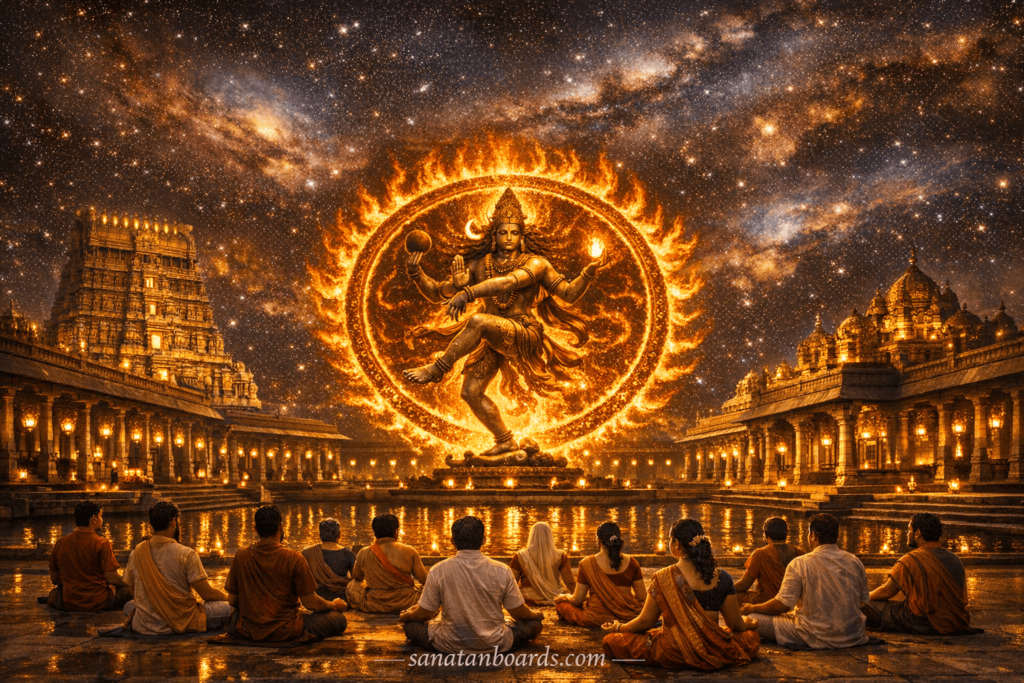
Case Study On Chidambaram Nataraja Temple (Tamil Nadu) – Cosmic Dance Of Shiva
The CHIDAMBARAM NATARAJA TEMPLE (TAMIL NADU) – COSMIC DANCE OF SHIVA serves as a powerful case study in the integration of spirituality, architecture, culture, and science. It represents how ancient civilizations encoded deep philosophical truths into physical structures.
Historically, the temple has been a center of Shaivism for centuries. It evolved under various dynasties such as the Cholas, who contributed significantly to its expansion and artistic detailing. The temple became a hub for religious teachings, cultural development, and philosophical discourse.
From an architectural perspective, the temple showcases advanced Dravidian design principles. The gopurams, mandapas, and sanctum are aligned with precise symbolic geometry. The structure reflects not just artistic excellence but also astronomical and cosmological understanding.
Spiritually, the temple’s central theme—the cosmic dance of Shiva—represents the eternal cycle of creation and destruction. This philosophy is comparable to modern scientific theories of energy conservation and universal expansion. The Nataraja form has even been used in scientific discussions as a metaphor for subatomic particle motion.
Culturally, the temple has influenced Indian classical dance, especially Bharatanatyam. The movements of Shiva’s dance are mirrored in dance postures, rhythm, and expressions. Artists consider the temple a source of divine inspiration.
Philosophically, the temple embodies the concept of non-duality. Shiva’s presence as both form and formlessness reflects the idea that the universe is both material and spiritual. This duality is central to Indian metaphysical thought.
Economically, the temple contributes to tourism and local livelihood. Pilgrims and tourists from around the world visit Chidambaram, supporting hospitality, transport, and cultural industries.
Educationally, the temple serves as a live classroom for students of history, architecture, and religion. Researchers study inscriptions, sculptures, and rituals to understand ancient knowledge systems.
In modern times, the temple has become a symbol of unity between science and spirituality. Many scholars interpret Shiva’s cosmic dance as a representation of energy flow in the universe.
This case study shows that the CHIDAMBARAM NATARAJA TEMPLE (TAMIL NADU) – COSMIC DANCE OF SHIVA is not only a religious monument #Sanatanboardsintamilnadu but also a multidisciplinary knowledge center that connects ancient wisdom with modern understanding.
White Paper On Chidambaram Nataraja Temple (Tamil Nadu) – Cosmic Dance Of Shiva
The CHIDAMBARAM NATARAJA TEMPLE (TAMIL NADU) – COSMIC DANCE OF SHIVA stands as a unique convergence point of spirituality, culture, architecture, and philosophy. A white paper on this temple highlights its multidimensional importance in historical, religious, scientific, and cultural contexts.
The temple represents Lord Shiva in his Nataraja form, symbolizing cosmic energy and universal rhythm. The Ananda Tandava is not just a mythological concept but a philosophical framework describing the continuous cycle of creation, preservation, and dissolution.
From a historical perspective, the temple has been a center of Shaiva worship for over a thousand years. It reflects the contributions of South Indian dynasties, particularly the Cholas, who enhanced its architecture and cultural prominence.
Architecturally, the temple is a masterpiece of Dravidian design. Its spatial layout, sculptural detailing, and symbolic representation of cosmic elements demonstrate advanced knowledge of geometry, aesthetics, and sacred science.
Religiously, the temple serves as a major pilgrimage site for Shaivites. It reinforces the belief in Shiva as the supreme consciousness. Rituals performed here emphasize the importance of devotion, discipline, and spiritual realization.
From a scientific perspective, the Nataraja symbol has been interpreted as representing cosmic motion and energy transformation. The concept of rhythmic dance aligns metaphorically with modern physics, especially particle movement and universal vibration.
Culturally, the temple is a living institution of Indian heritage. It supports classical dance, music, and ritual traditions. Bharatanatyam performances often draw inspiration from the cosmic dance theme.
Economically, the temple plays a vital role in tourism and regional development. It attracts visitors globally, contributing to local businesses and cultural exchange.
Educationally, it serves as a case study for interdisciplinary research in history, architecture, anthropology, and religious studies.
The white paper concludes that the CHIDAMBARAM NATARAJA TEMPLE (TAMIL NADU) – COSMIC DANCE OF SHIVA is not only a sacred religious #Sanatanboardsinvasai structure but also a global cultural asset. It represents the unity of science, spirituality, and art, making it a timeless symbol of human understanding.
Industry Application On Chidambaram Nataraja Temple (Tamil Nadu) – Cosmic Dance Of Shiva
The CHIDAMBARAM NATARAJA TEMPLE (TAMIL NADU) – COSMIC DANCE OF SHIVA serves as a powerful source of inspiration and practical application across multiple modern industries due to its deep cultural, artistic, philosophical, and architectural significance.
1. Tourism and Hospitality Industry
The temple is a major heritage tourism destination in India. It attracts pilgrims, international travelers, cultural tourists, and researchers. Travel companies, hotels, guides, and local businesses benefit from the continuous inflow of visitors. Heritage tourism packages often include the temple as a key highlight of Tamil Nadu’s cultural circuit.
2. Education and Academic Research
In education, the temple is widely used as a case study in history, archaeology, architecture, religious studies, and cultural anthropology. Universities analyze its Dravidian structure, ritual systems, and symbolic philosophy. It helps students understand ancient Indian knowledge systems and temple-based learning traditions.
3. Arts, Dance, and Entertainment Industry
The temple is deeply connected with classical Indian dance, especially Bharatanatyam, which draws inspiration from the cosmic dance of Shiva. The iconic Nataraja form is often used in stage choreography, visual storytelling, and cultural performances. Nataraja (Shiva as Cosmic Dancer) continues to influence global art, sculpture, and theater.
4. Architecture and Design Industry
Architects and designers study the temple’s Dravidian style, spatial geometry, and symbolic construction. The temple provides insights into ancient engineering, sustainable design, and sacred geometry. It influences modern temple architecture and cultural monument restoration projects.
5. Wellness, Yoga, and Spiritual Industry
The temple’s philosophy of cosmic rhythm and inner balance is used in meditation, yoga practices, and mindfulness programs. Wellness centers often draw inspiration from its symbolic representation of universal energy and consciousness.
6. Film, Media, and Creative Industry
The temple and its symbolism are frequently featured in documentaries, films, digital art, and cultural storytelling. It provides strong visual and philosophical themes for creative content development.
7. Research and Science Interpretation Fields
The concept of Shiva’s cosmic dance is sometimes used as a metaphor in discussions of physics, energy cycles, and universal motion. Researchers explore the symbolic link between ancient philosophy and modern cosmology.
8. Heritage Conservation Industry
Conservation experts use the temple as a model for preserving ancient monuments, restoring sculptures, and maintaining cultural heritage sites using traditional and modern techniques.
The CHIDAMBARAM NATARAJA TEMPLE (TAMIL NADU) – COSMIC DANCE OF SHIVA continues to be a multidisciplinary influence, bridging ancient wisdom with #Sanatanboardsinmumbai modern industrial, cultural, and academic development.
source : Temples India
ASK FAQ
1. What is special about Chidambaram Nataraja Temple in Tamil Nadu?
The Chidambaram Nataraja Temple is special because it represents Lord Shiva as Nataraja, symbolizing the cosmic dance of creation, preservation, and destruction. It also represents the element of space (Akasha).
2. Why is Shiva called Nataraja in Chidambaram Temple?
Shiva is called Nataraja because he performs the cosmic dance (Ananda Tandava), which represents the universal cycle of energy, movement, and time within the Chidambaram Temple.
3. What does the Chidambaram Temple cosmic dance symbolize?
The cosmic dance symbolizes the continuous cycle of the universe—creation, protection, destruction, illusion, and liberation, showing that life is always in motion.
4. Where is the Chidambaram Nataraja Temple located?
The Chidambaram Nataraja Temple is located in Chidambaram town in the Cuddalore district of Tamil Nadu, India.
5. Why do people visit Chidambaram Nataraja Temple?
People visit the temple for spiritual blessings, cultural learning, classical dance inspiration, historical exploration, and to experience the divine symbolism of Shiva’s cosmic dance.
Table of Contents
DISCLAIMER
This content is created purely for educational and informational purposes only. It is intended to provide general knowledge about cultural, historical, and spiritual aspects of the subject. It should not be considered as religious advice, professional guidance, or absolute historical interpretation. Readers are encouraged to refer to authentic historical sources, scholarly research, and official references for deeper study.