HINDU TEMPLE (TRINIDAD & TOBAGO)
Hindu temples in Trinidad and Tobago represent one of the most significant cultural and spiritual pillars of the Indo-Trinidadian community. These temples are not only places of worship but also centers of cultural preservation, social bonding, and heritage continuity. The presence of Hinduism in Trinidad and Tobago dates back to the 19th century, when Indian indentured laborers were brought to the Caribbean by the British colonial system to work on sugar plantations. Along with their labor they carried their religious beliefs, rituals, traditions, and sacred practices.
Over time, despite facing social challenges and cultural suppression during the early colonial period, the Hindu community preserved its identity through prayer gatherings, home-based worship, and eventually the establishment of formal temples. Today, Hindu temples are spread across Trinidad and Tobago, serving as vibrant centers for festivals such as Divali, Phagwa (Holi), and Shivratri.
These temples are architecturally unique as well, often blending traditional Indian temple designs with Caribbean influences. They symbolize resilience, cultural pride, and spiritual devotion. Beyond religious services, they host educational programs, language classes (such as Hindi), music training, and community welfare initiatives.
Hindu temples in Trinidad and Tobago are not limited to religious identity alone—they represent a living heritage of migration, adaptation, and cultural survival. They continue to play a crucial role in strengthening community ties and maintaining intergenerational cultural transmission. In modern society, they also act as bridges of multicultural harmony, contributing to the diverse religious landscape of the nation.
What Is Hindu Temple (Trinidad & Tobago) ?
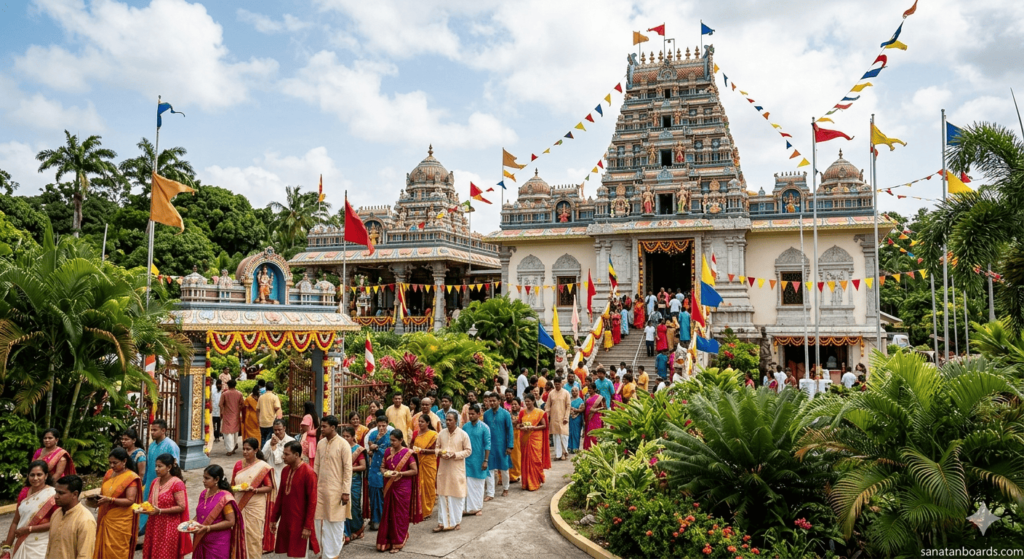
A Hindu temple in Trinidad and Tobago is a structured sacred space dedicated to Hindu deities and spiritual practices, established by the Indo-Trinidadian Hindu community. It serves as a religious, cultural, and educational institution where devotees gather to perform rituals, offer prayers, and celebrate festivals according to Hindu traditions.
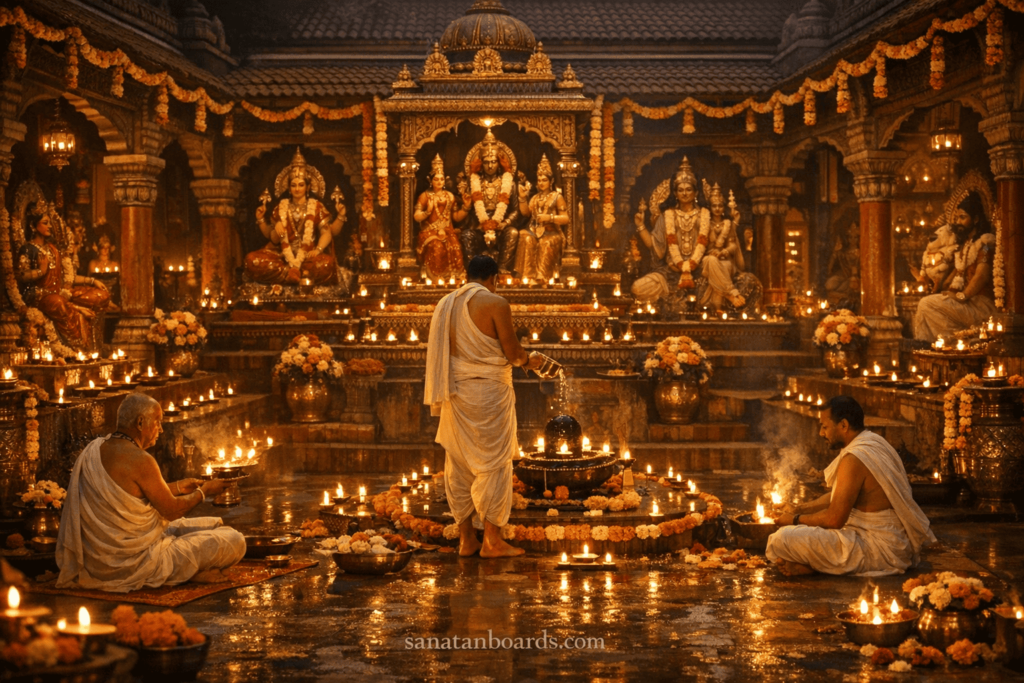
These temples typically house deities such as Lord Shiva, Vishnu, Hanuman, Lakshmi, Saraswati, and Durga. Rituals include puja (worship ceremonies), aarti (light offerings), bhajans (devotional singing), and yajnas (sacred fire rituals). The temple environment is designed to promote spiritual connection, discipline, and moral values.
In Trinidad and Tobago, Hindu temples are not only places of worship but also community hubs. They often include multipurpose halls for cultural events, wedding ceremonies, language classes, and youth programs. This dual role makes them essential to preserving Hindu identity in a multicultural Caribbean society.
The architecture of these temples varies widely. Some follow traditional North or South Indian designs, while others are adapted to local construction styles due to historical resource limitations. Notable temples, such as those built during the 20th century, reflect the gradual acceptance and recognition of Hinduism in the region.
Furthermore, these temples are governed by committees made up of community members who manage religious activities, maintenance, and social outreach programs. They function democratically, ensuring community participation in decision-making.
Overall, Hindu temples in Trinidad and Tobago are dynamic institutions that blend spirituality, education, and cultural identity, ensuring that Hindu traditions continue to thrive far from their place of origin.
Who Is Required Hindu Temple (Trinidad & Tobago) ?
Hindu temples in Trinidad and Tobago are primarily required by the Indo-Trinidadian Hindu population, which forms the core practicing community of Hinduism in the country. These individuals seek temples as spaces for worship, religious ceremonies, and cultural connection to their ancestral roots.
Devotees require temples to perform daily and occasional rituals such as prayers for health, prosperity, marriage blessings, naming ceremonies, and funeral rites. Priests (pundits) are also essential stakeholders, as they depend on temples to conduct religious services and guide the community in spiritual matters.
Beyond individual worshippers, families require Hindu temples as spaces to pass down traditions to younger generations. In a multicultural society, temples help children and youth understand Hindu values, mythology, language, and customs.
Cultural organizations and educational groups also require temples because they often function as centers for teaching Hindi language, classical music, dance forms like Bharatanatyam, and religious philosophy.
Additionally, the wider Trinidad and Tobago society indirectly benefits from Hindu temples. They promote multicultural understanding, interfaith dialogue, and national unity through public festivals such as Divali, which is celebrated as a national holiday.
Government and heritage organizations also recognize temples as important cultural landmarks. They require these institutions for preserving historical identity and supporting cultural tourism.
Thus, Hindu temples are required not only by religious followers but also by educators, cultural leaders, policymakers, and society at large. They serve as multi-functional institutions that support spiritual life, cultural preservation, and community development.
When Hindu Temple (Trinidad & Tobago) Is Required ?
A Hindu temple in Trinidad and Tobago is required at multiple times and occasions, both in daily life and during special religious and cultural events. The need for temples is continuous, as they serve as centers for regular worship and periodic ceremonies.
On a daily basis, devotees require temples for morning and evening prayers. These rituals help individuals maintain spiritual discipline and connect with divine energies. Many people visit temples before starting important work, examinations, or business activities, seeking blessings for success and protection.
Temples are especially required during major Hindu festivals. For example, during Divali, temples become central locations for lighting diyas, performing Lakshmi Puja, and organizing community celebrations. Similarly, during Phagwa (Holi), temples host prayers and cultural gatherings that strengthen social unity. Shivratri involves night-long worship and fasting ceremonies conducted in temples.
Life-cycle events also create essential demand for temples. These include birth ceremonies (naming rituals), weddings, sacred thread ceremonies (upanayana), and funeral rites. Each of these events requires priestly guidance and a sacred space to perform rituals correctly according to Hindu scriptures.
Temples are also required during times of personal difficulty or crisis. Devotees visit temples seeking emotional relief, spiritual strength, or healing prayers during illness, financial hardship, or family problems.
In addition, temples are required during educational and cultural programs. Weekly classes, religious storytelling sessions, and youth development programs are often conducted on weekends or evenings, making temples essential community centers outside of formal worship hours.
Temples also become highly active during national cultural events and interfaith celebrations. In Trinidad and Tobago, where multiple religions coexist, Hindu temples play a role in promoting harmony and cultural exchange during public holidays and national festivals.
Therefore, Hindu temples are required throughout the year, across daily routines, life milestones, seasonal festivals, emergencies, and educational activities. Their role is continuous and deeply integrated into both spiritual and community life.
Where Hindu Temple (Trinidad & Tobago) Is Required ?
Hindu temples are required in various geographical and social locations across Trinidad and Tobago, particularly in regions with significant Indo-Trinidadian populations. Historically, these communities settled in agricultural areas, and temples were established close to villages, plantations, and residential settlements.
In Trinidad, temples are commonly found in central and southern regions such as Couva, Penal, Chaguanas, San Fernando, and Princes Town. These areas have high concentrations of Hindu families, making temples essential for accessible worship and community activities. In Tobago, although the Hindu population is smaller, temples still exist to serve local devotees and visiting practitioners.
Temples are required in both rural and urban environments. In rural areas, they serve as central gathering points for dispersed populations, often becoming the only formal religious infrastructure available. In urban areas, temples function as cultural anchors amidst fast-paced city life, offering spiritual balance and community connection.
They are also required within educational and cultural zones. Many temples are located near schools or community centers to facilitate youth participation in religious and cultural education programs. This helps maintain cultural continuity among younger generations.
Additionally, temples are required in diaspora communities wherever Indo-Trinidadians have settled. Even outside Trinidad and Tobago, such communities often establish temples to preserve cultural identity, though within the country itself, temples remain concentrated in traditional settlement zones.
Temples are also required in symbolic and historical locations. Some temples are built near sites of historical significance related to indentured laborers, serving as memorials and cultural heritage markers.
Overall, Hindu temples in Trinidad and Tobago are strategically required wherever Hindu communities reside, ensuring accessibility, cultural preservation, and spiritual continuity across both densely populated and remote areas.
How Hindu Temple (Trinidad & Tobago) Is Required ?
Hindu temples in Trinidad and Tobago are required through a combination of community organization, cultural preservation efforts, and religious necessity. Their establishment typically begins with collective community initiative, where members come together to build or convert a structure into a sacred space.
The requirement process begins with identifying a need for a communal worship space. Once a sufficient number of Hindu families reside in an area, they organize committees to raise funds, acquire land, and construct a temple. Donations from devotees, fundraising events, and community contributions are key mechanisms in this process.
Once established, temples require trained priests (pundits) to conduct rituals according to Hindu scriptures. These rituals include daily puja, special ceremonies, and festival observances. Without proper priestly guidance, the religious function of the temple cannot be maintained.
Temples are also required through administrative systems. Committees manage operations, including scheduling events, maintaining the building, organizing festivals, and coordinating educational programs. This structured management ensures sustainability.
Cultural transmission is another key mechanism through which temples are required. They function as centers where traditions are taught, including language, music, dance, and religious philosophy. This ensures that younger generations remain connected to their heritage.
Temples are also required through social support systems. They provide assistance during crises, host community gatherings, and promote charitable activities such as food distribution and disaster relief support.
In addition, government recognition and multicultural policies in Trinidad and Tobago support the requirement of temples as legitimate cultural institutions. This ensures their protection and integration into national heritage frameworks.
Thus, Hindu temples are required through a structured combination of community effort, religious necessity, administrative management, and cultural preservation mechanisms that ensure their continued existence and relevance.
Case Study On Hindu Temple (Trinidad & Tobago)
Hindu temples in Trinidad and Tobago provide a strong case study of cultural preservation through migration, adaptation, and community resilience. One of the most illustrative examples is the development of Hindu temples following the arrival of Indian indentured laborers in the 19th century.
Initially, these laborers faced harsh working conditions on sugar plantations and limited freedom to practice their religion openly. Despite this, they preserved their traditions through small prayer gatherings in homes and open fields. Over time, as communities stabilized, they began constructing small mandirs (shrines), which eventually evolved into formal temples.
A key case study example is the development of rural temple communities in central Trinidad. In these regions, Hindu families collectively built temples using local materials and volunteer labor. These temples became not only religious centers but also social hubs where people gathered to discuss community issues, celebrate festivals, and support one another.
One significant transformation occurred in the late 20th century when Hindu temples gained greater national recognition. Public celebrations of Divali became widely accepted, eventually being declared a national holiday. Temples played a central role in organizing these celebrations, showcasing Hindu culture to the broader society.
Another aspect of the case study is educational development. Many temples introduced structured programs for children and youth, including Hindi language classes, music training, and storytelling sessions based on Hindu epics such as the Ramayana and Mahabharata. This helped prevent cultural erosion among younger generations.
Temples also contributed to interfaith harmony in Trinidad and Tobago. In a multicultural society with Christian, Muslim, and Hindu populations, temples became spaces for cultural exchange and mutual respect. Open festivals and public events encouraged participation from people of different backgrounds.
However, challenges were also part of the case study. Early temples faced issues such as limited funding, social discrimination, and lack of formal recognition. Over time, these challenges were addressed through community mobilization, government support, and increasing cultural acceptance.
Modern Hindu temples now serve multifunctional roles, combining spirituality, education, and social welfare. They have become symbols of identity and resilience for Indo-Trinidadians, demonstrating how migrant communities can preserve their heritage while integrating into a new society.
This case study highlights that Hindu temples in Trinidad and Tobago are not static institutions but evolving cultural systems that adapt to social, political, and economic changes while maintaining their core spiritual purpose.
White Paper On Hindu Temple (Trinidad & Tobago)
Hindu temples in Trinidad and Tobago represent a critical component of cultural infrastructure within a multicultural society. This white paper examines their role in religious continuity, social cohesion, and cultural sustainability.
From a historical perspective, temples emerged as adaptive institutions formed by Indo-Trinidadian communities during colonial migration. Their primary purpose was to preserve religious identity under conditions of displacement and cultural restriction. Over time, they evolved into formal institutions with structured governance and recognized social functions.
From a socio-cultural standpoint, temples function as centers of identity formation. They support intergenerational knowledge transfer, ensuring that religious practices, language, and cultural traditions are preserved. This is particularly important in diaspora communities where cultural dilution is a risk.
Economically, temples also contribute indirectly to local economies. Festivals attract visitors, increase local commerce, and support small businesses involved in food, decoration, and cultural goods. Large-scale celebrations such as Divali have measurable economic impact in retail and tourism sectors.
From an educational perspective, temples act as informal learning institutions. They provide instruction in religious philosophy, moral values, arts, and language. This supplements formal education systems and contributes to holistic development.
From a governance perspective, temples operate through community-led committees, demonstrating a model of participatory management. This structure ensures accountability and community ownership, reducing dependency on external institutions.
From a multicultural policy perspective, Hindu temples contribute to national harmony. Trinidad and Tobago’s diverse society benefits from religious pluralism, and temples play a key role in fostering respect and understanding among different communities.
However, challenges include modernization pressures, youth disengagement, and resource limitations. Some temples struggle to maintain attendance among younger generations due to globalization and changing cultural priorities. Addressing this requires digital engagement, modernization of outreach, and youth-centered programming.
The sustainability of Hindu temples depends on strategic planning, including infrastructure development, leadership training, and cultural innovation. Integration of technology, such as online streaming of rituals and virtual learning programs, is increasingly important.
In conclusion, Hindu temples in Trinidad and #sanatanboardsinvasai Tobago are not only religious institutions but also cultural, educational, and socio-economic systems. Their continued relevance depends on adaptive strategies that balance tradition with modernization while maintaining spiritual authenticity.
Industry Application On Hindu Temple (Trinidad & Tobago)
Although Hindu temples are primarily religious institutions, they have several indirect applications across various societal “industries,” including cultural tourism, education, community development, event management, and media.
In cultural tourism, Hindu temples serve as important heritage sites. Visitors interested in architecture, religion, and Caribbean-Indian history often explore temples as part of cultural tours. This contributes to tourism revenue and promotes international awareness of Trinidad and Tobago’s multicultural identity.
In the education sector, temples function as supplementary learning centers. They provide instruction in language (Hindi and Sanskrit basics), religious studies, music, and dance. These activities support formal education systems by enhancing cultural literacy and artistic skills.
In community development, temples act as welfare hubs. They organize charity events, food distribution programs, and disaster relief efforts. This positions them as grassroots institutions that support social stability and resilience.
In event management, temples are central to organizing large-scale festivals such as Divali and Phagwa. These events require coordination of logistics, lighting, decoration, security, and cultural programming. As such, temples indirectly support a network of event-related industries.
In media and digital communication, temples are increasingly adopting online platforms to broadcast religious ceremonies, share educational content, and engage younger audiences. This creates opportunities in digital content creation, livestreaming, and cultural documentation.
In the arts and performance sector, temples preserve and promote traditional Indian art forms such as devotional music, drumming, and classical dance. This sustains artistic heritage and provides performance opportunities for local artists.
In social integration, temples play a role in promoting multicultural dialogue. They collaborate with schools, government institutions, and other religious organizations to foster unity and understanding.
From an economic perspective, temples generate indirect employment for priests, artisans, decorators, caterers, and cultural instructors. Festivals also stimulate demand for goods such as flowers, clothing, religious items, and food.
Thus, Hindu temples in Trinidad and Tobago function as multi-sector contributors, influencing tourism, education, economy, arts, and social development. #sanatanboardsinmumbai Their impact extends far beyond religious practice, making them integral to the broader socio-economic ecosystem.
source: WION
ASK FAQ
1. What is the importance of Hindu temples in Trinidad and Tobago?
Hindu temples are important as they preserve religious practices, cultural traditions, and community unity among Indo-Trinidadians while also promoting festivals and spiritual learning.
2. When did Hindu temples start in Trinidad and Tobago?
Hindu temples began forming in the 19th century when Indian indentured laborers brought Hinduism to the Caribbean and gradually built places of worship.
3. Where are most Hindu temples located in Trinidad and Tobago?
Most Hindu temples are located in central and southern Trinidad, such as Chaguanas, Couva, Penal, and San Fernando.
4. Why are Hindu temples important for the community?
They are important for religious worship, cultural education, festivals, social support, and maintaining Hindu identity across generations.
5. How do Hindu temples help preserve culture in Trinidad and Tobago?
They preserve culture by organizing festivals, teaching languages like Hindi, conducting rituals, and passing traditions to younger generations.
Table of Contents
Disclaimer
This content is provided for educational and informational purposes only and is intended to give a general understanding of Hindu temples in Trinidad and Tobago, their cultural, historical, and social significance. It does not represent any official religious authority, organization, or governing body. The information is based on widely available historical and cultural knowledge and should not be considered definitive or exhaustive. Readers are advised to verify details from authentic academic or religious sources if required. The content is not intended to offend, misrepresent, or favor any religion, belief system, or community in any form.