
Ranakpur Jain Temple (Rajasthan)
Ranakpur Jain Temple stands as one of the most magnificent and spiritually significant Jain temples in India. Nestled in the serene Aravalli hills of Rajasthan, this architectural marvel is renowned for its intricate carvings, symmetrical design, and tranquil atmosphere. Dedicated to Lord Adinatha, the first Tirthankara of Jainism, the temple reflects the profound religious devotion and artistic excellence of medieval India.
Constructed in the 15th century, the temple is widely admired for its elaborate marble work and the astonishing detail found in its 1,444 uniquely carved pillars. Each pillar is distinct, showcasing the exceptional craftsmanship of the artisans of that era. The temple’s layout follows a Chaumukha (four-faced) design, symbolizing the Tirthankara’s omnipresence and universal vision.
Beyond its architectural beauty, the temple serves as a significant pilgrimage site for followers of Jainism. It embodies key Jain principles such as non-violence, simplicity, and spiritual purity. The peaceful environment surrounding the temple enhances its role as a place for meditation and introspection.
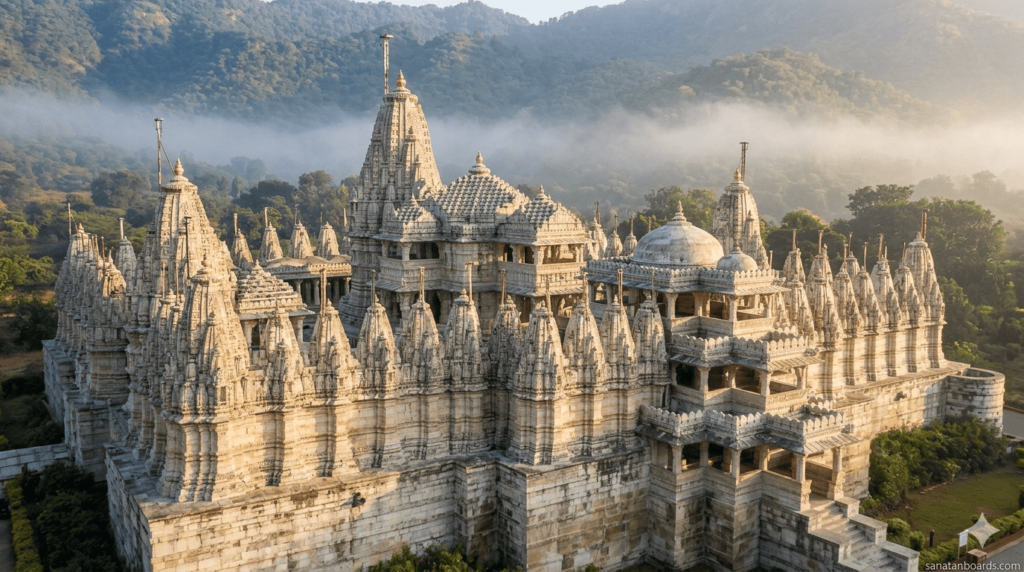
Tourists and historians alike are drawn to Ranakpur Jain Temple not only for its religious importance but also for its cultural and historical value. The temple complex includes several smaller shrines, adding to its grandeur and spiritual depth. Surrounded by lush greenery and hills it offers a unique blend of natural beauty and sacred ambiance.
Overall, Ranakpur Jain Temple represents a perfect harmony of devotion, art, and architecture. It continues to inspire awe among visitors and stands as a timeless testament to India’s rich heritage and spiritual traditions.
What Is Ranakpur Jain Temple (Rajasthan) ?
Ranakpur Jain Temple is a prominent religious and architectural landmark located in the Pali district of Rajasthan, India. It is primarily dedicated to Lord Adinatha, the first Tirthankara in Jainism, and serves as an important center for spiritual practice and pilgrimage. The temple is widely recognized for its stunning marble construction and detailed craftsmanship, making it one of the finest examples of Jain temple architecture.
The temple complex is built entirely of light-colored marble, which enhances its visual appeal and creates a serene environment. Its most distinctive feature is the presence of 1,444 intricately carved pillars, each designed differently, symbolizing the uniqueness of life and artistic creativity. The temple follows a Chaumukha architectural plan, meaning it has four entrances, allowing devotees to approach the deity from all directions.
Inside the temple, the central shrine houses an idol of Lord Adinatha, surrounded by numerous smaller domes, halls, and shrines. The ceilings are adorned with elaborate carvings depicting mythological scenes, celestial beings, and geometric patterns. These artistic elements not only enhance the beauty of the temple but also convey spiritual teachings and cultural narratives.
Ranakpur Jain Temple is not just a place of worship but also a symbol of India’s rich artistic and cultural heritage. It attracts tourists, historians, architects, and spiritual seekers from around the world. The temple’s peaceful surroundings and intricate design create an atmosphere conducive to meditation and reflection.
Who Is Required Ranakpur Jain Temple (Rajasthan) ?
Ranakpur Jain Temple is significant for a wide range of individuals and groups, each deriving unique value from its existence. Primarily, it is essential for followers of Jainism, who regard it as a sacred pilgrimage site. Devotees visit the temple to offer prayers, seek spiritual guidance, and practice meditation in a serene environment. For them, the temple represents faith, devotion, and adherence to the principles of non-violence and truth.
Historians and researchers also find Ranakpur Jain Temple highly valuable. It provides insights into the socio-cultural and religious dynamics of 15th-century India. The temple’s inscriptions, architectural style, and historical background offer important information about the period in which it was built. Scholars studying Indian history, religion, and art consider it an essential subject of study.
Architects and artists are another group for whom the temple holds great importance. The intricate carvings, symmetrical layout, and innovative design techniques used in its construction serve as inspiration and learning material. The temple is often studied as a masterpiece of structural engineering and artistic excellence.
Tourists and travelers are also among those who benefit from the temple. It serves as a major attraction, drawing visitors who wish to experience its beauty, history, and spiritual ambiance. The temple contributes significantly to cultural tourism in Rajasthan.
Additionally, educators and students use Ranakpur Jain Temple as a resource for learning about Indian culture, religion, and architecture. It provides a practical example of how art and spirituality can be integrated.
When Ranakpur Jain Temple (Rajasthan) Is Required ?
The relevance and requirement of Ranakpur Jain Temple can be understood across different time periods and contexts. Historically, the temple was required during the 15th century when it was constructed under the patronage of a Jain businessman named Dharna Shah, with the support of the ruler Rana Kumbha. During this period, there was a need to establish significant religious centers that could serve as places of worship and spiritual learning for the Jain community. The temple fulfilled this requirement by becoming a major religious hub.
In ancient and medieval times, such temples were essential not only for religious purposes but also for community gatherings and cultural development. Ranakpur Jain Temple provided a space where people could come together, engage in spiritual discussions, and strengthen their faith. It also played a role in preserving religious teachings and traditions.
In the present day, the temple continues to be required for spiritual and cultural reasons. For devotees, it remains a place to practice religion, seek peace, and connect with their beliefs. In an increasingly fast-paced world, such places offer a sense of calm and introspection, which is highly valued.
The temple is also required in the context of education and research. Students, historians, and architects study it to understand historical construction techniques, artistic expression, and religious symbolism. Its continued existence allows future generations to learn from and appreciate the past.
Furthermore, Ranakpur Jain Temple is important for tourism and economic development. It attracts visitors from across the globe, contributing to local businesses and promoting Rajasthan as a cultural destination. This makes it relevant in the modern economic context as well.
In times of cultural preservation, the temple becomes even more important. It stands as a symbol of India’s heritage and needs to be maintained to ensure that its historical and artistic value is not lost.
Thus, Ranakpur Jain Temple has been required throughout history and continues to be relevant in modern times for religious, educational, cultural, and economic purposes.
Where Ranakpur Jain Temple (Rajasthan) Is Required ?
Ranakpur Jain Temple is required and significant in multiple geographical and conceptual contexts. Physically, it is located in the Pali district of Rajasthan, nestled within the Aravalli mountain range. This specific location enhances its importance, as it provides a शांत and प्राकृतिक वातावरण suitable for spiritual practices. The remote and peaceful setting makes it an ideal place for meditation and religious activities.
Regionally, the temple is important within Rajasthan, a state known for its rich cultural heritage and architectural landmarks. Ranakpur Jain Temple contributes to the state’s identity as a center of historical and religious tourism. It complements other famous sites in Rajasthan, forming part of a broader cultural landscape that attracts visitors from across India and the world.
Nationally, the temple is required as a representation of India’s diverse religious traditions and architectural achievements. It showcases the depth of Jain philosophy and the excellence of Indian craftsmanship. As part of the country’s heritage, it plays a role in promoting cultural awareness and national pride.
Globally, Ranakpur Jain Temple holds significance as a heritage site that reflects universal values such as peace, harmony, and non-violence. It attracts international tourists and scholars who are interested in exploring India’s spiritual and artistic traditions. The temple serves as a cultural bridge, helping people from different backgrounds understand and appreciate Jainism and Indian heritage.
Conceptually, the temple is required wherever there is a need for spiritual growth, cultural preservation, and artistic inspiration. It represents ideals that are relevant across all locations, including urban and rural areas. Its influence extends beyond its physical boundaries, inspiring people worldwide.
In educational institutions, museums, and cultural studies, Ranakpur Jain Temple is often referenced as a case example of excellence in architecture and religious expression. It is required as a subject of study and admiration in these contexts.
Thus, while its physical presence is in Rajasthan, its importance spans regional, national, and global levels, making it relevant in various places and contexts.
How Ranakpur Jain Temple (Rajasthan) Is Required ?
Ranakpur Jain Temple is required in various ways, depending on the perspective from which it is viewed. From a religious standpoint, it serves as a place where devotees can practice their faith through rituals, prayers, and meditation. The temple facilitates spiritual growth by providing a शांत वातावरण that encourages reflection and inner peace.
From an architectural perspective, the temple is required as a model of design excellence. Its construction demonstrates advanced engineering techniques and artistic precision. The use of marble, the symmetrical layout, and the detailed carvings make it an important reference for architects and designers. It shows how functionality and beauty can be combined effectively.
In the context of education, the temple is required as a learning resource. Students and researchers study its history, design, and cultural significance to gain insights into India’s past. It serves as a practical example in subjects such as history, art, architecture, and religious studies.
Economically, Ranakpur Jain Temple is required as a driver of tourism. It attracts a large number of visitors, which supports local businesses such as hotels, restaurants, and transportation services. This contributes to the economic development of the region.
Culturally, the temple is required to preserve and promote traditional values and artistic heritage. It stands as a reminder of the skills and creativity of ancient artisans. By maintaining and showcasing the temple, society ensures that these traditions are not forgotten.
Environmentally, the temple’s location in a natural setting highlights the importance of harmony between human creations and nature. It demonstrates how structures can be built in a way that respects and enhances the surrounding environment.
Overall, Ranakpur Jain Temple is required in religious, educational, architectural, economic and cultural contexts. Its multifaceted importance makes it a valuable asset that continues to serve various purposes in society.
Case Study On Ranakpur Jain Temple (Rajasthan)
Ranakpur Jain Temple serves as an excellent case study for understanding the integration of religion, architecture, and cultural heritage. Built in the 15th century, the temple reflects the vision of Dharna Shah, a Jain devotee, who sought to create a grand temple dedicated to Lord Adinatha. With the support of Rana Kumbha, the project was successfully completed, resulting in one of the most remarkable architectural achievements in India.
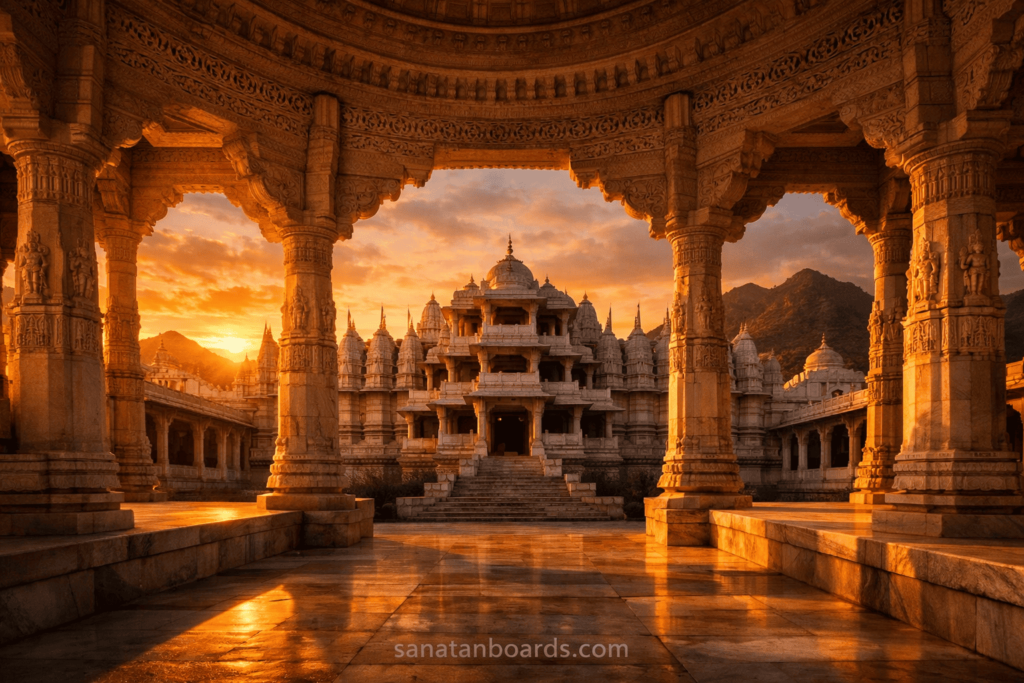
The temple’s design is based on the Chaumukha concept, featuring four entrances that symbolize openness and inclusivity. This design allows devotees to enter from any direction, emphasizing the universal nature of spiritual truth. The temple’s layout includes multiple halls, domes, and shrines, creating a complex yet harmonious structure.
One of the most striking features of the temple is its 1,444 marble pillars, each uniquely carved. This not only demonstrates the skill of the artisans but also reflects the philosophical idea that every individual is unique. The intricate carvings on the ceilings and walls depict various mythological and symbolic elements, adding to the temple’s aesthetic and spiritual value.
From a construction perspective, the temple showcases advanced engineering techniques. The use of marble provides durability and enhances the visual appeal. The structure is designed in a way that allows natural light to filter through, creating a serene and uplifting atmosphere inside the temple.
In terms of cultural impact, Ranakpur Jain Temple has become a major tourist attraction. It draws visitors from across the world, contributing to the local economy and promoting cultural exchange. The temple also plays a role in preserving traditional art forms and craftsmanship.
However, the temple faces challenges related to conservation and maintenance. Environmental factors, tourism pressure, and natural wear and tear can affect its structure and carvings. Efforts are being made to preserve the temple through restoration projects and sustainable tourism practices.
This case study highlights the importance of preserving cultural heritage while balancing modern needs. It demonstrates how historical structures can continue to be relevant and beneficial in contemporary society.
Overall, Ranakpur Jain Temple is not just a religious site but a comprehensive example of how art, architecture, and spirituality can come together to create a lasting legacy.
White Paper On Ranakpur Jain Temple (Rajasthan)
Ranakpur Jain Temple represents a significant intersection of religious devotion, architectural excellence, and cultural heritage. This white paper aims to analyze the temple’s importance, challenges, and potential for future sustainability.
The temple’s architectural design is one of its most notable features. Constructed entirely of marble, it demonstrates exceptional craftsmanship and attention to detail. The Chaumukha layout and the presence of 1,444 uniquely carved pillars highlight the innovative approach taken by its builders. These features make the temple a valuable subject for architectural studies and heritage conservation.
From a religious perspective, the temple serves as a major pilgrimage site for the Jain community. It plays a crucial role in preserving and promoting Jain teachings and practices. The temple’s serene environment supports meditation and spiritual growth, making it an important center for religious activities.
Economically, Ranakpur Jain Temple contributes significantly to tourism in Rajasthan. It attracts both domestic and international visitors, generating revenue and supporting local businesses. This economic impact underscores the importance of maintaining and promoting the temple as a tourist destination.
However, the temple faces several challenges. Environmental factors such as weathering and pollution can damage the marble structure. Additionally, the increasing number of visitors can lead to wear and tear. Effective conservation strategies are required to address these issues.
Sustainable tourism practices can play a key role in preserving the temple. This includes regulating visitor numbers, promoting awareness about heritage conservation, and implementing maintenance programs. Collaboration between government bodies, local communities, and conservation experts is essential for ensuring the temple’s longevity.
Technological advancements can also aid in preservation efforts. Techniques such as digital documentation and 3D modeling can help in monitoring the condition of the temple and planning restoration activities.
In conclusion, Ranakpur Jain Temple is a valuable cultural and architectural asset that requires careful management and preservation. #Sanatanboardsinvasai By adopting sustainable practices and leveraging technology, it is possible to ensure that the temple continues to inspire future generations.
Industry Application On Ranakpur Jain Temple (Rajasthan)
Ranakpur Jain Temple is not only a religious monument but also a valuable reference across multiple industries due to its architectural brilliance, cultural importance, and historical relevance. Its influence extends into practical applications that benefit various sectors in modern society.
1. Architecture and Construction Industry
Ranakpur Jain Temple serves as a benchmark for excellence in architectural design and construction techniques. The temple’s intricate marble carvings, symmetrical structure, and complex pillar system are studied by architects and engineers worldwide. It demonstrates how traditional methods can achieve both durability and aesthetic perfection. Modern architects draw inspiration from its design principles to incorporate detailed craftsmanship and sustainable materials into contemporary structures.
2. Tourism and Hospitality Industry
The temple plays a significant role in promoting cultural tourism in Rajasthan. It attracts thousands of domestic and international visitors each year, contributing to the growth of the tourism sector. Travel agencies, tour operators, and hospitality businesses such as hotels and restaurants benefit from the steady influx of tourists. The temple is often included in heritage tourism circuits, boosting the regional economy and creating employment opportunities.
3. Education and Research Industry
Educational institutions use Ranakpur Jain Temple as a case study in subjects like history, architecture, archaeology, and religious studies. Researchers analyze its design, inscriptions, and historical background to understand ancient Indian civilization and craftsmanship. It provides practical insights that enhance academic learning and research development.
4. Heritage Conservation and Management Industry
The temple is an important example in the field of heritage conservation. Conservation experts study its structure to develop strategies for preserving ancient monuments. It highlights challenges such as environmental impact, material degradation, and tourist pressure. The temple helps professionals design sustainable preservation techniques and policies for maintaining historical sites.
5. Art and Design Industry
Artists and designers draw inspiration from the temple’s intricate carvings, patterns, and motifs. Its detailed artwork influences modern interior design, sculpture, and decorative arts. The temple serves as a rich source of creative ideas, blending traditional aesthetics with contemporary design practices.
6. Media and Entertainment Industry
Ranakpur Jain Temple is frequently featured in documentaries, travel shows, photography projects, and cultural films. Its visual grandeur makes it a popular subject for storytelling and visual content creation. It helps promote Indian heritage on global platforms and enhances cultural awareness.
7. Environmental and Sustainable Development Industry
The temple’s integration with its natural surroundings demonstrates sustainable construction practices. Built within the Aravalli hills, it reflects harmony between architecture and environment. This aspect is studied in sustainable development to promote eco-friendly building designs and preservation of natural landscapes.
Conclusion
Ranakpur Jain Temple has wide-ranging applications across industries, from architecture and tourism to education and conservation. Its timeless design and #Sanatanboardsinmumbai cultural value make it a versatile resource that continues to inspire innovation, learning, and sustainable practices in various professional fields.
source : City Express
ASK FAQ
1. What is Ranakpur Jain Temple famous for?
Ranakpur Jain Temple is famous for its stunning marble architecture, 1,444 uniquely carved pillars, and detailed Jain craftsmanship dedicated to Lord Adinatha.
2. Where is Ranakpur Jain Temple located?
It is located in the Pali district of Rajasthan, India, in the Aravalli hills, surrounded by a peaceful natural environment ideal for spiritual visits.
3. Who built Ranakpur Jain Temple?
The temple was built in the 15th century by Jain businessman Dharna Shah with support from the ruler Rana Kumbha.
4. Why is Ranakpur Jain Temple important?
It is important for religious worship, historical heritage, tourism, and architectural excellence, representing Jain values like peace and non-violence.
5. How many pillars are in Ranakpur Jain Temple?
The temple has 1,444 uniquely carved marble pillars, and no two pillars are alike, showcasing exceptional craftsmanship and design creativity.
Table of Contents
Disclaimer
This content is intended solely for informational and knowledge-sharing purposes. While efforts have been made to ensure accuracy and completeness, readers are encouraged to conduct further research and refer to official sources for detailed and updated information.