
PATAL BHUVANESHWAR (UTTARAKHAND) – UNDERGROUND SHIVA TEMPLE
Patal Bhuvaneshwar Underground Shiva Temple is one of the most mystical and spiritually significant underground cave temples located in the Pithoragarh district of Uttarakhand, India. Hidden deep inside the Kumaon Himalayas, this sacred site is believed to be a divine abode of Lord Shiva and many other deities from Hindu mythology. The temple is not just a place of worship but also a fascinating natural limestone cave system that stretches deep beneath the earth’s surface.
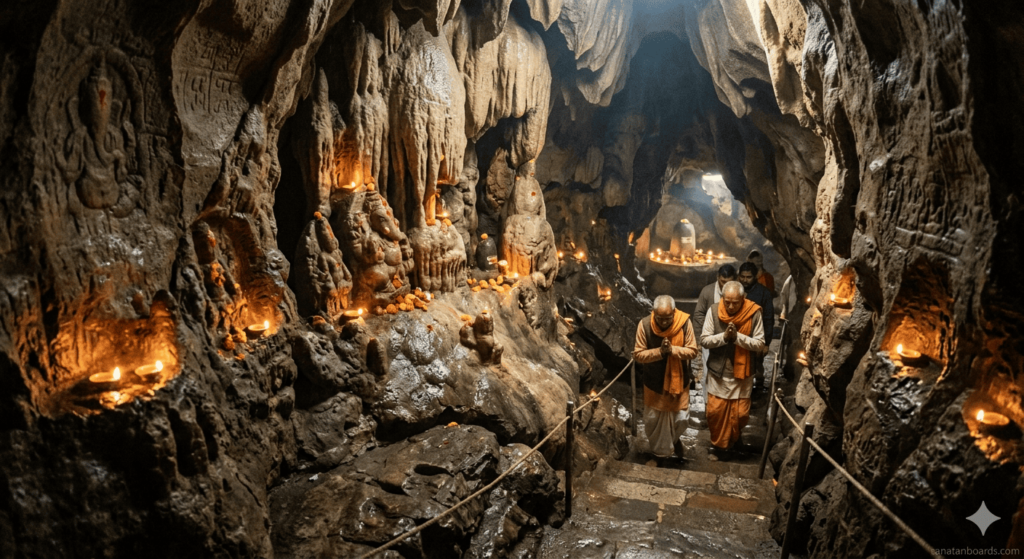
The entrance of the cave opens into a narrow tunnel that gradually leads visitors into a world filled with naturally formed rock structures that resemble various Hindu gods, goddesses, and mythological symbols. As devotees move deeper, they experience an atmosphere filled with mystery, devotion, and awe. According to belief, this cave represents the gateway to “Patal Lok” the underworld described in ancient Hindu scriptures.
The temple is mentioned in several ancient texts and is deeply associated with the legends of the Pandavas, who are believed to have discovered this sacred cave during their journey. Over time, it has become a significant pilgrimage destination for devotees of Lord Shiva, as well as for travelers interested in spirituality, geology, and mythology.
What makes this place truly unique is its natural formation combined with spiritual interpretation. The limestone structures inside the cave are not carved by humans but shaped by nature over thousands of years, yet they are believed to depict divine figures. This blend of natural wonder and religious belief creates a powerful sense of divine presence.
Today, this underground temple continues to attract pilgrims, researchers, and tourists from across India and the world, making it one of the most intriguing spiritual destinations in the Himalayas.
What Is Patal Bhuvaneshwar (Uttarakhand) – Underground Shiva Temple ?
Patal Bhuvaneshwar Underground Shiva Temple is a sacred limestone cave temple dedicated primarily to Lord Shiva. It is located at an altitude of around 1,350 meters above sea level in the Pithoragarh district of Uttarakhand. The temple is not a constructed shrine in the traditional sense but a naturally formed underground cave system filled with intricate rock formations.
The cave extends deep into the earth and is accessible through a narrow tunnel-like entrance. Inside, it opens into multiple chambers and passages, each containing unique stalactite and stalagmite formations. These formations are interpreted by devotees as representations of Hindu deities, celestial beings, and mythological events.
According to Hindu beliefs, this cave is considered one of the holiest sites associated with Lord Shiva. It is said to symbolize the “Patal Lok,” or the underworld, and is believed to be the place where several divine energies reside. Many structures inside the cave are identified with figures such as Lord Shiva, Goddess Parvati, Lord Ganesha, and the Navagrahas (nine planetary deities).
The cave is also linked to the Pandavas from the epic Mahabharata, who are believed to have explored this hidden realm during their exile. Over centuries, saints and sages have meditated here, enhancing its spiritual significance.
Geologically, the cave is formed from limestone deposits that have been shaped over millions of years due to water flow and mineral deposition. This natural process has created unique formations that resemble sculptures, giving rise to spiritual interpretations.
Thus, Patal Bhuvaneshwar is both a geological wonder and a deeply revered spiritual site, blending natural history with mythological significance in a unique way.
Who Is Required Patal Bhuvaneshwar (Uttarakhand) – Underground Shiva Temple
Patal Bhuvaneshwar Underground Shiva Temple holds significance for a wide range of people, each drawn to it for different reasons including spirituality, exploration, research, and cultural interest.
For devotees of Lord Shiva, this sacred cave is a highly revered pilgrimage destination. It is believed that visiting the temple and offering prayers here brings spiritual purification and divine blessings. Many devotees seek peace, relief from life struggles, and deeper connection with spirituality.
For Hindu pilgrims in general, especially those following Shaivism, the temple represents an important spiritual site that is associated with ancient scriptures and mythological beliefs. It is often included in spiritual journeys across Uttarakhand, which is known as “Devbhoomi” or the land of gods.
Historians and mythological researchers are also deeply interested in this location. The cave is linked with references from Hindu epics like the Mahabharata, making it valuable for studying ancient beliefs, oral traditions, and cultural evolution.
Geologists and natural scientists find the site equally important. The limestone formations inside the cave provide insight into geological processes such as sedimentation, mineral deposition, and cave formation over thousands of years. It serves as a natural laboratory for studying underground ecosystems and rock structures.
Adventure travelers and tourists are also drawn to the site due to its mysterious underground pathways and natural beauty. The experience of moving through narrow tunnels and observing naturally formed divine shapes adds to its appeal.
Spiritual seekers, yogis, and meditators consider this place ideal for introspection and deep meditation due to its calm and isolated underground environment.
Thus, this temple is required and valued by devotees, researchers, explorers, and seekers alike for its spiritual, scientific, and cultural importance.
When Patal Bhuvaneshwar (Uttarakhand) – Underground Shiva Temple Is Required ?
Patal Bhuvaneswar Underground Shiva Temple becomes significant at different times in a person’s life depending on spiritual, emotional, and situational needs. It is not limited to a specific season or event but is considered meaningful whenever an individual seeks spiritual awakening, peace of mind, or divine connection.
Many devotees feel the need to visit this sacred site during important religious periods such as Maha Shivaratri. During this time, worship of Lord Shiva is considered highly auspicious, and visiting the temple is believed to amplify spiritual benefits. Pilgrims also visit during Shravan month, which is dedicated to Lord Shiva in the Hindu calendar.
From a personal perspective, individuals often feel drawn to the temple during moments of emotional distress, confusion, or life transitions. The calm and spiritually charged environment of the cave is believed to help people find clarity, strength, and mental stability. The underground setting symbolizes detachment from worldly distractions, making it ideal for introspection.
Researchers and scholars may require access to the site during field studies, geological surveys, or mythological research projects. Since the cave contains unique limestone formations, studying it at different times of the year can provide insights into environmental changes and structural stability.
Tourists and explorers often visit when travel conditions in the Himalayan region are favorable, typically between March and June or September to November. These periods offer safer trekking conditions and better accessibility.
Spiritual practitioners, including yogis and meditators, may seek this place whenever they feel the need for deep meditation or isolation from daily life. The temple’s underground environment provides a natural setting for spiritual discipline and inner reflection.
In a broader sense, the temple is “required” whenever there is a search for meaning beyond material existence. It becomes relevant in moments when individuals seek answers about life, spirituality, or the connection between nature and divinity.
Thus, the significance of this temple is timeless, but its importance is often realized during periods of spiritual pursuit, personal transformation, or intellectual curiosity.
Where Patal Bhuvaneshwar (Uttarakhand) – Underground Shiva Temple Is Required ?
Patal Bhuvaneshwar Underground Shiva Temple is located in the serene village of Bhubneshwar in the Pithoragarh district of Uttarakhand, India. This region lies in the Kumaon division of the Himalayas, surrounded by dense forests, mountain ranges, and remote natural landscapes. The temple is situated at an altitude of approximately 1,350 meters above sea level, making it part of the mid-Himalayan terrain.
The location is significant because it is deeply embedded in a geographically stable limestone region, which has allowed the formation of extensive underground cave systems over millions of years. The entrance to the cave is located within a small temple complex on the hillside, from where visitors descend into the underground world.
This sacred site is required or valued in the context of pilgrimage routes in Uttarakhand, which is known for its spiritual geography. It forms part of the broader network of Himalayan shrines, including destinations like Kedarnath, Badrinath, and Jageshwar. However, unlike open mountain temples, this one is uniquely located underground, making its geographical identity distinct.
For travelers, the temple is required as a destination within spiritual tourism circuits in northern India. It is often included in itineraries for those exploring Kumaon’s religious and natural heritage. The nearest towns and access points include Chaukori, Berinag, and Almora, which serve as transit hubs for reaching the cave.
From an environmental and geological perspective, this location is required for studying karst landscapes, underground cave formations, and mineral deposits. The surrounding Himalayan ecosystem also provides a rich biodiversity zone that supports ecological research.
In cultural terms, the location is required as a living representation of Himalayan spirituality. The remote and elevated setting enhances the sense of sacred isolation, making it an ideal place for religious practices and introspective experiences.
Thus, the importance of this temple’s location lies in its combination of natural beauty, geological uniqueness, and spiritual significance within the Himalayan region.
How Patal Bhuvaneshwar (Uttarakhand) – Underground Shiva Temple Is Required ?
Patal Bhuvaneshwar Underground Shiva Temple is accessed and experienced through a unique combination of physical travel, spiritual practice, and guided exploration. The process of reaching and engaging with the temple involves several stages that make the journey itself an important part of the experience.
To begin with, visitors must travel to the Pithoragarh district in Uttarakhand. From nearby towns such as Almora or Berinag, road travel leads to the village where the cave entrance is located. The final approach includes walking uphill paths that pass through natural Himalayan landscapes.
Once at the entrance, visitors descend through a narrow passage that leads into the underground cave system. The entry is controlled and often guided by local priests or caretakers who explain the significance of various formations inside the cave. This guided movement is essential for safety and understanding the spiritual symbolism.
Inside the cave, movement is slow and careful due to narrow pathways, low ceilings, and uneven surfaces. Visitors observe natural limestone formations that are interpreted as divine figures and mythological scenes. The experience is both physical and spiritual, requiring patience, attention, and respect for the environment.
Spiritually, the temple is “accessed” through rituals such as prayers, offerings, and meditation. Devotees often chant mantras dedicated to Lord Shiva while moving through the cave. This enhances the sense of divine connection and inner focus.
From a geological perspective, the temple is studied through scientific observation methods such as rock analysis, mapping of cave structures, and documentation of mineral formations. Researchers use specialized equipment to ensure safety and accuracy while exploring deeper sections.
Thus, the temple is required not only through physical visitation but also through structured exploration, spiritual engagement, and scientific study. The combination of these approaches makes the experience multidimensional and deeply impactful.

Case Study On Patal Bhuvaneshwar (Uttarakhand) – Underground Shiva Temple
Patal Bhuvaneshwar Underground Shiva Temple serves as a unique case study that integrates spirituality, geology, cultural anthropology, and tourism development. This underground limestone cave temple provides an exceptional example of how natural formations can evolve into deeply revered religious sites over time.
Background
Located in the Kumaon Himalayas, the site is a naturally formed cave system that has been associated with Hindu mythology for centuries. According to traditional beliefs, the cave represents the entrance to the underworld (Patal Lok) and is inhabited by divine forces. Over time, it became recognized as a sacred shrine dedicated to Lord Shiva.
Geological Perspective
From a scientific standpoint, the cave is formed through the process of limestone dissolution and deposition over millions of years. Water seepage through rock layers created intricate stalactites and stalagmites, forming shapes that resemble human figures and objects. This natural phenomenon has led to spiritual interpretations, as devotees identify these formations with Hindu deities.
Cultural and Religious Significance
The cave holds strong cultural importance in Hindu tradition. It is linked with legends of the Pandavas and references in ancient scriptures. The identification of rock formations with gods such as Shiva, Vishnu, and Ganesha reinforces its sacred status. This demonstrates how natural landscapes can be integrated into religious narratives, strengthening cultural identity.
Tourism and Pilgrimage Impact
Over the years, the site has become an important destination for both pilgrims and tourists. Pilgrims visit seeking blessings and spiritual fulfillment, while tourists are drawn by curiosity and adventure. The dual nature of the site creates a balanced tourism ecosystem, although it also raises concerns about environmental preservation.
Challenges
One of the major challenges faced by the site is maintaining structural safety and environmental stability. The cave’s narrow passages and delicate formations require careful management. Increased foot traffic can lead to erosion and damage to natural structures. Another challenge is balancing religious sentiments with scientific explanations.
Management and Preservation
Local authorities and temple caretakers regulate visitor entry to ensure safety. Guided tours are mandatory, and access to deeper sections is restricted. Preservation efforts focus on maintaining the natural integrity of the cave while allowing controlled religious and tourist activities.
Socio-Economic Impact
The temple contributes to the local economy by generating income through tourism, guides, and small businesses. It also promotes cultural heritage awareness and supports rural livelihoods in the Himalayan region.
Conclusion of Case Study
This site demonstrates the powerful interaction between nature, mythology, and human belief systems. It highlights how geological formations #Sanatanboardsinvasai can evolve into sacred spaces and how such sites require balanced management to preserve both cultural and natural heritage.
White Paper On Patal Bhuvaneshwar (Uttarakhand) – Underground Shiva Temple
Patal Bhuvaneshwar Underground Shiva Temple represents a rare convergence of natural geology, religious heritage, and sustainable tourism potential. This white paper examines its significance as a multi-dimensional heritage site and proposes a structured framework for its preservation, study, and sustainable utilization.
1. Introduction
The site is a limestone cave system located in the Kumaon Himalayas, widely regarded as a sacred underground temple dedicated to Lord Shiva. It is both a geological formation and a religious landmark, attracting pilgrims, researchers, and tourists.
2. Geological Importance
The cave is formed through karst processes involving limestone dissolution. Over millions of years, mineral-rich water created complex formations. These structures provide valuable data for studying subterranean geology, climate history, and mineral deposition patterns.
3. Religious and Cultural Value
The temple holds immense significance in Hindu tradition. It is associated with mythological narratives such as the Mahabharata and is believed to represent the underworld realm. The identification of natural formations with deities demonstrates the integration of spirituality with natural observation.
4. Tourism Potential
The site has strong potential for sustainable tourism development. Its unique combination of spirituality and natural beauty attracts both domestic and international visitors. However, unmanaged tourism can lead to environmental degradation.
5. Environmental Concerns
The cave’s ecosystem is sensitive to human activity. Factors such as humidity changes, physical contact, and artificial lighting can affect its natural formations. Conservation strategies are essential to preserve its structural integrity.
6. Preservation Strategy
A structured preservation approach includes:
- Controlled entry systems
- Guided tours only
- Restricted access zones
- Environmental monitoring
- Awareness programs for visitors
7. Research Opportunities
The site offers opportunities for interdisciplinary research in geology, anthropology, religious studies, and environmental science. It can serve as a model for studying the interaction between natural formations and cultural interpretation.
8. Socio-Economic Development
Tourism associated with the temple supports local communities through employment opportunities in guiding services, hospitality, and transport. Sustainable development can further enhance these benefits.
9. Recommendations
- Develop a digital mapping system of the cave
- Implement strict conservation policies
- Promote responsible tourism practices
- Encourage academic research collaborations
- Improve infrastructure without harming natural structures
10. Conclusion
The underground temple is a unique heritage site that requires balanced management. Its value lies not only in religious devotion #Sanatanboardsinmumbai but also in its geological and cultural significance. Sustainable preservation ensures that future generations can continue to experience its uniqueness.
Industry Application On Patal Bhuvaneshwar (Uttarakhand) – Underground Shiva Temple
Patal Bhuvaneshwar Cave Temple is primarily a religious and geological heritage site, but in modern times it also contributes to several industry sectors—especially tourism, geology, culture, and regional economy.
1. Tourism Industry (Primary Application)
The biggest real-world application is in the pilgrimage and eco-tourism sector.
- It is a major Shaivite pilgrimage site dedicated to Lord Shiva.
- Attracts domestic and international tourists as part of Kumaon tourism circuits.
- Supports:
- Local guides
- Transport services (taxi, jeep routes from Gangolihat)
- Hotels and homestays
- Pilgrimage tour operators
- Generates seasonal employment
- Boosts rural tourism economy in Pithoragarh district
2. Geological & Earth Science Applications
The cave system is a natural limestone karst formation, making it important for:
- Speleology (cave science)
- Study of stalactites and stalagmites
- Understanding karst topography in the Himalayas
- Research on long-term hydrological erosion processes
- Used by geology students and researchers as a natural laboratory
- Helps study sedimentary rock evolution in Himalayan regions
3. Cultural & Heritage Industry
The temple is deeply linked with Hindu mythology (Skanda Purana references) and Shaiva tradition.
Applications:
- Preservation of intangible cultural heritage
- Promotion of mythology-based tourism storytelling
- Film/documentary shooting (religious documentaries, travel shows)
- Inclusion in Uttarakhand’s heritage tourism branding
4. Local Economy & Rural Development
Indirect but important industry effects:
- Employment for local youth as guides and caretakers
- Growth of handicraft and souvenir markets
- Demand for local food and hospitality services
- Infrastructure improvement (roads, steps, safety railings)
5. Education & Research Tourism
The site is also used for:
- Field visits by geology students
- Studies in religious anthropology
- Research in Hindu temple architecture and mythology
6. Spiritual Wellness & Pilgrimage Economy
Modern tourism also includes:
- Meditation and spiritual retreats
- Yoga and wellness tourism
- Pilgrimage circuits connecting Kumaon Shiva temples
Summary
Although Patal Bhuvaneshwar Cave Temple is a sacred underground Shiva temple, its industry applications extend beyond religion, mainly into:
- Tourism economy (primary driver)
- Geological research
- Cultural heritage industry
- Rural development and employment
- Educational field studies
source : DP Play
ASK FAQ
1. What is the industry application of Patal Bhuvaneshwar cave temple?
Patal Bhuvaneshwar mainly supports the tourism industry, geological research, cultural heritage studies, and local rural economy development through pilgrimage and eco-tourism.
2. How does Patal Bhuvaneshwar contribute to tourism in Uttarakhand?
It attracts pilgrims and adventure tourists, boosting hotels, guides, transport services, and local businesses in the Kumaon region of Uttarakhand.
3. Why is Patal Bhuvaneshwar important for geological studies?
The cave is a natural limestone formation (karst system), useful for studying stalactites, stalagmites, and Himalayan underground rock structures.
4. How does Patal Bhuvaneshwar support the local economy?
It creates employment for guides, homestays, transport providers, and local shops, helping rural development in Pithoragarh district.
5. What is the cultural and religious importance of Patal Bhuvaneshwar?
It is a sacred Shiva cave temple linked to Hindu mythology, promoting spiritual tourism, heritage preservation, and cultural storytelling industry.
Table of Contents
DISCLAIMER
The information provided above is a structured narrative based on historical beliefs, cultural traditions, geological interpretations, and widely known descriptions of the site. Interpretations of mythology and religious significance may vary among individuals and communities.