
PANDHARPUR (MAHARASHTRA) – VITHOBA TEMPLE
Pandharpur is one of the most sacred pilgrimage towns in India, located on the banks of the Chandrabhaga River in the Solapur district of Maharashtra. The town is globally famous for the holy shrine of Vithoba Temple, Pandharpur, dedicated to Lord Vithoba, a revered form of Lord Vishnu or Krishna. This temple is the spiritual heart of Maharashtra’s Bhakti movement and attracts millions of devotees every year.
Pandharpur holds immense cultural and religious importance, especially among followers of the Varkari tradition. The town becomes vibrant during major pilgrimages like Ashadhi Ekadashi and Kartiki Ekadashi, when devotees walk hundreds of kilometers singing devotional songs called “abhangs” in praise of Lord Vithoba.
The Vithoba Temple stands as a symbol of devotion, equality, and spiritual unity. It is not just a religious structure but a living center of faith that has influenced Marathi culture, literature music and social harmony for centuries. Saints like Sant Tukaram, Sant Dnyaneshwar, and Sant Namdev have glorified Pandharpur through their teachings and poetry.
The architecture of the temple reflects ancient Hemadpanthi style with deep spiritual symbolism. The idol of Lord Vithoba is uniquely depicted standing on a brick with hands on hips, symbolizing readiness to bless devotees.
Pandharpur is not only a destination of faith but also a cultural heritage site that connects millions of people through devotion and tradition. It continues to be a powerful spiritual center that represents love, surrender, and devotion in Indian spirituality.
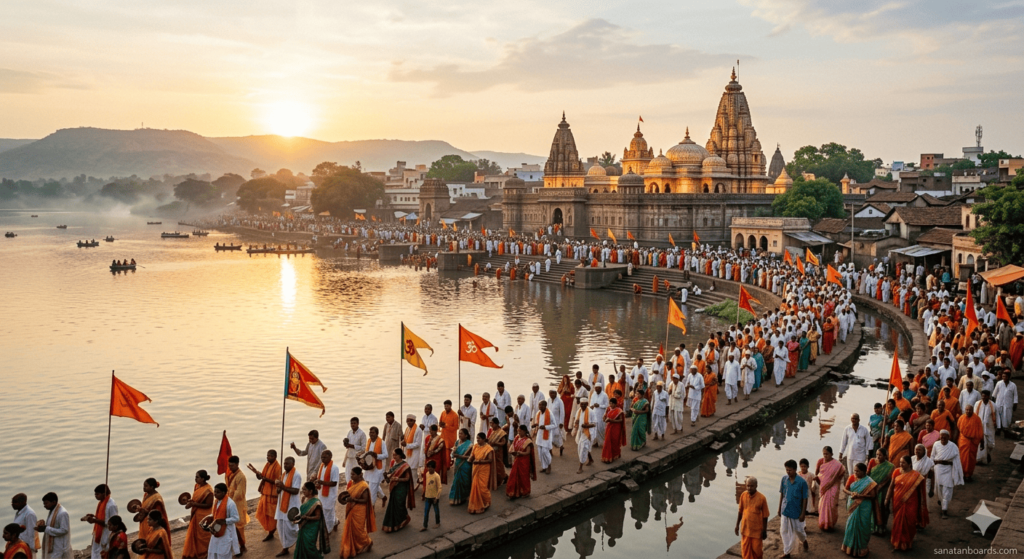
What Is Pandharpur (Maharashtra) – Vithoba Temple ?
Pandharpur is a sacred pilgrimage town known as the “Southern Kashi” of India. It is primarily recognized for housing Vithoba Temple, Pandharpur, one of the most visited and spiritually significant temples in Maharashtra. The temple is dedicated to Lord Vithoba, also called Vitthal, a manifestation of Lord Krishna.
The Vithoba Temple is the central place of worship for the Varkari sect, a devotional movement that emphasizes equality, love, and devotion to God. The temple’s spiritual atmosphere is deeply connected with bhakti (devotion), where devotees express their faith through singing, dancing, and chanting.
Pandharpur is located on the banks of the Chandrabhaga River, which holds religious importance as devotees believe its waters are sacred. The temple complex is simple yet powerful in its spiritual energy. The idol of Vithoba stands on a brick, with both hands resting on his hips, symbolizing divine patience and compassion.
Historically, the temple has been a center of social reform and spiritual awakening. Saints from different backgrounds contributed to its popularity and spiritual teachings. Their abhangs continue to inspire millions of followers even today.
The temple is not just a religious destination but also a cultural hub where traditions, rituals, and community bonding come together. Festivals like Ashadhi Ekadashi transform Pandharpur into a massive spiritual gathering.
Who Is Required Pandharpur (Maharashtra) – Vithoba Temple ?
Pandharpur and Vithoba Temple, Pandharpur are required by a wide range of devotees, spiritual seekers, cultural enthusiasts, and scholars.
First, devotees of Lord Vithoba, especially followers of the Varkari tradition, consider this temple essential for their spiritual journey. They believe that visiting Pandharpur and having darshan of Lord Vithoba brings peace, liberation, and divine blessings. For them, it is not just a place but the center of their faith.
Second, saints and spiritual practitioners have historically required Pandharpur as a center of devotion and learning. Saints like Tukaram and Dnyaneshwar shaped their spiritual teachings around the philosophy of devotion practiced here. Even today, spiritual leaders and learners visit to experience the devotional environment.
Third, cultural researchers, historians, and students require Pandharpur to study Maharashtra’s Bhakti movement, medieval traditions, and religious evolution. The temple serves as an important case study for understanding Indian spirituality and social reform movements.
Fourth, tourists and heritage explorers visit Pandharpur to experience its unique culture, festivals, and architecture. The temple and surrounding ghats provide insights into ancient traditions and community life.
Finally, local communities depend on Pandharpur’s religious importance for economic and cultural activities. Pilgrimage tourism supports thousands of livelihoods, including hospitality, transport, and local markets.
Thus, Pandharpur and the Vithoba Temple are required not only for religious devotion but also for cultural, historical, educational, and economic reasons, making it a multidimensional sacred destination.
When Pandharpur (Maharashtra) – Vithoba Temple Is Required ?
Pandharpur and Vithoba Temple, Pandharpur are required at various times throughout the year, both spiritually and culturally, depending on religious calendars and personal devotion.
The most important time when Pandharpur is required is during major pilgrimage events such as Ashadhi Ekadashi and Kartiki Ekadashi. During these periods, millions of devotees undertake long walking pilgrimages called “Wari” to reach the temple. These events are considered highly sacred, and participation is believed to bring spiritual fulfillment and blessings.
Apart from these major festivals, Pandharpur is required during individual spiritual needs. Devotees visit the temple when they seek peace, healing, guidance, or emotional relief. It is often considered a place to reconnect with faith during difficult life phases.
The temple is also required during important life events such as births, marriages, or new beginnings. Many families consider visiting Pandharpur as an auspicious ritual to seek blessings for prosperity and happiness.
From a cultural perspective, Pandharpur is required throughout the year for religious learning, bhajan singing, and spiritual gatherings. Saints and devotees frequently organize devotional programs, making the temple active beyond festival seasons.
In a broader sense, Pandharpur is required whenever individuals feel a spiritual calling or wish to experience devotion in its purest form. The temple’s presence is not limited to time-bound rituals but extends to continuous spiritual significance.
Even the Varkari pilgrimage tradition ensures that Pandharpur remains relevant every year, as thousands of devotees prepare months in advance for their journey. Thus, Pandharpur is not bound by a single time but is required continuously across seasons, festivals, and personal spiritual experiences.
Where Pandharpur (Maharashtra) – Vithoba Temple Is Required ?
Pandharpur is located in the Solapur district of Maharashtra, India, on the banks of the Chandrabhaga River. Within this sacred town lies the famous Vithoba Temple, Pandharpur, which is the central spiritual destination.
The temple is required in the heart of Maharashtra’s religious geography. It acts as a focal point for pilgrims coming from all parts of India, especially from rural regions of Maharashtra, Karnataka, and surrounding states. The location makes it easily accessible for large-scale pilgrimages.
Geographically, Pandharpur is situated in a semi-arid region but transforms into a vibrant spiritual hub during pilgrimage seasons. The riverbanks surrounding the temple are used for ritual bathing and religious ceremonies, making the location essential for spiritual purification practices.
Culturally, Pandharpur is required wherever the Varkari tradition is followed. Even outside the physical location, its spiritual influence spreads across villages and cities through bhajans, kirtans, and devotional teachings.
From an administrative perspective, Pandharpur is required as a major religious tourism center in Maharashtra. It plays a crucial role in managing pilgrimage crowds, cultural events, and religious festivals.
Symbolically, Pandharpur is required in the spiritual imagination of devotees. For them, it represents the divine home of Lord Vithoba, where ultimate surrender and devotion take place.
Thus, Pandharpur is not only a physical place but also a spiritual geography that exists wherever devotion to Vithoba is practiced and celebrated.
How Pandharpur (Maharashtra) – Vithoba Temple Is Required ?
Pandharpur and the Vithoba Temple are required through a combination of devotion, pilgrimage practices, cultural traditions, and organized religious systems.
Devotees access Pandharpur primarily through pilgrimage journeys known as Wari. These journeys are carried out on foot, where groups of Warkaris walk long distances while singing abhangs dedicated to Lord Vithoba. This process of travel itself is considered a spiritual discipline.
At the temple, worship is performed through darshan (viewing of the deity), aarti (ritual worship with lamps), and offerings such as flowers, coconuts, and prayers. Devotees believe that participating in these rituals brings spiritual blessings and peace.
The temple is also required through organized festival management systems. During peak times like Ashadhi Ekadashi, authorities manage crowd control, security, food distribution, and accommodation for millions of pilgrims.
Culturally, Pandharpur is required through devotional music traditions. Bhajans and abhangs are performed continuously, keeping the spiritual atmosphere alive. These traditions are passed down through generations.
Administratively, Pandharpur is maintained by temple trusts and government bodies that ensure proper functioning of rituals, infrastructure, and pilgrim facilities.
From a social perspective, Pandharpur is required as a unifying space where people from different backgrounds come together in devotion, breaking social barriers and promoting equality.
Thus, Pandharpur and the Vithoba Temple are required through physical pilgrimage, ritual practices, cultural expressions, and institutional support systems.
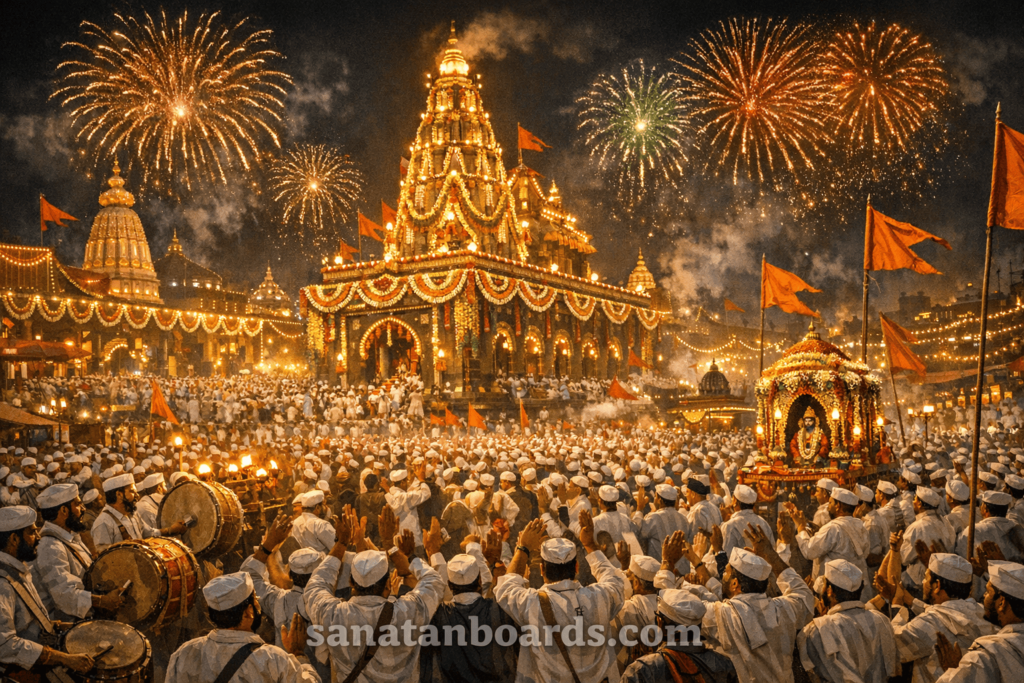
Case Study On Pandharpur (Maharashtra) – Vithoba Temple
Pandharpur and the Vithoba Temple serve as a powerful case study of mass pilgrimage management, cultural continuity, and spiritual sociology in India.
The Warkari pilgrimage, known as Wari, represents one of the largest organized religious movements in the world. Every year, lakhs of devotees travel from various parts of Maharashtra to Pandharpur, covering distances of over 200–300 kilometers. This movement is not driven by institutional enforcement but by voluntary devotion, making it a unique case of collective religious behavior.
One of the key aspects of this case study is crowd management. During peak pilgrimage seasons, especially Ashadhi Ekadashi, Pandharpur faces massive inflow of people. Authorities coordinate with police, municipal bodies, and volunteers to ensure safety, food distribution, and medical assistance. Despite the huge crowd, the pilgrimage remains largely peaceful, which is a notable achievement in mass event management.
Another important aspect is cultural sustainability. The traditions of abhang singing, palakhi processions, and communal walking have remained unchanged for centuries. This continuity shows how cultural identity can be preserved without formal enforcement.
From a sociological perspective, Pandharpur represents social equality. The temple and pilgrimage tradition emphasize that devotion is open to all, regardless of caste, class, or economic background. During the Wari, people from different communities walk together, eat together, and pray together, creating a strong sense of unity.
Economically, Pandharpur experiences a significant boost during pilgrimage seasons. Local vendors, transport services, hotels, and small businesses benefit from the influx of pilgrims. This demonstrates how religious tourism contributes to regional economies.
Environmentally, the massive gatherings also present challenges such as waste management and water usage. In recent years, improved planning and awareness campaigns have been introduced to maintain cleanliness and sustainability in the town and surrounding river areas.
Technologically, modern systems like CCTV surveillance, digital donation systems, and crowd monitoring tools are increasingly used to manage the pilgrimage efficiently.
This case study highlights Pandharpur as a model of spiritual tourism, cultural preservation, and large-scale event coordination, where tradition and modern management coexist effectively.
White Paper On Pandharpur (Maharashtra) – Vithoba Temple
Pandharpur and the Vithoba Temple represent a significant framework for analyzing religious heritage management, cultural sustainability, and pilgrimage economics in India.
The white paper focuses on understanding Pandharpur as a multi-dimensional system involving spiritual, social, economic, and administrative components. At its core, the temple serves as a religious institution that attracts millions of devotees annually, making it one of the most important pilgrimage centers in India.
From a heritage perspective, Pandharpur is a living tradition. Unlike static monuments, it functions continuously as a place of worship. This creates challenges in balancing preservation with active usage. Authorities must ensure that the temple structure, rituals, and surrounding environment remain intact despite heavy footfall.
Economically, the pilgrimage economy of Pandharpur plays a vital role in regional development. Seasonal inflow of pilgrims supports transport operators, local businesses, artisans, and hospitality services. This creates a micro-economy that depends heavily on religious tourism cycles.
Socially, Pandharpur acts as a unifying platform. The Warkari tradition emphasizes equality and devotion, reducing social divisions during pilgrimage. This social cohesion is a key factor in the sustainability of the tradition.
Administratively, the management of Pandharpur requires coordination between temple trusts, local government, police, and health services. Infrastructure planning includes roads, sanitation systems, accommodation facilities, and emergency response mechanisms.
A major challenge identified in this white paper is sustainability. The increasing number of pilgrims places pressure on water resources, waste management systems, and transportation networks. Strategic planning is required to ensure long-term balance between devotion and environmental responsibility.
Another key aspect is digital transformation. The integration of technology in crowd control, donation systems, and information dissemination has improved efficiency. However, maintaining the traditional essence of pilgrimage while adopting modern systems remains a delicate balance.
Culturally, Pandharpur continues to preserve centuries-old devotional practices such as abhang singing and palakhi processions. These traditions are central to identity formation among devotees.
The white paper concludes that #Sanatanboardsinvasai Pandharpur is not only a religious site but also a dynamic system that integrates faith, economy, culture, and governance.
Industry Application On Pandharpur (Maharashtra) – Vithoba Temple
Pandharpur and the Vithoba Temple have wide-ranging applications across multiple industries due to their status as one of India’s most important pilgrimage destinations. The continuous inflow of devotees, especially during major festivals like Ashadhi Ekadashi and Kartiki Ekadashi, creates a strong ecosystem that supports tourism, infrastructure, hospitality, transport, technology, and public administration sectors.
1. Tourism Industry
Pandharpur is a major hub of religious tourism. Travel agencies design pilgrimage packages that include transportation, accommodation, and guided visits. The town attracts millions of visitors annually, making it a key destination in Maharashtra’s spiritual tourism circuit. This supports both domestic tourism growth and cultural heritage promotion.
2. Hospitality Industry
Hotels, lodges, dharamshalas, and guest houses benefit significantly from the constant flow of pilgrims. Temporary accommodations and food services expand during festival seasons. Local restaurants and food vendors also experience high demand, leading to seasonal economic growth.
3. Transportation and Logistics Industry
The pilgrimage movement, especially the Wari procession, generates large-scale demand for buses, private transport, rail services, and logistics support. Special transport arrangements are often organized by government and private operators to handle peak crowds efficiently.
4. Infrastructure and Urban Development
The heavy footfall requires continuous development of roads, sanitation systems, drinking water supply, waste management, and public facilities. Urban planners and construction companies play a major role in expanding and maintaining pilgrimage infrastructure.
5. Event Management Industry
Large-scale festivals and pilgrimages require professional crowd control, security planning, medical emergency setups, and volunteer coordination. Event management systems are essential to handle millions of devotees safely and efficiently.
6. Digital Technology Industry
Modern systems such as online darshan, digital donation platforms, CCTV surveillance, mobile apps for navigation, and crowd monitoring tools are increasingly used. This improves safety, accessibility, and pilgrim experience.
7. Local Economy and Handicrafts
Small businesses, street vendors, artisans, and souvenir sellers benefit from pilgrimage-driven commerce. This strengthens rural and semi-urban livelihoods around Pandharpur.
Conclusion
Pandharpur and the Vithoba Temple act as a powerful economic and industrial catalyst. Beyond spiritual significance, they contribute to multiple #Sanatanboardsinmumbai industries by generating employment, boosting regional development, and encouraging technological innovation in pilgrimage management.
source : Traveller Rishabh
ASK FAQ
1. What is Pandharpur famous for?
Pandharpur is famous for the sacred Vithoba Temple, a major pilgrimage site dedicated to Lord Vithoba, attracting millions of devotees every year.
2. Why is Vithoba Temple important in Pandharpur?
The Vithoba Temple is important because it is the spiritual center of the Warkari tradition and symbolizes devotion, equality, and faith in Lord Vithoba.
3. When is the best time to visit Pandharpur?
The best time to visit Pandharpur is during Ashadhi Ekadashi and Kartiki Ekadashi, when grand pilgrimages and festivals take place with massive devotion.
4. How do devotees reach Pandharpur?
Devotees reach Pandharpur mainly through the Wari pilgrimage, walking long distances in groups while singing devotional songs dedicated to Lord Vithoba.
5. What is the cultural significance of Pandharpur?
Pandharpur holds great cultural importance as it represents the Bhakti movement, promoting devotion, equality, and unity through centuries-old traditions and festivals.
Table of Contents
Disclaimer
This content is prepared for informational and descriptive writing purposes only. It is intended to provide structured knowledge about Pandharpur and the Vithoba Temple and does not claim absolute historical, religious, or academic authority. Interpretations may vary based on different cultural, traditional, and scholarly perspectives.