
MURUDESHWAR (KARNATAKA) – WORLD’S SECOND-LARGEST SHIVA STATUE
Murudeshwar Shiva Statue, located in the coastal town of Murudeshwar in Karnataka, India, is one of the most remarkable spiritual and architectural landmarks in the country. Standing tall on the shores of the Arabian Sea, this colossal statue of Lord Shiva is widely recognized as the world’s second-largest Shiva statue, attracting devotees, tourists, photographers, and architecture enthusiasts from across the globe.
The statue is situated within the sacred complex of Murudeshwar Temple which is dedicated to Lord Shiva and holds immense religious significance in Hindu tradition. The monument is not only a place of worship but also a symbol of cultural pride, devotion, and artistic excellence. The towering figure of Lord Shiva, seated in a meditative posture, is surrounded by the natural beauty of the Western coastal belt, with the Arabian Sea forming a breathtaking backdrop.
This iconic structure was designed to reflect spiritual serenity while also showcasing modern engineering skills. The statue’s location on Kanduka Hill enhances its visibility from far distances, making it a landmark for travelers approaching the coastal region of Karnataka. The surrounding temple complex and infrastructure have further developed Murudeshwar into a prominent pilgrimage and tourism destination.
Beyond its religious importance, the site plays a key role in promoting cultural tourism in India. It represents a blend of mythology, devotion, and contemporary construction techniques. The statue’s serene expression and towering presence symbolize peace meditation, and divine strength, aligning with the spiritual teachings associated with Lord Shiva.
Murudeshwar today stands as a destination where spirituality meets natural beauty, making it one of the most visited sacred coastal sites in South India.
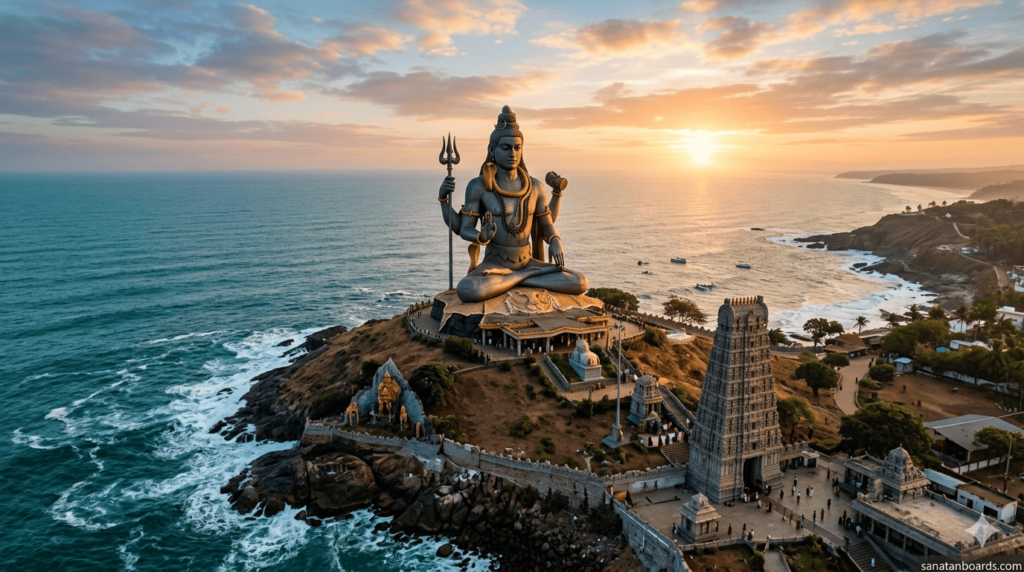
What Is Murudeshwar (Karnataka) – World’s Second-Largest Shiva Statue ?
Murudeshwar is a coastal town in Karnataka known for its deep spiritual roots and scenic beauty. At the heart of this town lies the famous Murudeshwar Shiva Statue, which is a massive representation of Lord Shiva and serves as a central attraction for visitors.
The statue is part of the larger temple complex of Murudeshwar Temple, which is dedicated to Lord Shiva. The temple and statue together form a major pilgrimage center for Hindu devotees. The statue depicts Lord Shiva seated in a meditative pose, symbolizing peace, destruction of evil, and cosmic balance.
Murudeshwar is not just a religious destination but also a geographical highlight of Karnataka’s coastline. It is located along the Arabian Sea, which adds a dramatic natural backdrop to the spiritual environment. The combination of sea, hills, and religious architecture makes the location visually unique and culturally significant.
The Shiva statue itself is one of the tallest in the world, standing at an impressive height that dominates the skyline of Murudeshwar. It is made using modern construction techniques, including reinforced concrete and metal frameworks, ensuring durability against coastal weather conditions.
Murudeshwar has grown into a major tourist destination due to this statue. Visitors come not only for religious purposes but also to experience the architectural brilliance and scenic views. The site is well-connected by road and rail, making it accessible to travelers from different parts of India.
Who Is Required Murudeshwar (Karnataka) – World’s Second-Largest Shiva Statue ?
The significance of Murudeshwar Shiva Statue extends to various groups of people, each connected to it in different ways.
For devotees of Lord Shiva, the statue and the surrounding Murudeshwar Temple serve as a sacred pilgrimage site. It provides a space for prayer, meditation, and spiritual reflection. Many believers visit to seek blessings, peace of mind, and spiritual fulfillment.
For tourists, Murudeshwar in Karnataka is an essential destination due to its combination of religious importance and scenic beauty. The coastal landscape, along with the towering Shiva statue, offers a unique travel experience that blends culture and nature.
Architects, engineers, and students of structural design also find the statue highly relevant. It stands as an example of large-scale sculpture engineering and coastal construction techniques. The design demonstrates how modern materials can be used to create durable monumental art that withstands environmental challenges.
Cultural researchers and historians are also interested in Murudeshwar because it reflects the evolution of temple architecture and religious art in India. It represents how traditional beliefs can be preserved while adapting to modern construction styles.
Local communities benefit economically from tourism generated by the site. Hotels, transport services, guides, and small businesses depend on the steady flow of visitors throughout the year.
Thus, Murudeshwar is “required” or important for spiritual seekers, travelers, professionals in engineering and architecture, cultural scholars, and the local economy. Each group interacts with the site in a unique way, making it a multi-dimensional landmark.
When Murudeshwar (Karnataka) – World’s Second-Largest Shiva Statue Is Required ?
The relevance of Murudeshwar Shiva Statue is continuous throughout the year, but its significance becomes especially prominent during religious festivals, tourism seasons, and cultural events.
One of the most important times is during major Hindu festivals such as Maha Shivaratri. During this period, thousands of devotees visit Murudeshwar to offer prayers at Murudeshwar Temple. The entire complex becomes vibrant with rituals, chanting, lighting ceremonies, and spiritual gatherings. This time reflects the peak religious importance of the site.
Another significant period is the winter tourism season, generally from October to February. During these months, the coastal weather of Karnataka remains pleasant, making it ideal for sightseeing and travel. Visitors prefer this time to explore the statue, the beach, and surrounding attractions comfortably.
The site is also relevant during educational trips and architectural study tours. Students of engineering and architecture often visit throughout the academic year to study the structural design and engineering methods used in constructing the massive statue.
Additionally, weekends and holiday seasons see a steady flow of tourists from nearby cities. Families and travel groups visit the location for spiritual peace as well as leisure, combining pilgrimage with vacation.
From a cultural perspective, Murudeshwar remains important at all times because it represents Lord Shiva’s symbolism of meditation and cosmic balance. This makes it a timeless spiritual destination rather than one limited to specific occasions.
Even during off-peak seasons, the site maintains its importance as a place of worship for local devotees who visit regularly for daily prayers and rituals.
Therefore, Murudeshwar is not limited to a specific time frame but is continuously relevant for spiritual, cultural, educational, and tourism purposes. Its peak significance is seen during festivals and tourist-friendly weather conditions, but its importance remains constant throughout the year.
Where Murudeshwar (Karnataka) – World’s Second-Largest Shiva Statue Is Required ?
Murudeshwar is located in the coastal region of Karnataka, along the western shoreline of India, facing the Arabian Sea. This geographical position plays a major role in the significance of the Murudeshwar Shiva Statue.
The statue is positioned on Kanduka Hill, which provides elevation and allows it to be visible from long distances, especially from the sea. This strategic placement enhances its symbolic presence as a guardian-like figure overlooking the coastline. The nearby Murudeshwar Temple adds religious depth to the location, making it both a spiritual and geographical landmark.
Being located on the coast gives Murudeshwar a unique identity compared to other pilgrimage sites in India. The combination of sea waves, rocky hills, and spiritual architecture creates a serene environment that enhances meditation and worship experiences.
The region is also well-connected through road and rail networks, making it accessible for pilgrims and tourists from different parts of Karnataka and neighboring states. Its proximity to other coastal attractions further increases its importance in regional tourism circuits.
The location also plays a role in its cultural identity. Coastal Karnataka has a long tradition of temple architecture and Shiva worship, and Murudeshwar is one of its most prominent representations. The statue acts as a landmark for maritime navigation and is often visible to fishermen and travelers at sea.
From an economic perspective, the location supports tourism-driven development. Hotels, restaurants, transportation services, and local markets thrive due to the steady influx of visitors.
Thus, Murudeshwar’s location is not just geographical but also spiritual, cultural, and economic in importance. Its coastal positioning enhances its visual appeal, religious symbolism, and tourism value, making it one of the most significant landmarks in southern India.
How Murudeshwar (Karnataka) – World’s Second-Largest Shiva Statue Is Required ?
The Murudeshwar Shiva Statue in Murudeshwar, Karnataka is a result of advanced engineering, artistic craftsmanship, and careful planning combined with religious inspiration. The creation of this massive statue required coordination between sculptors, engineers, architects, and construction workers over several years.
The process began with detailed design planning, where the proportions of Lord Shiva were carefully calculated. Every feature, including facial expressions, posture, ornaments, and symbolic elements, was designed to maintain spiritual accuracy while ensuring structural balance. The design phase also included technical blueprints for internal support systems.
The statue was constructed using reinforced concrete and steel frameworks. Steel rods formed the internal skeleton, which provided strength and stability. Concrete was then layered over this framework to create the outer shape. This method ensures durability, especially in the coastal climate of Karnataka where strong winds, salt air, and heavy rainfall are common.
Special attention was given to the statue’s height and weight distribution. Engineers ensured that the structure remains stable even during extreme weather conditions. The base was strongly anchored into Kanduka Hill, which provides a natural foundation and elevation.
Sculptors played a major role in shaping the final appearance. Fine detailing was done manually to bring out the divine expression of Lord Shiva. The serene face, matted hair, ornaments, and seated posture were crafted with artistic precision to maintain religious symbolism.
Painting and finishing work were done using weather-resistant materials to protect the statue from corrosion and fading. Regular maintenance is also carried out to preserve its appearance and structural integrity.
The surrounding infrastructure, including the Murudeshwar Temple complex, was developed alongside the statue, making it part of a larger spiritual environment.
Overall, the construction of the statue is a perfect example of how modern engineering techniques and traditional religious art can come together to create a monumental structure that stands as both a spiritual symbol and an architectural marvel.
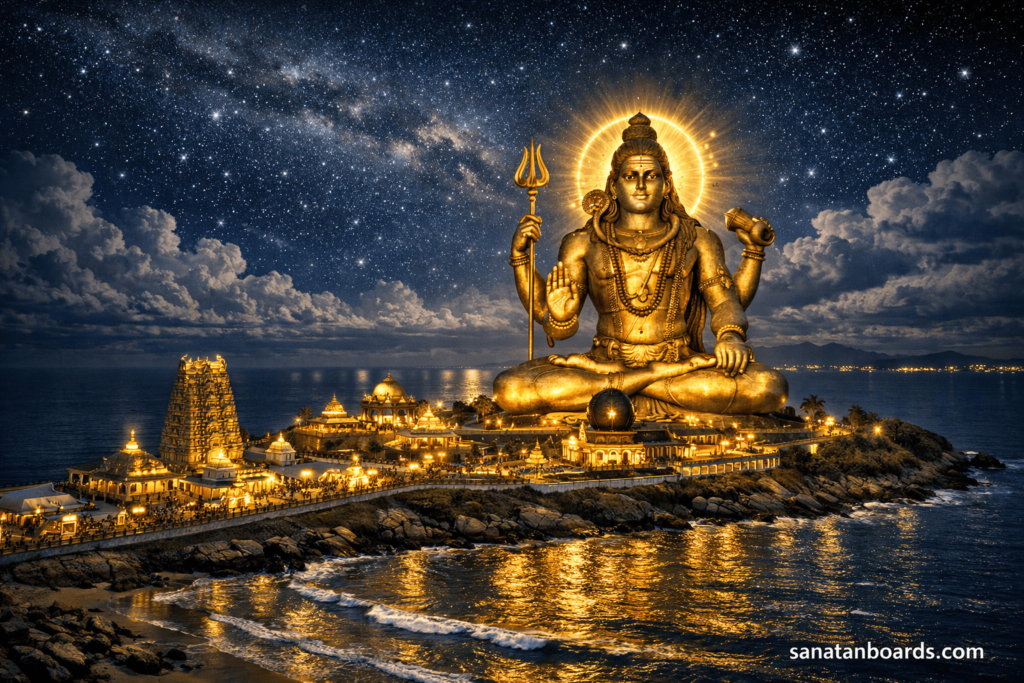
Case Study On Murudeshwar (Karnataka) – World’s Second-Largest Shiva Statue
The Murudeshwar Shiva Statue located in Murudeshwar, Karnataka, serves as an important case study in the fields of religious tourism development, large-scale sculpture engineering, and cultural preservation.
The primary objective behind the development of this monumental statue was to create a spiritual landmark that would enhance the religious significance of the already existing Murudeshwar Temple. Over time, this objective expanded into a broader vision of promoting tourism and regional development.
From an engineering perspective, constructing such a massive statue on a coastal hill posed several challenges. The structure had to withstand strong coastal winds, salt-laden air, and heavy monsoon conditions typical of Karnataka’s western coastline. To address this, reinforced concrete and steel frameworks were used, ensuring stability and durability. The statue’s design also required precise structural calculations to maintain balance and aesthetics at such a large scale.
The project demonstrates successful integration of traditional iconography with modern engineering techniques. The depiction of Lord Shiva in a seated meditative posture required careful attention to proportions, facial detailing, and symbolic accuracy.
From a tourism development standpoint, Murudeshwar transformed from a relatively quiet coastal town into a major pilgrimage and tourist destination. The statue became a central attraction that significantly increased visitor inflow. This led to the development of infrastructure such as roads, accommodations, eateries, and transportation services.
Economically, the statue has had a positive impact on the local community. Employment opportunities increased in hospitality, retail, transport, and guide services. Local businesses benefited from the steady stream of domestic and international tourists.
Culturally, the statue strengthened the identity of coastal Karnataka as a spiritual and heritage-rich region. It reinforced the importance of Lord Shiva worship in the region and contributed to the preservation of religious traditions.
Environmentally, the location required careful planning to minimize ecological disruption. Being near the Arabian Sea, construction had to consider coastal erosion and environmental sustainability.
The success of Murudeshwar demonstrates how religious monuments can act as catalysts for regional transformation. It highlights the importance of balancing spirituality, tourism, engineering, and environmental considerations.
Today, Murudeshwar stands as a model for how large-scale religious infrastructure projects can positively influence regional development while preserving cultural and spiritual values.
White Paper On Murudeshwar (Karnataka) – World’s Second-Largest Shiva Statue
The Murudeshwar Shiva Statue in Murudeshwar, Karnataka represents a unique intersection of spirituality, cultural heritage, tourism development, and engineering innovation.
1. Overview
The statue is part of the larger religious complex of Murudeshwar Temple and serves as a key religious and tourist attraction. It depicts Lord Shiva in a meditative posture and is recognized as one of the tallest Shiva statues globally.
2. Cultural Importance
The statue reinforces the cultural identity of the region. It reflects the enduring significance of Shaivism in Indian tradition and highlights the continuity of mythological storytelling through modern artistic expression.
3. Engineering Framework
The construction required advanced structural design principles. The coastal environment demanded materials resistant to corrosion and weathering. Reinforced concrete and steel frameworks were used to ensure stability and longevity.
4. Tourism Impact
Murudeshwar has become a major tourism hub in Karnataka. The statue attracts pilgrims, international tourists, and architecture enthusiasts. This influx supports local businesses and strengthens the regional economy.
5. Socio-Economic Development
The development of tourism infrastructure has improved employment opportunities in the region. Hospitality, transportation, and retail sectors have grown significantly due to increased visitor numbers.
6. Environmental Considerations
Being a coastal installation, environmental sustainability was an important factor. Measures were taken to minimize ecological impact while ensuring long-term durability of the structure.
7. Challenges
Key challenges included coastal weather conditions, structural stability at height, and maintaining artistic accuracy at large scale. These were addressed through advanced engineering solutions and careful planning.
8. Outcomes
The project successfully achieved its objectives of creating a global landmark that combines religious significance with tourism development. It also strengthened Karnataka’s position on the cultural tourism map of India.
9. Conclusion
Murudeshwar stands as a benchmark for integrating religious heritage with modern development. It demonstrates how large-scale cultural infrastructure #Sanatanboardsinvasai can drive economic growth while preserving spiritual identity.
Industry Application On Murudeshwar (Karnataka) – World’s Second-Largest Shiva Statue
The Murudeshwar Shiva Statue located in Murudeshwar, Karnataka is not only a religious monument but also a structure that influences multiple industries. Its impact extends beyond spirituality into economic, technical, cultural, and service-based sectors.
1. Tourism Industry
The statue is a major attraction for domestic and international visitors. It strengthens pilgrimage tourism as part of the Murudeshwar Temple complex. Tour operators, travel agencies, and guides depend heavily on visitor flow to this destination. It has helped position coastal Karnataka as a key tourism circuit.
2. Architecture and Civil Engineering Industry
The structure serves as a real-world example of large-scale statue engineering. It demonstrates the use of reinforced concrete, structural stability techniques, and coastal construction methods. Architects and engineers study it for understanding monument design, load distribution, and environmental resistance.
3. Construction and Materials Industry
The project highlights the application of high-strength concrete, steel reinforcement, protective coatings, and weather-resistant materials. These technologies are essential for building structures in coastal environments with high humidity and salt exposure.
4. Hospitality and Service Industry
Due to continuous tourist inflow, hotels, lodges, restaurants, and transport services in Murudeshwar have grown significantly. This has created employment opportunities and boosted local business ecosystems.
5. Cultural and Heritage Industry
The statue strengthens cultural storytelling and heritage preservation. It supports cultural tourism, educational tours, and documentation of Indian religious architecture. It also promotes awareness of Lord Shiva traditions.
6. Media, Photography, and Film Industry
The scenic combination of the Arabian Sea, temple architecture, and the towering statue makes Murudeshwar a popular location for photography, documentaries, travel content, and film shooting.
7. Education and Research Sector
Engineering colleges, architecture institutes, and cultural studies programs use the statue as a case study for structural design, religious symbolism, and large-scale project management.
Conclusion
The Murudeshwar Shiva Statue is not only a spiritual landmark but also a multi-industry contributor. It supports tourism, engineering innovation, #Sanatanboardsinmumbai hospitality growth, and cultural education, making it an important asset for regional development in Karnataka.
source : MusafirV3
ASK FAQ
1. What is Murudeshwar Shiva Statue famous for?
It is famous for being one of the tallest Lord Shiva statues in the world, located in Murudeshwar, Karnataka, and is part of the sacred Murudeshwar Temple complex.
2. Where is Murudeshwar Shiva Statue located?
It is located on Kanduka Hill in the coastal town of Murudeshwar, along the Arabian Sea in Karnataka, India.
3. Why is Murudeshwar Shiva Statue important?
It is important for religious devotion, tourism, cultural heritage, and architectural significance, attracting millions of visitors every year.
4. How tall is Murudeshwar Shiva Statue?
The statue is approximately 123 feet tall, making it one of the tallest Shiva statues globally.
5. When is the best time to visit Murudeshwar?
The best time to visit is between October and February when the weather is cool and ideal for sightseeing and temple visits.
Table of Contents
Disclaimer: The information provided about Murudeshwar Shiva Statue in Murudeshwar, Karnataka is intended only for educational and informational purposes to enhance general knowledge about its cultural, architectural, and tourism significance. While efforts have been made to ensure accuracy, the content should not be considered as official, verified, or professional advice, and readers are encouraged to cross-check details from authoritative sources if needed. This content does not intend to promote or misrepresent any religious belief, sentiment, or tradition and is presented with respect to all cultural and spiritual perspectives associated with the site.