The SURYAVANSHI DYNASTY is one of the most renowned lineages in ancient Indian history and mythology. This dynasty traces its origins to the Sun God, Surya, and is celebrated for its righteous kings who upheld dharma and justice. Among the most illustrious rulers of this lineage is King Dasharatha, the father of Lord Rama. King Dasharatha, known for his wisdom, courage, and deep devotion, ruled the kingdom of Ayodhya with fairness and prosperity.
Lord Rama, his eldest son, is revered as an ideal king, son, and human being. His life, described in the epic Ramayana, exemplifies values like duty, honor, compassion, and devotion. Rama’s journe, including his exile and victory over evil, serves as a guiding story for generations. The SURYAVANSHI DYNASTY symbolizes the principles of leadership, morality, and divine heritage. Educationally, learning about King Dasharatha and Lord Rama provides insights into ancient governance, ethics, and the cultural significance of dharma. This dynasty continues to inspire students, historians, and spiritual seekers worldwide, highlighting the integration of mythology with moral education.
What Is Suryavanshi Dynasty – King Dasharatha, Lord Rama ?
The SURYAVANSHI DYNASTY – KING DASHARATHA, LORD RAMA represents a historical and mythological lineage tracing back to the Sun God, Surya. The term “Suryavanshi” literally means “descendants of the Sun,” symbolizing royalty, divine blessings, and moral responsibility. This dynasty is prominent in Indian epics, particularly the Ramayana, which narrates the lives and deeds of its members.
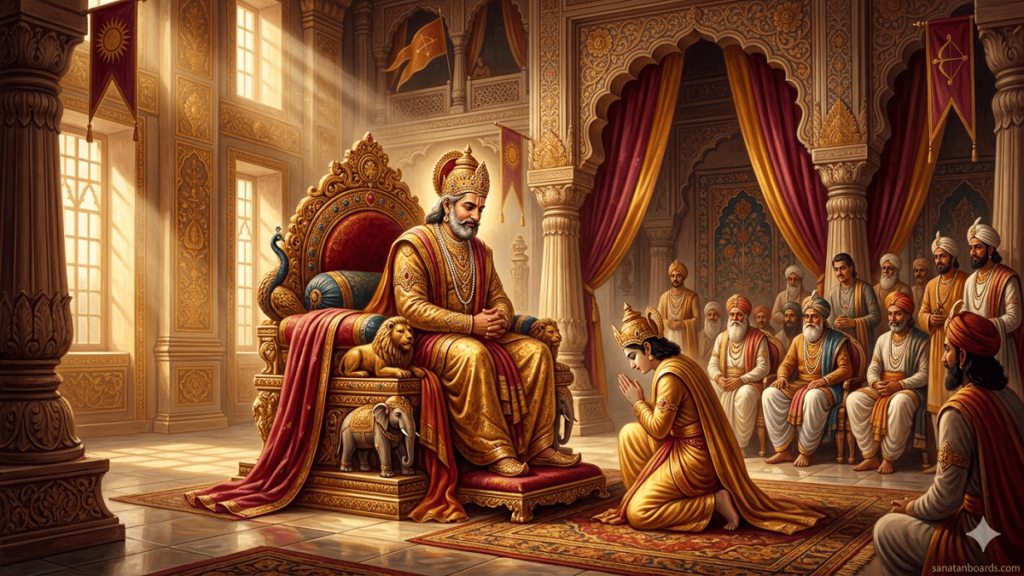
King Dasharatha, a key figure of this dynasty, ruled Ayodhya with wisdom, fairness, and devotion. He is known for his virtues, strategic leadership, and deep familial love. His reign is often described as a golden era of peace and prosperity, demonstrating the significance of dharma and righteous rule. King Dasharatha’s life is also marked by personal challenges, especially his emotional dilemma when he had to send his son, Lord Rama, into exile to honor a promise, reflecting the interplay of duty and personal sacrifice.
Lord Rama, his son, embodies the ideals of truth, virtue, and compassion. Revered as Maryada Purushottam, Rama’s life journey—from his birth, education, marriage to Sita, exile, and eventual victory over the demon king Ravana—serves as a timeless moral and ethical guide. The SURYAVANSHI DYNASTY is thus not only a historical concept but also an educational symbol, representing the values of leadership, devotion, and righteousness.
Learning about this dynasty offers insights into ancient Indian culture, philosophy, and governance. It highlights how mythology and history intertwine to provide moral education. Scholars, students, and spiritual enthusiasts study the SURYAVANSHI DYNASTY to understand principles of dharma, leadership ethics, and the significance of familial and societal responsibilities.
Who Is Required – Suryavanshi Dynasty – King Dasharatha, Lord Rama ?
The study of SURYAVANSHI DYNASTY – KING DASHARATHA, LORD RAMA is required for students, educators, historians, spiritual seekers, and anyone interested in ancient Indian culture and ethics. Understanding this dynasty provides insights into moral principles, leadership qualities, and the social and religious framework of ancient India.
Students at school and university levels often study this topic as part of history, literature, and moral education. It introduces them to epic narratives, such as the Ramayana, and helps develop an understanding of values like duty, sacrifice, and righteousness. Learning about King Dasharatha and Lord Rama is particularly useful for courses in Indian history, religious studies, ethics, and cultural education.
Educators and teachers are required to understand this topic deeply so they can impart these lessons effectively. By explaining the actions and decisions of Dasharatha and Rama, educators teach students about the importance of leadership, justice, and moral responsibility. The dynasty provides practical examples of ethical dilemmas, governance, and family duties that remain relevant even today.
Historians and researchers studying Indian dynasties and mythology are also required to explore this lineage. The SURYAVANSHI DYNASTY connects historical context with mythological narratives, offering a comprehensive understanding of ancient societal structures, governance practices, and cultural heritage.
Spiritual seekers and practitioners find this knowledge essential for understanding dharma, devotion, and the embodiment of virtue. Lord Rama is considered the ideal human being, whose life serves as a guide for ethical conduct, devotion, and self-discipline. People engaged in spiritual studies often reflect on his decisions and conduct to develop personal character and leadership skills.
Moreover, writers, storytellers, and content creators require knowledge of this topic to accurately convey cultural and historical narratives. This ensures that the rich traditions and values associated with the SURYAVANSHI DYNASTY are preserved and shared with modern audiences.
When Suryavanshi Dynasty – King Dasharatha, Lord Rama Is Required ?
Understanding the SURYAVANSHI DYNASTY – KING DASHARATHA, LORD RAMA is required at multiple stages and situations in educational, cultural, and personal development contexts. It is not limited to a single time or circumstance; rather, it is relevant whenever there is a need to study values, leadership principles, or the historical and mythological heritage of India.
During formal education, this knowledge is required when students study Indian history, literature, or ethics. For instance, while reading the Ramayana, students learn about Lord Rama’s exile, King Dasharatha’s dilemmas, and the administration of Ayodhya. It is particularly required in curriculum segments focusing on moral lessons, dharma, governance, and family responsibility. Understanding the dynasty helps learners connect historical events with ethical decision-making.
For personal growth and moral education, this knowledge is required whenever individuals seek guidance on ethical behavior, self-discipline, and leadership. The dilemmas faced by King Dasharatha, including honoring promises despite personal loss, are examples of the application of moral principles in real life. Similarly, Lord Rama’s life is required as a reference point whenever people wish to understand ideal conduct, devotion, and duty towards society and family.
In cultural or religious contexts, studying this dynasty is required during festivals like Rama Navami or during discussions on Hindu epics and mythology. Scholars, priests, and educators require knowledge of the dynasty to explain the historical and symbolic significance of events, rituals, and moral lessons associated with Lord Rama and King Dasharatha.
In leadership training and ethical workshops, this knowledge is required to teach the balance between personal emotions, responsibility, and decision-making. King Dasharatha’s rule of Ayodhya and Lord Rama’s exemplary governance are required references when illustrating ideal leadership, fairness, and accountability.
Finally, for historians, writers, and researchers, this knowledge is required whenever there is an effort to document, analyze, or share the cultural heritage of India. The SURYAVANSHI DYNASTY serves as a historical and ethical framework, making it required whenever one needs insights into ancient traditions, epic literature, or moral education.
Where Suryavanshi Dynasty – King Dasharatha, Lord Rama Is Required ?
The knowledge of SURYAVANSHI DYNASTY – KING DASHARATHA, LORD RAMA is required in multiple locations, environments, and settings where education, cultural awareness, or ethical understanding is emphasized. It is not confined to classrooms or temples; rather, it is relevant wherever historical, spiritual, or moral learning takes place.
In educational institutions, this knowledge is required in schools, colleges, and universities, especially in departments teaching Indian history, literature, religion, or ethics. History classes may examine the lineage of the Suryavanshi kings, while literature courses often explore the epic Ramayana, analyzing Rama’s life and Dasharatha’s rule. Moral education classes require this knowledge to teach students about ethical dilemmas, responsibility, and leadership principles.
In cultural and religious settings, this knowledge is required in temples, spiritual centers, and during festivals like Rama Navami. Priests, scholars, and devotees use the stories of King Dasharatha and Lord Rama to explain dharma, devotion, and righteous living. Such settings emphasize learning through narrative, meditation, and discourse, making the SURYAVANSHI DYNASTY central to moral and spiritual education.
In professional and leadership environments, this knowledge is required in training centers, workshops, and seminars focused on ethics, governance, and leadership. King Dasharatha’s governance of Ayodhya and Lord Rama’s exemplary rule serve as practical case studies for ethical decision-making, strategic thinking, and integrity in leadership. Professionals in management, public service, and social work can apply these lessons to modern organizational and societal contexts.
In research and literary exploration, this knowledge is required in libraries, museums, research institutes, and digital archives. Historians, authors, and content creators need access to accurate information about the SURYAVANSHI DYNASTY to study its historical, cultural, and moral significance.
In homes and personal learning spaces, this knowledge is also required as parents and mentors guide younger generations. Storytelling, moral lessons, and discussions about ethical behavior inspired by King Dasharatha and Lord Rama are essential for character-building.
How Suryavanshi Dynasty – King Dasharatha, Lord Rama Is Required ?
The SURYAVANSHI DYNASTY – KING DASHARATHA, LORD RAMA is required through structured learning, cultural engagement, and reflective practice, allowing individuals to gain knowledge, moral guidance, and historical insight. Understanding how this dynasty is required involves examining the approaches used in education, spiritual learning, leadership studies, and cultural transmission.
In formal education, this knowledge is required through textbooks, lectures, and discussions. Students study the dynasty by analyzing the Ramayana, learning about King Dasharatha’s governance, Rama’s exile, and the moral choices that shaped their kingdom. Teachers guide learners through storytelling, question-and-answer sessions, and critical analysis, enabling students to internalize lessons on duty, leadership, and righteousness.
In spiritual and cultural practices, this knowledge is required through rituals, storytelling, and festivals. Devotees and learners engage with the narratives of the SURYAVANSHI DYNASTY via temple discourses, dramatizations, and recitations of Rama’s life. These activities reinforce ethical principles and provide practical examples of dharma and devotion in everyday life.
In leadership and ethical training, this knowledge is required by case studies, role-playing, and workshops. King Dasharatha’s dilemmas and Lord Rama’s decisions serve as models for ethical governance, conflict resolution, and accountability. Trainees learn how to balance duty with personal responsibility, making the lessons of the dynasty applicable in modern organizational and societal contexts.
In personal and informal learning, this knowledge is required through books, digital media, and storytelling at home or community spaces. Parents, mentors, and content creators convey the values of the dynasty by illustrating examples of honesty, courage, and moral integrity, helping individuals incorporate these principles into daily life.
In research and scholarship, this knowledge is required through analytical study, documentation, and interdisciplinary exploration. Historians, writers, and scholars examine the historical context, literary significance, and moral teachings of the SURYAVANSHI DYNASTY to produce knowledge that informs education, literature, and cultural preservation.

Case Study On Suryavanshi Dynasty – King Dasharatha, Lord Rama
Introduction
The SURYAVANSHI DYNASTY – KING DASHARATHA, LORD RAMA represents a legendary lineage in Indian mythology, tracing its origin to the Sun God, Surya. This dynasty is celebrated not only for its royal heritage but also for its embodiment of moral values, ethical governance, and devotion. Among the most significant figures are King Dasharatha, the ruler of Ayodhya, and his eldest son, Lord Rama, whose life has been immortalized in the epic Ramayana. Studying this dynasty provides insights into leadership, ethics, family responsibility, and spiritual principles.
Historical and Cultural Context
The Suryavanshi lineage claims descent from Surya, symbolizing divine authority and moral responsibility. King Dasharatha’s reign is depicted as a golden era of peace, prosperity, and righteous governance in Ayodhya. He was known for balancing the interests of his kingdom with the responsibilities of family life. Dasharatha’s decisions, especially sending Lord Rama into exile to fulfill a promise, exemplify the complexities of dharma—duty, ethics, and personal sacrifice.
Lord Rama, as the eldest son, is revered as Maryada Purushottam, the ideal human being. His life demonstrates unwavering adherence to dharma, respect for elders, courage, and compassion. From his marriage to Sita, exile, and the ultimate battle against Ravana, Rama embodies the integration of spiritual devotion and practical action. The dynasty is thus central to understanding the moral and cultural fabric of ancient India.
Objectives of the Case Study
- To examine the ethical and moral principles of the Suryavanshi Dynasty.
- To understand leadership and governance models exemplified by King Dasharatha and Lord Rama.
- To analyze the educational and cultural relevance of the dynasty in modern contexts.
- To explore how these narratives inform personal development, spirituality, and societal values.
Analysis
1. Ethical Dilemmas and Moral Lessons
King Dasharatha faced one of the most significant moral challenges when he had to send Lord Rama into exile to honor a promise to Queen Kaikeyi. This decision highlights the importance of integrity and honoring commitments, even when they conflict with personal desires. Students and leaders can study this scenario to understand decision-making under ethical constraints.
Lord Rama’s response to exile demonstrates obedience, humility, and adherence to dharma. He accepted the hardship without resentment, teaching lessons in self-discipline, resilience, and service to family and society.
2. Leadership and Governance
Dasharatha’s rule emphasizes responsible leadership. His ability to manage the kingdom while maintaining fairness, justice, and moral authority provides a model for modern governance. Lord Rama, later as king, exemplifies ideal leadership, prioritizing the welfare of his citizens and promoting justice, inclusivity, and ethical administration.
3. Educational Applications
The Suryavanshi Dynasty is essential for ethics, history, and literature education. Students learn about moral courage, duty, and the consequences of actions. The dynasty provides case studies for leadership training, cultural literacy, and spiritual education, illustrating timeless lessons applicable across generations.
4. Cultural Significance
The dynasty is celebrated through festivals, storytelling, and literary works. Rama Navami, Ram Leela performances, and recitations of the Ramayana reinforce values such as loyalty, devotion, and justice. This cultural practice highlights how mythology preserves societal values while educating communities about moral principles.
Conclusion
The SURYAVANSHI DYNASTY – KING DASHARATHA, LORD RAMA is more than a historical or mythological lineage; it is a repository of ethical, spiritual, and cultural lessons. King Dasharatha’s decisions and Lord Rama’s life provide practical #suryavanshidynastyinindia examples of leadership, dharma, and moral conduct. By studying this dynasty, students, educators, leaders, and spiritual seekers gain insights into responsible governance, ethical decision-making, and personal development.
This case study emphasizes that the lessons from the Suryavanshi Dynasty are timeless, offering guidance for modern society in education, leadership, and moral conduct. #suryavanshidynastyinrajasthan It demonstrates that mythology and history can converge to teach principles that remain relevant for generations.
White Paper On Suryavanshi Dynasty – King Dasharatha, Lord Rama
Executive Summary
The SURYAVANSHI DYNASTY – KING DASHARATHA, LORD RAMA represents a foundational lineage in Indian cultural, historical, and ethical studies. Tracing its origins to the Sun God, Surya, this dynasty has influenced literature, governance, moral philosophy, and spiritual practices for centuries. King Dasharatha, as the ruler of Ayodhya, and his son, Lord Rama, immortalized in the Ramayana, exemplify principles of duty, leadership, and ethical conduct. This white paper examines the historical, cultural, ethical, and educational significance of the dynasty, emphasizing its application in modern contexts.
1. Introduction
The Suryavanshi lineage, literally meaning “descendants of the Sun,” occupies a central place in Indian mythology and history. It is revered not only for its divine heritage but also for the ethical frameworks and governance principles its leaders demonstrated. The epic Ramayana provides the most comprehensive account of the dynasty, detailing the lives of King Dasharatha and Lord Rama.
This white paper aims to provide a structured analysis of the dynasty’s historical significance, leadership models, moral and ethical teachings, and relevance in education, research, and contemporary leadership development.
2. Historical and Mythological Context
The SURYAVANSHI DYNASTY is rooted in the belief that its members are descendants of Surya, the Sun God, granting them divine legitimacy and moral responsibility. Historical records and mythological texts indicate that King Dasharatha ruled Ayodhya with fairness, wisdom, and justice, establishing a prosperous kingdom guided by dharma.
Lord Rama, his eldest son, is considered the ideal human being, embodying virtues such as honesty, compassion, courage, and devotion. His journey—from birth, education, and marriage to exile and eventual triumph over evil—demonstrates the integration of moral principle with practical action. The dynasty serves as a bridge between myth and moral education, illustrating how historical narratives can inform ethical and societal behavior.
3. Ethical Framework and Governance
King Dasharatha exemplifies ethical governance and leadership. His decision to honor a promise to Queen Kaikeyi, sending Rama into exile, illustrates the tension between personal desire and duty—a key lesson in ethical decision-making. Scholars and leadership trainers analyze this as a case of integrity, accountability, and adherence to social and familial commitments.
Lord Rama provides a model for ideal leadership, balancing personal virtue with public responsibility. His rule in Ayodhya demonstrates fairness, transparency, and a focus on citizen welfare. Organizations and educational institutions can apply these principles as models for modern governance, conflict resolution, and ethical leadership development.
4. Educational Relevance
The SURYAVANSHI DYNASTY is required in curriculums on history, literature, ethics, and cultural studies. Students studying the dynasty learn:
- Moral reasoning: Understanding dharma through King Dasharatha’s and Rama’s decisions.
- Leadership principles: Lessons in governance, fairness, and conflict resolution.
- Cultural literacy: Awareness of ancient Indian traditions, festivals, and epics.
- Character development: Encouraging virtues such as courage, compassion, and discipline.
The use of case studies, storytelling, and experiential learning allows learners to engage deeply with the dynasty’s values, making abstract ethical concepts tangible.
5. Cultural Significance
The Suryavanshi lineage continues to influence Indian society through:
- Festivals: Rama Navami celebrates Lord Rama’s birth, reinforcing values of devotion and righteousness.
- Theatrical performances: Ram Leela dramatizes the life of Rama, teaching moral lessons to communities.
- Literature and arts: Ancient texts and modern interpretations preserve and transmit ethical, cultural, and historical knowledge.
These cultural practices ensure that the dynasty remains relevant, fostering intergenerational learning and moral education.
6. Research and Scholarly Applications
Researchers and historians study the SURYAVANSHI DYNASTY to analyze:
- The intersection of mythology and history, examining how narrative shapes societal values.
- Leadership and governance models, providing lessons for political science and management studies.
- Ethical paradigms, contributing to philosophy, ethics, and cultural studies.
Interdisciplinary research combines literature, history, ethics, and sociology to explore the dynasty’s ongoing relevance in modern society.
7. Modern Applications
The principles of the SURYAVANSHI DYNASTY can be applied in:
- Leadership development: Training programs use Rama’s example to teach ethical decision-making and servant leadership.
- Educational programs: Integrating epic narratives into curricula enhances moral education and cultural literacy.
- Community engagement: Festivals, storytelling, and dramatizations promote values, social cohesion, and civic responsibility.
By applying these lessons, modern society can balance tradition with contemporary ethical and leadership challenges.
8. Conclusion
The SURYAVANSHI DYNASTY – KING DASHARATHA, LORD RAMA is a timeless framework for ethics, leadership, and cultural education. King Dasharatha’s governance and Lord Rama’s life provide practical, moral, and spiritual lessons that transcend time. #suryavanshidynastyinuttarpradesh This dynasty’s study is essential for educators, leaders, students, and scholars who seek to integrate ethical principles, historical understanding, and cultural literacy into modern learning and professional contexts.
By analyzing the dynasty through historical, cultural, and ethical lenses, this white paper demonstrates that ancient narratives can continue to inform and guide #suryavanshidynastyinayodhya contemporary decision-making, leadership, and moral development, making the SURYAVANSHI DYNASTY as relevant today as it was centuries ago.
Industry Appplication On Suryavanshi Dynasty – King Dasharatha, Lord Rama
Introduction
The SURYAVANSHI DYNASTY – KING DASHARATHA, LORD RAMA is not only a cornerstone of Indian mythology but also a rich source of principles applicable in modern industries. From education to leadership development, ethical training, cultural management, and digital media, the dynasty’s narratives provide frameworks for teaching, decision-making, and organizational culture. By studying King Dasharatha and Lord Rama, organizations can translate ancient lessons of morality, governance, and duty into practical applications.
1. Educational Industry Applications
Curriculum Development:
Educational institutions can integrate the SURYAVANSHI DYNASTY into history, literature, ethics, and cultural studies curricula. Textbooks and digital learning modules can highlight King Dasharatha’s governance, Rama’s life, and moral dilemmas to teach critical thinking, moral reasoning, and ethical decision-making.
Experiential Learning:
Schools and universities can adopt storytelling, dramatization, and role-play exercises inspired by the Ramayana. For instance, students can simulate leadership scenarios based on King Dasharatha’s dilemmas or Rama’s exile, which fosters empathy, problem-solving, and collaborative skills.
E-learning Platforms:
Online courses and educational apps can include modules on the dynasty, enabling interactive learning through quizzes, animations, and virtual storytelling. This expands access to global learners, making the dynasty relevant in digital education ecosystems.
2. Leadership and Management Training
Corporate Leadership Programs:
Principles from King Dasharatha and Lord Rama can be applied in ethical leadership, conflict resolution, and strategic decision-making workshops. For example, Dasharatha’s dilemma teaches leaders how to balance personal emotions with professional commitments, while Rama’s actions demonstrate servant leadership, integrity, and accountability.
Organizational Culture:
The dynasty’s values—justice, fairness, and moral integrity—can inform corporate ethics policies and employee engagement programs. Leaders can use narratives from the Suryavanshi lineage to cultivate a culture of responsibility, transparency, and moral courage within organizations.
Team Building and Mentorship:
Role-playing episodes from the Ramayana allow team members to explore collaboration, problem-solving, and ethical decision-making in realistic scenarios, enhancing workplace cohesion and mentorship programs.
3. Cultural and Media Industry Applications
Performing Arts and Entertainment:
Ram Leela performances, dramatizations, and animations based on the SURYAVANSHI DYNASTY have commercial and educational value. Production companies can create films, web series, or virtual reality experiences that teach ethical lessons while engaging audiences.
Publishing and Literature:
Books, graphic novels, and digital storytelling can reinterpret the dynasty’s narratives for modern readers, combining entertainment with moral education. This creates content that is both culturally enriching and commercially viable.
Festivals and Tourism:
Events like Rama Navami, cultural exhibitions, and heritage tours showcase the dynasty’s significance, attracting tourism and promoting cultural awareness. Event management companies can develop educational tourism packages centered on Ayodhya and related historical sites.
4. Technology and Digital Applications
Gamification of Learning:
Educational technology companies can develop interactive games and simulations that allow learners to experience ethical decision-making, leadership challenges, and moral dilemmas inspired by King Dasharatha and Lord Rama.
Virtual Reality (VR) Experiences:
VR applications can recreate episodes from the Ramayana, offering immersive lessons in leadership, strategy, and ethics. Students, employees, or spiritual learners can engage directly with the narrative, enhancing retention and experiential understanding.
Digital Archives and AI Tools:
Digital platforms can compile interactive timelines, genealogies, and narratives of the SURYAVANSHI DYNASTY, providing scholars, educators, and enthusiasts with easy access to curated, structured content for research or teaching.
5. Social Impact and Community Engagement
Ethics and Civic Education:
Community programs can use stories from the dynasty to teach ethical behavior, civic responsibility, and leadership principles to youth and adults. Social organizations can design workshops, storytelling sessions, or mentorship programs based on the values demonstrated by King Dasharatha and Lord Rama.
Intergenerational Learning:
By integrating the dynasty into cultural, educational, and social programs, communities can ensure that moral, ethical, and leadership lessons are passed across generations. This promotes social cohesion, cultural literacy, and value-based education.
CSR Initiatives:
Corporate social responsibility programs can leverage the dynasty’s principles to create campaigns that emphasize ethical leadership, education, and cultural preservation, aligning business practices with societal development.
Conclusion
The SURYAVANSHI DYNASTY – KING DASHARATHA, LORD RAMA has extensive applications across industries including education, leadership development, #sanatandharmaaccreditationboardsinmumbai media, technology, and social programs. By translating ancient narratives into modern frameworks, organizations can foster ethical governance, cultural awareness, moral education, and leadership skills.
From classrooms to corporate boardrooms, VR learning platforms to cultural festivals, the dynasty offers practical insights for building ethical, informed, and culturally conscious communities. Its relevance in modern industries #sanatandharmaaccreditationboardsindelhi demonstrates the timeless applicability of ancient knowledge in shaping responsible leaders, informed citizens, and socially aware organizations.
source : Mythik Entertainment
ASK FAQ
What is the SURYAVANSHI DYNASTY?
The SURYAVANSHI DYNASTY is a legendary lineage in Indian mythology, tracing descent from the Sun God, Surya. It is known for its righteous kings, including King Dasharatha and Lord Rama, who symbolize duty, morality, and ethical leadership.
Who was King Dasharatha?
King Dasharatha, ruler of Ayodhya, was a wise and just monarch of the SURYAVANSHI DYNASTY. He is renowned for his devotion, ethical governance, and the moral dilemma of sending his son Rama into exile.
Who is Lord Rama?
Lord Rama, son of King Dasharatha, is considered the ideal human being. Revered as Maryada Purushottam, he represents truth, compassion, courage, and adherence to dharma.
Why is the SURYAVANSHI DYNASTY important?
The dynasty is important for moral education, leadership principles, and cultural heritage. Its stories guide ethics, governance, and spiritual understanding across generations.
How can we learn from King Dasharatha and Lord Rama?
By studying their life decisions and actions, individuals learn about integrity, responsibility, ethical leadership, and the balance between duty and personal values.
Table of Contents
Disclaimer
The content on SURYAVANSHI DYNASTY – KING DASHARATHA, LORD RAMA is provided solely for educational, informational, and cultural purposes. It draws from historical and mythological texts to explain the lineage, ethical lessons, and moral principles of the dynasty. This material is not intended to promote religious beliefs, political views, or commercial agendas. Interpretations are academic and meant to enhance understanding of leadership, ethics, and cultural heritage. Readers are encouraged to consult original sources and scholarly references for deeper research. The information is for personal learning, teaching, and knowledge enrichment only.