The Satavahana Empire, one of the most prominent ancient Indian dynasties, ruled large parts of central and southern India between the 1st century BCE and the 3rd century CE. The empire played a crucial role in promoting trade, culture, and political stability in the Deccan region. Among its most celebrated rulers was King Gautamiputra Satakarni, often regarded as the greatest Satavahana emperor.
King Gautamiputra Satakarni strengthened the empire by defeating rival kingdoms such as the Shakas and consolidating power across central India. He is well-known for his inscriptions, coins, and patronage of Buddhism and Hinduism, reflecting the religious tolerance and cultural richness of his reign.
Under his leadership, the Satavahana Empire achieved political stability, economic prosperity, and artistic growth. Trade flourished with foreign nations, particularly through the ports on India’s western coast. His reign is marked by administrative efficiency, military prowess and devotion to his subjects.
Today, Gautamiputra Satakarni is remembered as a symbol of strong leadership and dedication to the welfare of the empire. His contributions continue to be studied in schools, colleges, and research institutes, highlighting the importance of ancient Indian history for educational purposes.
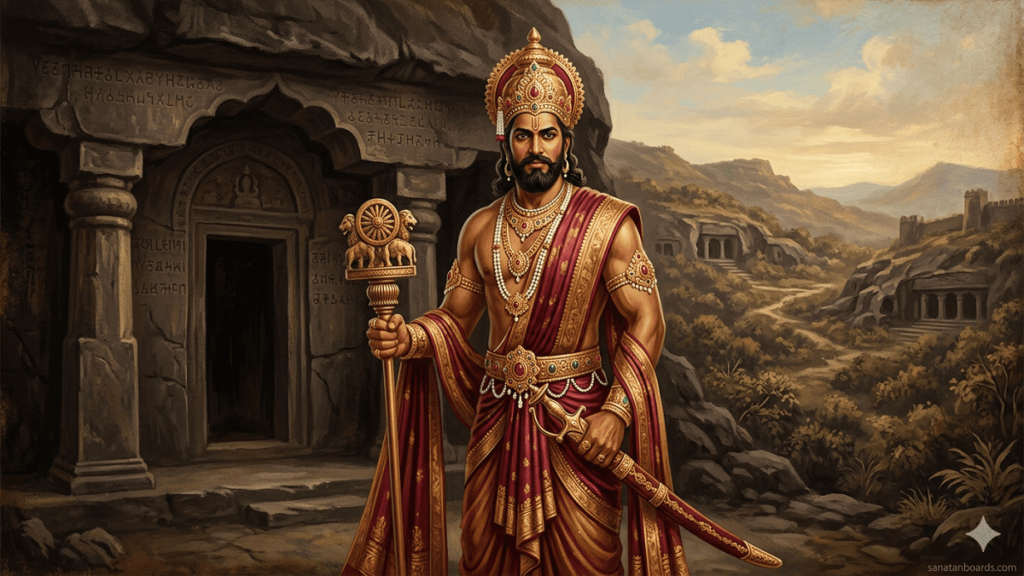
What Is Satavahana Empire – King Gautamiputra Satakarni ?
The Satavahana Empire was a major Indian dynasty that ruled parts of central and southern India, mainly the Deccan plateau, from around the 1st century BCE to the 3rd century CE. The Satavahanas played a pivotal role in bridging the northern and southern regions of India through trade, culture, and politics. They are credited with promoting art, architecture, religion, and economic stability in ancient India.
King Gautamiputra Satakarni is considered the most illustrious ruler of the Satavahana dynasty. He ascended the throne at a young age and quickly established his authority by defeating powerful rivals such as the Shakas, Western Kshatrapas, and Pandyas. His reign is celebrated for its military achievements, administrative reforms, and cultural contributions.
Gautamiputra Satakarni left behind significant historical records, including inscriptions and coins, that provide valuable insights into the governance, economy, and social structure of his time. He supported multiple religions, including Buddhism and Hinduism, which fostered a climate of religious tolerance and cultural development.
The Satavahana Empire under his leadership witnessed flourishing trade routes connecting India to Southeast Asia and the Mediterranean world. Agricultural development, urban centers, and maritime trade thrived, contributing to the overall prosperity of the empire.
In addition to his military and economic accomplishments, Gautamiputra Satakarni emphasized welfare and justice, earning a reputation as a benevolent ruler. His legacy continues to be studied in educational institutions, serving as an example of strong and effective leadership in ancient India.
Who Is Required Satavahana Empire – King Gautamiputra Satakarni ?
SATAVAHANA EMPIRE – KING GAUTAMIPUTRA SATAKARNI can be interpreted as who benefits from studying or understanding this historical figure and empire. The answer spans multiple audiences interested in education, history, culture, and governance.
- Students and Educators: Knowledge about Gautamiputra Satakarni and the Satavahana Empire is essential for students studying Indian history. Understanding his reign helps learners grasp the evolution of early Indian political systems, trade networks, and cultural practices. Teachers use this material to explain the consolidation of power in ancient India and the administrative strategies that sustained large empires.
- Historians and Researchers: Scholars and historians find Gautamiputra Satakarni indispensable for reconstructing the socio-political and economic conditions of the Deccan region. His inscriptions, coins, and historical records provide primary sources for research into ancient Indian dynasties, warfare, and cultural interactions.
- Cultural Enthusiasts: Anyone interested in India’s rich cultural heritage can benefit from learning about the Satavahana Empire. Gautamiputra Satakarni’s patronage of religion, arts, and architecture showcases early examples of religious tolerance and regional art forms, which remain culturally significant today.
- Policy Analysts and Leaders: Leadership lessons from Gautamiputra Satakarni’s reign can inspire modern administrators and policymakers. His emphasis on justice, welfare, and strategic diplomacy offers timeless insights into governance and statecraft.
- Tourists and Heritage Professionals: Archaeologists, historians, and tourists exploring ancient Indian sites require this knowledge to appreciate historical monuments, inscriptions, and regional heritage linked to the Satavahana period.
When Satavahana Empire – King Gautamiputra Satakarni Is Required ?
The Satavahana Empire rose to prominence around the 1st century BCE and lasted until the 3rd century CE. During this period, India was marked by regional kingdoms and frequent conflicts over territory and trade routes. Gautamiputra Satakarni ascended the throne in this complex environment and redefined the political landscape of central and southern India. His reign is believed to have been in the early 2nd century CE, and it marked the peak of Satavahana power.
The “when” is critical for educational purposes because it situates the Satavahana Empire within a larger historical timeline. Students studying ancient Indian history need to place this dynasty alongside other contemporaneous powers, such as the Shakas, the Western Kshatrapas, and the Kushanas. This timeline demonstrates how Gautamiputra Satakarni successfully defended his kingdom against external invasions, stabilized regional politics, and expanded trade networks during a time of fragmentation.
Additionally, knowing the timing of his reign is important for understanding cultural and economic developments. The Satavahana period coincided with flourishing Buddhist art, early Hindu temples, and trade with the Roman Empire. Maritime routes, agriculture, and urban centers prospered under his governance. By studying the “when,” learners can connect historical events with broader patterns of human development, technology, and culture.
From a modern perspective, the “when” also emphasizes the relevance of this knowledge today. Historical studies focused on early 2nd century CE provide lessons in leadership, governance, and cultural integration. This makes SATAVAHANA EMPIRE – KING GAUTAMIPUTRA SATAKARNI a significant reference point not just in history textbooks but also in comparative studies of empires, trade networks, and political strategy.
Where Satavahana Empire – King Gautamiputra Satakarni Is Required ?
The Satavahana Empire primarily covered large portions of central and southern India, including present-day Maharashtra, Andhra Pradesh, Telangana, Madhya Pradesh, and Karnataka. The strategic location of the empire allowed it to control important trade routes between northern India, the Deccan plateau, and coastal ports that connected India to the Mediterranean, the Middle East, and Southeast Asia. The Western Deccan region, especially areas around Nashik, Nasik, and Amaravati, became cultural and administrative hubs under Gautamiputra Satakarni.
Educationally, the “where” is essential for students, historians, and tourists. Understanding the locations of Satavahana inscriptions, coins, and archaeological sites helps contextualize the empire’s influence. For instance, Nasik caves and Karle caves bear inscriptions referencing Gautamiputra Satakarni’s reign, reflecting his patronage of religion and art. Similarly, coins found in regions from Maharashtra to Telangana reveal the extent of trade and economic integration under his rule.
The geographic significance of the Satavahana Empire also highlights the role of rivers and ports. The Godavari and Krishna rivers were vital for agriculture, transportation, and trade, while western ports like Dharanikota and Kalyan facilitated maritime commerce. Modern researchers study these locations to understand ancient urban planning, trade networks, and cultural diffusion.
Today, learning “where” Gautamiputra Satakarni ruled and administered provides a spatial perspective of ancient Indian history. Schools, colleges, museums, and heritage sites across India emphasize these locations to help students connect textual knowledge with real-world geography. Additionally, understanding “where” the Satavahana Empire thrived allows policymakers and cultural organizations to preserve archaeological and historical sites for educational and tourism purposes.
How Satavahana Empire – King Gautamiputra Satakarni Is Required ?
SATAVAHANA EMPIRE – KING GAUTAMIPUTRA SATAKARNI explores the ways in which his reign, policies, and accomplishments are relevant and can be studied or applied in modern contexts.
How is it studied historically?
Scholars study Gautamiputra Satakarni through inscriptions, coins, and literary references. The famous Nasik inscription records his achievements, victories over rival kingdoms, and administrative reforms. Coins minted during his reign help historians understand the economic systems, trade routes, and symbolic messaging of the Satavahana Empire. Archaeological excavations at sites like Amaravati and Karle caves reveal his contribution to religious architecture, art, and urban development.
How is it relevant educationally?
In schools and universities, his reign is included in history curricula to illustrate early Indian governance, leadership, and regional power dynamics. Teachers use maps, artifacts, and timelines to explain his military conquests, consolidation of territory, and cultural contributions. By studying how Gautamiputra Satakarni ruled, students learn lessons in diplomacy, strategic thinking, and statecraft.
How is it applied culturally and socially?
Modern historians and cultural organizations analyze his policies of religious tolerance and support for both Buddhism and Hinduism to understand cultural integration. Students of sociology and cultural studies explore how his administration promoted cohesion in a multi-ethnic, multi-religious society.
How is it relevant today?
The “how” also extends to leadership and governance lessons. Contemporary policymakers and leaders can draw inspiration from his strategic defense of the empire, efficient administration, and emphasis on welfare. Additionally, heritage tourism and archaeology use his historical sites to educate the public about India’s ancient past.
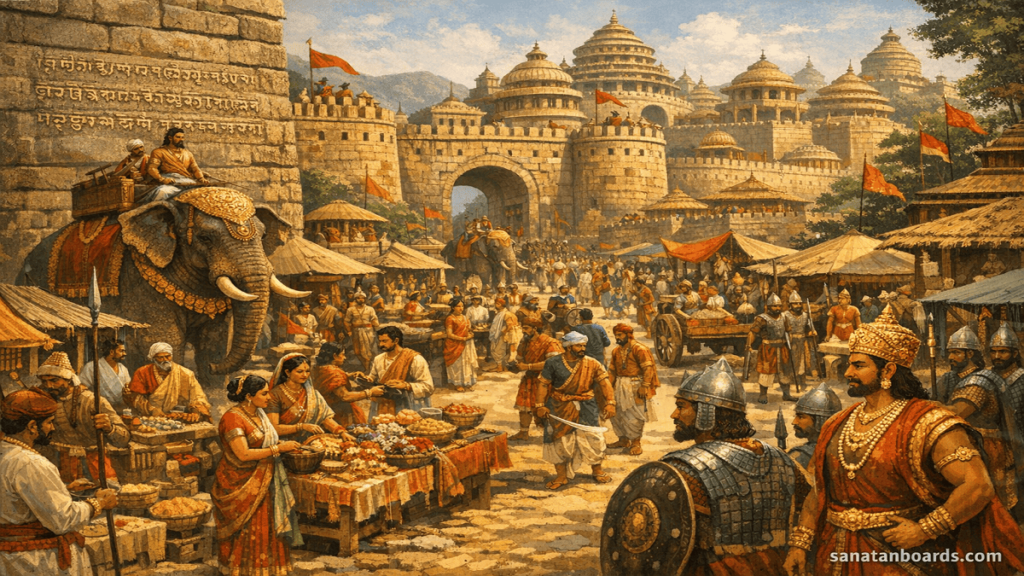
Case Study On Satavahana Empire – King Gautamiputra Satakarni
Introduction
The Satavahana Empire, which flourished from the 1st century BCE to the 3rd century CE, represents a pivotal era in Indian history. Among its rulers, King Gautamiputra Satakarni stands out for consolidating the empire, defeating rival powers, and fostering economic, cultural, and religious growth. This case study explores his reign, governance strategies, military campaigns, cultural contributions, and enduring legacy, highlighting why his leadership remains a key focus for educational and historical learning.
Historical Background
The Satavahana dynasty emerged after the decline of the Mauryan Empire, filling a power vacuum in the Deccan and central India. The empire’s foundation rested on strategic geographical positioning, which allowed control over fertile lands, major rivers like the Godavari and Krishna, and trade routes linking the north and south of India.
Before Gautamiputra Satakarni, the empire faced threats from the Shakas (Western Kshatrapas), regional Pandyas, and internal succession disputes. The political landscape demanded a strong and strategic leader to unify the empire and secure its borders.
Military Campaigns and Political Consolidation
King Gautamiputra Satakarni ascended the throne at a young age and quickly established his authority through military prowess. He successfully defeated the Shakas, thereby reclaiming lost territories and asserting Satavahana dominance in central India. His campaigns against rival dynasties, including the Pallavas and Pandyas, strengthened the empire’s southern frontiers and expanded influence across the Deccan.
Strategically, Gautamiputra Satakarni combined military might with diplomacy, forming alliances when advantageous and consolidating territories through efficient governance. His inscriptions, particularly the Nasik cave inscription, celebrate these victories and reflect his ambition to establish a unified, stable empire.
Administrative Reforms
Gautamiputra Satakarni’s administration was marked by centralized control coupled with regional governance. Governors and local officials oversaw provinces, while the king maintained authority over taxation, trade regulation, and military organization. Agricultural development received special attention, ensuring surplus production and economic stability.
Coins issued during his reign provide insight into economic systems and the symbolic authority of the king. These coins, featuring royal insignia and references to his victories, promoted loyalty, legitimacy, and trust in governance.
Cultural and Religious Contributions
Beyond politics, Gautamiputra Satakarni was a patron of religion and art. He supported Buddhism, Hinduism, and local spiritual traditions, fostering cultural harmony. Cave complexes, such as the Nasik and Karle caves, bear inscriptions and carvings indicating royal sponsorship for religious and artistic endeavors.
The empire under his reign witnessed flourishing trade and urban development. Western coastal ports enabled commerce with the Roman Empire, while inland trade connected central India with southern kingdoms. This economic prosperity further supported the growth of art, architecture, and religious institutions.
Legacy and Educational Significance
The reign of Gautamiputra Satakarni is studied today as a model of effective leadership, combining military strategy, administrative efficiency, and cultural patronage. His rule illustrates how early Indian kingdoms managed internal and external challenges, providing lessons in governance, diplomacy, and economic planning.
Educational institutions use his reign to teach history, politics, and culture. Archaeologists study inscriptions and coins to reconstruct socio-political and economic conditions. Heritage sites associated with the Satavahanas serve as living classrooms, allowing students and researchers to experience history firsthand.
Conclusion
The case study of SATAVAHANA EMPIRE – KING GAUTAMIPUTRA SATAKARNI highlights the interplay between military conquest, administrative acumen, #satavahanaempireinlucknow economic management, and cultural development. His reign not only secured the Satavahana Empire’s place in Indian history but also offers enduring lessons for scholars, #satavahanaempireinsrajasthan students, and cultural enthusiasts.
White Paper On Satavahana Empire – King Gautamiputra Satakarni
Executive Summary
The Satavahana Empire, a significant Indian dynasty from the 1st century BCE to the 3rd century CE, played a pivotal role in shaping early Indian political, economic, and cultural landscapes. Among its rulers, King Gautamiputra Satakarni stands out as a transformative leader who consolidated territories, strengthened governance, and promoted cultural development. This white paper explores his reign, historical significance, administrative strategies, cultural contributions, and relevance in contemporary education and research.
Introduction
The Satavahana dynasty bridged northern and southern India, fostering trade, culture, and political stability. Gautamiputra Satakarni, considered the greatest Satavahana ruler, ascended the throne during a period of fragmentation and regional conflict. His reign represents the peak of Satavahana power, marked by military victories, territorial consolidation, economic growth, and cultural patronage.
This white paper analyzes his contributions to governance, trade, religious tolerance, and education, offering insights into how early Indian empires managed complex societies.
Historical Context
Following the decline of the Mauryan Empire, central and southern India experienced political fragmentation. The Satavahanas emerged as a unifying force, controlling strategic regions including present-day Maharashtra, Telangana, Andhra Pradesh, Karnataka, and Madhya Pradesh.
Before Gautamiputra Satakarni’s reign, the empire faced constant threats from Shakas (Western Kshatrapas), southern dynasties like the Pandyas, and internal succession disputes. These challenges necessitated a leader capable of military strategy, administrative acumen, and economic foresight.
Military Leadership and Territorial Consolidation
Gautamiputra Satakarni is renowned for his military campaigns that consolidated Satavahana power. He decisively defeated the Shakas, regaining lost territories and asserting dominance over central India. Campaigns against southern rivals, including the Pallavas and Pandyas, expanded the empire’s influence to the Deccan and coastal regions.
His strategy combined force with diplomacy. Alliances were formed to stabilize borders, while local governance structures ensured loyalty and administrative efficiency. Inscriptions, such as the Nasik inscription, document these victories and highlight his claim as a unifying monarch.
Administrative and Economic Strategies
Gautamiputra Satakarni’s administration balanced centralized control with regional governance. Governors and officials managed provinces, while the central authority oversaw taxation, trade, and military organization. Key administrative policies included:
- Agricultural promotion: Investment in irrigation and land management to ensure food security.
- Trade regulation: Ports and riverine routes were maintained to facilitate commerce with foreign and domestic markets.
- Currency system: Coins issued during his reign standardized economic transactions and reflected royal authority.
The empire’s prosperity under Gautamiputra Satakarni allowed for urban development, including markets, trade centers, and religious monuments. Trade extended beyond India, reaching the Roman Empire via western ports, showcasing the Satavahana contribution to global commerce.
Cultural and Religious Contributions
Gautamiputra Satakarni was a patron of religion and art, supporting Buddhism, Hinduism, and regional spiritual practices. Cave complexes, including Nasik and Karle, reflect royal sponsorship of artistic and religious endeavors.
Cultural policies encouraged religious tolerance, education, and knowledge preservation. His support for Buddhism and Hinduism promoted harmony and strengthened the empire’s social cohesion. Additionally, art and architecture from this period influenced subsequent Indian dynasties, leaving a lasting legacy.
Educational Significance
Studying SATAVAHANA EMPIRE – KING GAUTAMIPUTRA SATAKARNI provides critical insights for educators, historians, and students. Key educational benefits include:
- Leadership studies: Analyzing military strategy, governance, and diplomacy.
- Cultural understanding: Exploring religious tolerance and artistic patronage.
- Economic history: Understanding trade, currency, and urban development in ancient India.
Artifacts, coins, inscriptions, and archaeological sites serve as primary teaching tools, linking theoretical knowledge to tangible historical evidence.
Contemporary Relevance
The reign of Gautamiputra Satakarni is relevant beyond historical study. Leadership lessons, strategies for managing diverse populations, and approaches to economic development are applicable in modern governance and policy-making. Heritage tourism and preservation of historical sites continue to educate and inspire the public, emphasizing the importance of cultural legacy.
Conclusion and Recommendations
SATAVAHANA EMPIRE – KING GAUTAMIPUTRA SATAKARNI exemplifies the integration of military strategy, governance, economic management, and cultural #satavahanaempireinsouth patronage. Key takeaways include:
- Strong, strategic leadership is critical for empire-building and stability.
- Economic development and trade facilitation underpin long-term prosperity.
- Cultural patronage and religious tolerance foster societal cohesion.
- Historical study provides lessons for education, governance, and heritage preservation.
Educational institutions, policymakers, and cultural organizations are encouraged to incorporate his reign into curricula, research, and heritage initiatives to preserve #satavahanaempireinkarnataka knowledge and inspire future generations.
Industry Application On Satavahana Empire – King Gautamiputra Satakarni
Introduction
The historical legacy of the Satavahana Empire and its illustrious ruler, King Gautamiputra Satakarni, extends beyond textbooks into multiple contemporary industries. From education to heritage tourism, leadership training, cultural preservation, and even digital content creation, the study of this ancient empire has practical applications in today’s economy. This section explores how industries can leverage knowledge about the Satavahana period to create educational, cultural, and business value.
1. Education and Academic Industry
SATAVAHANA EMPIRE – KING GAUTAMIPUTRA SATAKARNI serves as a cornerstone for historical and cultural education. Academic publishers, online learning platforms, and educational technology companies use his reign to develop curricula and learning materials:
- Textbooks and e-Learning Modules: Schools and universities include chapters on Satavahana history to teach Indian political evolution, trade systems, and cultural integration. Digital platforms create interactive content using maps, timelines, and 3D reconstructions of Satavahana sites.
- Historical Research Institutes: Scholars utilize inscriptions, coins, and cave sites to conduct research on governance, economy, and art, which contributes to academic publications and conferences.
- Educational Tours and Workshops: Institutions organize field trips to Nasik, Karle, and Amaravati caves, allowing students to engage directly with historical artifacts, deepening understanding of ancient Indian governance and culture.
This application highlights how historical knowledge supports curriculum development, digital learning, and experiential education, bridging past and present.
2. Heritage Tourism and Cultural Industry
Tourism and heritage sectors benefit directly from the legacy of Gautamiputra Satakarni:
- Archaeological and Heritage Sites: Caves, inscriptions, and ancient city remnants attract local and international tourists. Heritage management companies design tours, guided experiences, and educational exhibits.
- Cultural Festivals: Reenactments, exhibitions, and festivals celebrating Satavahana history promote local economies and cultural appreciation.
- Museum Exhibits: Coins, sculptures, and inscriptions are displayed in museums, accompanied by storytelling and digital experiences that highlight the ruler’s achievements.
These initiatives drive cultural tourism, local employment, and global awareness of India’s ancient heritage.
3. Leadership and Management Training
King Gautamiputra Satakarni’s reign provides lessons in strategic leadership, diplomacy, and governance. Corporate training and consultancy firms integrate his case studies into programs:
- Strategy Workshops: Business schools use his military campaigns and administrative efficiency as analogies for strategic planning, conflict resolution, and resource management.
- Leadership Development: Principles of governance, delegation, and ethical leadership from his reign inspire training modules for modern executives.
- Policy Analysis: Government and public administration courses study his reforms in taxation, trade, and cultural integration to understand historical models of sustainable governance.
This translates ancient wisdom into practical leadership applications across industries and institutions.
4. Digital Content and Media Industry
The entertainment and digital content sector leverages historical figures like Gautamiputra Satakarni for storytelling:
- Documentaries and Educational Films: Streaming platforms and broadcasters produce content based on the Satavahana Empire, bringing history to a global audience.
- Gaming and VR Experiences: Game developers create historically accurate simulations of Satavahana cities, battles, and trade networks, combining entertainment with education.
- Social Media and Digital Campaigns: Museums and heritage organizations use digital campaigns featuring Satavahana history to engage younger audiences, increasing awareness of India’s ancient civilizations.
By integrating history with technology, this application demonstrates innovation and engagement in cultural education.
5. Cultural Preservation and Archaeology Industry
Knowledge of Gautamiputra Satakarni informs heritage conservation, archaeological research, and urban planning:
- Archaeological Excavations: Companies and institutions use advanced methods to preserve inscriptions, coins, and cave architecture.
- Restoration Projects: Cultural preservation firms reconstruct ancient sites and develop protective measures, promoting sustainable tourism.
- Policy and Advisory Services: Experts advise government agencies on preserving Satavahana-era heritage while balancing development and conservation.
This ensures that historical knowledge has a tangible, lasting impact on industry practices.
6. Economic and Trade Studies
The Satavahana Empire’s emphasis on trade, currency, and agriculture provides insights for modern economic education and consultancy:
- Trade Networks Analysis: Study of maritime and inland trade during Gautamiputra Satakarni’s reign informs research on supply chain management and regional commerce.
- Economic Policy Learning: His taxation and administrative policies serve as historical models for managing resources efficiently.
- Agri-business Insights: Understanding ancient agricultural strategies provides case studies for sustainable practices in developing regions.
These applications highlight cross-disciplinary value, bridging history, economics, and management.
Conclusion
The study of SATAVAHANA EMPIRE – KING GAUTAMIPUTRA SATAKARNI extends far beyond academia. Its applications touch:
- Education: Curriculum development, research, and experiential learning.
- Heritage and Tourism: Archaeological preservation, cultural tourism, and local economic development.
- Leadership and Management: Strategic planning, governance, and policy modeling.
- Digital Media: Documentaries, games, VR, and digital storytelling.
- Cultural Preservation: Archaeology, restoration, and advisory services.
- Economic Studies: Trade, taxation, and agricultural insights.
This demonstrates the enduring relevance of #sanatandharmaaccreditationboardsinmumbai historical study, showing that ancient #sanatandharmaaccreditationboardsindelhi knowledge can fuel modern industry, innovation, and cultural appreciation.
source : Crazy Color Facts
ASK FAQ
Who was Gautamiputra Satakarni?
King Gautamiputra Satakarni was the most celebrated ruler of the Satavahana Empire, known for consolidating the kingdom, defeating rival dynasties like the Shakas, and promoting cultural and economic growth.
When did the Satavahana Empire flourish?
The Satavahana Empire ruled central and southern India approximately from the 1st century BCE to the 3rd century CE, with Gautamiputra Satakarni reigning in the early 2nd century CE.
Where was the Satavahana Empire located?
The empire primarily covered present-day Maharashtra, Andhra Pradesh, Telangana, Karnataka, and Madhya Pradesh, controlling strategic trade routes and fertile regions of the Deccan.
What were Gautamiputra Satakarni’s key achievements?
His key achievements include defeating the Shakas, consolidating the Satavahana Empire, supporting Buddhism and Hinduism, promoting trade, and issuing coins that standardized the economy.
Why is the Satavahana Empire important today?
The empire is important for historical education, cultural preservation, leadership studies, heritage tourism, and understanding ancient Indian governance, trade, and art.
Table of Contents
Disclaimer
All information provided in this content is intended for educational, informational, and knowledge purposes only. The historical details about SATAVAHANA EMPIRE – KING GAUTAMIPUTRA SATAKARNI are based on available scholarly research, inscriptions, coins, and archaeological evidence. Interpretations may vary depending on new findings or academic perspectives. This content is not intended for commercial, professional, or legal advice. Readers, educators, and students should cross-check with verified historical sources or academic publications before citing or applying the information. The creators of this content disclaim responsibility for any inaccuracies, omissions, or decisions made based on the material provided.