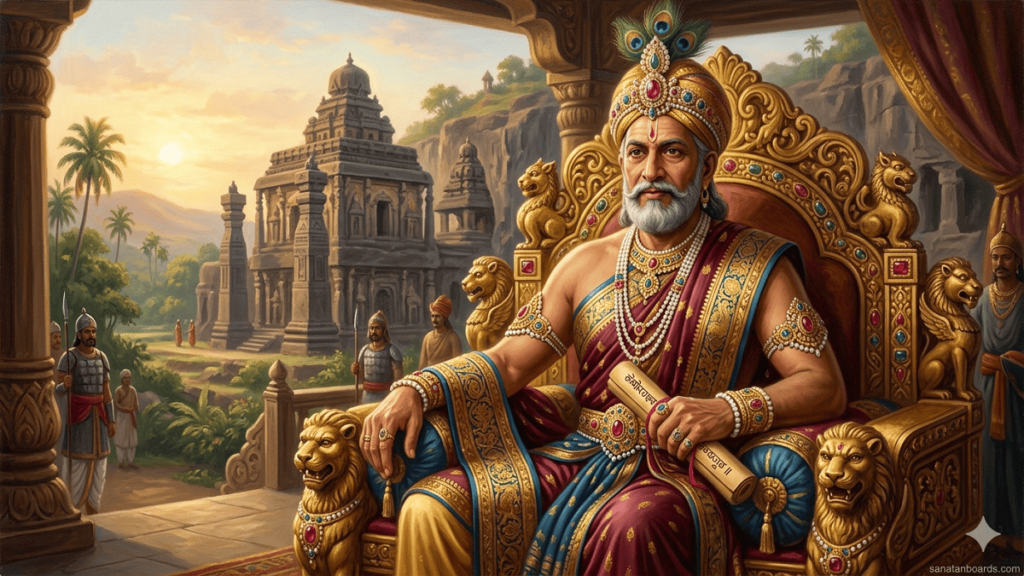
The Rashtrakuta Empire was one of the most powerful dynasties in medieval India, flourishing between the 8th and 10th centuries CE. Its influence extended across the Deccan region, covering modern-day Karnataka, Maharashtra, and parts of Andhra Pradesh. Among the most celebrated rulers of this dynasty was King Amoghavarsha I, who reigned from 814 to 878 CE. His rule is remembered not just for military strength but also for cultural, religious, and literary contributions.
King Amoghavarsha was a patron of art, literature, and religion. He encouraged scholars and poets, most notably the famous Kannada poet Sri Pampa, whose works flourished under his reign. The king was also deeply involved in promoting Jainism fostering a spirit of tolerance and harmony among various religions. Under his leadership, the Rashtrakutas established a strong administrative system that maintained order and prosperity across the empire.
Architecturally, the period saw remarkable achievements, including the construction of rock-cut temples at Ellora and cultural centers across the Deccan plateau. The legacy of King Amoghavarsha continues to inspire historians and students as an example of enlightened leadership, blending political power with cultural enrichment.
What Is Rashtrakuta Empire – King Amoghavarsha ?
The Rashtrakuta Empire – King Amoghavarsha represents one of the most remarkable chapters in Indian history, combining political strength with cultural brilliance. The Rashtrakutas were a dominant dynasty in the Deccan region, with their capital at Manyakheta (present-day Karnataka). They controlled vast territories, influencing both northern and southern India through trade, military conquests, and diplomatic alliances.
King Amoghavarsha I is the most renowned ruler of this dynasty, reigning for more than six decades from 814 to 878 CE. His rule is considered a golden period in the history of the Rashtrakutas due to his emphasis on cultural, literary, and religious development alongside stable governance. Unlike many rulers of his era, Amoghavarsha was not only a warrior but also a scholar and poet. His contributions to Kannada literature are highly significant, with his work “Kavirajamarga” being recognized as the earliest known literary work in Kannada, laying the foundation for future writers.
Amoghavarsha’s reign was marked by religious tolerance. Although he personally followed Jainism, he supported Hinduism and Buddhism, promoting harmony among various faiths. This helped create a culturally rich and inclusive society in the Rashtrakuta Empire.
Administratively, the king established a well-structured system with efficient revenue collection, local governance, and military organization. The empire flourished economically through agriculture, trade, and urban development. Moreover, the period witnessed remarkable architectural advancements, including elaborate rock-cut temples, sculptures, and monasteries.
Who Is Required Rashtrakuta Empire – King Amoghavarsha ?
The question “Who is required RASHTRAKUTA EMPIRE – KING AMOGHAVARSHA” can be understood in terms of who benefits from studying or understanding this historical period and its prominent ruler, King Amoghavarsha. His reign is not only a matter of historical record but also serves as an educational and cultural resource for various groups.
1. Students and Scholars of History:
History students, especially those studying medieval Indian dynasties, find the Rashtrakuta Empire and King Amoghavarsha crucial. His rule provides insights into governance, political strategy, military conquests, and societal structures of the 9th century. Scholars studying Indian history or comparative empires can analyze his administrative policies and cultural contributions to understand the evolution of Indian governance.
2. Literature Enthusiasts:
King Amoghavarsha was an accomplished scholar and poet. Anyone studying the Kannada language or Indian literature benefits from his works, particularly the Kavirajamarga, which laid the foundation for Kannada literary tradition. Literary students and researchers gain knowledge about the linguistic, poetic, and philosophical frameworks of that era.
3. Cultural and Religious Researchers:
Amoghavarsha’s patronage of Jainism, along with support for Hinduism and Buddhism, makes him significant for scholars exploring religious harmony, tolerance, and cultural integration in medieval India. Understanding his approach to religion helps analyze the coexistence of diverse faiths in Indian history.
4. Archaeologists and Art Historians:
The Rashtrakuta period produced remarkable architectural achievements, including rock-cut temples at Ellora and monolithic structures. Architects, archaeologists, and art historians studying Indian temple architecture, iconography, and sculpture find King Amoghavarsha’s reign essential for tracing cultural and artistic developments.
5. General Learners and Enthusiasts:
Anyone with an interest in Indian history, leadership, or governance can benefit from learning about Amoghavarsha. His balanced approach to ruling—combining power with scholarship, administration with culture—serves as an example of enlightened leadership.
When Rashtrakuta Empire – King Amoghavarsha Is Required ?
1. Historical Context:
The period during which Amoghavarsha ruled was a time of consolidation for the Rashtrakutas. Earlier, the Deccan region experienced frequent conflicts among local dynasties. Amoghavarsha’s reign brought a long era of peace, which enabled economic prosperity and cultural progress. Therefore, this timeline is crucial for historians to understand the evolution of medieval Indian empires.
2. Cultural and Literary Significance:
The 9th century, Amoghavarsha’s era, is considered a golden age for Kannada literature. Works like Kavirajamarga emerged during this time, providing insights into linguistic development and literary style. Knowing when he ruled helps literature students and historians place these contributions in the correct chronological framework and analyze their influence on later periods.
3. Architectural Developments:
This period also saw the construction of iconic rock-cut temples, including those at Ellora and Pattadakal. The timeline is essential for archaeologists and art historians to attribute architectural styles and innovations accurately to the Rashtrakuta period, connecting them to Amoghavarsha’s reign.
4. Religious and Social Context:
Amoghavarsha’s support for Jainism, alongside Hinduism and Buddhism, created a society where religious tolerance flourished. Understanding when he ruled helps contextualize these social policies within broader historical developments, including the interplay of dynasties and religious movements in the Deccan.
5. Modern Relevance:
Studying the specific time of his reign allows educators and learners to compare ancient governance, culture, and society with contemporary practices. It demonstrates the importance of timing in historical developments—how a long, stable reign like Amoghavarsha’s could foster literature, art, and religion
Where Rashtrakuta Empire – King Amoghavarsha Is Required ?
1. Core Region of the Empire:
The Rashtrakuta Empire was primarily based in the Deccan region of India, with its capital at Manyakheta (present-day Malkhed in Karnataka). From this strategic location, Amoghavarsha ruled vast territories encompassing present-day Karnataka, Maharashtra, Andhra Pradesh, Telangana, and parts of Madhya Pradesh. Understanding where the empire was centered helps scholars study the administrative divisions, trade routes, and cultural exchanges of the time.
2. Cultural and Architectural Sites:
Many historically significant locations from his reign are still accessible today. These include:
- Ellora Caves (Maharashtra): Rock-cut temples and monolithic structures reflecting Rashtrakuta architectural brilliance.
- Pattadakal (Karnataka): A UNESCO World Heritage site featuring Chalukya-Rashtrakuta temple styles.
- Malkhed (Karnataka): The ancient capital, which was the hub of administration, learning, and cultural activity.
These sites are where Amoghavarsha’s influence is most directly observed and studied, making them vital for historians, archaeologists, and tourists interested in medieval Indian heritage.
3. Literary and Religious Centers:
Amoghavarsha’s court attracted scholars and poets across regions. Karnataka, in particular, became the center of Kannada literature, while his support for Jainism established important monasteries and learning centers. Places like Shravanabelagola still hold relics of his patronage, reflecting the religious and educational footprint of his reign.
4. Modern Relevance:
Today, the “where” extends beyond geography to educational institutions, museums, and research centers that study Rashtrakuta history. Universities and history departments in India, especially in Karnataka and Maharashtra, focus on this region to understand medieval politics, literature, and architecture.
How Rashtrakuta Empire – King Amoghavarsha Is Required ?
Understanding “How is required RASHTRAKUTA EMPIRE – KING AMOGHAVARSHA” involves exploring the ways in which studying the Rashtrakuta Empire and King Amoghavarsha can be applied for educational, cultural, and scholarly purposes. It highlights how this knowledge is relevant, preserved, and utilized today.
1. Through Education:
Learning about Amoghavarsha and the Rashtrakuta Empire is done primarily through academic curricula in history and literature. Schools and universities include his reign in medieval Indian history courses, emphasizing governance, administration, and cultural achievements. Students analyze his policies, military strategies, and support for literature to understand how effective leadership can foster prosperity and intellectual growth.
2. Through Literature and Language:
King Amoghavarsha’s work Kavirajamarga is a foundational text for the Kannada language. Studying this text shows how literary works shaped language, poetry, and cultural expression during his reign. Scholars and students examine his contributions to understand early linguistic standards, poetic styles, and literary criticism.
3. Through Architecture and Archaeology:
Amoghavarsha’s rule saw remarkable architectural developments, including rock-cut temples at Ellora and monolithic structures at Pattadakal. Archaeologists, art historians, and heritage enthusiasts study these structures to see how engineering, artistic expression, and religious devotion were implemented. Through field visits, surveys, and preservation projects, they learn the practical methods of cultural conservation.
4. Through Religious and Cultural Studies:
Amoghavarsha promoted religious tolerance, supporting Jainism, Hinduism, and Buddhism. Researchers study how such policies created social harmony and cultural synthesis. Understanding how he ruled with tolerance and intellectual engagement provides insights into conflict resolution and societal development.
5. Through Modern Applications:
The methods of governance, cultural patronage, and literature promotion during Amoghavarsha’s reign inspire modern leadership studies. Public administrators, policymakers, and cultural institutions analyze how combining power with culture and education can create sustainable social progress.
Case Study On Rashtrakuta Empire – King Amoghavarsha
Introduction
The Rashtrakuta Empire was one of medieval India’s most influential dynasties, known for its extensive territorial control, cultural contributions, and administrative innovations. Among its rulers, King Amoghavarsha I (814–878 CE) stands out as a figure who combined political authority with scholarly and cultural leadership. This case study explores his reign, governance, literary and religious contributions, architectural achievements, and the enduring legacy of the Rashtrakuta Empire. The study provides insights into how medieval Indian rulers maintained stability, promoted cultural growth, and influenced future generations.
Historical Context
The Rashtrakutas rose to prominence in the Deccan region during the 8th century, consolidating territories across present-day Karnataka, Maharashtra, Andhra Pradesh, and Telangana. The empire acted as a bridge between northern and southern India, fostering trade, military alliances, and cultural exchanges. Amoghavarsha ascended the throne in 814 CE following the death of his father, Dhruva Dharavarsha, and reigned for more than six decades. His long rule provided political stability, enabling economic prosperity, infrastructure development, and cultural flourishing.
Political Governance and Administration
King Amoghavarsha implemented a well-structured administrative system. The empire was divided into provinces governed by officials who ensured revenue collection, law enforcement, and local governance. The king maintained a professional army to protect the borders, suppress rebellions, and expand influence. Unlike many rulers of his time, Amoghavarsha focused on peaceful diplomacy alongside military strength, allowing the empire to consolidate power without excessive warfare. This balance between authority and strategy demonstrates effective leadership in a complex socio-political environment.
Literary and Scholarly Contributions
Amoghavarsha was not only a ruler but also a scholar and patron of literature. His work Kavirajamarga is considered the earliest known literary work in Kannada and serves as a guide on poetry, grammar, and aesthetics. The text provides valuable insights into the linguistic, literary, and cultural standards of the time. Under his patronage, poets such as Sri Pampa flourished, producing epic poetry that continues to influence Kannada literature. By promoting literature, Amoghavarsha ensured that culture and learning were central to governance, creating a legacy of intellectual enrichment.
Religious Contributions and Social Harmony
King Amoghavarsha was a devout follower of Jainism, yet he promoted religious tolerance across the empire. He supported Hinduism, Buddhism, and Jainism equally, establishing monasteries, temples, and educational centers. Shravanabelagola, a major Jain center, thrived under his reign. This approach fostered social cohesion and religious harmony, which became a model for future rulers in India.
Architectural Achievements
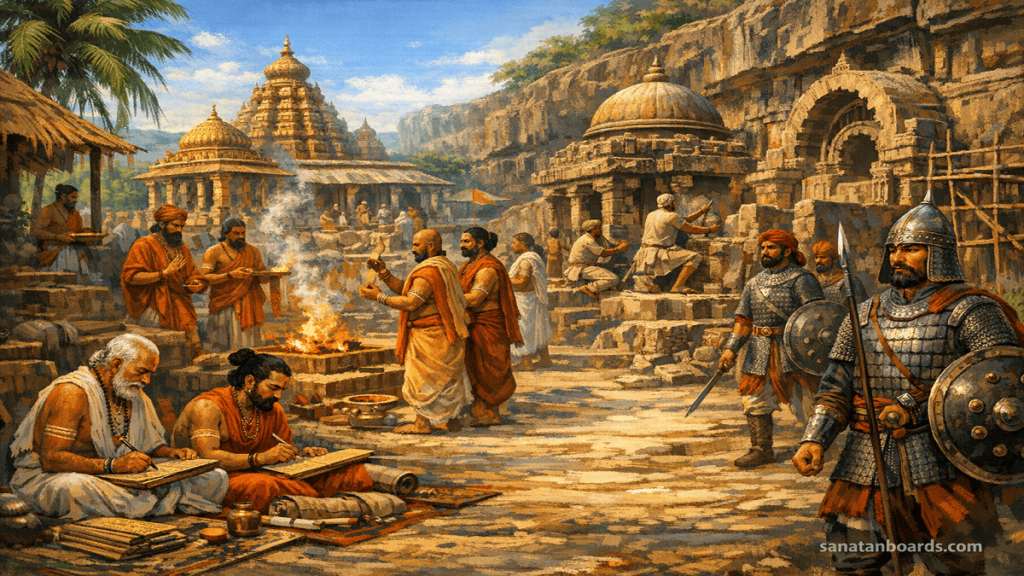
Amoghavarsha’s reign witnessed remarkable architectural developments. The Ellora Caves, especially the Rashtrakuta contributions, display rock-cut temples and monolithic structures. Pattadakal, a UNESCO World Heritage site, showcases a blend of Chalukyan and Rashtrakuta architectural styles. These sites reflect not only religious devotion but also advanced engineering skills, artistic excellence, and cultural sophistication.
Economic Development
The Rashtrakuta Empire flourished economically due to agriculture, trade, and urban development. Ports along the western coast facilitated maritime trade with Arabia and Southeast Asia. Internal trade networks ensured the distribution of resources, stimulating local economies. The king’s policies encouraged both rural and urban prosperity, creating a stable foundation for cultural and political achievements.
Legacy and Lessons
King Amoghavarsha’s reign illustrates the integration of political authority with cultural patronage, religious tolerance, and economic planning. Modern scholars study his governance as an example of sustainable leadership, where education, art, religion, and administration were interconnected. The empire’s architectural and literary contributions continue to inspire historians, architects, and writers.
Conclusion
The case study of RASHTRAKUTA EMPIRE – KING AMOGHAVARSHA highlights a ruler whose vision extended beyond conquest. . #rashtrakutaempireinnorthindia Through strategic governance, cultural patronage, religious inclusivity, and economic foresight, Amoghavarsha created a legacy that endured long after his reign. His life and achievements serve as a model for . #rashtrakutaempireinmumbai understanding the dynamics of medieval Indian empires, illustrating how leadership, scholarship, and culture can coexist to build a prosperous society.
White Paper On Rashtrakuta Empire – King Amoghavarsha
Executive Summary
The Rashtrakuta Empire, a prominent dynasty in medieval India, is renowned for its political influence, cultural contributions, and architectural achievements. At the forefront of this dynasty was King Amoghavarsha I (814–878 CE), whose reign is recognized as a golden period in Indian history. This white paper examines the Rashtrakuta Empire under Amoghavarsha, focusing on governance, culture, literature, architecture, religious policies, and modern implications for educational and cultural research. The document aims to provide a comprehensive overview to historians, educators, and cultural policymakers.
Introduction
The Rashtrakuta Empire emerged in the Deccan region, covering parts of modern Karnataka, Maharashtra, Andhra Pradesh, and Telangana. King Amoghavarsha I ascended to the throne in 814 CE, inheriting a strong political foundation established by his predecessors. His reign, which lasted over six decades, emphasized stability, cultural enrichment, and intellectual pursuits. Understanding his rule provides critical insights into effective medieval governance and the integration of cultural and political priorities.
Political Governance and Administrative Strategies
Amoghavarsha implemented a sophisticated administrative framework. The empire was divided into provinces, each managed by appointed governors responsible for law enforcement, revenue collection, and local governance. This structure ensured accountability and efficient administration. His approach combined diplomacy and military strategy, promoting stability without relying solely on force. The king’s policies enabled centralized control while allowing local autonomy, a model studied in contemporary public administration courses for insights into governance and decentralized management.
Cultural and Literary Contributions
One of Amoghavarsha’s defining achievements was his patronage of literature and arts. He authored Kavirajamarga, the earliest known work in Kannada, establishing linguistic and literary standards. His support for poets like Sri Pampa encouraged the creation of classical literature, which has endured for centuries. Literature under his reign not only documented historical events but also reflected societal values, ethical governance, and philosophical thought. Today, these texts are essential resources for language scholars, literary historians, and educators focusing on medieval Indian literature.
Religious Policy and Social Harmony
Amoghavarsha’s reign is notable for its religious inclusivity. A devout Jain, he supported Hinduism and Buddhism, fostering social cohesion and cultural integration. He established temples, monasteries, and educational centers, promoting dialogue among different faiths. This approach illustrates how rulers can combine personal belief with societal welfare, providing lessons in religious tolerance and inclusive policy-making.
Architectural and Artistic Achievements
The Rashtrakuta period witnessed unprecedented architectural development. Rock-cut temples at Ellora and monolithic structures at Pattadakal reflect technical mastery, artistic innovation, and spiritual expression. These monuments serve as both religious sites and historical records, highlighting the interplay between art, engineering, and cultural identity. Modern architects and historians study these works to understand construction techniques, stylistic evolution, and cultural symbolism.
Economic and Trade Contributions
Amoghavarsha’s reign also strengthened the empire’s economy. Agricultural productivity, urban growth, and internal trade networks ensured prosperity. Ports on the western coast facilitated maritime trade with Arabia and Southeast Asia. The economic strategies of the Rashtrakutas provide case studies for historians and economists studying sustainable resource management and trade policies in pre-modern societies.
Modern Implications and Applications
Studying the Rashtrakuta Empire under King Amoghavarsha informs multiple disciplines. In education, it provides context for history, literature, and cultural studies. In public administration, it offers lessons in decentralized governance and social cohesion. In architecture and heritage management, it illustrates preservation techniques and historical analysis. The study of Amoghavarsha’s reign can also inspire modern leadership models that integrate governance, culture, and societal well-being.
Conclusion
The Rashtrakuta Empire, under King Amoghavarsha I, represents a unique integration of political acumen, cultural patronage, and social responsibility. #rashtrakutaempireinmumbai His legacy extends beyond territorial conquests, influencing literature, architecture, religious tolerance, and economic prosperity. By analyzing his reign, modern scholars and policymakers . #rashtrakutaempireinsouthindia gain valuable insights into the effective management of complex societies, the promotion of culture and education, and the enduring impact of enlightened leadership.
Industry Application On Rashtrakuta Empire – King Amoghavarsha
Introduction
The Rashtrakuta Empire under King Amoghavarsha I (814–878 CE) is often studied in historical and cultural contexts, but its principles have applications across modern industries. From governance to architecture, literature, religious inclusivity, and economic management, the strategies and systems employed during his reign provide valuable lessons for modern sectors such as education, cultural heritage, tourism, administration, and creative industries. This document explores how knowledge of the Rashtrakuta Empire and King Amoghavarsha can be leveraged in contemporary professional and industrial settings.
1. Education and Research Industry
King Amoghavarsha’s patronage of literature and education makes the Rashtrakuta period highly relevant for educational institutions. Modern universities, especially those focusing on history, literature, and cultural studies, integrate his works, such as Kavirajamarga, into curricula to teach students about classical Indian literature, governance, and philosophy. Educational technology companies can develop interactive learning modules that simulate medieval administrative systems, trade, and cultural management, providing students with practical insights into historical leadership and societal organization.
2. Cultural Heritage and Tourism Industry
The architectural achievements of the Rashtrakutas, including Ellora Caves, Pattadakal, and Manyakheta, are major tourist attractions. The tourism and heritage industry can apply historical knowledge to preserve, restore, and market these sites. Heritage management firms use Amoghavarsha’s era as a case study in balancing cultural preservation with economic development, designing visitor experiences that educate while promoting sustainability. Virtual reality (VR) tours, augmented reality (AR) exhibits, and cultural festivals inspired by his reign can boost tourism revenues while preserving history.
3. Architecture and Construction Industry
The rock-cut temples and monolithic structures of the Rashtrakuta period reflect advanced engineering and artistic planning. Modern architects and civil engineers study these techniques for insights into durable design, spatial aesthetics, and sustainable construction methods. Adaptive reuse projects, inspired by Rashtrakuta architecture, can integrate historical styles into contemporary buildings, blending heritage with modern urban development.
4. Governance and Public Administration Sector
Amoghavarsha’s administrative strategies—dividing the empire into provinces, promoting efficient governance, and maintaining social harmony—offer lessons for modern public administration, corporate governance, and organizational management. Training programs can use his model to teach decentralized leadership, conflict resolution, and the integration of cultural values into policymaking. His approach to inclusive governance is particularly relevant for multicultural and multinational organizations today.
5. Arts, Literature, and Creative Industries
The promotion of Kannada literature under King Amoghavarsha demonstrates how cultural patronage fuels creativity. Publishing houses, media companies, and digital content creators can draw inspiration from his literary model to promote regional languages, develop classical content, and revive traditional art forms. Films, animated series, and documentaries based on Rashtrakuta history can create commercially viable content while educating audiences.
6. Religious Studies and Social Harmony Programs
Amoghavarsha’s support for multiple religions and his emphasis on tolerance provide a framework for interfaith initiatives, educational programs, and corporate social responsibility (CSR) projects. NGOs and cultural organizations can develop programs that reflect his model of inclusivity, fostering collaboration and understanding among diverse communities.
7. Economic and Trade Insights
The empire’s trade networks, agricultural management, and urban planning provide case studies for economic strategists, business schools, and logistics companies. Studying these systems helps modern professionals understand supply chain management, resource allocation, and sustainable urban development in historical contexts.
Conclusion
The RASHTRAKUTA EMPIRE – KING AMOGHAVARSHA provides a rich source of inspiration and practical lessons across multiple industries. From #sanatandharmaaccreditationboardsinmumbai education, tourism, and heritage management to architecture, public administration, creative arts, and economic strategy, the principles of governance, cultural patronage, and social harmony established during his reign continue to influence modern applications. #sanatandharmaaccreditationboardsindelhiBy leveraging historical knowledge, industries can create innovative solutions, preserve cultural identity, and enhance organizational efficiency while honoring the legacy of one of India’s most remarkable rulers.
source : Odd Compass
ASK FAQ
Who was King Amoghavarsha of the Rashtrakuta Empire?
King Amoghavarsha I (814–878 CE) was a renowned ruler of the Rashtrakuta Empire, famous for his long reign, promotion of Kannada literature, religious tolerance, and architectural achievements.
When did the Rashtrakuta Empire flourish under Amoghavarsha?
The Rashtrakuta Empire reached its cultural and political peak during Amoghavarsha’s reign from 814 to 878 CE.
What were the key contributions of King Amoghavarsha?
Amoghavarsha promoted literature (Kavirajamarga), supported Jainism, Hinduism, and Buddhism, built rock-cut temples, and maintained a strong, well-organized administration.
Where was the Rashtrakuta Empire located?
The Rashtrakuta Empire was primarily in the Deccan region of India, covering modern Karnataka, Maharashtra, Andhra Pradesh, and parts of Telangana.
Why is King Amoghavarsha important in Indian history?
He is remembered for blending political power with cultural, literary, and religious development, leaving a lasting legacy in medieval Indian history.
Table of Contents
Disclaimer
The content provided about RASHTRAKUTA EMPIRE – KING AMOGHAVARSHA is intended solely for educational and informational purposes. It is based on historical research and available records, but interpretations may vary with new findings. This information is not intended as professional, legal, or financial advice. Readers should consult credible historical texts, academic research, or experts for detailed study or scholarly purposes. The blog aims to provide knowledge about King Amoghavarsha, the Rashtrakuta Empire, and their contributions to Indian history and culture, promoting learning and awareness of India’s medieval heritage.