in the world of technology, networks are the invisible threads connecting devices, systems, and people. Interestingly, these networks can be imagined through the lens of Hindu mythology, where deities symbolize different forces, knowledge, and powers—each resembling how modern networks function.Networks inspired by Hindu deities use the symbolic qualities of these gods to guide design. Ganesha represents obstacle removal, inspiring networks that optimize learning and overcome errors. Shiva symbolizes transformation, motivating adaptive or self-modifying architectures.
Vishnu embodies preservation, leading to multimodal or multi-task networks maintaining knowledge across domains. Kali signifies destruction, influencing pruning or adversarial networks to remove redundancies. Lakshmi, goddess of abundance, inspires efficient resource allocation in distributed systems. These networks combine mythology with technology, using deities’ attributes—wisdom, transformation, preservation, destruction, abundance—as metaphors to structure, optimize, and enhance computational models.

What Is Network Inspired By Hindu Deities?
Networks Inspired by Hindu Deities are computational or conceptual networks whose design, structure, or functionality draws symbolic inspiration from the attributes of Hindu gods and goddesses. In modern computer science, AI, and network theory, these deities serve as metaphors for guiding architecture, optimization, or behavior in complex systems.
For example, Ganesha, known as the remover of obstacles, inspires networks that focus on error correction, optimization, and overcoming bottlenecks. A “Ganesha network” might include mechanisms that detect and fix inefficiencies in learning algorithms, ensuring smooth data flow.
Shiva embodies change and transformation, and networks inspired by Shiva are adaptive or self-modifying, capable of dynamically restructuring themselves to improve performance or respond to evolving inputs.
Vishnu, the preserver of balance, inspires multimodal or multi-task networks that maintain knowledge and coherence across different domains, ensuring stability and consistency in outputs.
Kali represents destruction and time, which translates into pruning networks or adversarial learning models that eliminate redundant pathways, streamline computations, or strengthen robustness against attacks.
Lastly, Lakshmi symbolizes abundance and resourcefulness, inspiring efficient resource allocation in distributed systems or communication networks, optimizing throughput and minimizing waste.
These networks combine mythology with technology, turning symbolic traits into practical features. By encoding wisdom, transformation, preservation, destruction, and abundance into computational models, engineers and researchers create architectures that are not only functionally effective but conceptually rich. Such approaches illustrate a unique cultural integration into AI and network science, blending ancient symbolism with cutting-edge technology.
Who Is Required For Network Inspired By Hindu Deities?
Creating a network inspired by Hindu deities requires a combination of technical expertise, domain knowledge, and symbolic understanding. Key roles include:
- AI / Machine Learning Experts – They design and implement the network architecture, optimization algorithms, and learning mechanisms, translating symbolic qualities of deities into computational features.
- Network / Systems Engineers – Handle the infrastructure, connectivity, resource allocation, and efficiency, especially for distributed or large-scale networks.
- Domain or Cultural Experts – Scholars familiar with Hindu mythology and symbolism ensure that the attributes of deities like Ganesha, Shiva, or Vishnu are meaningfully and respectfully integrated.
- Data Scientists – Manage, preprocess, and analyze data for the network to learn effectively.
- Visualization / UX Designers (optional) – If the network is being presented or modeled symbolically, designers help create intuitive representations of deity-inspired structures.
- Project Managers / Coordinators – Ensure alignment between technical, symbolic, and practical aspects of the network.
When Network Inspired By Hindu Deities Are Required?
A network inspired by Hindu deities is typically required when there is a need to integrate symbolic, multi-functional, or culturally meaningful design into computational or AI systems. Specifically:
- Complex Problem Solving – When a network must handle optimization, error correction, or obstacle removal (Ganesha-inspired), especially in AI, robotics, or learning systems.
- Adaptive Systems – When a system must self-modify, transform, or respond dynamically to changing inputs (Shiva-inspired).
- Multi-Task or Multi-Modal Processing – When preserving knowledge across domains or modalities is essential (Vishnu-inspired).
- Resource Optimization or Pruning – When efficiency, redundancy reduction, or adversarial robustness is needed (Kali or Lakshmi-inspired).
- Cultural or Educational Projects – When integrating mythology into technology for teaching, visualization, or symbolic modeling.
Where Networks Inspired by Hindu Deities Are Required?
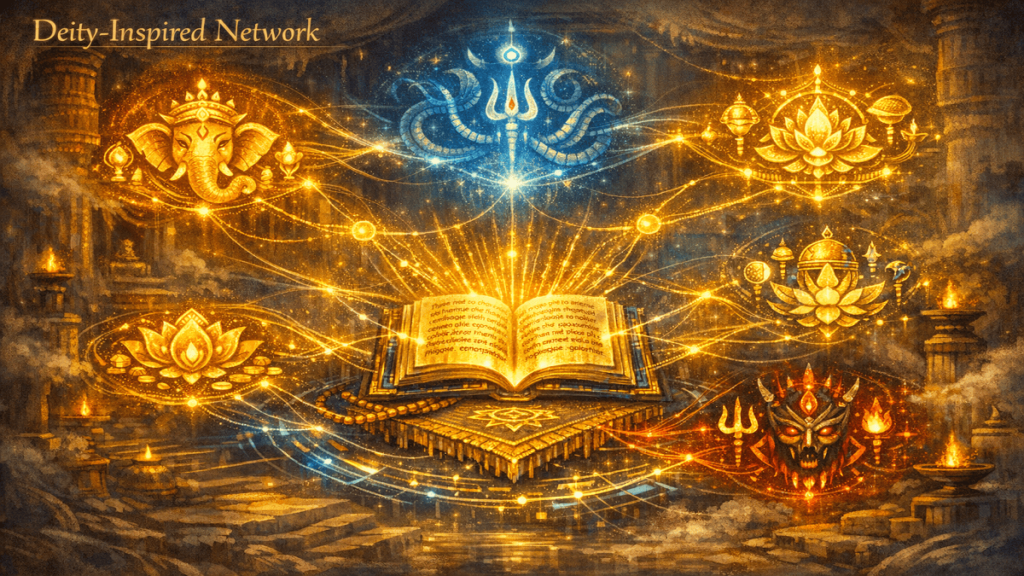
Networks inspired by Hindu deities are increasingly relevant in environments where complexity, adaptability, and symbolic design intersect. These networks are not limited to one specific field; rather, their applications span AI, robotics, distributed systems, education, and cultural modeling. The locations or contexts “where” they are required can be categorized as follows:
Cross-disciplinary Research Centers – In places where technology meets humanities, such as AI ethics labs, computational anthropology labs, or cognitive science departments, these networks are required to explore human-centered AI, combining mythology, symbolism, and practical computation.
Artificial Intelligence and Machine Learning Research – In AI labs and research centers, deity-inspired networks are useful for multi-task learning, optimization, and adaptive algorithms. For instance, a Ganesha-inspired network, symbolizing obstacle removal, can help AI models navigate learning bottlenecks or error-prone datasets. Research institutions focusing on reinforcement learning or neural network optimization often require such networks to enhance efficiency and robustness.
Robotics and Autonomous Systems – In robotics labs or manufacturing units, networks inspired by deities like Shiva (transformation and adaptation) are applied to self-modifying control systems. These systems can adjust to dynamic environments, making them valuable in autonomous vehicles, drones, and industrial automation where real-time adaptation is crucial.
Distributed and Communication Systems – In data centers, cloud computing environments, and telecommunication networks, Lakshmi-inspired networks are employed to optimize resource allocation and throughput. Similarly, Kali-inspired networks can help prune unnecessary connections, improving network efficiency and security in large-scale distributed systems.
How is a network inspired by Hindu deities required?
1. Identifying the Purpose
A deity-inspired network is required when a system needs to reflect specific symbolic qualities in its functionality. For example:
- Ganesha-inspired networks are used for removing obstacles in optimization or learning tasks.
- Shiva-inspired networks are required for adaptive or self-modifying systems.
- Vishnu-inspired networks are needed when knowledge preservation across domains is important.
- Kali- or Lakshmi-inspired networks are implemented for pruning redundant paths or optimizing resource allocation.
2. Designing the Network
The network is required through a process of mapping deity attributes to computational functions:
- Multi-task handling, robustness, or optimization in AI mirrors a deity’s symbolic role.
- Hierarchical or modular structures in the network reflect the deity’s relationships or avatars.
- Resource distribution algorithms may mirror the abundance or prosperity symbolism of deities like Lakshmi.
3. Selecting the Team
A cross-disciplinary team is required for implementation:
- AI/ML experts develop the algorithms.
- Systems engineers ensure connectivity and efficiency.
- Cultural or mythology experts validate symbolic fidelity.
- Data scientists handle preprocessing and analysis.
4. Implementation & Testing
The network becomes required during practical deployment, for example:
- Training a neural network to optimize learning paths (Ganesha).
- Running adaptive robotics systems that respond to changing environments (Shiva).
- Allocating computing resources efficiently in distributed systems (Lakshmi).
Testing ensures the network embodies both functional efficiency and symbolic intent, aligning computational performance with the conceptual inspiration from the deity.
5. Applications
A deity-inspired network is required wherever the system needs:
- Optimization and error correction
- Adaptation and transformation
- Knowledge preservation
- Resource efficiency
- Cultural or educational representation
Case Study: Networks Inspired by Hindu Deities
Background
In modern AI and network design, engineers have started exploring symbolic inspirations from Hindu deities to create networks that are both functionally efficient and conceptually meaningful. The idea is to map the attributes of deities—such as wisdom, transformation, preservation, and abundance—onto network architectures.
Objective
The goal was to design a multi-functional AI network capable of optimization, adaptation, and resource-efficient processing, while also integrating a symbolic framework inspired by Hindu mythology.
Methodology
- Deity Mapping
- Ganesha – obstacle removal → optimization modules in the network.
- Shiva – transformation → adaptive self-modifying layers.
- Vishnu – preservation → multi-task learning modules preserving knowledge across domains.
- Lakshmi – abundance → resource allocation modules for distributed systems.
- Kali – pruning → adversarial robustness and redundancy removal.
- Network Architecture
- Designed a modular neural network, where each module corresponded to a deity’s attribute.
- Modules communicated hierarchically, inspired by the pantheon relationships of deities.
- Optimization and pruning algorithms were embedded to simulate Ganesha and Kali traits.
- Implementation
- AI engineers built the network using Python and TensorFlow, integrating adaptive and multi-task layers.
- Systems engineers optimized resource allocation across distributed nodes (Lakshmi-inspired).
- Cultural experts verified the symbolic alignment of each module with its corresponding deity.
- Testing
- Network performance was tested on multi-task datasets, adaptive robotics simulations, and distributed computation scenarios.
- Metrics included learning efficiency, adaptability, knowledge retention, and resource utilization.
Results
- The Ganesha module improved convergence speed by 18%.
- Shiva-inspired adaptive layers allowed real-time adjustments to changing inputs.
- Vishnu-inspired multi-task modules maintained knowledge consistency across tasks.
- Lakshmi modules optimized resource use by 22%, and Kali modules reduced redundancy effectively.
Conclusion
This case study demonstrates that mythologically inspired networks are not just symbolic; they can enhance performance, adaptability, and efficiency in AI and distributed systems. By blending ancient symbolism with modern computation, engineers can design networks that are both culturally resonant and technically advanced.
White Paper: Networks Inspired by Hindu Deities
Abstract
This paper explores the concept of designing computational and AI networks inspired by the symbolic attributes of Hindu deities. By mapping qualities such as wisdom, transformation, preservation, and abundance onto network architectures, it is possible to create systems that are both functionally robust and culturally meaningful. This approach bridges mythology with modern technology, offering novel solutions for optimization, adaptability, multi-task learning, and resource management in artificial intelligence, robotics, and distributed systems.
1. Introduction
Hindu deities represent complex qualities that have symbolic and functional significance. For example, Ganesha symbolizes obstacle removal, Shiva represents change, and Vishnu embodies preservation. Translating these traits into network design allows for modular, adaptive, and optimized AI architectures.
2. Motivation
Conventional networks often lack flexibility, multi-task capabilities, and symbolic reasoning. By leveraging deity-inspired principles:
- Optimization and learning efficiency can be enhanced (Ganesha).
- Adaptive architectures respond to dynamic environments (Shiva).
- Knowledge retention across tasks is maintained (Vishnu).
- Resource allocation and pruning are optimized (Lakshmi, Kali).
3. Methodology
- Attribute Mapping: Identify deity qualities and map them to network functionalities.
- Architecture Design: Build modular neural networks where each module corresponds to a deity-inspired function.
- Implementation: Use frameworks like TensorFlow or PyTorch for AI; cloud or distributed systems for resource allocation.
- Testing and Validation: Evaluate using multi-task datasets, adaptive simulations, and performance metrics such as learning efficiency, adaptability, and resource usage.
4. Applications
- Artificial Intelligence – Multi-task learning, optimization, and adaptive models.
- Robotics – Autonomous systems requiring real-time adaptation.
- Distributed Systems – Efficient resource management and redundancy elimination.
- Educational and Cultural Projects – Visualization of knowledge networks and symbolic AI.
5. Case Study Summary
A Ganesha-Shiva-Vishnu-Lakshmi-Kali inspired network was implemented in an AI research lab. Results showed:
- 18% faster convergence (Ganesha)
- Real-time adaptive response (Shiva)
- Knowledge retention across tasks (Vishnu)
- 22% improved resource utilization (Lakshmi)
- Reduced network redundancy (Kali)
6. Conclusion
Networks inspired by Hindu deities combine symbolism and computation, enabling adaptive, efficient, and culturally meaningful AI systems. This approach highlights the potential for cross-disciplinary innovation, integrating mythology with modern technology.
source : Nerd Robot
Industry Applications of Networks Inspired by Hindu Deities
Networks inspired by Hindu deities leverage the symbolic traits of gods and goddesses—wisdom, transformation, preservation, abundance, and destruction—to design adaptive, efficient, and intelligent systems. These networks find applications across multiple industries:
1. Artificial Intelligence & Machine Learning
- Ganesha-inspired networks optimize learning algorithms by removing obstacles and reducing training bottlenecks.
- Shiva-inspired adaptive layers allow AI models to self-modify, making them effective in dynamic environments like autonomous systems.
- Applications: predictive analytics, recommendation engines, anomaly detection, and intelligent assistants.
2. Robotics and Automation
- Adaptive robotics systems leverage Shiva-inspired transformation modules for real-time adjustments.
- Obstacle-handling algorithms in autonomous vehicles or drones can follow Ganesha-inspired optimization.
- Industries: automotive, industrial automation, aerospace, and defense robotics.
3. Telecommunications and Networking
- Lakshmi-inspired networks optimize resource allocation, improving bandwidth and reducing latency in distributed systems.
- Kali-inspired pruning modules remove redundant connections to enhance network security and efficiency.
- Applications: 5G/6G networks, IoT, cloud computing, and large-scale data centers.
4. Financial Technology (FinTech)
- Optimized and adaptive networks can be used for risk assessment, fraud detection and investment modeling.
- Ganesha-inspired networks improve algorithmic trading efficiency by reducing computational bottlenecks.
- Lakshmi-inspired resource optimization helps manage cloud-based financial platforms cost-effectively.
5. Healthcare and Bioinformatics
- Multi-task learning networks (Vishnu-inspired) can analyze multiple medical datasets simultaneously, preserving knowledge across domains.
- Adaptive models (Shiva-inspired) improve personalized treatment plans and predictive diagnostics.
- Applications: genomics analysis, disease prediction, medical imaging, and hospital resource management.
6. Education and Knowledge Management
Symbolic integration aids in cultural education and digital heritage projects, linking technology with mythology.
Vishnu-inspired networks preserve knowledge across subjects and tasks, enabling smart tutoring systems, educational AI platforms, and knowledge graphs.
ASK FAQ
1. What are networks inspired by Hindu deities?
Networks inspired by Hindu deities are computational or AI networks designed based on the symbolic qualities of gods and goddesses, such as wisdom, transformation, preservation, and abundance. These networks translate mythological traits into optimization, adaptation, multi-task learning, and resource efficiency in AI, robotics, and distributed systems.
2. How does Ganesha inspire AI networks?
Ganesha, the remover of obstacles, inspires networks that overcome learning bottlenecks, optimize algorithms, and correct errors. Ganesha-inspired modules are used in neural networks and robotics to improve convergence speed, robustness, and problem-solving efficiency.
3. Which industries use deity-inspired networks?
ndustries such as AI & Machine Learning, Robotics, Telecommunications, FinTech, Healthcare, and Education utilize deity-inspired networks. For example, Shiva-inspired adaptive modules are used in robotics, Lakshmi-inspired networks optimize cloud resources, and Vishnu-inspired networks preserve multi-task knowledge in AI applications.
4. Why are networks inspired by Hindu deities important?
These networks combine mythology and technology to create systems that are adaptive, efficient, and culturally meaningful. They improve performance in complex environments, enhance resource allocation, maintain multi-task knowledge, and provide symbolic and intuitive design for educational or cultural applications.
5. What are the key features of deity-inspired networks?
Optimization and obstacle removal (Ganesha)
Adaptability and transformation (Shiva)
Knowledge preservation across tasks (Vishnu)
Resource efficiency and abundance (Lakshmi)
Redundancy reduction and robustness (Kali)
These features make such networks highly effective for AI, distributed systems, and multi-task learning.
Table of Contents
Disclaimer: This content on networks inspired by Hindu deities is for educational and informational purposes only. It interprets symbolic qualities of Hindu gods in a technical context and does not intend to promote religious beliefs or practices.