The Kushan Empire was one of the most influential dynasties in ancient Central and South Asia, reaching its peak under King Kanishka, who ruled during the 1st–2nd century CE. The empire originated from the Yuezhi tribes in the region of modern-day Afghanistan and Northern India. King Kanishka is renowned for his military conquests, administrative reforms, and promotion of culture and religion, particularly Buddhism.
Under his reign, the Kushan Empire became a hub of trade connecting the East and West along the Silk Road, fostering economic prosperity and cultural exchanges. King Kanishka is especially famous for convening the Fourth Buddhist Council, which played a significant role in spreading Mahayana Buddhism. His era saw the flourishing of art, coinage and architecture, leaving a lasting legacy in Central and South Asian history.
The study of the Kushan Empire and King Kanishka provides students and history enthusiasts with insights into early global trade, cultural syncretism, and the development of Buddhism. Learning about this period enriches our understanding of the socio-political and religious transformations in ancient Asia.
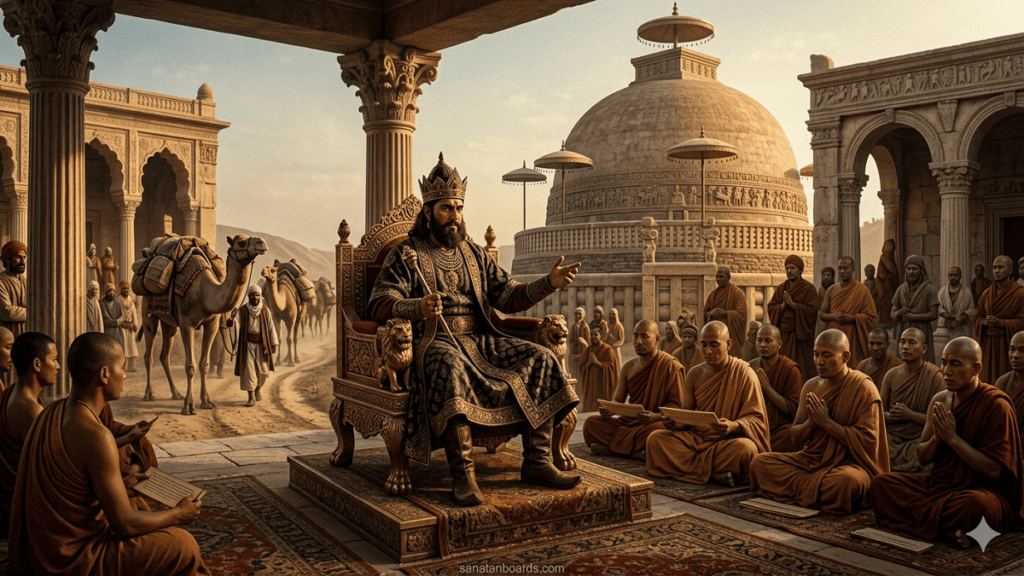
What Is Kushan Empire – King Kanishka ?
The Kushan Empire was a dominant power in ancient South and Central Asia, emerging around the 1st century CE. It was established by the Kushans, a branch of the Yuezhi nomadic tribes, who migrated from Central Asia. The empire extended over large parts of modern-day Afghanistan, Pakistan, and Northern India, making it a critical center for cultural and economic exchange between the East and West.
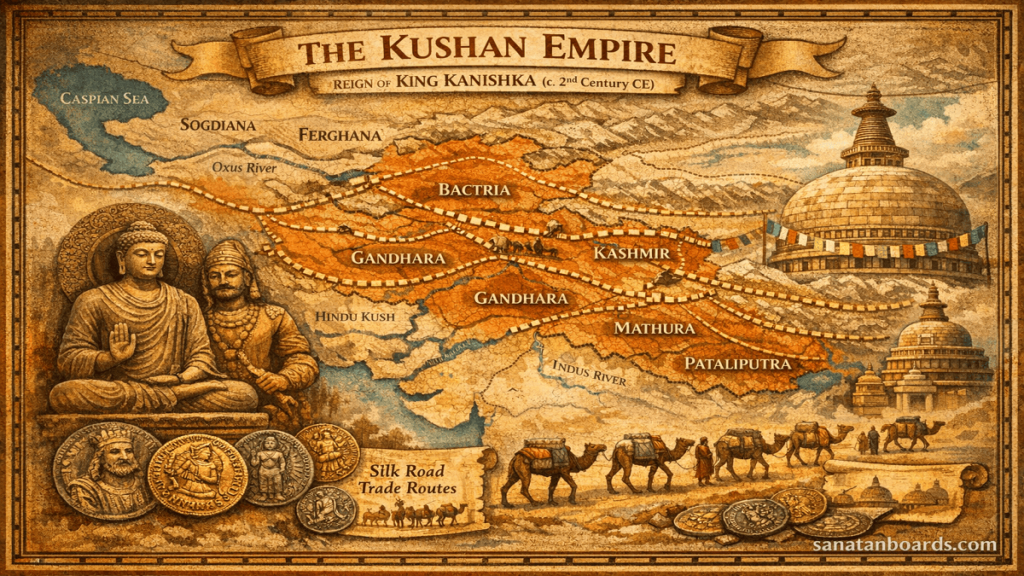
King Kanishka, the most celebrated ruler of the Kushan dynasty, is remembered for his strong leadership, military achievements, and patronage of arts and religion. His reign marked the empire’s greatest territorial expansion, reaching as far as Kashmir in the north, the Punjab in the east, and Bactria in the west. Kanishka’s era witnessed the flourishing of the Silk Road trade, connecting India with Persia, China, and the Roman Empire.
One of the key highlights of Kanishka’s rule was his support of Buddhism. He played a pivotal role in convening the Fourth Buddhist Council in Kashmir, which codified Buddhist doctrines and promoted Mahayana Buddhism. His support for Buddhism led to the construction of stupas, monasteries, and the famous Gandhara art, blending Greek, Persian, and Indian artistic styles.
Kanishka also issued gold, silver, and copper coins, which are today invaluable for historians studying the economy, art, and religion of the time. His reign is often seen as a golden era that brought political stability, cultural development, and economic prosperity.
Who Is Kushan Empire – King Kanishka Required ?
In the context of learning and understanding history, the Kushan Empire – King Kanishka is required for anyone studying the political, cultural, and religious development of ancient Central and South Asia. The key groups or individuals who are required to understand this topic include:
- Students and Scholars of History – Those studying ancient empires, trade routes, or religious expansion need to know about Kanishka’s leadership and policies. His reign demonstrates how governance, culture, and religion intersected in a historically significant period.
- Researchers of Buddhism – Kanishka is essential in Buddhist studies because he convened the Fourth Buddhist Council, which helped codify Mahayana Buddhism. Scholars researching the spread of Buddhism across Central Asia, China, and India require detailed knowledge of his contributions.
- Art and Cultural Historians – The era of Kanishka produced Gandhara and Mathura art, coins, and architecture blending Greek, Persian, and Indian styles. Historians analyzing artistic syncretism require this knowledge to understand cultural exchange along the Silk Road.
- Economists and Trade Historians – Kanishka’s promotion of trade along the Silk Road made the Kushan Empire a commercial hub. Anyone studying early international trade networks, currency systems, and economic development requires understanding his policies and the empire’s infrastructure.
- General Learners and Educators – For educational purposes, Kanishka’s reign serves as a case study of political strategy, cultural integration, and religious patronage. Educators require this knowledge to teach the dynamics of ancient empires.
When Is Kushan Empire – King Kanishka Required ?
The Kushan Empire – King Kanishka is required for study and understanding primarily in the context of the 1st–2nd century CE, approximately 127 CE to 150 CE, which marks the period of his reign and the golden era of the empire. This timeframe is significant because it highlights the historical conditions under which political stability, cultural growth, and religious advancement flourished.
During this period, the empire expanded its territories across Northern India, Afghanistan, and Central Asia. Understanding this timeframe is required for historians analyzing military campaigns, administrative structures, and the empire’s consolidation of power. Kanishka’s reign represents a clear period when centralized authority enabled prosperity, trade, and cultural development.
This era is also required in the study of religion, particularly Buddhism. The Fourth Buddhist Council, convened during Kanishka’s rule, was a pivotal moment in codifying Mahayana Buddhist teachings and spreading them across Asia. Scholars and students studying the evolution of Buddhism require knowledge of this specific period to understand how religious ideas were institutionalized and transmitted.
Economically, the period is required for examining Silk Road trade networks, which connected India with China, Persia, and the Roman Empire. The wealth and cultural exchange facilitated by trade during Kanishka’s reign underscore the empire’s strategic importance in global history.
Furthermore, this timeframe is required for studying art, coinage, and architecture, as Kanishka’s reign marked the development of Gandhara and Mathura styles, combining influences from Hellenistic, Persian, and Indian traditions. These cultural achievements reflect the unique historical moment that allowed art and commerce to flourish simultaneously.
Where Is Kushan Empire – King Kanishka Required ?
The Kushan Empire – King Kanishka is required in a variety of geographical and cultural contexts to understand the spread of his influence and the significance of his reign. The study of “where” focuses on the locations that were directly ruled, influenced, or connected by the empire during Kanishka’s time.
Firstly, Northern India was a central region where Kanishka consolidated power. Areas like Punjab, Kashmir, and Mathura were not only politically controlled but also became centers for religious and cultural activity. Mathura, in particular, emerged as a hub for Buddhist and Hindu art under his reign. Scholars and students require this region to study the political organization, art, and religious developments of the empire.
Secondly, Afghanistan and Bactria (modern-day Afghanistan and parts of Central Asia) were essential for Kanishka’s empire as strategic centers for trade and military control. These regions connected the Indian subcontinent with Central Asia, facilitating the movement of goods, ideas, and religious teachings. Historians and archaeologists require these areas to trace the Silk Road networks and Kanishka’s role in connecting the East and West.
Thirdly, Gandhara (in present-day Pakistan and eastern Afghanistan) is required for understanding the artistic and cultural achievements of Kanishka’s reign. Gandhara art, which combined Hellenistic, Persian, and Indian influences, flourished in this region, producing Buddhist sculptures and monasteries that continue to be studied today.
In addition, Central Asia and China are required to understand the extended influence of Kanishka’s trade and religious policies. His patronage of Buddhism and the Silk Road trade facilitated cultural exchanges that reached far beyond his empire’s core territories. Scholars studying the spread of Mahayana Buddhism or cross-cultural trade require these regions as part of Kanishka’s historical impact.
Lastly, archaeological sites and modern museums are required as locations for studying material culture from Kanishka’s era. Coins, inscriptions, stupas, and sculptures preserved in these areas allow researchers to understand governance, religion, and art under his rule.
How Is Kushan Empire – King Kanishka Required ?
The Kushan Empire – King Kanishka is required for understanding how an empire achieved political power, cultural development, economic growth, and religious influence in ancient times. Examining how Kanishka ruled and influenced society provides insights into governance, trade, religion, and art.
How Kanishka established political control: Kanishka consolidated territories stretching from Northern India to Central Asia through military campaigns and alliances. He structured the empire with regional administrators and officials who ensured law, order, and tax collection. This system is required to study how ancient empires maintained stability over vast regions.
How Kanishka promoted religion: One of the most important aspects of his reign was the promotion of Mahayana Buddhism. Kanishka convened the Fourth Buddhist Council, enabling scholars and monks to codify doctrines, standardize practices, and spread Buddhism along trade routes. Studying this is required to understand how a ruler can influence religion and culture on a large scale.
How Kanishka supported trade and economy: The Kushan Empire thrived as a central hub of the Silk Road, connecting India with China, Persia, and Rome. Merchants, artisans, and traders were encouraged through secure routes, minting of coins, and administrative support. This is required to explore how trade networks contributed to economic prosperity in ancient empires.
How Kanishka influenced art and culture: His reign saw the development of Gandhara and Mathura art, blending Greek, Persian, and Indian styles. The construction of stupas, monasteries, and statues under royal patronage illustrates how rulers can use art and architecture to reinforce religion and authority.
How Kanishka’s legacy is studied today: Scholars, students, and educators require understanding of how historical evidence—coins, inscriptions, sculptures, and texts—reveals the methods by which Kanishka shaped his empire. His reign demonstrates a model of leadership that combined military strength, religious patronage, economic policy, and cultural synthesis.
Case Study On Kushan Empire – King Kanishka
Introduction
The Kushan Empire, under the reign of King Kanishka (c. 127–150 CE), represents a pivotal period in ancient Central and South Asian history. The empire originated from the Yuezhi tribes of Central Asia and expanded into Afghanistan, Northern India, and Central Asia. King Kanishka is particularly remembered for his political, cultural, economic, and religious contributions, which shaped the historical trajectory of the region. This case study explores the empire’s administration, territorial expansion, economic systems, cultural achievements, religious patronage, and legacy.
Historical Background
The Kushan Empire emerged following the migration of the Yuezhi tribes from Central Asia. By the 1st century CE, the Kushans had established control over Bactria and northern India. Kanishka ascended the throne in this period of consolidation and expansion. His leadership marked the golden era of the Kushan Empire, transforming it into a regional power strategically located along the Silk Road, which connected the East and West.
Kanishka’s reign coincided with significant socio-religious changes, particularly the growth of Mahayana Buddhism. The empire’s cosmopolitan nature allowed for the integration of Greek, Persian, Indian, and Central Asian influences in governance, art, and culture.
Political Administration and Governance
Kanishka’s governance was highly organized. He employed regional governors to manage distant provinces, ensuring central authority while allowing local autonomy. Administrative reforms included:
- Standardized coinage for economic stability
- Legal frameworks to maintain law and order
- Military organization for territorial defense and expansion
The military played a critical role in securing the empire’s borders and enabling Kanishka to expand into Northern India, Kashmir, and Bactria. The centralization of power under Kanishka allowed for sustained political stability, which became a foundation for economic and cultural growth.
Economic Contributions
The Kushan Empire flourished economically under Kanishka. Trade along the Silk Road brought wealth from Persia, China, and the Roman Empire. Key economic features included:
- Minting of gold, silver, and copper coins
- Development of trade hubs in Gandhara, Mathura, and Peshawar
- Support for merchants and artisans through infrastructure and security
These policies facilitated not only wealth accumulation but also cultural exchanges that shaped art, religion, and architecture in the empire.
Religious Influence
King Kanishka’s reign is most noted for the promotion of Mahayana Buddhism. He convened the Fourth Buddhist Council in Kashmir, which codified Buddhist teachings and enabled the spread of Mahayana doctrine. The council also contributed to the translation of Buddhist texts into Central Asian languages, facilitating the religion’s expansion along trade routes.
Kanishka’s religious patronage extended to the construction of stupas, monasteries, and sculptures, which became important centers for Buddhist learning and worship. His support allowed Buddhism to gain prominence alongside other religious traditions, reflecting a policy of tolerance and cultural integration.
Cultural and Artistic Achievements
Kanishka’s era saw the rise of Gandhara and Mathura art, characterized by the synthesis of Greek, Persian, and Indian artistic elements. Major cultural developments included:
- Sculptures of Buddha and Bodhisattvas in stone and bronze
- Architectural advancements in stupas and monasteries
- Artistic representations on coins reflecting religious and political themes
The fusion of multiple artistic traditions during Kanishka’s reign highlights the empire’s role as a cultural crossroads, making it a subject of interest for art historians and cultural scholars.
Legacy and Historical Significance
The legacy of Kanishka and the Kushan Empire is multifaceted:
- Political: Demonstrated effective governance and expansion strategies in a multi-ethnic empire
- Economic: Boosted trade and commerce along the Silk Road, connecting East and West
- Religious: Facilitated the spread of Mahayana Buddhism across Central Asia and China
- Cultural: Left enduring artistic and architectural achievements, particularly Gandhara and Mathura art
Kanishka’s reign is often cited as a model for understanding how leadership, religious patronage, and economic strategy can converge to create a flourishing civilization.
Conclusion
The Kushan Empire – King Kanishka represents a crucial period in history where trade, religion, and cultural exchange flourished under strong political leadership. Kanishka’s contributions to governance, religion, art, and trade illustrate #kushanempirekingkanishkaingujrat how one ruler can shape the trajectory of an entire region. Studying his reign provides insights into the dynamics of empire-building, the spread of ideas and religions, and the integration of diverse cultural influences.
This case study highlights why Kanishka’s period is required in historical, cultural, and religious studies. It also underscores the importance of understanding how #kushanempirekingkanishkainkarnataka empires can act as bridges between civilizations, leaving a legacy that continues to influence modern scholarship.
White Paper On Kushan Empire – King Kanishka
Executive Summary
The Kushan Empire under King Kanishka (c. 127–150 CE) represents a pivotal epoch in Central and South Asian history. This white paper examines the empire’s political structure, economic framework, religious influence, and cultural contributions, highlighting the significance of Kanishka’s reign in shaping historical, artistic, and religious landscapes. The study draws insights for historians, educators, and students to understand how governance, trade, and cultural patronage can transform a civilization.
Introduction
The Kushan Empire, originating from the Yuezhi tribes of Central Asia, expanded into Afghanistan, Northern India, and Central Asia. King Kanishka’s rule marked the empire’s golden era, establishing it as a central hub of trade, religion, and culture. His reign is notable for the promotion of Mahayana Buddhism, the development of Gandhara and Mathura art, and the integration of diverse cultural influences.
This white paper explores:
- The political and administrative strategies of Kanishka
- Economic and trade networks under his rule
- Religious patronage and its impact on Buddhism
- Cultural, artistic, and architectural achievements
- Legacy and lessons for historical and educational studies
Political Structure and Governance
King Kanishka implemented a centralized yet flexible administrative system. The empire was divided into provinces governed by regional officials who reported directly to the central authority. Key governance features included:
- Administrative hierarchy to maintain law, taxation, and order
- Military organization for territorial expansion and defense
- Coinage and inscriptions as tools for communication and legitimacy
The governance structure enabled the Kushan Empire to manage diverse populations across vast territories, ensuring political stability and administrative efficiency.
Economic Systems and Trade
Kanishka’s reign coincided with the flourishing of the Silk Road, facilitating trade between India, China, Persia, and the Roman Empire. Key economic policies included:
- Minting of gold, silver, and copper coins to standardize transactions
- Development of urban centers such as Mathura, Peshawar, and Gandhara as trade hubs
- Support for merchants and artisans, fostering a vibrant commercial environment
The economic prosperity under Kanishka allowed investment in religious and cultural projects, demonstrating the interconnection between trade, governance, and culture.
Religious Patronage
One of the most significant aspects of Kanishka’s reign was his promotion of Mahayana Buddhism. Highlights include:
- Convening the Fourth Buddhist Council in Kashmir, standardizing Buddhist teachings
- Supporting the construction of stupas, monasteries, and statues
- Facilitating the translation of texts, promoting Buddhism across Central Asia and China
This period is required in religious studies as it illustrates how royal patronage can accelerate the spread of faith and intellectual traditions.
Cultural and Artistic Contributions
Kanishka’s rule fostered a rich cultural synthesis. Gandhara and Mathura art reflect a blend of Greek, Persian, and Indian influences, characterized by:
- Realistic sculptures of Buddha and Bodhisattvas
- Architectural innovations in monasteries and stupas
- Coinage featuring religious and political motifs
These artistic achievements illustrate the empire’s role as a cultural crossroads, providing material for historical, art, and archaeological research.
Strategic Significance
Kanishka’s empire served as a bridge between East and West, connecting diverse civilizations through trade, religion, and culture. The strategic location of the empire along the Silk Road ensured long-lasting influence in economic, cultural, and religious spheres.
Legacy and Lessons
The study of Kanishka and the Kushan Empire provides several key lessons:
- Leadership: Centralized authority coupled with regional governance enables political stability over vast territories.
- Cultural Integration: Embracing diverse traditions fosters innovation in art, religion, and society.
- Trade and Economy: Strategic economic planning supports cultural and religious patronage.
- Religious Influence: State support can significantly shape the growth and dissemination of faith.
Kanishka’s era remains a cornerstone for understanding the dynamics of empire-building, cultural exchange, and religious propagation in ancient Asia.
Conclusion
The Kushan Empire under King Kanishka represents a model of effective governance, economic prosperity, religious patronage, and cultural synthesis. #kushanempirekingkanishkainmumbai By studying this period, historians, educators, and students gain insights into how empires thrive by balancing military power, economic strategy, and cultural leadership. Kanishka’s reign exemplifies the enduring impact of visionary #kushanempirekingkanishkainsouthindia leadership on the political, cultural, and religious development of a civilization.
Industry Application Of Kushan Empire – King Kanishka
Introduction
The Kushan Empire under King Kanishka (c. 127–150 CE) is not only significant historically but also offers numerous applications across modern industries, particularly in education, tourism, cultural preservation, research, and media. Understanding the empire’s political, economic, and cultural achievements allows contemporary sectors to leverage historical knowledge for practical, educational, and commercial purposes. This paper explores how insights from Kanishka’s era can be applied across industries.
1. Educational Industry
The study of the Kushan Empire is highly relevant in history, art, religious studies, and political science curricula:
- School and University Programs: Courses on ancient empires, trade networks, and religious propagation use Kanishka’s reign as a case study for political consolidation and cultural exchange.
- Digital Learning Platforms: Online modules, virtual classrooms, and interactive tools can recreate Kushan trade routes, Buddhist councils, and artistic achievements to enhance learning.
- Educational Resources: Books, documentaries, and lectures on Kanishka’s empire provide resources for teachers, students, and scholars, supporting knowledge dissemination.
Through these applications, the educational industry benefits from a structured historical framework that teaches governance, economics, culture, and religion in an integrated manner.
2. Tourism and Heritage Industry
Kanishka’s empire left behind tangible heritage sites and artifacts, which are vital for tourism and cultural preservation:
- Heritage Sites: Gandhara, Mathura, and ancient stupas attract tourists interested in Buddhist architecture and Gandhara art.
- Museums and Exhibitions: Coins, inscriptions, and sculptures from Kanishka’s era are exhibited globally, creating opportunities for museum curators and cultural events.
- Cultural Tourism: Guided tours and educational travel experiences focusing on Kushan history enhance tourism revenue and cross-cultural understanding.
This application highlights how historical knowledge of Kanishka’s empire contributes to both economic development and cultural awareness.
3. Research and Academic Industry
Kanishka’s reign offers numerous opportunities for scholarly research:
- Archaeology: Excavations in Gandhara, Bactria, and Northern India provide material for studying political, economic, and cultural history.
- Religious Studies: Scholars analyze Kanishka’s role in spreading Mahayana Buddhism and convening the Fourth Buddhist Council.
- Numismatics and Art History: Coins and sculptures from his reign inform studies of trade, economy, iconography, and artistic syncretism.
Research applications foster cross-disciplinary collaboration between historians, archaeologists, economists, and art historians.
4. Media and Entertainment Industry
The legacy of Kanishka and the Kushan Empire can inspire content for films, documentaries, video games, and books:
- Films and Documentaries: Historical dramas and documentaries can depict Kanishka’s reign, Buddhist councils, and Silk Road trade.
- Educational Games and VR Experiences: Interactive platforms can simulate Kanishka’s empire, trade routes, and artistic creations.
- Publishing Industry: Books on Kanishka and Kushan history provide content for academic and general audiences.
These applications bridge education and entertainment, making history accessible and engaging for a modern audience.
5. Cultural Preservation and Policy
Studying Kanishka’s empire helps governments and organizations develop policies for heritage preservation, religious tourism, and cultural education:
- Protecting archaeological sites and artifacts
- Promoting international collaboration for heritage exchange
- Developing educational programs for schools and universities
These initiatives demonstrate how historical knowledge can inform modern governance and cultural policies.
Conclusion
The Kushan Empire under King Kanishka has far-reaching applications in modern industries, including education, tourism, research, media, #sanatandharmaaccreditationboardsinmumbai and cultural policy. By integrating historical insights into practical sectors, industries can leverage the empire’s legacy to:
- Enhance learning and scholarship
- Preserve and promote cultural heritage
- Drive tourism and economic growth
- Inspire media and creative content
Studying Kanishka’s reign not only enriches our understanding of history but also demonstrates the practical relevance #sanatandharmaaccreditationboardsindelhi of ancient civilizations in contemporary industry and society.
SOURCE : History Connect
ASK FAQ
What was the Kushan Empire under King Kanishka?
The Kushan Empire under King Kanishka was a powerful ancient empire in Central and South Asia during the 1st–2nd century CE, known for trade, cultural exchange, and the spread of Buddhism.
Why is King Kanishka important in history?
King Kanishka is important for promoting Mahayana Buddhism, expanding the Kushan Empire, and supporting trade along the Silk Road.
When did King Kanishka rule the Kushan Empire?
King Kanishka ruled around 127 CE to 150 CE, marking the golden age of the Kushan Empire.
Where was the Kushan Empire located?
The Kushan Empire covered regions of modern Afghanistan, Pakistan, and northern India, including Gandhara and Mathura.
How did King Kanishka contribute to Buddhism?
King Kanishka supported Buddhism by organizing the Fourth Buddhist Council and promoting the spread of Mahayana Buddhism across Asia.
Table of Contents
Disclaimer
This content is created solely for educational and informational purposes. The information provided about the Kushan Empire and King Kanishka is based on historical research and widely accepted academic sources. While efforts have been made to ensure accuracy, historical interpretations may vary among scholars. This content does not intend to misrepresent any culture, religion, or historical event. Readers are encouraged to refer to additional scholarly sources for deeper understanding and verification. The author is not responsible for any misuse or misinterpretation of the information presented. This material is intended to support learning, research, and general knowledge enhancement only.