Hampi, located in the present-day state of Karnataka, India, is one of the most remarkable historical and architectural sites in the world. It was once the flourishing capital of the great Vijayanagara Empire, which ruled large parts of South India during the 14th to 16th centuries. The landscape of Hampi is filled with ancient ruins, majestic temples, royal enclosures, and stunning stone structures that reflect the glory of a powerful civilization.
At the heart of this heritage site stands the iconic Virupaksha Temple, one of the oldest functioning temples in India. Dedicated to Lord Shiva, this temple continues to be an active place of worship even today. It is a symbol of deep spiritual devotion and architectural brilliance that has survived centuries of historical change, invasions, and natural transformations.
The entire region of Hampi represents a unique blend of religion, culture, trade, and governance that once thrived under the powerful rule of the Vijayanagara Empire. This empire was known for its military strength, economic prosperity, and unmatched contribution to art and temple architecture.
Hampi is not just a historical destination; it is a living museum that tells stories carved in stone. The ruins spread across boulder-strewn landscapes and riverbanks reflect the grandeur of a bygone era. From royal palaces to sacred temples, every structure reveals insights into the social and cultural life of the empire.
Today, Hampi is recognized as a UNESCO World Heritage Site and attracts historians, archaeologists pilgrims, and travelers from around the world. It continues to inspire curiosity and admiration for India’s rich cultural legacy and architectural excellence.
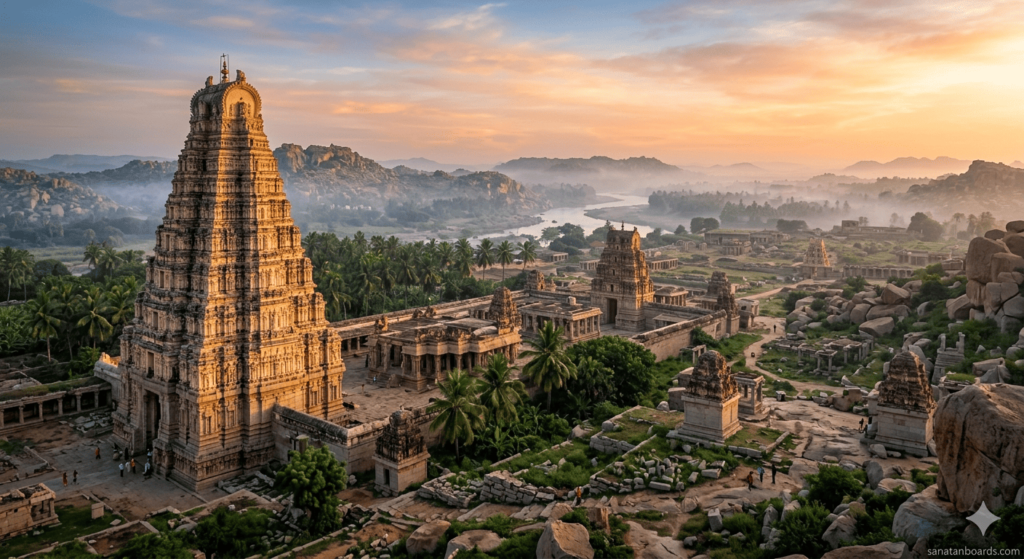
What Is Hampi (Karnataka) – Virupaksha Temple, Vijayanagara Empire ?
Hampi is an ancient historical town situated on the banks of the Tungabhadra River in Karnataka. It is best known for being the capital city of the powerful Vijayanagara Empire during its golden age. The region is spread over a vast landscape of rocky hills, river valleys, and archaeological remains that date back several centuries.
Hampi is essentially an open-air museum where one can witness the remains of palaces, market streets, fortifications, and temples that once formed a thriving urban center. The architecture found here reflects Dravidian-style temple construction, characterized by tall gopurams, intricate carvings, and massive stone pillars.
The most significant structure in Hampi is the Virupaksha Temple. It is dedicated to Lord Shiva and remains an active place of worship. The temple complex includes courtyards, pillared halls, and towering gateways that showcase the artistic excellence of the period.
Historically, Hampi was not just a religious center but also a major trading hub. Merchants from Persia, Portugal, and other regions visited this prosperous city making it one of the richest and most advanced urban settlements of its time.
The importance of Hampi lies in its ability to preserve history through ruins. It helps researchers and visitors understand how people lived, worshipped, and governed during the Vijayanagara period. The site is also recognized as a UNESCO World Heritage Site due to its outstanding cultural and historical significance.
Who Is Required Hampi (Karnataka) – Virupaksha Temple, Vijayanagara Empire ?
The significance of Hampi is relevant to a wide range of people, including historians, archaeologists, students, architects, pilgrims, and travelers. Each group finds value in the site for different reasons, making it a multidisciplinary heritage location.
Historians are deeply interested in Hampi because it represents the rise and fall of the Vijayanagara Empire. The ruins provide evidence of political systems, military strategies, trade relations, and cultural development. By studying inscriptions and structures, historians reconstruct the story of a once-great civilization.
Archaeologists are also highly dependent on Hampi for excavation and research. The site contains layers of historical artifacts that help them understand construction techniques, urban planning, and daily life in ancient times. Every stone and ruin offers clues about the past.
Architects and art historians study the Virupaksha Temple and surrounding structures to understand ancient Indian temple architecture. The design principles, symmetry, and sculpture work inspire modern architectural practices.
For pilgrims and spiritual seekers, Hampi remains an important religious destination. The temple continues to be a living place of worship, attracting devotees of Lord Shiva.
Students and researchers use Hampi as a case study in history, culture, and tourism development. It helps them understand how ancient civilizations functioned and evolved over time.
Finally, travelers and cultural enthusiasts visit Hampi to experience its unique landscape and historical atmosphere. The site provides a deep connection to India’s heritage and inspires appreciation for ancient achievements.
When Hampi (Karnataka) – Virupaksha Temple, Vijayanagara Empire is required ?
Hampi becomes highly relevant in various contexts, especially when there is a need to understand historical development, cultural heritage, architectural evolution, and religious continuity. It is required both in academic study and real-world exploration.
From a historical research perspective, Hampi is required when studying the rise of the Vijayanagara Empire, particularly between the 14th and 16th centuries. Scholars refer to Hampi when analyzing South Indian political history, trade networks, and imperial administration. It is also important when studying the decline of medieval Indian kingdoms.
In educational contexts, Hampi is required during lessons on Indian history, UNESCO World Heritage Sites, and ancient architecture. Schools and universities include it in their curriculum to help students understand how civilizations developed in India.
From a cultural perspective, Hampi is required during discussions on traditional Indian art forms, temple architecture, and religious practices. The Virupaksha Temple plays a key role in understanding how Hindu temples functioned as centers of both spirituality and community life.
Hampi is also required in tourism development studies, especially when analyzing heritage tourism, conservation strategies, and sustainable travel models. It serves as a case study for how historical sites can be preserved while promoting tourism.
In modern times, Hampi is required when planning cultural festivals, heritage walks, and archaeological exhibitions. It also becomes relevant when governments or organizations focus on preserving ancient monuments.
Additionally, Hampi is required in discussions about world heritage preservation under UNESCO guidelines. It helps policymakers understand the importance of maintaining historical integrity while allowing public access.
Where Hampi (Karnataka) – Virupaksha Temple, Vijayanagara Empire is required ?
Hampi is required in multiple geographical, educational, cultural, and institutional contexts. Geographically, it is located in the southern part of India, within Karnataka, and is an important reference point for studies related to South Indian heritage.
It is required in academic institutions such as schools, colleges, and universities where Indian history and archaeology are taught. Students studying medieval Indian history frequently encounter Hampi as a major topic due to its association with the Vijayanagara Empire.
In tourism geography, Hampi is required when mapping heritage destinations of India. It is one of the most significant UNESCO World Heritage Sites and is often included in global tourism circuits. Travel agencies, guidebooks, and cultural tours highlight Hampi as a must-visit destination.
Religious and spiritual contexts also require Hampi, particularly the Virupaksha Temple, which is located within the region. It is an active pilgrimage site and plays an important role in Hindu religious practices.
Hampi is required in government and conservation departments responsible for heritage protection. Archaeological surveys, restoration projects, and environmental planning often focus on this region to preserve its historical integrity.
It is also required in research institutions and museums that study ancient Indian civilization. Art historians, archaeologists, and cultural researchers use Hampi as a reference site for understanding temple architecture and urban planning of the Vijayanagara period.
In media and literature, Hampi is required when documenting India’s cultural heritage. Documentaries, books, and travel journalism frequently feature it as a representation of India’s historical richness.
Thus, Hampi is required in places where education, tourism, religion, research, and cultural preservation intersect. It stands as a global symbol of heritage that continues to be studied and appreciated worldwide.
How Hampi (Karnataka) – Virupaksha Temple, Vijayanagara Empire is required ?
Hampi is required in various ways depending on the context of use, including research, education, tourism, conservation, and cultural interpretation. It functions as both a physical heritage site and a conceptual learning model.
In education, Hampi is required through textbooks, presentations, and academic discussions. Teachers use it to explain the structure and achievements of the Vijayanagara Empire. Visual aids, maps, and case studies help students understand its historical importance.
In tourism, Hampi is required through guided tours, travel itineraries, and heritage walks. Visitors explore ancient ruins, especially the Virupaksha Temple, to experience India’s architectural legacy firsthand. Tour guides explain historical narratives to enhance visitor understanding.
In archaeology, Hampi is required through excavation methods, site surveys, and artifact analysis. Researchers carefully study stone structures, inscriptions, and layouts to reconstruct historical life and urban planning.
In conservation, Hampi is required through restoration techniques, environmental protection strategies, and heritage management policies. Experts work to preserve its fragile stone structures from weathering and human damage.
In cultural studies, Hampi is required to analyze religious traditions, temple rituals, and artistic expressions. It helps scholars understand how spirituality influenced architecture and society.
In digital media and virtual tourism, Hampi is required for creating 3D models, virtual tours, and documentaries. These tools make heritage accessible to global audiences.
Thus, Hampi is required through a combination of physical exploration, academic research, technological representation, and cultural preservation methods. It remains a dynamic subject of study and experience.
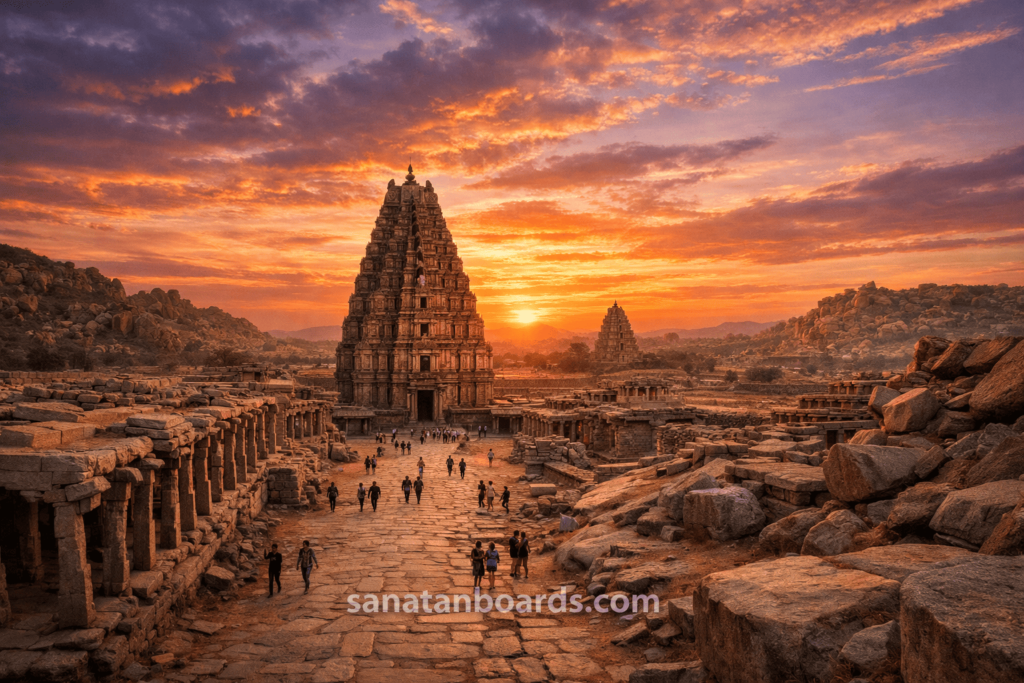
Case Study On Hampi (Karnataka) – Virupaksha Temple, Vijayanagara Empire
Hampi serves as an important case study in understanding the rise and fall of the Vijayanagara Empire and the development of South Indian urban civilization. The site provides deep insights into architecture, economy, religion, and political structure.
Historically, Hampi was established as the capital of the Vijayanagara Empire in the 14th century. Its strategic location along the Tungabhadra River allowed it to flourish as a center of trade and administration. The empire built strong fortifications, irrigation systems, and urban infrastructure that supported a large population.
One of the most significant structures in the case study is the Virupaksha Temple. This temple highlights the integration of religion and governance, where temples were not only spiritual centers but also economic and social hubs. The temple attracted pilgrims, traders, and artisans, contributing to the local economy.
Archaeological evidence shows that Hampi had a highly organized city layout with designated areas for markets, royal residences, and religious structures. The presence of foreign travelers’ accounts, such as those from Persian and Portuguese visitors, confirms its prosperity and global connections.
The decline of Hampi occurred after the Battle of Talikota in 1565, which led to the destruction of much of the city. Despite this, the ruins still reflect its former grandeur. This makes Hampi a valuable case study for understanding how powerful empires can rise and fall due to political and military conflicts.
From an architectural perspective, the case study of Hampi reveals advanced engineering skills. The stone temples, pillars, and carvings demonstrate precision and artistic excellence. The use of granite and complex construction methods shows a high level of technological development.
Economically, Hampi functioned as a major trade center. Markets were filled with goods from different regions, including spices, textiles, and precious stones. This economic diversity contributed to the empire’s wealth.
Culturally, Hampi represents a fusion of religion, art, and daily life. Festivals, rituals, and artistic performances were an integral part of society. The temple culture played a central role in uniting people.
In conclusion, Hampi as a case study provides a comprehensive understanding of medieval Indian civilization. It highlights the importance of urban planning, cultural integration, and historical continuity.
White Paper On Hampi (Karnataka) – Virupaksha Temple, Vijayanagara Empire
Hampi represents one of the most significant heritage landscapes in India and serves as a model for cultural preservation, tourism development, and historical research. As the former capital of the Vijayanagara Empire, it offers a unique combination of archaeological richness and cultural depth.
The white paper analysis of Hampi focuses on its historical significance, current preservation status, and future sustainability strategies. The core structure of Hampi, including the Virupaksha Temple, demonstrates the architectural brilliance of ancient Indian civilization.
From a heritage conservation perspective, Hampi faces challenges such as environmental degradation, uncontrolled tourism, and structural erosion. Stone monuments are vulnerable to weathering, while increasing visitor numbers can lead to physical damage. Therefore, sustainable tourism practices are essential.
Government and UNESCO involvement play a crucial role in protecting Hampi. Policies are designed to regulate construction activities, manage tourist flow, and preserve the authenticity of the site. Archaeological Survey of India (ASI) also contributes to ongoing restoration efforts.
Economically, Hampi contributes significantly to local livelihoods through tourism. Hotels, guides, transportation services, and local handicrafts benefit from the influx of visitors. However, economic development must be balanced with preservation needs.
Technological integration is becoming increasingly important in Hampi’s management. Digital mapping, 3D reconstruction, and virtual reality tours help document the site and reduce physical pressure on monuments. These tools also enhance global accessibility.
Educationally, Hampi is a key resource for research institutions. It provides data for studies in archaeology, architecture, anthropology, and history. Students and scholars use it as a reference point for understanding medieval urban planning.
Culturally, Hampi remains a living heritage site. The Virupaksha Temple continues to function as a place of worship, maintaining spiritual continuity across centuries. This dual role as both heritage site and religious center makes its management more complex.
Future strategies for Hampi include improved infrastructure planning, community involvement, stricter conservation laws, and global collaboration. Public awareness campaigns are also necessary to ensure responsible tourism.
In conclusion, Hampi stands as a global heritage asset that requires continuous preservation efforts. Its historical, cultural, and economic #Sanatanboardsinvasai value makes it a priority site for sustainable development and international cooperation.
Industry Application On Hampi (Karnataka) – Virupaksha Temple, Vijayanagara Empire
Hampi, the historic capital of the Vijayanagara Empire, along with the iconic Virupaksha Temple, has strong relevance across multiple modern industries. Its architectural, cultural, and historical value makes it a powerful resource for practical applications beyond heritage preservation.
1. Tourism and Hospitality Industry
Hampi is one of India’s leading heritage tourism destinations. Travel agencies, hotels, and tour operators design specialized heritage tours focused on temple circuits, especially the Virupaksha Temple. This supports local employment, guides, transport services, and eco-tourism development.
2. Education and Research Industry
Universities and schools use Hampi as a live case study in history, archaeology, architecture, and cultural studies. Researchers analyze Vijayanagara-era urban planning, temple architecture, and inscriptions to understand medieval Indian civilization.
3. Architecture and Construction Industry
The design of temples like Virupaksha Temple influences modern temple architecture and restoration projects. Structural techniques, stone carving styles, and Dravidian architectural principles are studied for heritage-inspired construction and adaptive reuse of traditional designs.
4. Heritage Conservation Industry
Archaeological and conservation bodies use Hampi as a major site for preservation technology development. This includes stone restoration methods, structural stabilization, climate impact studies, and sustainable visitor management systems.
5. Digital Technology Industry
Hampi is widely used in 3D mapping, virtual reality (VR), augmented reality (AR), and digital heritage documentation. These technologies help create virtual tours of temples and ruins, making cultural heritage accessible globally.
6. Media and Entertainment Industry
Hampi’s landscapes and temples are used in films, documentaries, photography, and cultural storytelling. Its dramatic ruins and historical depth make it a popular location for visual media production.
7. Cultural and Creative Industries
Artists, designers, and writers draw inspiration from Vijayanagara-era art, temple sculptures, and mythological themes depicted in Virupaksha Temple carvings.
Conclusion
Hampi and Virupaksha Temple serve as multi-industry assets, #Sanatanboardsinmumbai contributing to tourism, education, technology, conservation, and creative fields while preserving the legacy of the Vijayanagara Empire.
source : HISTORY TV18
ASK FAQ
1. What is Hampi famous for?
Hampi is famous for its ancient ruins, historical significance, and being the capital of the Vijayanagara Empire. It is also a UNESCO World Heritage Site known for its unique temple architecture.
2. Why is Virupaksha Temple important in Hampi?
The Virupaksha Temple is important because it is one of the oldest functioning temples in India, dedicated to Lord Shiva, and represents the religious heritage of the Vijayanagara Empire.
3. Which empire built Hampi monuments?
Most monuments in Hampi were developed during the Vijayanagara Empire, which ruled South India from the 14th to 16th centuries and promoted art, culture, and architecture.
4. Is Hampi a UNESCO World Heritage Site?
Yes, Hampi is recognized as a UNESCO World Heritage Site due to its outstanding historical ruins, temples, and cultural importance.
5. What is the best time to visit Hampi?
The best time to visit Hampi is from October to February when the weather is cooler and suitable for exploring temples and ruins comfortably.
Table of Contents
Disclaimer
This content is prepared purely for informational, educational, and knowledge-sharing purposes. It is based on historical and cultural interpretations of publicly available heritage information. The information is not intended to replace academic research, archaeological reports, or official historical documentation.