Ellora Caves located in the Indian state of Maharashtra represent one of the most remarkable examples of ancient rock-cut architecture in the world. Among these extraordinary structures, the Kailasa Temple stands out as the most magnificent and architecturally advanced creation. This temple is not just a religious structure but also a symbol of human creativity, engineering excellence, and artistic devotion carved entirely from a single massive rock.
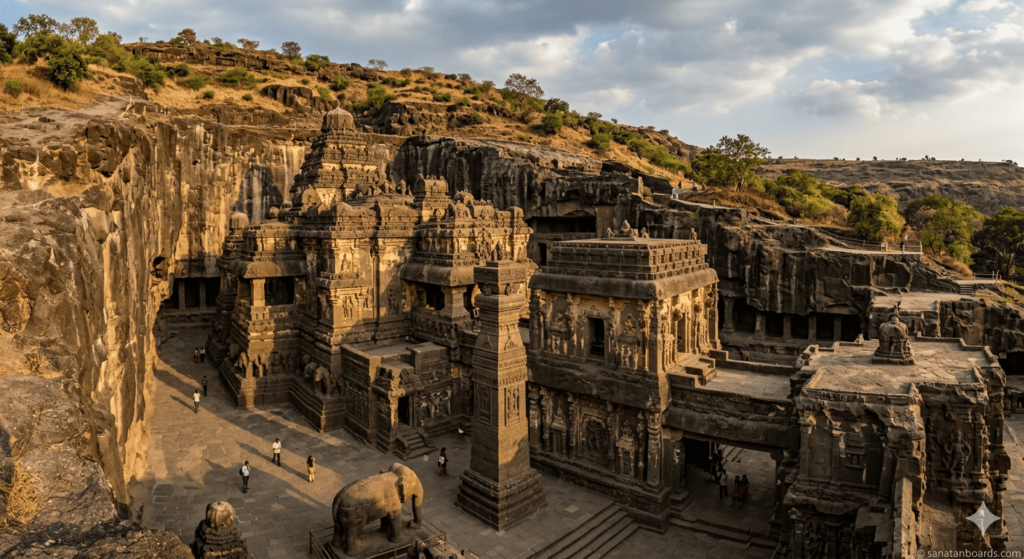
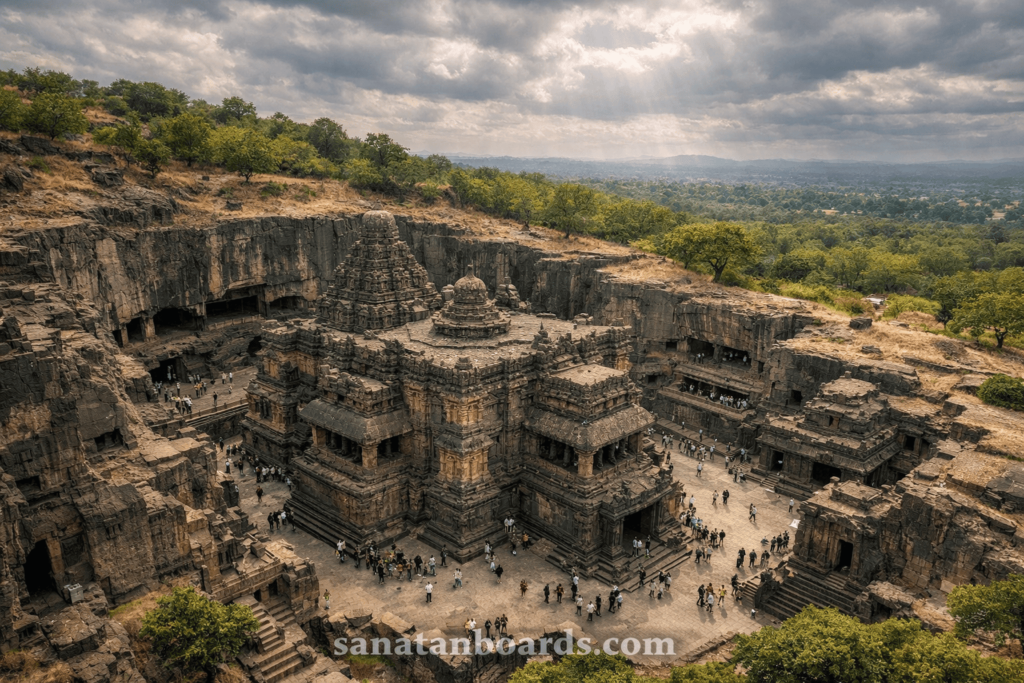
The Kailasa Temple is dedicated to Lord Shiva and is considered one of the largest monolithic rock-cut temples in the world. Unlike traditional temples that are built by assembling stones, this structure was carved vertically from top to bottom out of a single basalt rock cliff. This unique construction method makes it one of the most astonishing architectural achievements in human history.
The temple complex is part of a larger group of caves that represent Hindu, Buddhist, and Jain traditions, reflecting the cultural harmony that existed in ancient India. The Kailasa Temple itself is designed to resemble Mount Kailash, the mythical abode of Lord Shiva, symbolizing spiritual elevation and divine connection.
Its intricate carvings, detailed sculptures, massive pillars, and grand courtyard showcase the artistic brilliance of ancient Indian craftsmen. Every inch of the temple is covered with mythological scenes, deities, and symbolic motifs that narrate stories from Hindu epics.
Today, the Kailasa Temple is recognized globally as a UNESCO World Heritage Site and attracts historians, archaeologists, architects, and tourists from around the world. It continues to inspire modern engineering and architectural studies due to its complexity and precision.
The temple is not only a religious monument but also a living testimony of India’s rich cultural heritage, scientific understanding of rock engineering, and artistic excellence. It stands as a reminder of how advanced ancient civilizations were in terms of design, planning, and execution.
What Is Ellora Caves (Maharashtra) – Kailasa Temple ?
Ellora Caves are a complex of rock-cut temples and monasteries carved into the Charanandri hills of Maharashtra. Among them, the Kailasa Temple is the most famous structure, known for its size, design, and construction technique. It is a monolithic temple dedicated to Lord Shiva and represents Mount Kailash, which is considered his sacred residence in Hindu mythology.
The Kailasa Temple is unique because it was carved from a single piece of rock rather than being built using traditional construction methods. Skilled artisans removed thousands of tons of volcanic basalt rock to create a fully formed temple complex that includes the main shrine, gateway, courtyard, pillars, and sculptures.
This temple belongs to the Rashtrakuta dynasty period and reflects the architectural excellence achieved during that era. The structure includes detailed carvings of Hindu deities, mythological scenes, and symbolic representations that illustrate ancient Indian spiritual beliefs.
The temple complex is not isolated; it is part of a larger group of caves that include Buddhist monasteries and Jain temples, showing religious diversity and coexistence in ancient Indian society. Each cave has its own significance, but Kailasa Temple remains the highlight due to its scale and engineering complexity.
The structure also demonstrates advanced knowledge of geology, structural balance, and artistic planning. The precision required to carve such a massive structure from top to bottom without modern machinery is still considered a mystery and marvel in engineering history.
Today, Kailasa Temple is studied by historians, archaeologists, and engineers as a masterpiece of rock-cut architecture. It is also an important cultural and spiritual destination that continues to inspire awe among visitors worldwide.
Who Is Ellora Caves (Maharashtra) – Kailasa Temple Required ?
The creation and significance of the Kailasa Temple involve multiple groups of people across history and modern times. Originally, the temple was required and commissioned by rulers of the Rashtrakuta dynasty, particularly King Krishna I, who is believed to have initiated its construction. The purpose was to create a grand religious monument dedicated to Lord Shiva that would reflect divine power and royal authority.
The temple required the expertise of highly skilled artisans, sculptors, engineers, and laborers who possessed deep knowledge of rock excavation and carving techniques. These craftsmen played a crucial role in transforming a massive basalt rock into a detailed architectural masterpiece. Their skills were passed down through generations, making them essential contributors to India’s architectural heritage.
Religious scholars and priests were also involved in guiding the symbolic and spiritual design of the temple. Their input ensured that the structure accurately represented Hindu mythology and spiritual concepts associated with Lord Shiva and Mount Kailash.
In modern times, the Kailasa Temple is required for historians, archaeologists, and researchers who study ancient engineering, cultural evolution, and religious architecture. It is also essential for educators and students who learn about India’s history and architectural achievements.
Tourists and pilgrims are another important group for whom the temple holds significance. It serves as a spiritual destination for devotees and a historical attraction for travelers interested in ancient wonders.
Additionally, conservation experts are required to preserve and maintain the structure. Due to its age and exposure to natural elements, continuous preservation efforts are necessary to protect the temple from erosion and damage.
Thus, the Kailasa Temple is required by ancient rulers, artisans, scholars, modern researchers, tourists, and conservation professionals, making it a timeless monument of universal importance.
When Ellora Caves (Maharashtra) – Kailasa Temple Is Required ?
The Kailasa Temple was required during the period of the Rashtrakuta dynasty, approximately in the 8th century CE. This was a time when Indian rulers actively supported art, culture, and religious architecture to demonstrate their power, devotion, and cultural sophistication. King Krishna I is widely credited with commissioning this monumental project.
The requirement for such a temple emerged from both religious devotion and political motivation. Religiously, there was a strong tradition of constructing temples dedicated to Hindu deities, especially Lord Shiva. The Kailasa Temple was envisioned as a divine representation of Mount Kailash, believed to be Shiva’s celestial abode. Creating such a structure was seen as an act of spiritual merit and devotion.
Politically, large-scale architectural projects were often used by kings to establish their legacy and demonstrate their authority. The Kailasa Temple served as a symbol of the Rashtrakuta dynasty’s power, wealth, and advanced engineering capabilities. It reflected the kingdom’s ability to mobilize resources, labor, and expertise for ambitious projects.
The construction period likely extended over several decades, requiring continuous effort and planning. The temple’s creation was not just a one-time requirement but a sustained project that involved generations of workers and craftsmen.
In a broader historical context, the temple was required during a period when rock-cut architecture was highly developed in India. This was an era of experimentation and innovation in temple construction, where artisans explored new methods of carving entire structures from natural rock formations.
In modern times, the “requirement” of Kailasa Temple shifts from construction to preservation and study. It is required for academic research, tourism development, cultural identity, and heritage conservation. Governments and heritage organizations now focus on maintaining its structural integrity and ensuring that future generations can continue to learn from it.
Thus, the Kailasa Temple was originally required in the 8th century for religious devotion and royal prestige, and it remains required today for education, preservation, and cultural heritage.
Where Ellora Caves (Maharashtra) – Kailasa Temple Is Required ?
The Kailasa Temple is located within the Ellora Caves complex in the state of Maharashtra, India. It is situated in the Deccan region, specifically in the Charanandri Hills. This geographical location is significant due to its volcanic basalt rock formations, which provided the perfect material for rock-cut architecture.
The temple is positioned in a natural rocky terrain, which allowed ancient craftsmen to carve directly into the hillside. The entire complex is spread across a vast area that includes multiple caves representing Hindu, Buddhist, and Jain traditions. Among these, the Kailasa Temple is centrally located and stands as the most prominent structure.
From a geographical perspective, the location played a crucial role in its construction. The hard basalt rock provided durability and stability, making it suitable for intricate carvings and large-scale excavation. The natural elevation also gave the temple a majestic appearance, symbolizing a connection between earth and divinity.
Historically, this region was an important cultural and trade route, which allowed the exchange of ideas, art forms, and religious philosophies. The presence of multiple religious caves in one location reflects the cultural diversity and harmony of the region.
In modern times, the Kailasa Temple is located near the city of Chhatrapati Sambhajinagar (formerly Aurangabad), which serves as the main urban center for visitors. The site is easily accessible and attracts tourists, researchers, and pilgrims from across the world.
The location is also recognized as a protected heritage site under international conservation standards. Its geographical setting in a rocky hill environment makes it both a natural and cultural landmark.
Thus, the Kailasa Temple is required geographically as part of a unique rock formation in Maharashtra, historically as a cultural hub, and today as a global heritage and tourism destination.
How Ellora Caves (Maharashtra) – Kailasa Temple Is Required ?
The Kailasa Temple was constructed using an extraordinary rock-cut technique that distinguishes it from all other temple structures in the world. Instead of building upwards with materials, ancient engineers carved downward into a single massive basalt rock.
The construction process began at the top of the rock surface. Workers first marked the outline of the entire temple complex, including the main shrine, courtyard, pillars, and surrounding structures. Once the design was planned, they began removing rock layer by layer from the top, gradually shaping the temple downward.
This method required extreme precision and planning because any mistake in carving could not be corrected. Unlike modern construction, there were no blueprints or machinery, only manual tools such as chisels, hammers, and picks.
Thousands of laborers worked under skilled artisans who guided the carving process. The temple was designed in such a way that every sculpture and pillar was carved directly from the living rock, ensuring structural stability and permanence.
One of the most remarkable aspects of its construction is the monolithic nature of the temple. It was not assembled using separate stones but carved from a single rock formation, making it structurally unified and incredibly strong.
The process also involved deep knowledge of geology, as workers had to understand rock layers, pressure points, and structural balance to avoid collapse during excavation.
The entire construction likely took decades to complete, involving continuous effort and coordination. The result is a perfectly balanced architectural masterpiece that has survived for over a thousand years.
Thus, the Kailasa Temple was required to be built using innovative top-down excavation techniques, skilled craftsmanship, and advanced ancient engineering knowledge.
Case Study On Ellora Caves (Maharashtra) – Kailasa Temple
The Kailasa Temple at Ellora Caves is one of the most extraordinary case studies in ancient architecture engineering, and cultural history. It represents a unique convergence of religious devotion, artistic mastery, and advanced construction techniques that remain unmatched even in modern times.
The case study begins with its historical background. The temple is believed to have been commissioned during the reign of the Rashtrakuta dynasty, particularly under King Krishna I in the 8th century CE. The objective was to create a monumental shrine dedicated to Lord Shiva, symbolizing Mount Kailash. This was not merely a religious structure but also a statement of political authority and cultural supremacy.
From an architectural perspective, the Kailasa Temple is a monolithic structure carved from a single basalt rock formation. The most striking feature is its top-down construction method. Instead of building upwards, artisans began carving from the top of the rock and gradually excavated downward to reveal the final structure. This reverse engineering technique is one of the most complex construction methods ever attempted in human history.
The scale of excavation is another key aspect of the case study. It is estimated that approximately 200,000 to 300,000 tons of rock were removed to create the temple complex. This required thousands of workers, including skilled sculptors, laborers, and supervisors. The coordination and labor management reflect an advanced organizational system in ancient India.
Artistically, the temple is covered with intricate carvings depicting Hindu mythology, including scenes from the Ramayana and Mahabharata. The level of detail suggests highly developed sculptural techniques and deep understanding of religious symbolism. Every pillar, wall, and sculpture serves both decorative and narrative purposes.
Structurally, the temple demonstrates remarkable stability. Despite being carved from a single rock, it includes multiple levels, shrines, gateways, and halls. The engineering precision ensured that weight distribution was balanced, preventing collapse over centuries. This indicates advanced knowledge of rock mechanics and structural design.
Culturally, the temple reflects religious integration and artistic unity. Although located within a complex that includes Buddhist and Jain caves, the Kailasa Temple stands as a Hindu monument, showing coexistence of multiple traditions in one geographical space.
From a modern research perspective, the Kailasa Temple is studied in fields such as archaeology, architecture, geology, and civil engineering. Researchers analyze it to understand ancient construction techniques that defy conventional engineering logic. Many modern engineers consider it a benchmark for monolithic construction.
Tourism also plays an important role in the case study. The temple attracts visitors from around the world, contributing to local economy and cultural tourism. It is recognized as a UNESCO World Heritage Site, ensuring its global significance and protection.
Conservation efforts are another important aspect. Natural erosion, pollution, and human activity pose threats to the structure. Archaeological Survey of India (ASI) continuously works on preservation techniques to maintain its original form.
In conclusion, the Kailasa Temple is not just a monument but a complete case study in ancient innovation, cultural expression, and engineering brilliance. #Sanatanboardsinindia It continues to inspire researchers, architects, and historians globally.
White Paper On Ellora Caves (Maharashtra) – Kailasa Temple
The Kailasa Temple at Ellora Caves represents one of the most significant achievements in ancient rock-cut architecture. This white paper analyzes its historical significance, engineering methods, cultural value, and modern relevance.
1. Historical Context
The temple was developed during the Rashtrakuta dynasty in the 8th century CE. It reflects a period of cultural prosperity and architectural innovation in India. The motivation behind its construction was both religious devotion to Lord Shiva and political demonstration of imperial strength.
2. Architectural Innovation
The most important feature of the Kailasa Temple is its monolithic design. It was carved from a single basalt rock using a top-down excavation method. Unlike traditional construction, no separate building blocks were used. This method required precise planning, spatial visualization, and advanced carving techniques.
The temple includes multiple structural components such as the main shrine, Nandi pavilion, courtyards, pillars, and sculpted panels. Each element was directly carved into the rock, ensuring structural continuity.
3. Engineering Perspective
From an engineering standpoint, the temple demonstrates advanced understanding of load distribution, rock stability, and structural integrity. The removal of massive rock volumes without causing collapse suggests highly controlled excavation techniques.
The absence of modern tools makes the achievement even more remarkable. The tools used were simple chisels and hammers, yet the outcome reflects precision comparable to modern CNC-level accuracy.
4. Cultural and Religious Importance
The temple is dedicated to Lord Shiva and symbolizes Mount Kailash. It reflects deep spiritual symbolism and Hindu cosmology. The carvings depict mythological stories that serve both religious and educational purposes.
The presence of Buddhist and Jain caves nearby indicates religious harmony and cultural diversity in ancient India.
5. Technological Insights
The construction suggests possible use of advanced planning techniques, including spatial mapping and sequential carving strategies. Some researchers propose that multiple teams worked simultaneously on different sections.
6. Modern Relevance
Today, the Kailasa Temple is a subject of interdisciplinary research in archaeology, engineering, and history. It provides insights into sustainable construction methods and material efficiency.
It is also a major tourist attraction, contributing to cultural heritage tourism in India.
7. Preservation Challenges
The temple faces challenges such as weathering, pollution, and human impact. Conservation strategies include structural monitoring, chemical preservation, and controlled tourism.
8. Conclusion
The Kailasa Temple is not only a historical #Sanatanboardsinvasai monument but also a knowledge system that continues to influence modern architecture and engineering studies.
Industry Application On Ellora Caves (Maharashtra) – Kailasa Temple
The Kailasa Temple at Ellora Caves is not only an ancient architectural wonder but also a valuable source of inspiration and learning across multiple modern industries. Its unique monolithic construction, engineering precision, and artistic excellence make it relevant even in today’s technological and industrial context.
1. Architecture and Construction Industry
The Kailasa Temple serves as a benchmark for sustainable and monolithic architecture. Modern architects study its top-down rock-cut method to understand alternative construction techniques that minimize material usage and maximize structural strength. It also inspires designs focused on durability, spatial efficiency, and integration with natural landscapes.
2. Civil Engineering and Structural Design
Civil engineers analyze the temple’s stability, load distribution, and rock mechanics. Despite being carved from a single basalt rock, the structure has remained stable for over a thousand years. This provides insights into stress management in large structures, seismic resistance, and long-lasting construction methods.
3. Mining and Geology Industry
The temple offers real-world reference for controlled excavation in hard rock environments. Geologists study the basalt formation of the Ellora region to understand rock behavior, fracture patterns, and erosion resistance. Mining engineers also draw lessons on precise rock removal techniques.
4. Tourism and Hospitality Industry
Ellora Caves, especially the Kailasa Temple, play a major role in heritage tourism. The site attracts domestic and international tourists, boosting local economies. It supports hotels, travel agencies, guides, transportation services, and cultural tourism initiatives.
5. Education and Research Sector
Universities and research institutions use the Kailasa Temple as a case study in archaeology, history, architecture, and engineering. It helps students understand ancient Indian civilization, construction technologies, and cultural evolution.
6. Digital Technology and Media Industry
Modern technologies like 3D modeling, virtual reality (VR), and augmented reality (AR) use the temple as a subject for digital reconstruction. It is also featured in documentaries, films, and educational simulations to recreate ancient architectural marvels.
7. Cultural and Creative Industries
The temple influences artists, designers, writers, and filmmakers. Its sculptures, mythological themes, and grand scale inspire creative storytelling, visual arts, animation, and game design.
8. Heritage Conservation and Environmental Management
Conservation professionals study the temple to develop methods for preserving rock-cut monuments. It helps in creating strategies for erosion control, pollution protection, and sustainable tourism management.
Conclusion
The Kailasa Temple is not just a historical monument but a multi-industry learning model. Its engineering brilliance and cultural depth continue #Sanatanboardsinmumbai to influence modern architecture, technology, education, tourism, and conservation practices worldwide.
source : Traveller Rishabh
ASK FAQ
1. What is Ellora Caves Kailasa Temple famous for?
The Kailasa Temple is famous for being the world’s largest monolithic rock-cut temple carved from a single rock, dedicated to Lord Shiva, and known for its incredible ancient engineering.
2. Who built Kailasa Temple at Ellora Caves?
The Kailasa Temple is believed to have been built during the Rashtrakuta dynasty, mainly under King Krishna I in the 8th century CE.
3. Where is Kailasa Temple located?
Kailasa Temple is located in the Ellora Caves complex in the Charanandri Hills near Chhatrapati Sambhajinagar (Aurangabad), Maharashtra, India.
4. How was Kailasa Temple built?
It was carved from top to bottom out of a single basalt rock using a unique rock-cut technique, removing thousands of tons of stone manually.
5. Why is Kailasa Temple important today?
It is important for its architectural brilliance, cultural heritage, tourism value, and as a UNESCO World Heritage Site that attracts global researchers and visitors.
Table of Contents
DISCLAIMER
This content is created strictly for educational, informational, and knowledge-based purposes only. All interpretations are based on historical research, archaeological studies, and general scholarly understanding. Some details regarding construction methods and historical timelines may vary across academic sources. This write-up does not claim absolute historical accuracy beyond established research consensus.