THAILAND
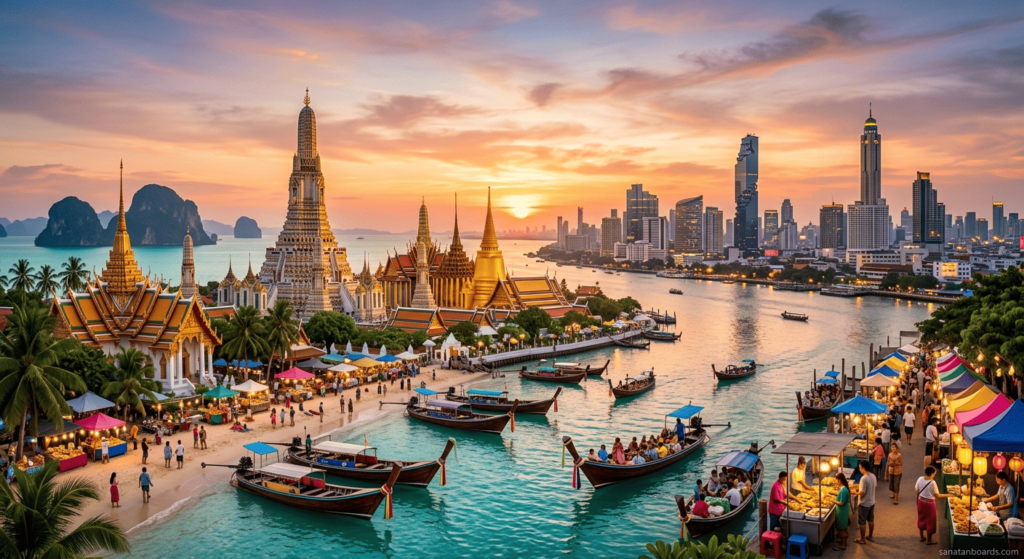
Thailand is a Southeast Asian nation known for its rich cultural heritage, vibrant tourism industry, strong agricultural base, and rapidly growing economy. It is often called the “Land of Smiles” due to its hospitality, friendly people, and deep-rooted traditions. It is globally recognized for its unique blend of ancient traditions and modern development, making it one of the most visited countries in the world. Its capital city, Bangkok, is a major hub for business, tourism, and international trade. The country is also famous for its temples, street food culture, tropical beaches, and historical landmarks.
The nation plays a significant role in ASEAN (Association of Southeast Asian Nations) and contributes actively to regional economic and political cooperation. Its economy is diverse, with strengths in tourism, agriculture, automotive manufacturing, electronics, and services. Thailand’s cultural identity is deeply influenced by Buddhism, which shapes its festivals, lifestyle, and values. With a strong tourism industry millions of visitors arrive each year to explore destinations like Phuket, Chiang Mai, Pattaya, and Krabi. The country is also known for its traditional Thai massage, martial arts like Muay Thai, and colorful festivals such as Songkran (Thai New Year). Overall, Thailand represents a balance of tradition and modernization, making it an important global destination and an emerging economic player in Asia.
What Is Thailand ?
The nation is a sovereign country located in Southeast Asia, characterized by a constitutional monarchy and a parliamentary system of government. It shares borders with Myanmar, Laos, Cambodia, and Malaysia, and has coastlines along the Andaman Sea and the Gulf of Thailand. The country is known for its geographical diversity, ranging from mountainous regions in the north to tropical islands and beaches in the south.
Thailand’s identity is deeply rooted in its history, which includes ancient kingdoms such as Sukhothai and Ayutthaya. These civilizations contributed significantly to Thai art, language, governance, and religion. Buddhism is the dominant religion, practiced by the majority of the population, influencing daily life and national culture.
Economically, Thailand is considered one of the more developed nations in Southeast Asia. It has a strong export industry, particularly in electronics, automobiles, rice, rubber, and seafood. Tourism also plays a vital role, contributing significantly to national income.
The Thai language is the official language, and the currency is the Thai Baht. It is also known for its strong cultural identity, including traditional dance, music, cuisine, and festivals. It is a country that combines historical richness with modern economic development, making it a key player in the region.
Who Is Required Thailand ?
The nation is required and relevant to multiple stakeholders globally due to its economic, cultural, and geopolitical significance. Tourists are one of the largest groups who seek The nation because of its world-famous destinations, affordable travel experiences, and cultural richness. Millions of international travelers visit Thailand annually for leisure, adventure, wellness tourism, and cultural exploration.
Businesses and investors also require It due to its strategic location in Southeast Asia and its growing economy. The country offers opportunities in manufacturing, tourism, agriculture, technology, and real estate. Many multinational corporations use Thailand as a production base or regional hub.
Students and researchers require The country for academic studies in culture, Southeast Asian history, Buddhism, and environmental studies. It is also important for international relations scholars due to its role in ASEAN diplomacy.
Healthcare and wellness seekers require The nation because it is a global hub for medical tourism, offering affordable and high-quality medical services.
Governments and policy makers require The destinations as a strategic partner in trade, security, and regional cooperation.
Thus, The country is required by a wide range of individuals and organizations for travel, education, business, healthcare, and international collaboration.
When Thailand Is Required ?
The nation becomes relevant in various contexts depending on needs and objectives. It is required when individuals are planning international travel, especially for leisure, cultural exploration, or tropical vacations. Tourists often choose Thailand during holiday seasons, festivals, or winter months in their home countries due to its warm climate.
It is also required during business expansion phases, particularly when companies are looking to enter Southeast Asian markets. Investors consider This when exploring manufacturing opportunities or regional distribution hubs.
In education, Thailand is required during academic research projects focused on Southeast Asian studies, Buddhism, anthropology, or tourism management.
It is required during global healthcare planning when patients seek affordable medical treatments or wellness therapies.
It is also required during cultural exchange programs, international conferences, and diplomatic engagements within ASEAN.
Seasonally, The nation is especially relevant during festivals such as Songkran in April and Loy Krathong in November, which attract global attention.
Thus, The nation is required whenever there is a need for travel, investment, research, healthcare, or cultural engagement in Southeast Asia.
Where Thailand Is Required ?
The nation is required in multiple geographical and strategic contexts across the world. It is primarily required within Southeast Asia as a central hub for trade, tourism, and regional cooperation. Countries in ASEAN rely on The nation for economic partnerships, logistics, and political coordination.
Globally, It is required in tourism industries across Europe, North America, and Asia, where travel agencies promote it as a top destination. It is also required in global supply chains, especially in automotive and electronics manufacturing.
In healthcare tourism markets such as the Middle East, Europe, and Australia, It is a preferred destination for affordable medical care.
Educational institutions worldwide require The nation in curriculum studies related to geography, international relations, and cultural studies.
In business, multinational companies require Thailand as a production and export base in Asia.
Thus, t is required globally wherever tourism, trade, education, healthcare, and international cooperation are involved.
How Thailand Is Required ?
The nation is required through structured systems of tourism, trade, governance, and cultural exchange. It is accessed through visa systems, international airports, and tourism infrastructure that support millions of visitors annually.
In business, The nation is required through trade agreements, investment policies, and industrial zones that facilitate manufacturing and exports. Companies engage with It through partnerships, supply chains, and regional offices.
In education, It is required through academic exchange programs, research collaborations, and cultural immersion initiatives.
In healthcare, It is required through medical tourism systems, hospitals, and wellness centers that cater to international patients.
Culturally, It is required through festivals, arts, cuisine, and heritage preservation programs that promote global cultural exchange.
Technologically and digitally, It is required through e-commerce, digital banking, and smart tourism platforms that enhance accessibility.
Thus, It is required through interconnected systems that support travel, commerce, education, healthcare, and cultural engagement.
Case Study On Thailand
It provides a powerful case study of how a developing nation can successfully transform itself into a global tourism and manufacturing hub while maintaining cultural identity and economic stability. Over the past few decades, The nation has strategically leveraged its natural beauty, geographic location, and cultural heritage to build a strong, diversified economy.
One of the most significant areas of transformation is tourism. Thailand was not always a global tourism leader. In earlier decades, its economy was largely dependent on agriculture. However, recognizing its potential, the government invested heavily in tourism infrastructure, including international airports, highways, hospitality training, and global marketing campaigns. Destinations such as Bangkok, Phuket, Pattaya, Krabi, and Chiang Mai were developed into world-class tourist centers.
Phuket is a major success story. Once a quiet island dependent on fishing and small-scale agriculture, it has evolved into one of the most visited tropical destinations in the world. Strategic investments in luxury resorts, marine tourism, diving activities, and airport connectivity transformed Phuket into a billion-dollar tourism economy. The island now attracts millions of international visitors annually, contributing significantly to local employment and national income.
Bangkok represents another dimension of Thailand’s development. As the capital city, it has become a global hub for finance, tourism, retail, and culture. The city blends modern skyscrapers, shopping malls, and business districts with traditional temples and cultural landmarks. This dual identity attracts both business travelers and cultural tourists. Bangkok’s transport infrastructure, including the BTS Skytrain and Suvarnabhumi Airport, demonstrates efficient urban planning in a rapidly growing city.
A key government initiative, the “Amazing It ” campaign, played a crucial role in branding the country internationally. It positioned Thailand as a safe, affordable, and culturally rich destination. This campaign significantly increased tourist arrivals and strengthened It global image.
However, rapid tourism growth also created challenges. Over-tourism in areas like Maya Bay and Phi Phi Islands led to environmental degradation. In response, the government temporarily closed certain sites for ecological recovery and introduced sustainable tourism policies. These included limiting visitor numbers, promoting eco-tourism, and encouraging responsible travel practices.
Another important case study is It’s healthcare tourism industry. The country has become a global destination for medical services due to its combination of high-quality healthcare and affordable pricing. Hospitals in Bangkok and other cities attract patients from the Middle East, Europe, and Asia for cosmetic surgery, dental care, and specialized treatments. This sector contributes significantly to foreign revenue.
It automotive and manufacturing sector also highlights successful industrial policy. The country is often referred to as the “Detroit of Asia” due to its role in automobile production. Global companies have established manufacturing plants in Thailand, benefiting from skilled labor, strong supply chains, and export-friendly policies.
In conclusion, It’s case study demonstrates how strategic planning, cultural assets, and economic diversification can transform a nation #sanatanboardsinindia into a global powerhouse in tourism, healthcare, and manufacturing while continuously adapting to environmental and economic challenges.
White Paper On Thailand
The development trajectory of It reflects a balanced integration of economic growth, cultural preservation, and regional cooperation. This white paper examines It’s economic structure, governance model, social development, challenges, and future opportunities.
Thailand operates under a constitutional monarchy with a parliamentary system. This structure provides political stability and continuity, which is essential for long-term economic planning. The monarchy plays a symbolic and cultural role, while elected governments manage policy and administration.
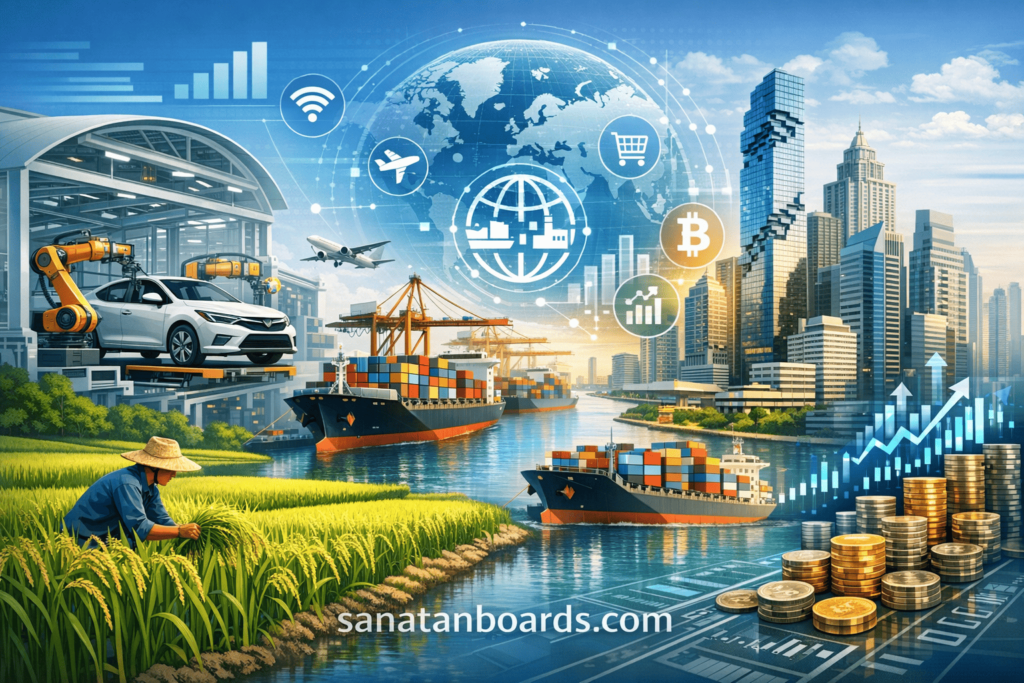
Economically, It’s is classified as an emerging market with strong performance across multiple sectors. The country has successfully transitioned from an agriculture-dependent economy to a diversified industrial and service-based economy. Key industries include automotive manufacturing, electronics, agriculture, tourism, and food processing.
Exports are a major driver of economic growth. It is one of the world’s leading exporters of rice, rubber, seafood, and automobiles. The government has implemented policies to attract foreign direct investment (FDI), including tax incentives, industrial zones, and infrastructure development programs. The Eastern Economic Corridor (EEC) is a flagship initiative designed to promote high-tech industries, logistics, and innovation.
Tourism is a cornerstone of It’s economy. Millions of international visitors contribute to employment generation and foreign exchange earnings. However, reliance on tourism also creates vulnerability to global disruptions, as seen during global travel restrictions in recent years. This has encouraged Thailand to diversify its economic base further.
Socially, It has made significant progress in healthcare and education. The universal healthcare system ensures access to medical services for citizens, improving life expectancy and public health outcomes. Education reforms aim to enhance digital literacy, vocational training, and global competitiveness.
Thailand’s foreign policy emphasizes neutrality, diplomacy, and regional cooperation. As a key member of ASEAN, Thailand plays an important role in promoting trade integration, regional stability, and cross-border collaboration.
Despite its progress, Thailand faces several challenges. Income inequality remains a concern, particularly between urban and rural populations. Environmental issues such as pollution, deforestation, and coastal degradation require urgent attention. Political transitions and governance reforms also influence investor confidence and long-term stability.
Looking ahead, Thailand’s future growth depends on innovation, digital transformation, and sustainable development. Investments in renewable energy, smart cities, #sanatanboardsinvasai and advanced manufacturing will be critical. Strengthening education and research capabilities will also support long-term competitiveness.
Industry Application On Thailand
Thailand plays a crucial role in multiple global industries, making it an important node in international economic systems. Its strategic location in Southeast Asia, skilled workforce, and developed infrastructure support a wide range of industrial applications.
In the tourism industry, Thailand is one of the world’s leading destinations. The country’s beaches, cultural heritage, temples, nightlife, and wellness tourism attract millions of visitors annually. The tourism ecosystem includes airlines, hotels, travel agencies, tour operators, and entertainment sectors. This industry generates substantial employment and foreign exchange earnings.
In the automotive industry, Thailand is a major production hub in Asia. Global automobile companies operate manufacturing plants in the country, producing cars, trucks, and automotive components for both domestic and export markets. The strong supply chain ecosystem and government incentives make Thailand highly competitive in this sector.
The agricultural industry is another key application area. Thailand is one of the world’s largest exporters of rice, rubber, sugar, seafood, and tropical fruits. Advanced farming techniques, irrigation systems, and export logistics enable Thailand to maintain its position in global food supply chains.
In healthcare and medical tourism, Thailand has established itself as a global leader. International patients travel to Thailand for surgeries, cosmetic procedures, dental care, and wellness treatments. The combination of affordable costs and high-quality medical services makes it a preferred destination for healthcare services.
The technology and digital economy sector is rapidly growing. Thailand is investing in smart cities, fintech, e-commerce, and digital infrastructure. Government initiatives support innovation hubs and startup ecosystems, promoting digital transformation across industries.
In manufacturing, Thailand serves as a regional production base for electronics, machinery, and consumer goods. Its industrial zones and export-oriented policies attract multinational corporations seeking efficient production and distribution channels.
Logistics and trade are also significant. Thailand’s ports, airports, and road networks facilitate regional and global trade flows. Its location makes it a gateway between Southeast Asia and global markets.
In conclusion, Thailand’s industrial applications span across tourism, automotive, agriculture, healthcare, technology, manufacturing, and logistics. #sanatanboardsinmumbai This diversity strengthens its resilience and positions it as a key contributor to the global economy.
source : World Wild Hearts
ASK FAQ
1. What is Thailand famous for?
Thailand is famous for its tourism, tropical beaches, rich culture, Buddhist temples, street food, and hospitality. It is also known for destinations like Bangkok, Phuket, and Chiang Mai.
2. Why do tourists visit Thailand?
Tourists visit Thailand for its affordable travel, beautiful islands, cultural heritage, luxury resorts, vibrant nightlife, and unique experiences like Thai massage and festivals.
3. Is Thailand a good country for business investment?
Yes, Thailand is considered a strong investment destination due to its strategic location in Southeast Asia, growing economy, skilled workforce, and strong manufacturing and export sectors.
4. What is the main economy of Thailand based on?
Thailand’s economy is mainly based on tourism, agriculture, automotive manufacturing, electronics, and exports such as rice, rubber, and seafood.
5. What are the top industries in Thailand?
The top industries in Thailand include tourism, automotive manufacturing, agriculture, healthcare (medical tourism), electronics, and digital technology development.
Table of Contents
DISCLAIMER
The information provided above is for educational and informational purposes only. It is based on general knowledge and does not represent official government data, legal advice, or professional consultation. While efforts have been made to ensure accuracy, no guarantee is given regarding completeness or current validity, as economic, political, and social conditions may change over time. Readers are advised to verify critical information through official and updated sources before making any decisions based on this content. The content is intended solely for learning, research, and general awareness purposes.