
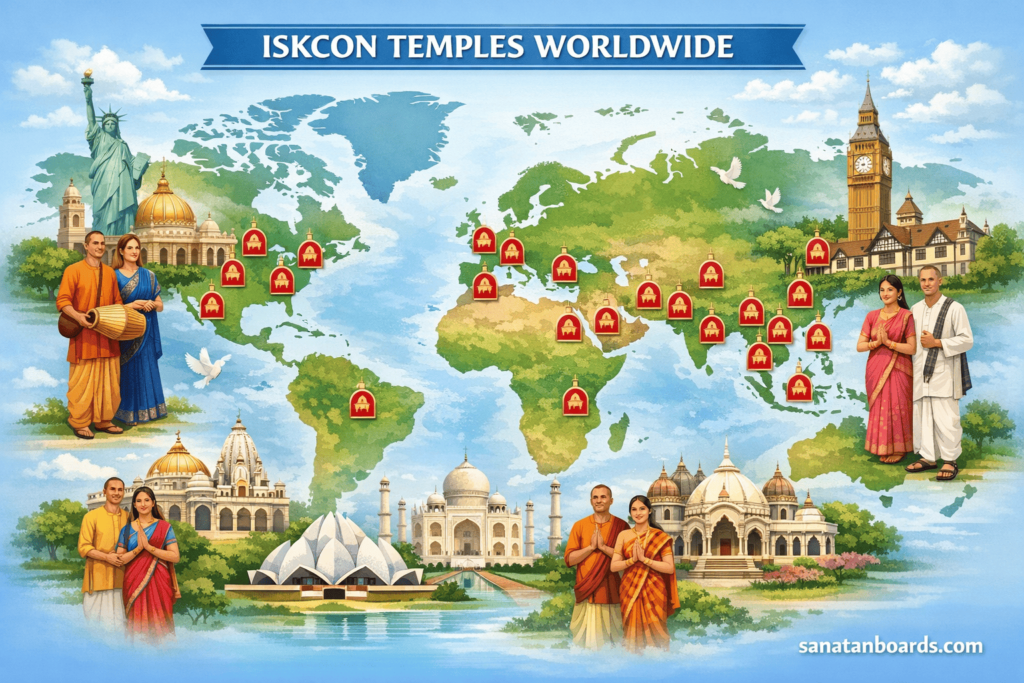
ISKCON TEMPLES WORLDWIDE
The global network of ISKCON temples represents one of the most visible expressions of modern spiritual globalization. Founded in 1966 by A. C. Bhaktivedanta Swami Prabhupada, the International Society for Krishna Consciousness has expanded far beyond its origins in New York City to become a worldwide spiritual and cultural presence. Today, ISKCON temples can be found across continents, serving as centers of devotion, education, community service, and cultural preservation.
These temples are dedicated primarily to the worship of Lord Krishna, following the teachings of the Bhagavad Gita and other Vedic texts. However, they are more than places of worship—they function as hubs for spiritual learning, vegetarian lifestyle promotion, and humanitarian outreach. From the grand ISKCON Temple, Vrindavan to modern urban centers like ISKCON Temple, London, each temple reflects a blend of tradition and adaptability.
The expansion of ISKCON temples worldwide reflects a growing global interest in mindfulness, devotion and alternative spiritual paths. These temples attract not only practicing Hindus but also individuals seeking philosophical understanding, stress relief, and a sense of community. Through festivals, food distribution programs, and educational initiatives, ISKCON continues to engage diverse populations.

What Is Iskcon Temples Worldwide ?
The concept of ISKCON temples worldwide refers to the global network of spiritual centers established under the guidance of the International Society for Krishna Consciousness. These temples are dedicated to the teachings of Krishna consciousness, a devotional tradition rooted in Gaudiya Vaishnavism, which emphasizes loving devotion (bhakti) to Lord Krishna as the supreme form of God.
Each ISKCON temple serves multiple functions. At its core, it is a place of worship where rituals such as kirtan (devotional singing), arati (ceremonial worship), and scriptural readings are conducted daily. These practices are largely inspired by teachings found in sacred texts like the Bhagavad Gita and Srimad Bhagavatam. However, the temples extend beyond religious rituals to offer structured educational programs, cultural events, and community outreach.
Globally, ISKCON temples are designed to adapt to local cultures while maintaining core spiritual principles. For instance, the ISKCON Temple, Mayapur acts as a spiritual headquarters and pilgrimage center, while temples in cities like Los Angeles cater to diverse, multicultural populations. This adaptability has been a key factor in the organization’s international success.
Another defining feature of ISKCON temples worldwide is their emphasis on lifestyle transformation. Devotees are encouraged to follow practices such as vegetarianism, meditation through chanting the Hare Krishna mantra, and ethical living. Many temples also run “Food for Life” programs, distributing free vegetarian meals to those in need.
Who Is Required Iskcon Temples Worldwide ?
The relevance of ISKCON temples worldwide extends to a wide range of individuals and communities, rather than a single specific group. Primarily, these temples serve devotees who follow the teachings of Krishna consciousness as propagated by A. C. Bhaktivedanta Swami Prabhupada. For such individuals, temples provide a structured environment for daily worship, spiritual growth, and community interaction.
However, the scope goes far beyond initiated followers. Students and young professionals often find ISKCON temples appealing due to their focus on philosophical inquiry and stress management. Teachings from the Bhagavad Gita are presented in a practical manner, addressing modern challenges such as anxiety, decision-making, and purpose in life.
Families also benefit from ISKCON temples as they offer a value-based environment for children. Cultural programs, festivals like Janmashtami, and educational classes help instill moral and spiritual values in younger generations.
Additionally, ISKCON temples are significant for individuals exploring alternative lifestyles. Those interested in vegetarianism, yoga, and mindfulness often engage with temple activities. The emphasis on simple living and high thinking attracts people seeking balance in an increasingly fast-paced world.
Academics and researchers in fields like Religious Studies and sociology also find ISKCON temples relevant. These institutions serve as living examples of how traditional belief systems adapt within modern global contexts.
Furthermore, underprivileged communities benefit from ISKCON’s humanitarian initiatives. Programs like food distribution and disaster relief highlight the organization’s commitment to social welfare.
When Iskcon Temples Worldwide Is Required ?
The need for ISKCON temples worldwide becomes particularly evident during times of personal, social, and cultural transition. On an individual level, people often turn to these temples during periods of stress, uncertainty, or existential questioning. The teachings derived from the Bhagavad Gita offer guidance on dealing with challenges such as loss, career dilemmas, and emotional instability.
Temples are also especially relevant during major life events—birth, marriage, and death—where spiritual rituals provide comfort and meaning. Devotional practices like chanting and meditation create a sense of stability and continuity during these transitions.
On a societal level, ISKCON temples play a crucial role during crises such as natural disasters or economic hardship. Their organized food distribution programs and community support systems provide immediate relief and long-term assistance. For example, during global crises, ISKCON’s outreach initiatives have helped thousands through free meal programs.
Culturally, these temples are essential during festivals and religious observances. Celebrations like Janmashtami attract large gatherings, fostering a sense of unity and shared identity among participants. For diaspora communities, especially in countries like United States and United Kingdom, ISKCON temples help preserve cultural heritage.
In the modern digital age, the relevance of ISKCON temples has expanded further. Many temples now offer online lectures, virtual kirtans, and digital resources, making spiritual guidance accessible anytime, anywhere.
Therefore, ISKCON temples worldwide are required whenever individuals or communities seek spiritual clarity, emotional resilience, cultural connection, or humanitarian support. Their role becomes even more significant in times of uncertainty, where they provide both practical assistance and philosophical insight.
Where Iskcon Temples Worldwide Is Required ?
ISKCON temples are required across diverse geographical and cultural settings due to their universal approach to spirituality. They are prominently established in spiritually significant locations such as Vrindavan and Mayapur, which are historically associated with Lord Krishna. These places serve as major pilgrimage centers attracting devotees from around the world.
In urban environments, ISKCON temples play a different yet equally important role. Cities like Mumbai and London host temples that cater to fast-paced lifestyles, offering a space for meditation, reflection, and community engagement amidst urban chaos.
In Western countries, ISKCON temples are particularly significant for cultural integration. They act as bridges between Eastern spiritual traditions and Western lifestyles, promoting understanding and inclusivity. Temples in New York City and Los Angeles exemplify this role.
Rural and underserved areas also benefit from ISKCON’s presence. Through initiatives like food distribution and educational outreach, temples address basic needs while introducing spiritual practices.
Additionally, ISKCON temples are increasingly relevant in digital spaces. Virtual platforms extend their reach beyond physical boundaries, allowing global participation in spiritual activities.
How Iskcon Temples Worldwide Is Required ?
The importance of ISKCON temples worldwide is realized through a combination of spiritual practices, community engagement, and social initiatives. At the core is the practice of bhakti yoga, which emphasizes devotion through chanting, worship, and service. The chanting of the Hare Krishna mantra is a central activity that promotes mental clarity and emotional well-being.
Education is another key mechanism. ISKCON temples conduct lectures, seminars, and courses based on texts like the Bhagavad Gita. These programs translate ancient wisdom into practical guidance for modern life.
Community building is equally significant. Temples organize festivals, cultural events, and group activities that foster a sense of belonging. Celebrations such as Janmashtami bring people together across cultural and social boundaries.
Humanitarian work further demonstrates their relevance. Initiatives like food distribution, disaster relief, and educational support address real-world issues. These efforts reflect the principle of सेवा (selfless service), a cornerstone of ISKCON philosophy.
Technology also plays a growing role. Online platforms allow temples to reach a global audience, offering virtual participation in spiritual activities.
Through these combined approaches, ISKCON temples worldwide fulfill spiritual, social, and cultural needs, making them an integral part of modern society.
Case Study On Iskcon Temples Worldwide
A compelling case study that demonstrates the global reach and operational effectiveness of ISKCON temples is the development of the ISKCON Temple, Mayapur, widely regarded as the spiritual headquarters of the International Society for Krishna Consciousness. Over the past few decades, Mayapur has evolved from a modest rural town into a major international pilgrimage and cultural center, attracting millions of visitors annually.
The transformation began under the vision of A. C. Bhaktivedanta Swami Prabhupada, who identified Mayapur as a spiritually significant location associated with Chaitanya Mahaprabhu. The temple complex today includes large-scale infrastructure such as guest houses, educational institutions, hospitals, and community kitchens. This development has significantly boosted the local economy by generating employment and encouraging small businesses such as handicrafts, food services, and tourism-related enterprises.
One of the most impactful initiatives at Mayapur is its large-scale food distribution program, often associated with ISKCON’s global “Food for Life” initiative. Thousands of meals are distributed daily to pilgrims and local residents, addressing food insecurity while promoting vegetarianism. This initiative not only fulfills humanitarian goals but also strengthens community relations and social trust.
Another relevant case is the ISKCON Temple, Mumbai, which showcases urban adaptability. Located in a densely populated metropolitan environment, this temple serves as a spiritual retreat for professionals, students, and families. It offers structured programs such as youth leadership workshops, spiritual counseling, and corporate seminars based on teachings from the Bhagavad Gita. The temple successfully integrates spirituality with modern urban needs, making it highly accessible and relevant.
Internationally, the ISKCON Temple, London illustrates cultural integration. It hosts multicultural festivals, educational tours, and interfaith dialogues, creating a platform for cross-cultural understanding. This temple attracts not only Indian diaspora communities but also local residents interested in spirituality and cultural diversity.
Despite these successes, ISKCON temples face challenges such as maintaining financial sustainability, managing large visitor volumes, and adapting to local regulations. However, their structured governance and volunteer-driven approach help mitigate these issues.
Overall, this case study highlights how ISKCON temples worldwide function as multifaceted institutions. They combine spirituality, community service, and economic development, demonstrating a scalable model for global religious organizations.
White Paper On Iskcon Temples Worldwide
ISKCON temples worldwide represent a unique intersection of spirituality, organizational management, and social impact. Established in 1966 by A. C. Bhaktivedanta Swami Prabhupada in New York City, the International Society for Krishna Consciousness has grown into a global network spanning over 100 countries.
Organizational Structure
ISKCON operates through a decentralized model supported by a central governing body known as the Governing Body Commission (GBC). Each temple maintains operational autonomy while adhering to shared philosophical principles derived from texts like the Bhagavad Gita and Srimad Bhagavatam. This hybrid structure allows flexibility and consistency, enabling adaptation across diverse cultural contexts.
Core Functions
ISKCON temples fulfill three primary roles: spiritual practice, education, and social service. Daily rituals, including chanting and worship, form the spiritual core. Educational initiatives include lectures, seminars, and publications aimed at translating ancient teachings into modern contexts. Social services, particularly food distribution programs, address humanitarian needs.
Economic Impact
Major ISKCON temples contribute significantly to local economies. For instance, the ISKCON Temple, Vrindavan attracts international pilgrims, boosting tourism-related sectors such as hospitality and transportation. Employment opportunities generated by temple operations further enhance economic development.
Social Impact
ISKCON’s Food for Life initiative is among the largest vegetarian food relief programs globally. It addresses hunger while promoting sustainable dietary practices. Additionally, educational institutions and cultural programs foster community development and social cohesion.
Technological Integration
In recent years, ISKCON has adopted digital technologies to expand its reach. Online lectures, virtual temple tours, and digital publications have made spiritual resources accessible to a global audience. This shift has been particularly significant during times when physical gatherings are limited.
Challenges and Opportunities
Challenges include financial management, cultural adaptation, and maintaining relevance among younger generations. However, opportunities lie in expanding digital engagement, strengthening interfaith collaborations, and enhancing sustainability initiatives.
Conclusion
ISKCON temples worldwide exemplify a scalable model that integrates spirituality with socio-economic development. Their ability to balance tradition #sanatanboardsinvasai with innovation positions them as influential institutions in the global religious and social landscape.
Industry Application On Iskcon Temples Worldwide
ISKCON temples worldwide offer valuable insights and practical applications across various industries, demonstrating how spiritual organizations can influence economic, social, and cultural sectors.
Tourism Industry
ISKCON temples are major drivers of religious and cultural tourism. Locations such as the ISKCON Temple, Vrindavan attract millions of visitors annually. This influx supports hotels, restaurants, transportation services, and local artisans. The temples themselves often provide accommodation and guided tours, creating a comprehensive tourism ecosystem.
Education Sector
ISKCON’s educational initiatives provide a model for value-based learning. Teachings from the Bhagavad Gita are presented in a practical, application-oriented manner. Schools and universities can adopt similar frameworks to integrate ethics, mindfulness, and character development into their curricula.
Wellness and Lifestyle Industry
The wellness industry benefits significantly from ISKCON’s emphasis on holistic living. Practices such as meditation, chanting, and vegetarianism align with global trends in mental health and sustainable living. ISKCON’s approach offers a structured, community-based alternative to individual wellness practices.
Non-Profit and Social Sector
ISKCON’s Food for Life program serves as a benchmark for large-scale humanitarian initiatives. Its efficient distribution networks and volunteer-driven model provide insights into resource management, community engagement, and scalability. Non-profit organizations can replicate these strategies to enhance their impact.
Corporate and Leadership Development
Corporate sectors increasingly draw from ISKCON’s teachings on leadership and ethics. Concepts such as self-discipline, purpose-driven work, and mindfulness are integrated into training programs. These principles help improve employee well-being and organizational performance.
Technology and Digital Outreach
ISKCON’s adoption of digital platforms demonstrates effective global engagement. Live-streamed events, online courses, and digital publications allow temples to reach audiences beyond geographical boundaries. This approach is relevant for organizations seeking to expand their digital presence.
Cultural and Creative Industries
ISKCON temples also contribute to cultural preservation and creative expression. Festivals, music, dance, and art forms associated with Krishna devotion are promoted globally. This supports cultural industries and fosters cross-cultural exchange.
Conclusion
The industry applications of ISKCON temples worldwide extend far beyond religious practice. They provide actionable insights for tourism, education, wellness, non-profit management, #sanatanboardsinmumbai corporate leadership, and digital innovation. By integrating spiritual principles with practical strategies, ISKCON offers a versatile model adaptable across multiple sectors.
source : Hare Krsna TV
ASK FAQ
1. What are ISKCON temples and what is their purpose?
ISKCON temples are spiritual centers established by the International Society for Krishna Consciousness to promote devotion to Lord Krishna. They focus on worship, spiritual education, community service, and spreading teachings from texts like the Bhagavad Gita.
2. Where are ISKCON temples located around the world?
ISKCON temples are present in over 100 countries, including India, the United States, and the United Kingdom. Major centers include ISKCON Temple, Vrindavan and ISKCON Temple, Mayapur.
3. Who founded ISKCON temples worldwide?
ISKCON temples were founded by A. C. Bhaktivedanta Swami Prabhupada in 1966 to spread Krishna consciousness globally.
4. Why are ISKCON temples important today?
They provide spiritual guidance, promote vegetarianism, support mental well-being, and run humanitarian programs like free food distribution, making them relevant in modern society.
5. What activities take place in ISKCON temples?
Common activities include devotional singing (kirtan), meditation, lectures on scriptures, festivals like Janmashtami, and community service programs.
Table of Contents
Disclaimer
This content is intended for informational and educational purposes only. It provides a general overview of ISKCON temples worldwide based on publicly available knowledge and does not represent official views of the International Society for Krishna Consciousness. Interpretations of spiritual practices, cultural significance, and organizational functions may vary across regions and individuals. Readers are encouraged to consult official ISKCON sources or visit local temples for more accurate and personalized information. The content does not promote or discourage any religious belief and aims solely to present a balanced and informative perspective.