
HINDU CAVE TEMPLES OF MALAYSIA (BATU CAVES)
The Hindu Cave Temples of Malaysia, widely known through Batu Caves, represent one of the most significant religious and cultural landmarks outside India. Located near Kuala Lumpur these limestone cave temples are a blend of natural geological formations and deeply rooted Hindu spiritual traditions. The site is dedicated primarily to Lord Murugan, a revered deity in Hinduism symbolizing courage, virtue, and youth.
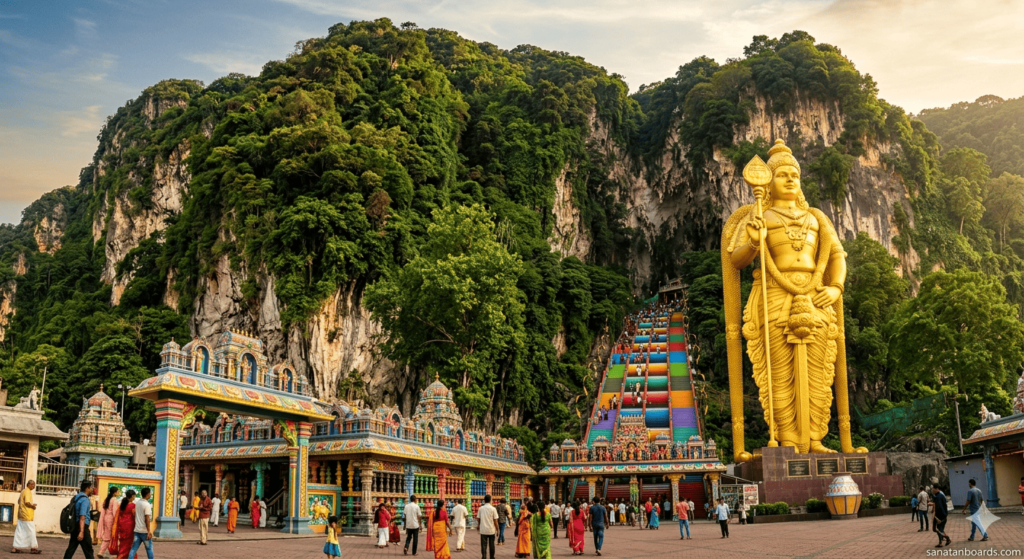
The temple complex is situated within a series of caves and cave temples formed over millions of years. Over time, these natural caves have been transformed into sacred spaces of worship, meditation, and pilgrimage. The most iconic feature is the towering golden statue of Lord Murugan at the entrance, which stands as a symbol of devotion and cultural identity for the Tamil Hindu community in Malaysia.
Batu Caves is not just a religious site but also a cultural bridge that connects generations of Indian diaspora communities with their ancestral heritage. It is especially significant during the annual Thaipusam festival, when thousands of devotees gather to perform rituals, carry offerings, and undertake acts of devotion.
The site also serves as a major tourist attraction, drawing visitors from around the world who are interested in religion, architecture, history, and natural beauty. The limestone formations, vibrant murals, and intricate shrines inside the caves create a unique spiritual atmosphere.
Overall, the Hindu Cave Temples of Malaysia stand as a symbol of faith, resilience, and cultural continuity, blending nature and spirituality in a powerful way that continues to inspire both devotees and visitors alike.
What Is Hindu Cave Temples Of Malaysia (Batu Caves)?
The Hindu Cave Temples of Malaysia, commonly referred to through Batu Caves, are a series of limestone caves that have been transformed into sacred Hindu temples and shrines. These caves are located just north of Kuala Lumpur and are among the most important Hindu pilgrimage sites outside India.
Geologically, Batu Caves are estimated to be over 400 million years old, formed through natural limestone erosion. Over time, these caves became a spiritual center for Hindu worship, particularly for devotees of Lord Murugan. The transformation of natural caves into religious sanctuaries reflects the integration of nature with spirituality.
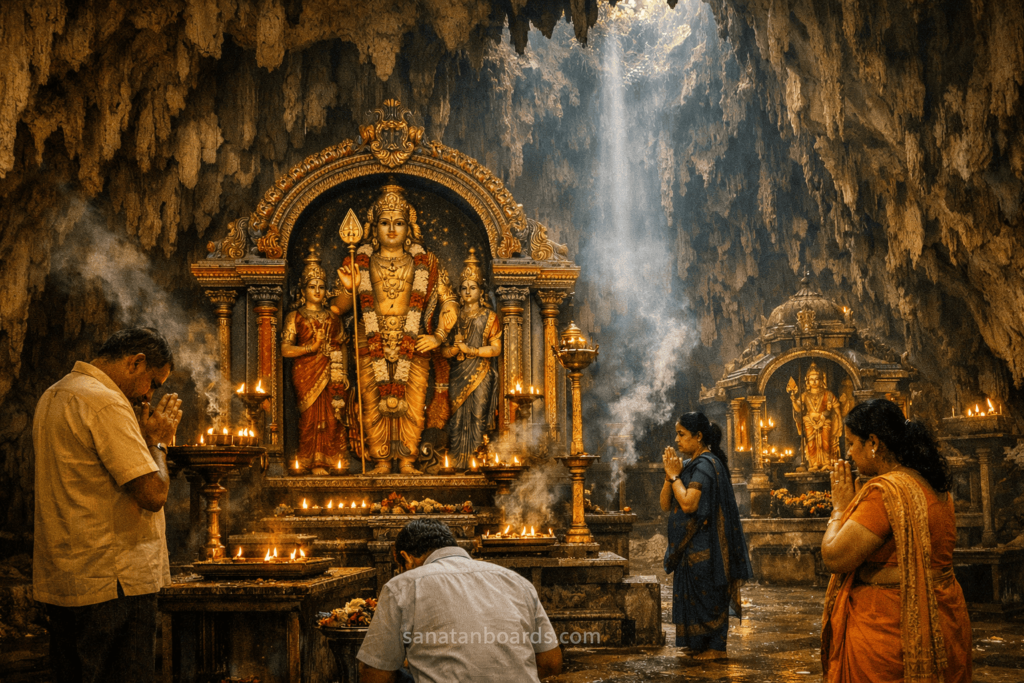
The complex consists of several main areas: the Cathedral Cave (or Temple Cave), the Dark Cave, and various smaller shrines at the base. The Temple Cave is the most visited section, accessed by climbing a steep staircase of over 270 steps. Inside, visitors find elaborately decorated shrines, statues, and religious paintings depicting Hindu mythology.
The site is managed as both a religious and cultural landmark. It plays a vital role in preserving Hindu traditions among the Malaysian Indian community. Rituals, prayers, and festivals are regularly conducted here, with Thaipusam being the most prominent annual event.
Beyond its religious importance, Batu Caves is also an ecological and educational site. The caves are home to unique flora and fauna, including bats and tropical vegetation adapted to the limestone environment. Conservation efforts are in place to preserve both the natural and cultural heritage of the site.
Thus, Batu Caves is not just a temple complex but a living symbol of faith, history, and natural wonder. It represents how sacred spaces can evolve over time while maintaining their spiritual essence.
Who Is Required Hindu Cave Temples Of Malaysia (Batu Caves) ?
The Hindu Cave Temples of Malaysia, especially Batu Caves, are primarily required by Hindu devotees, particularly those who follow Lord Murugan. Devotees visit the site for worship, prayer, spiritual cleansing, and fulfillment of vows. It is especially important for the Tamil Hindu community in Malaysia and neighboring countries.
Religious leaders and priests are essential for conducting rituals, maintaining temple sanctity, and guiding devotees through traditional ceremonies. They ensure that prayers and offerings are performed according to Hindu scriptures and customs.
Pilgrims from around the world also form an important group. Many travel specifically to experience the spiritual energy of the caves or to participate in major religious festivals such as Thaipusam. These pilgrims often undertake acts of devotion such as carrying milk pots or performing penance as part of their faith.
Historians, researchers, and cultural scholars are also required at the site to study its historical evolution, religious significance, and architectural transformation. The caves provide valuable insights into the spread of Hindu culture outside India and its adaptation in Southeast Asia.
Tourists and educational groups are another important category. They visit to learn about Hindu traditions, geology, and cultural diversity. For many, the site serves as an introduction to Hindu mythology and Malaysian multiculturalism.
Additionally, conservationists and environmental scientists are required to maintain the ecological balance of the limestone caves. Their work ensures that tourism and religious activities do not damage the fragile natural environment.
Government authorities and heritage organizations also play a key role in managing infrastructure, safety, and preservation efforts.
Thus, Batu Caves serves a wide range of people including devotees, scholars, tourists, and environmental experts, all of whom contribute to its continued relevance and sustainability.
When Hindu Cave Temples Of Malaysia (Batu Caves) Is Required ?
The Hindu Cave Temples of Malaysia, particularly Batu Caves, are required throughout the year, but their significance intensifies during specific religious and cultural periods.
Daily, the temples are required for routine worship, meditation, and prayer by local devotees. Morning and evening rituals are conducted regularly, allowing individuals to maintain their spiritual practices and connect with Lord Murugan.
The most important time when Batu Caves becomes highly significant is during the annual Thaipusam festival. This event usually occurs in January or February and attracts millions of devotees and visitors. During Thaipusam, the site transforms into a major pilgrimage hub, where devotees fulfill vows, carry offerings, and participate in religious processions.
Special occasions such as religious anniversaries, Hindu holy days, and full moon days also increase the importance of the site. These periods are considered spiritually powerful in Hindu tradition, making temple visits more meaningful.
From a cultural perspective, the site is required during tourism seasons as well. International tourists and educational groups visit throughout the year, but peak demand occurs during holidays and festival seasons.
In addition, the caves are required during academic research periods when scholars conduct field studies on religion, anthropology, and geology. Environmental monitoring is also carried out periodically to ensure the preservation of the cave ecosystem.
Thus, Batu Caves is not limited to a specific time but is continuously required for religious, cultural, educational, and environmental purposes. Its importance peaks during festivals but remains active throughout the year.
Where Hindu Cave Temples Of Malaysia (Batu Caves) Is Required ?
The Hindu Cave Temples of Malaysia are located at Batu Caves, situated approximately 13 kilometers north of Kuala Lumpur, the capital city of Malaysia. This strategic location makes it easily accessible to both local and international visitors.
Geographically, the site is set within a limestone hill formation that rises prominently from the surrounding landscape. This natural structure provides a unique environment for cave temples, combining geological beauty with religious significance.
The caves are required in Malaysia as a central spiritual hub for the Hindu community. They serve as one of the most important places of worship for Hindus living in Southeast Asia, particularly those of Tamil origin.
On a cultural level, Batu Caves is required as a symbol of multicultural identity in Malaysia. The country is home to diverse ethnic and religious groups, and this site represents the Hindu heritage within that diversity.
Tourism-wise, the location is required as a major attraction in Kuala Lumpur’s travel circuit. It is often included in cultural and religious tourism itineraries, drawing visitors from across the globe.
From an educational perspective, the site is required for schools, universities, and research institutions that study religion, geology, and cultural heritage. The caves offer real-world examples of limestone formations and religious adaptation.
Environmentally, the location is required for biodiversity studies, as the caves host unique ecosystems that are important for scientific observation.
Thus, Batu Caves is required not only as a religious site but also as a cultural, educational, and ecological landmark located in a highly accessible and significant region of Malaysia.
How Hindu Cave Temples Of Malaysia (Batu Caves) Is Required ?
The Hindu Cave Temples of Malaysia, known through Batu Caves, are required through a combination of religious rituals, cultural practices, tourism management, and conservation efforts.
Religiously, the site is required through daily prayers, rituals, and offerings performed by priests and devotees. These practices maintain spiritual continuity and uphold Hindu traditions. Devotees often climb the stairs as an act of devotion, symbolizing spiritual effort and discipline.
Culturally, the temples are required through festivals such as Thaipusam. During these events, large-scale preparations are made, including decorations, processions, and community participation. These activities strengthen cultural identity and unity among Hindus.
From a tourism perspective, the site is required through infrastructure such as stairways, visitor facilities, guided tours, and information centers. These elements ensure that visitors can safely and meaningfully experience the site.
Educationally, the caves are required through structured learning programs, guided studies, and research documentation. Students and researchers analyze both the religious and geological aspects of the site.
Environmentally, the site is required through conservation methods such as controlled access to sensitive cave areas, wildlife protection, and maintenance of natural formations.
Technologically, modern systems such as lighting, safety monitoring, and crowd management are used to ensure smooth functioning during peak periods.
Thus, Batu Caves is required through an integrated system of spiritual devotion, cultural preservation, tourism development, education, and environmental protection.
Case Study On Hindu Cave Temples Of Malaysia (Batu Caves)
The Hindu Cave Temples of Malaysia, represented by Batu Caves, provide a compelling case study of how natural landscapes can be transformed into globally significant religious and cultural heritage sites.
Originally, Batu Caves were natural limestone formations formed over millions of years. These caves remained largely untouched until the late 19th century when they were discovered and gradually developed into a Hindu religious site. The transformation was driven by the Tamil Hindu community in Malaysia, who sought a sacred space dedicated to Lord Murugan.
The case study highlights three major dimensions: religious transformation, cultural integration, and tourism development.
Religiously, the caves evolved into one of the most important pilgrimage destinations for Hindus outside India. The installation of shrines, statues, and temples inside the caves reflects the adaptation of Hindu worship practices to a natural environment. The annual Thaipusam festival is a key example, where millions of devotees participate in rituals that demonstrate faith, endurance, and devotion.
Culturally, Batu Caves illustrates the preservation of identity among diaspora communities. Tamil Hindus in Malaysia used the site to maintain their religious traditions while integrating into a multicultural society. Over time, it became a symbol of unity and cultural pride.
From a tourism perspective, Batu Caves has become a global attraction. The site draws millions of visitors annually, contributing significantly to Malaysia’s cultural tourism industry. Infrastructure improvements such as stairways, lighting, and transportation access have enhanced visitor experience while maintaining religious sanctity.
However, the case study also reveals challenges. Environmental concerns include damage to limestone formations, waste management during festivals, and impact on local wildlife. Managing large crowds during Thaipusam also presents logistical and safety issues.
In response, authorities and temple management have implemented conservation strategies, including controlled access to sensitive areas, awareness campaigns, and improved waste disposal systems.
The case of Batu Caves demonstrates how a site can successfully balance religion, culture, tourism, and environmental sustainability. It serves as a model for managing sacred natural sites worldwide.
White Paper On Hindu Cave Temples Of Malaysia (Batu Caves)
The Hindu Cave Temples of Malaysia, located at Batu Caves, represent a unique convergence of natural geology, religious devotion, cultural identity, and tourism economics. This white paper examines the site as a multi-dimensional heritage asset and evaluates its role in cultural preservation, sustainable tourism, environmental conservation, and socio-economic development.
1. Cultural and Religious Significance
Batu Caves serves as one of the most important Hindu pilgrimage destinations outside India. It is dedicated primarily to Lord Murugan and functions as a spiritual anchor for the Tamil Hindu diaspora in Malaysia. The site preserves centuries-old Hindu rituals, devotional practices, and festival traditions, particularly Thaipusam, which attracts millions of devotees annually. These practices reinforce cultural identity and ensure continuity of religious heritage in a multicultural society.
The caves symbolize spiritual discipline and devotion, especially through the physical act of climbing hundreds of steps to reach the main temple. This act is often seen as a metaphor for overcoming human challenges through faith and perseverance.
2. Tourism and Economic Impact
Batu Caves is a major contributor to Malaysia’s tourism industry. Its proximity to Kuala Lumpur makes it a high-traffic destination for both domestic and international visitors. Tourism activities include guided tours, cultural experiences, photography, and religious observation.
The economic impact extends beyond entry visits. Local communities benefit through transportation services, food vendors, souvenir shops, accommodation providers, and tour operators. During festivals, especially Thaipusam, the economic activity in surrounding regions increases significantly, creating seasonal employment opportunities.
3. Environmental and Geological Importance
The caves are part of a limestone hill system estimated to be over 400 million years old. This makes Batu Caves not only a religious site but also a geological heritage zone. The ecosystem supports bats, insects, and specialized flora adapted to cave environments.
However, increased human activity poses environmental challenges such as waste accumulation, erosion, and disturbance to wildlife. Sustainable management strategies include controlled access, environmental awareness programs, and regular maintenance.
4. Governance and Heritage Management
The site is managed through collaboration between religious authorities, government bodies, and tourism organizations. Policies focus on balancing religious freedom with conservation needs. Infrastructure improvements such as stairways, lighting, and visitor management systems help regulate foot traffic while preserving sanctity.
5. Strategic Recommendations
- Implement digital crowd management systems during peak festivals
- Strengthen waste management infrastructure
- Increase environmental education for visitors
- Develop sustainable tourism certification for vendors
- Enhance conservation funding for limestone protection
6. Conclusion
Batu Caves stands as a model of integrated heritage management, where religion, tourism, and environmental conservation coexist. Its long-term sustainability #sanatanboardsinvasai depends on responsible governance, community participation, and environmental protection strategies.
Industry Application On Hindu Cave Temples Of Malaysia (Batu Caves)
The Hindu Cave Temples of Malaysia at Batu Caves have wide-ranging applications across multiple industries, making the site not only a religious landmark but also a valuable economic, educational, and technological resource.
1. Tourism and Travel Industry
Batu Caves is a core attraction in Malaysia’s tourism portfolio. Travel agencies design specialized cultural tours that include religious storytelling, heritage exploration, and festival participation. The site contributes to both mass tourism and niche religious tourism markets.
Tour operators benefit from year-round visitor flow, while seasonal spikes during Thaipusam generate high revenue. The tourism industry also leverages digital marketing, virtual tours, and influencer content centered around the site.
2. Education and Academic Research
Educational institutions use Batu Caves as a real-world learning environment. Subjects such as geography, geology, religious studies, anthropology, and cultural history are enriched through field visits.
Students study limestone formation, cave ecosystems, Hindu rituals, and diaspora culture. Researchers also analyze how religion adapts within multicultural societies, making the site a valuable academic case study.
3. Environmental and Geological Research
The limestone formations provide opportunities for geological research, including rock dating, erosion studies, and ecosystem analysis. Environmental scientists monitor biodiversity within cave habitats, including bat colonies and micro-ecosystems.
Conservation biology studies focus on balancing human activity with ecosystem preservation.
4. Media, Film, and Creative Industries
Batu Caves is widely featured in documentaries, travel films, photography projects, and cultural storytelling. Its dramatic limestone backdrop and vibrant religious ceremonies make it visually appealing for global audiences.
Content creators use the site to showcase cultural diversity, spirituality, and natural beauty.
5. Hospitality and Local Economy
Hotels, restaurants, transport services, and local vendors benefit from tourism generated by Batu Caves. The hospitality sector experiences increased occupancy rates during festivals and holiday seasons.
Local artisans and souvenir businesses also depend heavily on tourist inflow.
6. Digital Technology Applications
Modern technologies such as virtual reality tours, mobile navigation apps, and digital ticketing systems enhance visitor experience. Social media platforms play a major role in promoting the site globally.
Smart monitoring systems are increasingly used for crowd control and safety management during large festivals.
7. Heritage and Policy Development
Urban planners and heritage organizations study Batu Caves as a model for managing religious tourism sites in urban environments. It informs policies on sustainable tourism, cultural preservation, and environmental protection.
8. Conclusion
Batu Caves demonstrates strong cross-industry relevance. It contributes to economic development, education, environmental science, media production, and digital #sanatanboardsinindia innovation while maintaining its core religious identity.
source : To Northern Star
ASK FAQ
1. What are Batu Caves in Malaysia famous for?
Batu Caves are famous for their Hindu cave temples dedicated to Lord Murugan, their massive golden statue at the entrance, and the annual Thaipusam festival that attracts millions of devotees and tourists.
2. Where are Batu Caves located?
Batu Caves are located near Kuala Lumpur in Malaysia, making them one of the most accessible and popular Hindu pilgrimage and tourist sites in the country.
3. Why are Batu Caves important for Hindus?
Batu Caves are important because they serve as a major Hindu religious site outside India, dedicated to Lord Murugan, and are a center for devotion, rituals, and major festivals like Thaipusam.
4. How many steps are there in Batu Caves?
There are approximately 272 colorful steps leading up to the main Temple Cave, symbolizing spiritual effort and devotion required to reach the sacred shrine.
5. When is Thaipusam celebrated at Batu Caves?
Thaipusam at Batu Caves is celebrated annually, usually in January or February, attracting large crowds of devotees who perform rituals and fulfill vows in honor of Lord Murugan.
Table of Contents
DISCLAIMER
The information provided about the Hindu Cave Temples of Malaysia at Batu Caves is intended solely for educational and informational purposes. It is based on general knowledge of cultural, religious, historical, and environmental aspects and should not be considered official, authoritative, or exhaustive. Interpretations of religious practices and historical details may vary among scholars and communities. Visitors are advised to follow local laws, respect religious customs, and adhere to safety and conservation guidelines when visiting the site. The content does not intend to offend any beliefs or traditions and should be cross-verified with official or academic sources for accuracy.