
BRIHADEESWARAR TEMPLE (TAMIL NADU) – UNESCO HERITAGE SHIVA TEMPLE
The Brihadeeswarar Temple, located in Tamil Nadu, is one of the most remarkable architectural masterpieces in India and a shining example of the grandeur of ancient Dravidian temple architecture. Also known as the “Big Temple,” it stands as a symbol of the power, devotion and artistic excellence of the Chola dynasty. Built during the reign of Raja Raja Chola I in the early 11th century, this temple is dedicated to Lord Shiva and continues to be an active place of worship even today.
The temple is not only a religious center but also a historical treasure that reflects the cultural and technological achievements of medieval South India. Its towering vimana (temple tower) intricate carvings, and massive stone structure showcase advanced engineering skills that were far ahead of its time. The temple is constructed entirely from granite, a material not locally available in the surrounding region, which highlights the extraordinary planning and effort involved in its construction.
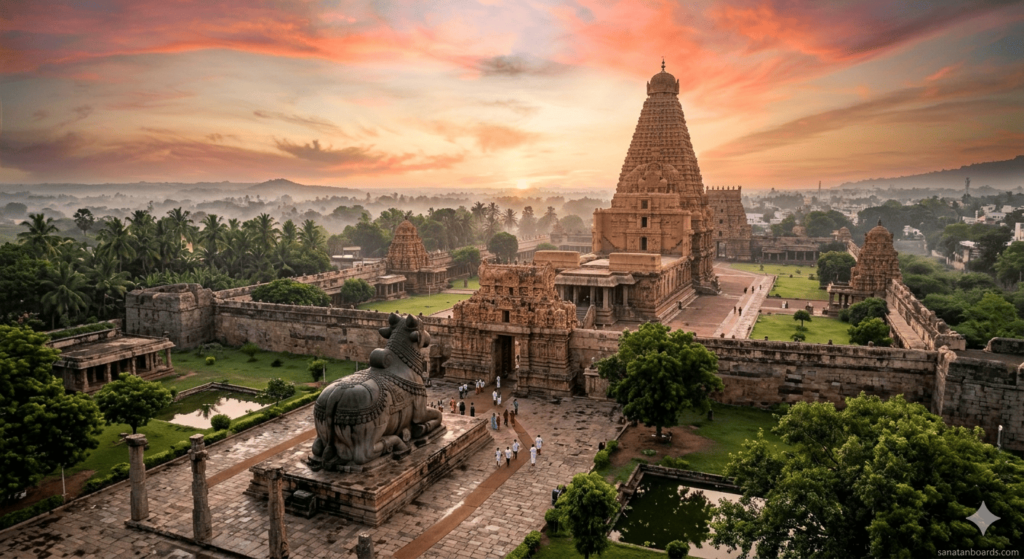
Recognized as a UNESCO World Heritage Site, the Brihadeeswarar Temple forms part of the “Great Living Chola Temples.” It represents the peak of Chola architectural brilliance and religious devotion. The temple complex includes a large courtyard, a massive Nandi statue carved from a single stone, and beautifully sculpted walls depicting Hindu mythology and cultural traditions.
Beyond its religious importance, the temple also serves as an important educational and cultural landmark. Historians, archaeologists, architects, and tourists from around the world visit this monument to study its design, inscriptions, and historical significance. The inscriptions on its walls provide valuable insights into the Chola administration, economy, and social structure.
Even after more than a thousand years, the Brihadeeswarar Temple continues to stand strong, representing the eternal legacy of Indian civilization. It remains a powerful reminder of human creativity, devotion, and architectural excellence.
What Is Brihadeeswarar Temple (Tamil Nadu) – Unesco Heritage Shiva Temple ?
The Brihadeeswarar Temple is a grand Hindu temple dedicated to Lord Shiva and is located in Thanjavur, Tamil Nadu. It is one of the largest and most famous temples in India, known for its massive structure, artistic carvings, and historical importance. Built in 1010 CE by the Chola emperor Raja Raja Chola I the temple is a masterpiece of Dravidian architecture and is considered one of the finest achievements of Indian temple design.
The main feature of the temple is its towering vimana, which rises to about 66 meters and is among the tallest of its kind in the world. At the top of the temple sits a massive stone dome, which is believed to have been placed using a specially designed ramp system. The temple is made entirely of granite, and its construction reflects advanced engineering knowledge of the Chola period.
Inside the temple, the main deity is a large Shiva Lingam, representing Lord Shiva in his formless form. The sanctum is surrounded by corridors filled with intricate wall paintings and sculptures that depict various Hindu gods, mythological stories, and scenes from daily life during the Chola period.
Another significant feature is the enormous Nandi statue (bull vehicle of Lord Shiva), carved from a single stone. It is one of the largest monolithic Nandi statues in India.
The temple is also famous for its inscriptions, which provide detailed records about the Chola empire, including donations, administration, and cultural activities. These inscriptions make the temple an important source of historical information.
Today, Brihadeeswarar Temple is not just a place of worship but also a symbol of India’s rich cultural heritage. It attracts historians, architects, devotees, and tourists from around the world who come to admire its beauty, engineering brilliance, and spiritual significance.
Who Is Required Brihadeeswarar Temple (Tamil Nadu) – Unesco Heritage Shiva Temple ?
The Brihadeeswarar Temple was primarily required and commissioned by the Chola emperor Raja Raja Chola I, one of the most powerful rulers in South Indian history. His vision was to create a grand temple dedicated to Lord Shiva that would not only serve as a religious center but also symbolize the strength, prosperity, and cultural supremacy of the Chola dynasty.
During his reign, the Chola empire was expanding rapidly, and there was a strong need to establish cultural and religious landmarks that could unify the people under shared spiritual values. The construction of the temple fulfilled this requirement by becoming a central place of worship for Shaivism, a major sect of Hinduism that worships Lord Shiva as the supreme deity.
The temple was also required to serve administrative and social purposes. In ancient times, temples were not just religious centers but also acted as hubs of education, art, economy, and governance. Brihadeeswarar Temple became a place where scholars, artists, dancers, and priests gathered, making it a cultural hub of the region.
Additionally, the temple was required as a demonstration of royal authority and devotion. By building such a massive structure, Raja Raja Chola I showcased his power, wealth, and dedication to Lord Shiva. It also helped in strengthening the political stability of the empire by gaining the trust and devotion of the people.
The temple also fulfilled a spiritual requirement for devotees, offering a sacred space for rituals, prayers, and festivals. It provided a permanent and grand place for religious practices that aligned with Vedic traditions.
Thus, the Brihadeeswarar Temple was required not only for religious devotion but also for political, cultural, social, and administrative purposes, making it a multifunctional institution of the Chola era.
When Brihadeeswarar Temple (Tamil Nadu) – Unesco Heritage Shiva Temple Is Required ?
The Brihadeeswarar Temple was required during the height of the Chola dynasty, specifically in the late 10th century and early 11th century CE. The decision to construct the temple was made during the reign of Raja Raja Chola I, who ruled from 985 CE to 1014 CE. The temple construction began around 1003 CE and was completed in 1010 CE.
This period was significant in South Indian history because the Chola empire had reached a stage of political stability, economic prosperity, and military strength. With successful expansion across South India and even overseas territories, the empire required monumental architecture that could represent its power and cultural identity.
The need for the temple arose when Raja Raja Chola I wanted to establish a permanent symbol of devotion to Lord Shiva, who was considered the royal deity of the Cholas. It was also a time when temple-building was an important part of state policy, as rulers used temples to promote religion, culture, and administration.
The early 11th century was also a time of architectural innovation. The Cholas had developed advanced techniques in stone construction, sculpture, and structural engineering. This made it possible to build large-scale temples like Brihadeeswarar Temple, which required precise planning, skilled labor, and significant resources.
The temple was also required during a period when religious devotion was deeply integrated into daily life. Temples were central to society, serving not only spiritual needs but also acting as centers for education, art, and community gatherings.
Furthermore, the timing of its construction coincided with the Chola empire’s desire to leave a lasting legacy. The temple was built to endure for centuries, and its continued existence today proves the foresight of its creators.
Where Brihadeeswarar Temple (Tamil Nadu) – Unesco Heritage Shiva Temple Is Required ?
The Brihadeeswarar Temple is required in Thanjavur, a historically significant city in the southern Indian state of Tamil Nadu. Thanjavur, also known as Tanjore, was once the capital of the Chola dynasty, making it an ideal location for constructing such a grand temple.
The geographical location of Thanjavur played an important role in the selection of the site. The region is situated in the fertile Cauvery delta, which supported agriculture and provided economic stability to the Chola empire. This prosperity allowed the rulers to invest in large-scale architectural projects like the Brihadeeswarar Temple.
The temple is centrally located within Thanjavur city and forms the focal point of cultural and historical identity for the region. Its placement reflects the importance of integrating religion with urban planning during the Chola period. The temple complex was designed to be easily accessible to devotees, scholars, and travelers.
Thanjavur was also strategically important because it was a political and administrative center of the Chola empire. By building the temple here, Raja Raja Chola I ensured that it became a symbol of royal authority and religious devotion in the heart of his kingdom.
The region’s climate and soil conditions also influenced the temple’s construction. The builders used granite sourced from distant quarries, transporting it to Thanjavur for construction. This demonstrates the advanced logistics and planning capabilities of the Chola administration.
Today, Thanjavur remains one of the most important cultural destinations in India, largely because of the Brihadeeswarar Temple. It attracts pilgrims, historians, and tourists from across the world who come to explore its architectural brilliance and historical significance.
Thus, the Brihadeeswarar Temple is required in Thanjavur due to its historical importance, geographical advantage, political significance, and cultural centrality, making it the perfect location for such a monumental structure.
How Brihadeeswarar Temple (Tamil Nadu) – Unesco Heritage Shiva Temple Is Required ?
The Brihadeeswarar Temple is required through a combination of advanced architectural planning, engineering techniques, skilled craftsmanship, and organized labor management developed during the Chola period. Its construction represents one of the greatest achievements in ancient Indian engineering.
The temple was built entirely using granite stones, which required precise cutting, shaping, and transportation. Since granite is extremely hard, skilled artisans used iron tools and innovative techniques to carve detailed sculptures and structural elements. The stones were transported from distant locations using carts and possibly river routes, demonstrating a well-organized logistical system.
The architectural design follows the principles of Dravidian temple architecture. The structure includes a sanctum (garbhagriha), a towering vimana, pillared halls, and an enclosed courtyard. The entire layout was carefully planned to align with religious and astronomical principles, ensuring spiritual significance and structural stability.
One of the most remarkable engineering features is the placement of the massive dome at the top of the vimana. It is believed that a long inclined ramp was constructed to lift the heavy stone to the top, showcasing the ingenuity of ancient builders.
The temple also required a large workforce, including architects, sculptors, engineers, laborers, and priests. This organized workforce was managed under royal supervision, ensuring smooth execution of the project over several years.
In addition, inscriptions played a key role in documenting donations, construction details, and administrative records. This reflects the systematic approach used in managing temple resources.
Religious rituals and Vedic traditions also influenced the construction process. The temple was designed to facilitate daily worship, festivals, and ceremonies dedicated to Lord Shiva.
Overall, the Brihadeeswarar Temple was required through a combination of engineering excellence, artistic skill, administrative organization, and spiritual guidance, making it one of the most sophisticated architectural projects of its time.
Case Study On Brihadeeswarar Temple (Tamil Nadu) – Unesco Heritage Shiva Temple
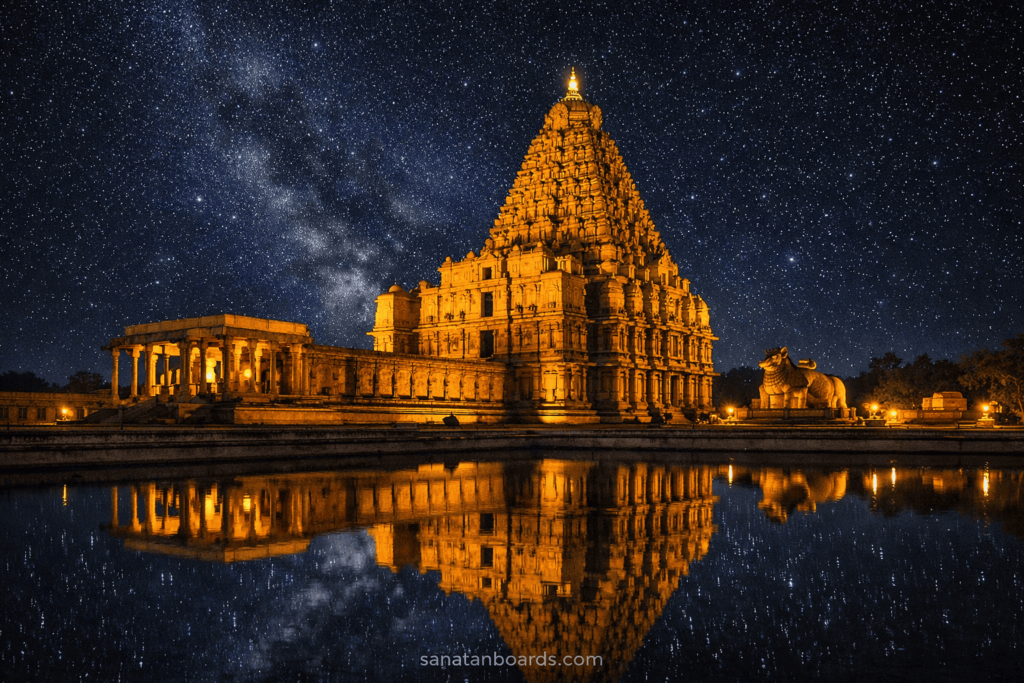
The Brihadeeswarar Temple serves as a remarkable case study in ancient architecture, engineering innovation, cultural development, and heritage conservation. Built in 1010 CE by Raja Raja Chola I, it represents the peak of Chola dynasty achievements and continues to function as both a religious and historical monument.
From an architectural perspective, the temple demonstrates advanced planning and precision. The use of granite stone for the entire structure is significant because granite is extremely hard and difficult to shape. Despite this, the builders achieved highly detailed sculptures and perfectly aligned structural components. The vimana, standing approximately 66 meters tall, remains one of the tallest temple towers in the world, showcasing engineering mastery.
One of the key case study aspects is the construction technique. Historians suggest that a massive inclined ramp was used to place the capstone at the top of the tower. This reflects the Chola engineers’ understanding of physics and mechanical advantage. The absence of modern machinery makes this achievement even more impressive.
From a cultural perspective, the temple functioned as a center of education, art, and religion. It was not only a place of worship but also a hub for dance, music, sculpture, and literature. The inscriptions found on its walls provide detailed records of donations, governance, and daily temple activities, making it a valuable historical archive.
Economically, the temple played a significant role in the Chola empire. It was supported by land grants, agricultural income, and royal patronage. Temples during this period acted as economic institutions that managed resources and supported local communities.
Socially, the temple brought together people from different professions and backgrounds, including priests, artisans, dancers, scholars, and farmers. This integration contributed to a strong cultural identity and social cohesion in the region.
From a technological standpoint, the construction reflects advanced knowledge of material science, geometry, and structural balance. The precision in stone fitting without modern binding materials highlights exceptional craftsmanship.
In terms of heritage conservation, the temple has survived for over a thousand years, enduring natural wear, environmental changes, and human influence. Its recognition as a UNESCO World Heritage Site ensures its preservation for future generations.
This case study highlights the Brihadeeswarar Temple as a symbol of human creativity, engineering brilliance, and cultural richness. It stands as evidence of #Sanatanboardsintamilnadu how ancient civilizations achieved extraordinary architectural feats without modern technology.
White Paper On Brihadeeswarar Temple (Tamil Nadu) – Unesco Heritage Shiva Temple
The Brihadeeswarar Temple is a monumental structure that represents the integration of religion, architecture, governance, and culture in early medieval South India. This white paper analyzes its significance from historical, architectural, socio-economic, and cultural perspectives.
Historically, the temple was constructed during the reign of Raja Raja Chola I, marking a period of political stability and imperial expansion. The Chola dynasty used temple construction as a means of establishing authority and cultural identity. The Brihadeeswarar Temple became a symbol of royal patronage and devotion to Lord Shiva.
Architecturally, the temple represents the pinnacle of Dravidian design. Its massive vimana, intricate carvings, and symmetrical layout demonstrate advanced engineering knowledge. The use of granite and precise stone fitting techniques highlights the sophistication of Chola builders. The structural design ensures both durability and aesthetic beauty.
The temple complex follows a well-organized spatial plan, including sanctum, mandapas (halls), and courtyards. This reflects a deep understanding of geometry and spatial harmony. The alignment of structures also suggests astronomical considerations.
From a socio-economic perspective, the temple functioned as an institution that influenced agriculture, trade, and employment. Land grants were provided to support temple activities, and these lands generated revenue that sustained religious and cultural practices. The temple also provided employment to artisans, priests, and laborers.
Culturally, the temple was a center for performing arts such as Bharatanatyam dance and classical music traditions. It played a key role in preserving and promoting Tamil culture and literature. Inscriptions on temple walls provide valuable insights into language, administration, and social structure of the Chola period.
Religiously, the temple serves as a major center for Shaivism. It continues to be an active place of worship, demonstrating continuity of spiritual traditions over a millennium.
In terms of conservation, the temple is recognized as a UNESCO World Heritage Site, ensuring international support for its preservation. Conservation efforts focus on maintaining structural integrity, protecting inscriptions, and managing tourism impact.
This white paper concludes that the Brihadeeswarar Temple is #Sanatanboardsinvasai not just a religious structure but a multidimensional institution that reflects the complexity and advancement of Chola civilization.
Industry Application On Brihadeeswarar Temple (Tamil Nadu) – Unesco Heritage Shiva Temple
The Brihadeeswarar Temple offers valuable lessons and applications across multiple modern industries, including architecture, engineering, tourism, cultural studies, and heritage management.
In the architecture and construction industry, the temple serves as a case study in sustainable design and durable construction. The use of locally available natural materials, precise stone carving, and long-lasting structural design provides insights into building techniques that can inspire modern eco-friendly architecture. Engineers study its load distribution and structural stability for understanding ancient construction methods.
In the tourism industry, the temple is a major heritage attraction that supports cultural tourism in Tamil Nadu. It draws visitors from around the world, contributing to local economies through hospitality, transport, and guided tours. Tourism management strategies around the temple help in developing sustainable tourism models that balance visitor inflow with conservation needs.
In education and research, the temple is widely studied in fields such as archaeology, history, art history, and anthropology. It provides primary data for understanding ancient South Indian civilization, governance systems, and cultural practices. Universities and research institutions use it as a reference point for heritage studies.
In information technology and digital preservation, the temple is being digitally documented using 3D scanning, virtual reality, and GIS mapping. These technologies help preserve its structure and allow global audiences to experience it virtually.
In the cultural and creative industries, the temple inspires artists, filmmakers, writers, and designers. Its sculptures and architectural forms influence modern art and cultural expression.
In public administration and heritage management, the temple serves as a model for managing large historical sites. Policies related to conservation, crowd control, and maintenance are developed based on lessons learned from managing such heritage structures.
Thus, the Brihadeeswarar Temple has wide-ranging #Sanatanboardsinmumbai applications across industries, making it not only a historical monument but also a living source of knowledge and innovation.
source : StudyIQ IAS
ASK FAQ
1. What is Brihadeeswarar Temple famous for?
Brihadeeswarar Temple is famous for its massive Dravidian architecture, 11th-century Chola construction, and being a UNESCO World Heritage Site dedicated to Lord Shiva.
2. Who built Brihadeeswarar Temple in Tamil Nadu?
It was built by Chola emperor Raja Raja Chola I in the early 11th century as a symbol of devotion and architectural excellence.
3. Where is Brihadeeswarar Temple located?
The temple is located in Thanjavur (Tanjore), Tamil Nadu, India, and is one of the most important historical landmarks in South India.
4. Why is Brihadeeswarar Temple a UNESCO World Heritage Site?
It is a UNESCO site due to its outstanding Chola architecture, historical importance, engineering brilliance, and cultural significance.
5. How old is Brihadeeswarar Temple?
The temple is over 1,000 years old, constructed in 1010 CE during the reign of Raja Raja Chola I.
Table of Contents
Disclaimer: This content is provided strictly for educational and informational purposes only. It is intended to support learning, research, and general knowledge about historical, cultural, and architectural heritage. All details are written based on commonly available historical and academic references and are meant to help readers understand the significance of the Brihadeeswarar Temple. No part of this content is intended to misrepresent facts, hurt religious sentiments, or provide authoritative historical certification. Readers are encouraged to refer to verified scholarly sources, archaeological studies, and official records for deeper or more precise academic research and confirmation of information presented here.