
Dwāpara Yuga, which is the third of the four yugas (epochs) in Hindu cosmology.
Dwāpara Yuga Overview
Dwāpara Yuga is the third age in the Hindu cycle of four yugas, following Satya Yuga and Treta Yuga, and preceding Kali Yuga. It is traditionally believed to last 864,000 years, during which the world experiences a significant decline in dharma, or righteousness. While knowledge, spirituality, and moral principles still exist, they are no longer universally observed. People in this age increasingly prioritize material desires, worldly ambitions, and personal gain. Despite this gradual decline in moral standards, Dwāpara Yuga continues to offer opportunities for individuals to cultivate virtue, wisdom, and devotion. It is an age that emphasizes the practical application of knowledge in navigating the complexities of life.
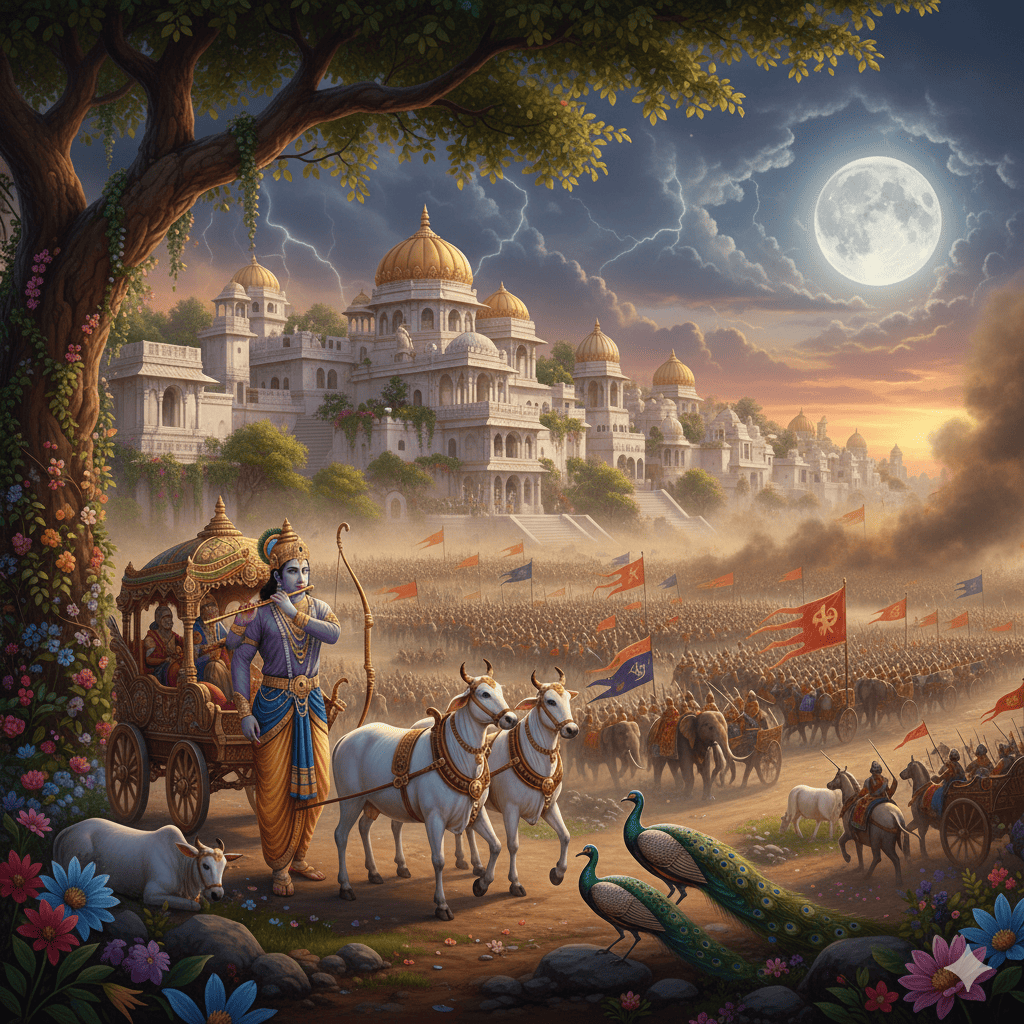
One of the most important aspects of Dwāpara Yuga is that dharma stands on only two legs, compared to four in Satya Yuga and three in Treta Yuga. This metaphor illustrates that righteousness is partially maintained but is weaker than before, requiring conscious effort to uphold ethical conduct. Moral dilemmas, conflicts, and struggles between duty and desire are common during this period. As a result, guidance through sacred texts, spiritual teachers, and personal reflection becomes essential for maintaining balance and leading a virtuous life.
The key figures and sources of knowledge in Dwāpara Yuga include Krishna, whose teachings in the Bhagavad Gita provide timeless guidance on duty, action, and devotion. Arjuna, the warrior-disciple, serves as an example of the human seeker, illustrating how one can navigate moral uncertainty with wisdom and courage. The Mahābhārata epic chronicles the events of the era and highlights ethical, social, and spiritual lessons. Additionally, the Vedas and other Puranic texts provide foundational knowledge about dharma, karma, and spiritual practice, offering guidance that is both philosophical and practical.
Knowledge in Dwāpara Yuga is required by everyone, not only scholars or spiritual practitioners. Leaders, rulers, warriors, and ordinary people must understand the principles of dharma, karma, and bhakti (devotion) to navigate ethical dilemmas, make sound decisions, and maintain personal and societal harmony. Knowledge is particularly needed during times of crisis, moral conflict, or life-changing decisions. Unlike previous yugas, where righteousness was more naturally upheld, Dwāpara Yuga demands conscious effort, reflection, and practical application of knowledge.
The application of knowledge in this age occurs through listening to teachings, reflecting on moral principles, practicing righteous actions, cultivating devotion, and seeking guidance from mentors or spiritual teachers. This combination of learning, contemplation, and action ensures that knowledge is not merely theoretical but lived and experienced. Arjuna’s example on the battlefield illustrates this perfectly: he listens to Krishna’s guidance, reflects on his duty, and performs his actions without attachment to results, embodying the essence of Dwāpara Yuga knowledge.
In modern terms, the principles of Dwāpara Yuga knowledge can be applied in leadership, education, conflict resolution, mindfulness, and ethics. By integrating dharma, reflection, and conscious action, individuals and organizations can navigate challenges, uphold ethical standards, and maintain balance in a complex and materialistic world.
In essence, Dwāpara Yuga highlights the importance of knowledge, reflection, practical action, and devotion in maintaining moral and spiritual integrity during an era of partial decline, preparing humanity for the challenges of the next age, Kali Yuga.
Characteristics:
Dharma (righteousness) is said to stand on two legs (in Satya Yuga it was four, Treta three).
People are less virtuous than in previous yugas.
Knowledge and spirituality exist but are not practiced universally.
Humanity becomes more materialistic; conflicts and desires increase.
Significant Events:
Many stories from the Mahābhārata occur in this era.
The life of Krishna, including the Kurukshetra War, falls within this yuga.
The Bhagavad Gita is delivered during this time.
WHAT IS DWAPARA YUG
Dwāpara Yuga is the third age (yuga) in the Hindu cycle of four ages. It comes after Treta Yuga and before Kali Yuga.
Key Points about Dwāpara Yuga
- Position in the cycle: 3rd out of 4 yugas (Satya → Treta → Dwāpara → Kali).
- Duration: Traditionally 864,000 years.
- Dharma (Righteousness): Only half as strong as in Satya Yuga, meaning moral and spiritual values are declining.
- Characteristics:
- People are less virtuous and more materialistic.
- Knowledge exists but is not widely practiced.
- Society is more prone to conflicts and desires.
- Famous events:
- The Mahābhārata war takes place.
- Life and teachings of Krishna happen during this age.
- The Bhagavad Gita is given to Arjuna.
- Transition: Dwāpara Yuga ends when Kali Yuga begins, the age of darkness and moral decline.
WHO IS REQUIRED KNOWLEDGE
Essential Knowledge in Dwāpara Yuga
- Spiritual Figures
- Krishna – central figure of Dwāpara Yuga; his teachings guide people toward dharma and devotion.
- Arjuna – disciple of Krishna; represents the seeker who applies divine guidance.
- Other sages and warriors of the Mahābhārata era, who preserved dharma.
- Sacred Texts
- Bhagavad Gita – core spiritual and moral guide, teaching duty (dharma), devotion (bhakti), and wisdom (jnana).
- Mahābhārata – the epic that chronicles the age, including moral lessons, political strategy, and human behavior.
- Vedic knowledge – rituals, duties, and ethical principles that were still practiced.
- Key Principles
- Dharma (Righteousness) – live according to duty and moral law, though it’s weaker than in previous ages.
- Bhakti (Devotion) – devotion to God becomes a major spiritual path.
- Karma (Action) – understanding that actions have consequences.
- Self-control and moderation – essential as desires and materialism increase.
- Purpose of Knowledge in Dwāpara Yuga
- To maintain spiritual balance despite moral decline.
- To prepare for the upcoming Kali Yuga, where knowledge will be even harder to practice.
- To guide people toward liberation (moksha) through dharma, devotion, and wisdom.
WHEN DWAPARA YUG KNOWLWDGE IS RERQUIRED
Throughout Life
- The guidance of dharma, devotion, and karma should be applied at all stages of life.
- Knowledge from Krishna, the Mahābhārata, and the Vedas is meant to direct daily actions, duties, and moral choices.
During Challenges and Conflicts
- Dwāpara Yuga is a time of increasing desires, conflicts, and moral complexity.
- Knowledge is especially required when making difficult choices (like Arjuna on the battlefield).
- Applying this wisdom helps maintain righteousness despite temptations and struggles.
At Transitions
- The age leads toward Kali Yuga, where spiritual practice becomes more difficult.
- Knowledge is required before the decline worsens, to prepare one’s mind and soul for the upcoming challenges.
For Spiritual Growth
- Anytime a person seeks liberation (moksha) or higher understanding, Dwāpara Yuga teachings are necessary.
- Bhakti (devotion), dharma (duty), and jnana (wisdom) are the main tools.
SOURCE :THE DWAPARA YUG
WHERE KNOWLEDGE IS REQUIRED
In Dwāpara Yuga, the third age in the Hindu cycle of yugas, knowledge is not confined to sacred spaces or scholarly study alone; it is required everywhere and in all aspects of life. This era is marked by a decline in dharma, the moral and spiritual law that governed human behavior, and as a result, people must consciously apply knowledge to navigate daily life, ethical challenges, and societal responsibilities. Unlike Satya Yuga, where righteousness was naturally upheld, and Treta Yuga, where virtue still flourished, Dwāpara Yuga requires deliberate effort to maintain balance, meaning knowledge must be actively applied in diverse contexts.
At home, knowledge is required in family life and domestic responsibilities. Individuals must apply lessons of dharma and ethical conduct to nurture harmonious relationships, educate children, and maintain moral integrity. Parents and elders are responsible for passing down values, guiding younger generations, and ensuring that love and discipline are balanced with ethical principles. In this environment, knowledge is both practical and moral—it directs day-to-day decisions, resolves disputes, and sustains emotional and spiritual health within the household.
In society, knowledge is required to uphold justice, fairness, and ethical governance. Leaders, rulers, and community members must act with awareness of dharma to ensure equitable treatment, resolve conflicts, and promote social harmony. Ethical decision-making, accountability, and transparency are applications of Dwāpara Yuga knowledge in public life. The Mahābhārata illustrates this clearly, showing how leaders and warriors face dilemmas that demand wisdom, reflection, and moral courage. Knowledge is essential in all forms of social interaction, including trade, education, and civic engagement, to prevent corruption, greed, and exploitation.
In spiritual spaces, knowledge is required for personal growth and devotion. Temples, ashrams, and meditation centers serve as environments where teachings from the Vedas, Bhagavad Gita, and Mahābhārata can be studied, reflected upon, and practiced. Rituals, meditation, chanting, and service to others cultivate both moral discipline and spiritual understanding. Even here, knowledge is not theoretical; it must guide action, shaping character and promoting self-awareness, humility, and devotion.
During challenges or crises, knowledge is required wherever moral and ethical decisions arise. Whether facing personal struggles, societal conflicts, or metaphorical “battles” in life, the guidance of dharma, reflection on karma, and application of ethical principles become crucial. The example of Arjuna on the battlefield illustrates this vividly: he applies Krishna’s guidance, reflects on his duty, and acts without attachment to results. Such scenarios demonstrate that knowledge is most critical when decisions have lasting consequences, affecting both self and others.
Finally, knowledge is required in all places of human activity, including work, education, travel, and personal endeavors. Dwāpara Yuga emphasizes that ethical and spiritual principles must permeate every sphere of life, not just formal or sacred contexts. By applying knowledge universally, individuals can maintain balance, make morally sound choices, and navigate an age of declining dharma successfully.
In conclusion, Dwāpara Yuga knowledge is required everywhere—at home, in society, in spiritual spaces, during challenges, and in all daily activities. Its purpose is to guide action, sustain dharma, and cultivate both ethical behavior and spiritual growth, ensuring that humanity thrives even as moral and spiritual standards face gradual decline.
HOW KNOWLEDGE IS REQUIRED
Through Listening and Learning (Śravaṇa)
- Learning from sacred texts like Krishna’s teachings in the Bhagavad Gita.
- Listening to sages, elders, and wise people who understand dharma.
- Oral transmission of knowledge was a key method in Dwāpara Yuga.
Through Reflection and Understanding (Manana)
- Thinking deeply about moral duties, karma, and life lessons.
- Contemplating how dharma applies in everyday decisions and challenges.
- Example: Arjuna reflecting on his duty before the war.
Through Practice (Nidhidhyāsana / Karma)
- Applying the knowledge in daily life, not just studying it.
- Performing duties faithfully, practicing self-discipline, and devotion.
- Acting according to dharma even when it is difficult.
Through Devotion (Bhakti)
- Developing love and surrender to God as taught by Krishna.
- Prayer, meditation, chanting, and rituals.
- Bhakti complements knowledge (jnana) to achieve spiritual growth.
Through Guidance (Guru-Shishya Tradition)
- Seeking a teacher or mentor to clarify doubts and provide practical instructions.
- Knowledge is most effective when transmitted under the guidance of someone experienced in dharma.
CASE STUDY ON DWAPARA YUG KNOWLEDGE
Dwāpara Yuga is the third age in Hindu cosmology, marked by declining dharma, increasing desires, and moral challenges. While knowledge exists, it is not universally followed, making guidance essential for spiritual and moral life.
Key Figure
Krishna
- Central teacher and guide during this era.
- Provides practical wisdom through Bhagavad Gita to navigate moral dilemmas.
Arjuna
- A warrior facing an ethical crisis during the Kurukshetra war.
- Represents the human seeker who struggles with duty vs. attachment.
Problem / Challenge
Arjuna is confused about fighting his own relatives and teachers in the war. He faces:
- Ethical dilemma (dharma conflict)
- Emotional attachment to family
- Fear of consequences and societal judgment
This situation exemplifies how Dwāpara Yuga humans must balance morality, duty, and desire, reflecting the age’s characteristics of partial righteousness.
Application of Knowledge
- Listening (Śravaṇa):
- Arjuna listens to Krishna’s guidance carefully, absorbing moral and spiritual principles.
- Reflection (Manana):
- He contemplates the meaning of dharma, karma, and selfless action.
- Practical Action (Karma):
- Arjuna applies the knowledge by performing his duty as a warrior, without attachment to results.
- Devotion (Bhakti):
- Trusting Krishna and surrendering to divine guidance strengthens his resolve.
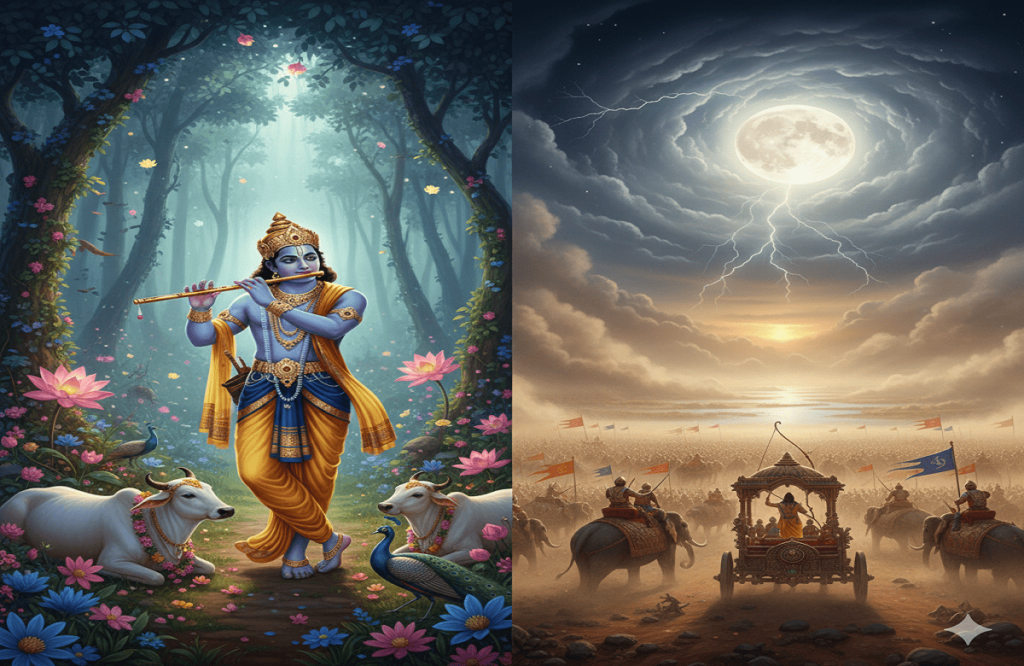
Outcome / Lessons
- Arjuna overcomes confusion and performs his duty according to dharma.
- Knowledge in Dwāpara Yuga is practical, situational, and meant for application, not just theory.
- Spiritual guidance helps humans navigate moral decline and prepare for Kali Yuga.
Conclusion
The Dwāpara Yuga case shows that knowledge is required to act ethically, reflect wisely, and cultivate devotion in an age of declining righteousness. It emphasizes living knowledge, not just learning it.
WHITE PAPER ON KNOWLEDGE IN DWAPAR YUG
Prepared By: [RAMANRAYAN MAURYA/ SIXSIGMA QUALITY INTERNATIONAL]
Date: 6March 2026
Executive Summary
Dwāpara Yuga, the third epoch in the Hindu yuga cycle, is characterized by partial decline in dharma (righteousness), increasing materialism, and moral challenges. Knowledge in this era is crucial for maintaining ethical balance, guiding action, and achieving spiritual growth. This white paper examines the nature, application, and significance of knowledge in Dwāpara Yuga.
1. Introduction
- Dwāpara Yuga follows Treta Yuga and precedes Kali Yuga.
- Duration: 864,000 years (traditional texts).
- Key characteristics: Dharma is half as strong as in Satya Yuga; spiritual and moral knowledge exists but is selectively applied.
Purpose of this White Paper:
To provide a detailed understanding of who needs knowledge, when, where, and how it should be applied during Dwāpara Yuga.
2. Key Figures and Sources of Knowledge
| Figure / Source | Role | Key Contribution |
|---|---|---|
| Krishna | Spiritual guide | Bhagavad Gita, moral and ethical guidance |
| Arjuna | Seeker / practitioner | Example of applying dharma in challenging situations |
| Mahābhārata | Epic scripture | Illustrates ethical dilemmas, warfare, and societal duties |
| Vedas | Spiritual texts | Prescribes rituals, duties, and ethical conducthttps://sanatanboards.com/ |
3. When Knowledge is Required
- Throughout life: Daily duties, family life, societal responsibilities.
- During challenges: Moral dilemmas, conflicts, or crises.
- At transitions: Preparing for the moral decline of Kali Yuga.
- For spiritual growth: Pursuit of moksha (liberation) through dharma, bhakti, and karma.
4. Where Knowledge is Applied
- Home: Family duties, teaching values.
- Society: Ethical leadership, fair trade, conflict resolution.
- Spiritual spaces: Temples, ashrams, and meditation centers.
- Battles / crises: Making ethical decisions under pressure.
- Daily life: Work, education, personal development.
5. How Knowledge is Applied
- Listening (Śravaṇa): From scriptures, sages, and mentors.
- Reflection (Manana): Contemplating moral and spiritual principles.
- Practice (Karma / Nidhidhyāsana): Applying knowledge in action.
- Devotion (Bhakti): Prayer, meditation, and surrender to God.
- Guidance (Guru-Shishya): Mentorship to clarify and implement knowledge.
6. Case Study: Arjuna on the Battlefield
- Problem: Ethical dilemma of fighting his own relatives in the Kurukshetra war.
- Knowledge Applied: Krishna’s guidance (Bhagavad Gita), reflection on dharma, and detached action.
- Outcome: Arjuna performs his duty without attachment, demonstrating practical application of Dwāpara Yuga knowledge.
7. Conclusion
Dwāpara Yuga knowledge is essential for navigating moral complexity, maintaining dharma, and achieving spiritual growth. It emphasizes practical application, devotion, and reflection, rather than mere theoretical understanding. Knowledge in this era is a guiding force to prepare humanity for the challenges of Kali Yuga.
References
- Mahābhārata – Vyasa, Epic Sanskrit text.
- Bhagavad Gita – Conversation between Krishna and Arjuna.
- Traditional Hindu texts on the Yuga cycle (Puranas).
Industry Applications of Dwāpara Yuga Knowledge
Leadership & Management
- Principles Applied: Dharma (duty), ethical decision-making, and detached action.
- Use Case: Executives and managers can make ethical choices in high-pressure situations, similar to Arjuna applying Krishna’s guidance.
- Benefit: Encourages responsible leadership, long-term sustainability, and corporate ethics.
2. Education & Training
- Principles Applied: Listening (Śravaṇa), reflection (Manana), and practice (Karma).
- Use Case: Modern education can integrate moral reasoning, critical thinking, and applied learning, inspired by Dwāpara Yuga methods.
- Benefit: Develops students with practical wisdom, ethical awareness, and problem-solving skills.
3. Mental Health & Wellness
- Principles Applied: Meditation, self-reflection, and devotion (Bhakti).
- Use Case: Stress management programs, mindfulness training, and therapeutic practices draw on these principles.
- Benefit: Improves emotional resilience, clarity of mind, and personal balance in high-stress workplaces.
4. Conflict Resolution & Negotiation
- Principles Applied: Applying dharma in dilemmas, impartial judgment, and ethical conduct.
- Use Case: Mediation, legal frameworks, and corporate negotiation strategies can use these teachings to resolve disputes.
- Benefit: Ensures fair, principled, and sustainable solutions in business and governance.
5. Technology & AI Ethics
- Principles Applied: Karma (action and consequence), reflection, and guidance from mentors (or frameworks).
- Use Case: AI and robotics development guided by ethical principles, ensuring technology serves humanity responsibly.
- Benefit: Promotes ethical AI, responsible innovation, and long-term societal impact.
6. Personal & Organizational Development
- Principles Applied: Continuous learning, self-discipline, and devotion to higher purpose.
- Use Case: Employee training programs, leadership retreats, and strategic vision planning.
- Benefit: Aligns individual growth with organizational values, reducing burnout and promoting meaningful work.