Panchatantra is an ancient Indian collection of moral stories written to teach wisdom, ethics, and practical life skills. It was composed in Sanskrit by the scholar Vishnu Sharma around 200 BCE. The stories were originally created to educate young princes about leadership, intelligence, and human behavior through interesting tales.
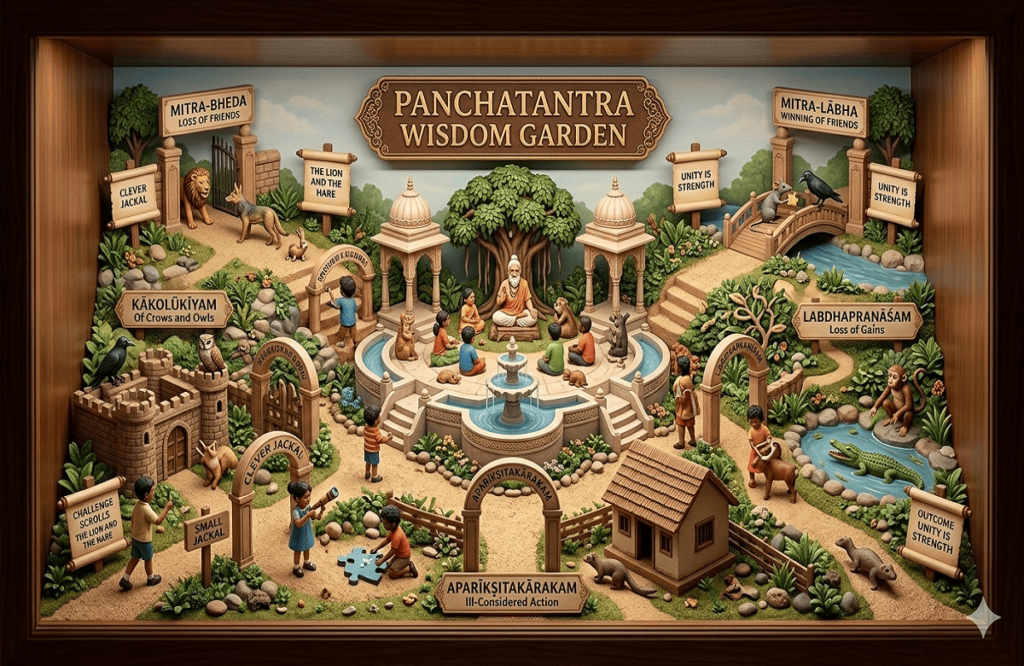
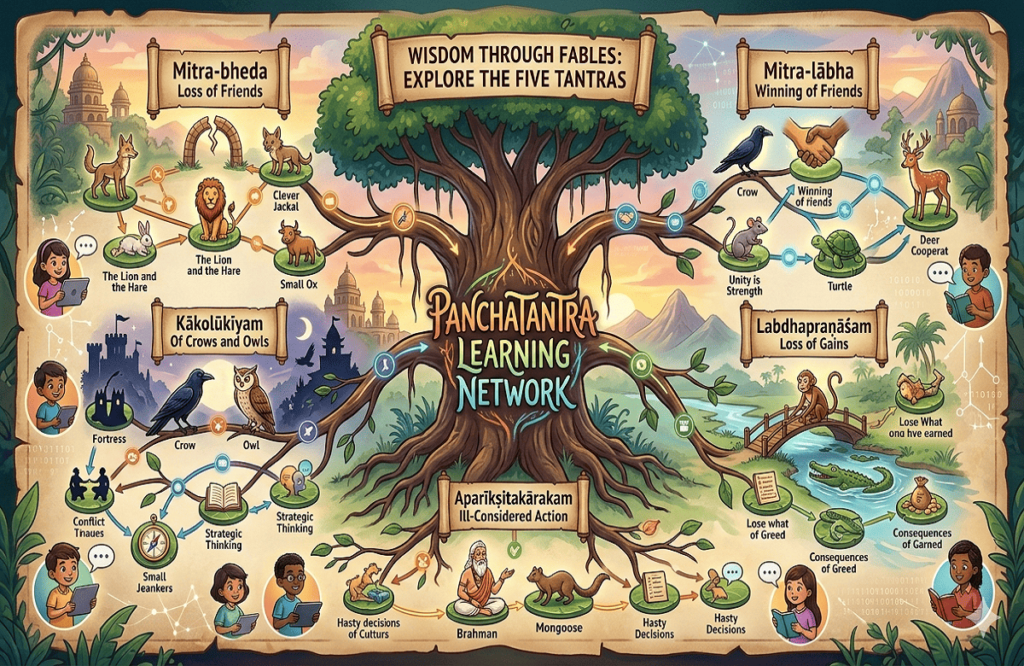
The Panchatantra is divided into five parts, each focusing on an important principle of life. These are Mitra Bheda (Loss of Friends), Mitra Labha (Gaining Friends), Kakolukiyam (Crows and Owls), Labdhapranasam (Loss of Gains), and Aparikshitakarakam (Ill-considered Actions). Through these sections, the text teaches lessons about friendship, trust, strategy, careful decision-making, and avoiding greed.
Most stories use animals as characters, such as lions, monkeys, crows, turtles, and crocodiles. These animals behave like humans and help readers understand different qualities such as cleverness, honesty, teamwork, and patience. Popular stories like The Monkey and the Crocodile show how intelligence and quick thinking can solve problems.
The main learning from the Panchatantra is that wisdom and good judgment are essential for success in life. Its simple yet meaningful stories continue to educate children and adults around the world about values, relationships, and smart decision-making
WHAT IS PANCHATANTRA LEARNING NETWORK?
The Panchatantra Learning Network focuses on spreading knowledge and wisdom through storytelling and interactive learning methods. The stories of Panchatantra teach several important concepts such as friendship, intelligence, leadership, teamwork, honesty, and problem-solving. Each story contains a moral lesson that helps learners understand the importance of making good decisions in life. The learning network encourages people to think wisely, avoid mistakes, and handle difficult situations with intelligence and patience.
Learning Methods
The Panchatantra Learning Network uses different methods to make learning interesting and effective. One of the main methods is storytelling, where teachers explain the stories and their moral lessons. Another important method is group discussion, where learners share their opinions and understand different viewpoints. Case studies and examples from real life are also used to show how Panchatantra teachings can be applied in everyday situations. In addition, activities, games, and role-playing are used to make learning more engaging and interactive.
Benefits of Panchatantra Learning Network
There are many benefits of learning through the Panchatantra approach. It helps individuals develop critical thinking and decision-making skills. It also improves communication, leadership, and teamwork abilities. The lessons from Panchatantra encourage people to act wisely, respect others, and build strong relationships. These teachings help students and adults become more confident and responsible in their personal and professional lives.
Conclusion
In conclusion, the Panchatantra Learning Network is an effective way of using ancient wisdom to teach modern life skills. The teachings of the Panchatantra continue to guide people by promoting intelligence, ethics, and good behavior. By learning from these stories, individuals can develop a strong character and make better decisions in life. Therefore, the Panchatantra Learning Network plays an important role in spreading valuable knowledge and helping people grow into wise and responsible individuals.
WHO IS REQUIRED IN PANCHATANTRA LEARNING NETWORK?
Learners / Students
- These are children, students, or adults who join the network to learn life skills.
- They actively participate in storytelling, discussions, activities, and role-playing to understand the morals and practical lessons of Panchatantra.
Teachers
Coordinators / Organizers
- These are educators, trainers, or mentors who understand Panchatantra stories and their meanings.
- They guide the learners, explain the stories, highlight the morals, and help participants apply lessons to daily life situations.
- People or institutions like schools, NGOs, or online platforms manage the network.
- They plan learning sessions, schedule activities, handle registrations, and ensure the smooth functioning of the program.
Parents
- Parents of younger learners support the children in understanding lessons at home.
- They encourage discussion, reinforce learning, and help learners apply moral lessons in daily life.
Community
- Fellow learners and members of the network help each other through teamwork and discussions.
- Peer groups create a collaborative environment, making learning more interactive and effective.
WHEN IS PANCHATANTRA LEARNING NETWORK REQUIRED?
The Panchatantra Learning Network is an educational program that uses the wisdom of the ancient Indian text Panchatantra to teach moral values, life skills, and practical decision-making abilities. The stories of Panchatantra, written by the scholar Vishnu Sharma, are designed to convey important lessons through simple yet engaging animal fables. A learning network based on these stories is required whenever there is a need to teach values, develop intelligence, and prepare learners for real-life challenges. It is not only meant for children but also for teenagers, adults, and communities who wish to strengthen their life skills in an interactive and meaningful way.
For Early Education and Character Building
One of the most important times when a Panchatantra Learning Network is required is during early education. Children are at a stage where they are forming habits, understanding social relationships, and learning to distinguish between right and wrong. The stories of Panchatantra teach them the importance of honesty, friendship, kindness, patience, and respect for others. By participating in the network, young learners can understand the consequences of actions and the value of making wise choices. This early exposure helps build strong character and ensures that moral lessons are internalized in a way that lasts throughout life.
For Leadership, Problem-Solving, and Teamwork
Another critical situation when the network is required is for teenagers, students, and adults who want to develop leadership skills, critical thinking, and problem-solving abilities. Panchatantra stories often highlight cleverness, strategy, and intelligence, which are essential qualities for handling challenges and making good decisions. In group learning or team environments, the network teaches individuals how to collaborate, communicate, and resolve conflicts effectively. It is particularly useful in schools, colleges, organizations, and community programs where teamwork and ethical decision-making are emphasized. The network encourages learners to think analytically, plan wisely, and act responsibly in both personal and professional life
For Personal Development and Modern Learning Platforms
The Panchatantra Learning Network is also required in personal development programs and online learning platforms. Adults seeking self-improvement, emotional intelligence, or leadership training benefit from the structured lessons of the network. The interactive format, including storytelling, discussions, role-playing, and case studies, allows learners to apply Panchatantra teachings in real-life situations. Online platforms make it accessible for learners who cannot attend traditional classrooms, ensuring that the network can reach a wide audience. In today’s fast-paced world, where ethical decision-making and life skills are essential, the network is required to guide individuals toward wisdom, responsibility, and practical knowledge.
WHERE IS PANCHATANTRA LEARNING NETWORK REQUIRED?
In Schools and Educational Institutions
The network is most commonly required in schools and educational institutions, where children are at a stage of building habits and understanding social relationships. Teachers and facilitators use Panchatantra stories to make learning engaging and meaningful. Students learn the importance of ethical behavior, patience, problem-solving, and teamwork. Activities, storytelling, and discussions help students internalize values, making schools a key place for implementing the network effectively.
In Colleges, Leadership Programs, and Community Learning
The Panchatantra Learning Network is also required in colleges, youth development programs, and leadership training sessions. At this stage, learners focus on critical thinking, decision-making, and developing leadership qualities. The network provides examples of strategic thinking, teamwork, and intelligent problem-solving. It is particularly useful in community learning centers, NGOs, or group workshops, where participants can collaborate, discuss, and practice life skills in a guided environment.
In Personal Development and Online Learning Platforms
Modern applications of the network are required in personal development programs and online learning platforms. Adults and professionals who want to improve communication skills, emotional intelligence, and decision-making can benefit from structured Panchatantra-based lessons. Online platforms allow the network to reach learners who cannot attend physical classes, ensuring that the teachings of Panchatantra are accessible to a wider audience. This makes it relevant anywhere there is a need for learning practical life skills and moral guidance, whether at home, in organizations, or in digital classrooms.
HOW IS PANCHATANTRA LEARNING NETWORK REQUIRED?
The Panchatantra Learning Network is required through structured and practical methods that ensure learners can understand, internalize, and apply the wisdom of Panchatantra stories in their daily lives. It is not only about reading or listening to stories; the network engages learners actively so they can develop moral values, critical thinking, problem-solving skills, leadership qualities, and effective decision-making abilities. The implementation of the network depends on creating interactive learning experiences that connect the stories to real-life situations.
One of the primary methods through which the network is required is storytelling. Teachers or facilitators narrate the Panchatantra stories in an engaging way, using gestures, discussions, and examples to make the lessons relatable. Stories such as “The Monkey and the Crocodile” or “The Lion and the Bull” serve as case studies to illustrate how intelligence, strategic thinking, patience, and moral choices can influence outcomes. Storytelling allows learners to visualize scenarios, analyze character behavior, and understand the consequences of actions in a memorable and relatable format. This approach ensures that the lessons are internalized naturally rather than memorized mechanically.
Another important method is group activities, discussions, and role-playing exercises. Learners participate in simulations of story scenarios, debates about moral decisions, and collaborative problem-solving exercises. These activities teach communication, teamwork, empathy, and analytical skills, helping participants evaluate the impact of decisions and actions. For example, a group activity based on a friendship story from Panchatantra can help learners understand the importance of trust, honesty, and collaboration. Group discussions allow learners to consider different perspectives, make informed decisions, and build reasoning skills that can be applied in real-life situations.
Additionally, the network is required through case studies and practical applications. Facilitators show how the morals and strategies from the stories can be applied in daily life, such as handling conflicts, making ethical decisions, planning effectively, or working in teams. Quizzes, interactive games, and project-based exercises further strengthen learning by giving learners the opportunity to practice these lessons actively. This hands-on approach ensures that the Panchatantra teachings are not only understood but also applied, making the learning experience relevant and impactful.
By combining storytelling, interactive discussions, role-playing, case studies, and practical exercises, the Panchatantra Learning Network provides a comprehensive, engaging, and effective method for teaching life skills, moral values, and decision-making to learners of all ages.
CASE STUDY ON PANCHATANTRA LEARNING NETWORK
Background
The Panchatantra Learning Network is a structured educational program that uses the wisdom of the ancient Indian text Panchatantra to teach life skills, moral values, and decision-making abilities. The stories, written by Vishnu Sharma, use animal characters to convey lessons about friendship, intelligence, leadership, teamwork, and ethical behavior. The network is designed to make learning interactive, engaging, and practical, helping learners apply these lessons in real-life situations.
Case Study: Implementation at a School
At Greenfield Public School, the Panchatantra Learning Network was introduced for students aged 10–14 to enhance critical thinking, communication skills, and ethical decision-making. The program was implemented over a period of six months, with weekly sessions led by trained facilitators.
Methodology:
- Storytelling Sessions: Facilitators narrated stories like “The Monkey and the Crocodile” and “The Lion and the Bull”, emphasizing the moral lessons and asking students to reflect on character choices.
- Group Discussions: Students discussed the stories in small groups, analyzing the decisions of the characters and debating alternative actions.
- Role-Playing: Learners enacted the stories, acting as different characters to understand perspectives, consequences, and ethical dilemmas.
- Practical Exercises: Real-life scenarios were presented, such as resolving conflicts among classmates or planning a team activity, and students applied lessons from the stories to find solutions.
Observations:
- Students showed improved problem-solving skills and decision-making abilities.
- Teamwork and communication improved significantly through group discussions and role-playing exercises.
- Learners became more aware of moral and ethical consequences in their actions, applying lessons to everyday school life.
- The interactive approach increased engagement, participation, and interest in learning.
Impact and Benefits
The case study demonstrated that using the Panchatantra Learning Network:
- Encourages critical thinking and reasoning among learners.
- Strengthens ethical awareness and values in practical situations.
- Improves teamwork, leadership, and communication skills.
- Makes learning memorable and enjoyable by connecting stories with real-life applications.
Conclusion
The case of Greenfield Public School shows that the Panchatantra Learning Network is an effective tool for teaching moral lessons and life skills. By combining storytelling, discussions, role-playing, and practical exercises, students not only understand the lessons but also apply them in their daily lives, making the network a valuable addition to modern education.
SOURCE : About Stories
WHITE PAPER ON : PANCHATANTRA LEARNING NETWORK
The Panchatantra Learning Network is an innovative educational framework that leverages the wisdom of the ancient Indian text Panchatantra to teach moral values, life skills, and decision-making capabilities. The stories, written by the scholar Vishnu Sharma, use animal characters and fables to convey practical lessons about friendship, intelligence, leadership, teamwork, ethical conduct, and problem-solving. This learning network is designed to make lessons interactive, relatable, and applicable to real-life situations, bridging the gap between traditional storytelling and modern educational needs.
The network requires several key participants to function effectively. Learners or students are the primary beneficiaries who actively engage with the stories through discussions, role-playing, and problem-solving exercises. Teachers or facilitators guide the learners, narrate the stories, highlight morals, and help participants understand how to apply the lessons in daily life. Coordinators or organizers, such as schools, community organizations, or online platforms, ensure smooth implementation, scheduling, and monitoring of learning sessions. In addition, parents or guardians support younger learners by reinforcing lessons at home, while peer groups enhance understanding through collaborative learning and group activities. These participants together create a structured and engaging environment for effective knowledge transfer.
The Panchatantra Learning Network is required in multiple contexts where the development of moral reasoning, life skills, and strategic thinking is essential. During early education, the network helps children develop ethical behavior, understand social relationships, and internalize lessons about honesty, patience, and empathy. For teenagers and young adults, it fosters leadership qualities, critical thinking, and strategic problem-solving. In colleges, youth workshops, and community programs, the network enhances teamwork, conflict resolution, and collaborative decision-making. Additionally, online learning platforms expand the network’s reach, enabling learners in remote or digital environments to access structured lessons and interactive sessions, making it relevant across diverse educational and developmental settings.
The network is implemented through storytelling, interactive activities, role-playing, case studies, and real-life applications. Teachers narrate stories such as “The Monkey and the Crocodile” or “The Lion and the Bull”, explaining characters’ actions and consequences. Group discussions allow learners to debate moral dilemmas, explore different perspectives, and practice critical thinking. Role-playing exercises help participants empathize with characters, while case studies and real-life simulations demonstrate how the lessons can be applied in school, home, or workplace scenarios. Games, quizzes, and projects further reinforce learning, ensuring that the lessons are not only understood but also practiced.
A practical example can be seen in the implementation of the network at Greenfield Public School, where students aged 10–14 participated in weekly sessions over six months. Facilitators used storytelling, group discussions, and role-playing to teach problem-solving, teamwork, and ethical decision-making. Observations showed significant improvement in learners’ communication, critical thinking, collaboration, and ethical awareness. Students were able to apply Panchatantra lessons in real-life scenarios, such as resolving conflicts with classmates, planning group activities, and making responsible decisions.
The Panchatantra Learning Network offers a scalable, flexible, and impactful approach to education. By combining the timeless wisdom of Panchatantra with modern interactive methods, it helps learners of all ages develop practical life skills, ethical reasoning, and social intelligence. Its implementation in schools, colleges, communities, and online platforms ensures that learners are not only educated but also empowered to make wise decisions and grow into responsible individuals.
INDUSTRY APPLICATION OF PANCHATANTRA LEARNING NETWORK
The Panchatantra Learning Network is not limited to schools or educational institutions; its teachings and methods have significant applications in various industries where leadership, teamwork, strategic thinking, communication, and ethical decision-making are essential. By translating the moral lessons and problem-solving strategies from the ancient Panchatantra stories into practical training modules, organizations can enhance employee skills, strengthen workplace culture, and improve productivity.
In the corporate sector, the network can be applied in leadership and management training programs. Stories from Panchatantra, such as “The Lion and the Clever Rabbit”, demonstrate strategic thinking, patience, and decision-making under pressure. By using these stories in workshops, managers and team leaders can learn how to anticipate challenges, analyze risks, and make ethical decisions that benefit the team and organization. Interactive methods like group discussions, role-playing, and case studies based on these stories help employees apply these lessons to real workplace scenarios.
The network is also useful in team-building and communication training across industries. Panchatantra stories emphasize cooperation, trust, and collaboration, which are key for team success. Companies can use storytelling and role-playing exercises to simulate workplace conflicts, encourage problem-solving, and promote mutual understanding among team members. For example, a story about friendship or alliance-building can be adapted to teach employees about teamwork, conflict resolution, and the importance of clear communication in achieving goals.
In human resources and employee development, the network supports ethical and value-based training. Lessons from Panchatantra help employees understand the consequences of unethical behavior, develop integrity, and make responsible choices. By integrating these teachings into corporate orientation programs or ethics workshops, companies can foster a strong organizational culture built on honesty, trust, and social responsibility.
The network is also relevant in customer service and client management industries. Employees can learn to handle difficult situations patiently, think creatively to solve problems, and communicate effectively, reflecting the intelligence and moral reasoning emphasized in Panchatantra stories.
Furthermore, in startup and entrepreneurship programs, the network can teach young entrepreneurs about strategic planning, risk management, and ethical decision-making. Stories highlighting strategy, cleverness, and foresight provide practical lessons for managing resources, building partnerships, and solving unexpected challenges in business.
Table of Contents
ASK FAQ
1.What is Panchatantra Learning Network?
The Panchatantra Learning Network is an educational system that uses the stories of the ancient Indian text Panchatantra, written by Vishnu Sharma, to teach moral values, life skills, leadership, teamwork, and decision-making. It combines storytelling, interactive activities, role-playing, and case studies to make learning practical, engaging, and applicable in real life.
2.Who can benefit from Panchatantra Learning Network?
Students, children, teenagers, adults, and professionals can benefit from the Panchatantra Learning Network. Learners develop critical thinking, ethical reasoning, leadership skills, and problem-solving abilities. Teachers, facilitators, coordinators, parents, and peer groups play supporting roles to make the learning interactive and effective.
.3.Where is Panchatantra Learning Network applied?
The network is applied in schools, colleges, community programs, training workshops, online learning platforms, and corporate training programs. It is effective wherever learners need guidance in life skills, teamwork, ethical behavior, and decision-making.
4.How is Panchatantra Learning Network implemented?
It is implemented through storytelling, group discussions, role-playing, case studies, and practical exercises. Facilitators narrate stories, conduct interactive sessions, simulate real-life scenarios, and encourage learners to apply lessons in daily life. Games, quizzes, and projects are also used to reinforce learning and make it engaging.
5.What are the industry applications of Panchatantra Learning Network?
The network has applications in corporate leadership training, team-building, communication workshops, ethics training, customer service, and entrepreneurship programs. By adapting Panchatantra stories to corporate and professional scenarios, organizations can develop strategic thinking, teamwork, ethical decision-making, problem-solving, and interpersonal skills among employees.