VIRUPAKSHA RAYA (VIJAYANAGAR) refers to a ruler associated with the Vijayanagara Empire, one of the most important Hindu kingdoms of medieval South India. The Vijayanagara Empire was a dominant political and military power from the mid‑14th century to the mid‑17th century, safeguarding and shaping the cultural, economic and religious life of the Deccan and Southern India against repeated invasions from northern sultanates. Its imperial capital was at Vijayanagara (modern Hampi), a sprawling city famed now for its architectural ruins and temple complexes.
In the early history of the empire, the throne was often contested among members of the Sangama dynasty, which led to short and turbulent reigns for some emperors. Virupaksha Raya I became emperor in 1404 CE after the death of his father, Harihara II, but his concent was contested by his brothers, leading to a brief and unstable rule that lasted less than a year.
Another figure associated with this name is Virupaksha Raya II, who ruled a much later period (1465–1485 CE). He was a member of the same dynasty but his reign occurred during a more troubled phase of the empire, when external pressures from rival sultanates and internal aristocratic dissent weakened centralized authority.
The story of Virupaksha Raya — both I and II — highlights the dynastic politics, succession disputes and fragility that could accompany even powerful empires like Vijayanagara, especially at times when leadership transitions coincided with larger geopolitical challenges Understanding this contribution sheds light on the nature of medieval South Indian statecraft, governance and historical continuity in a major pre‑modern polity.
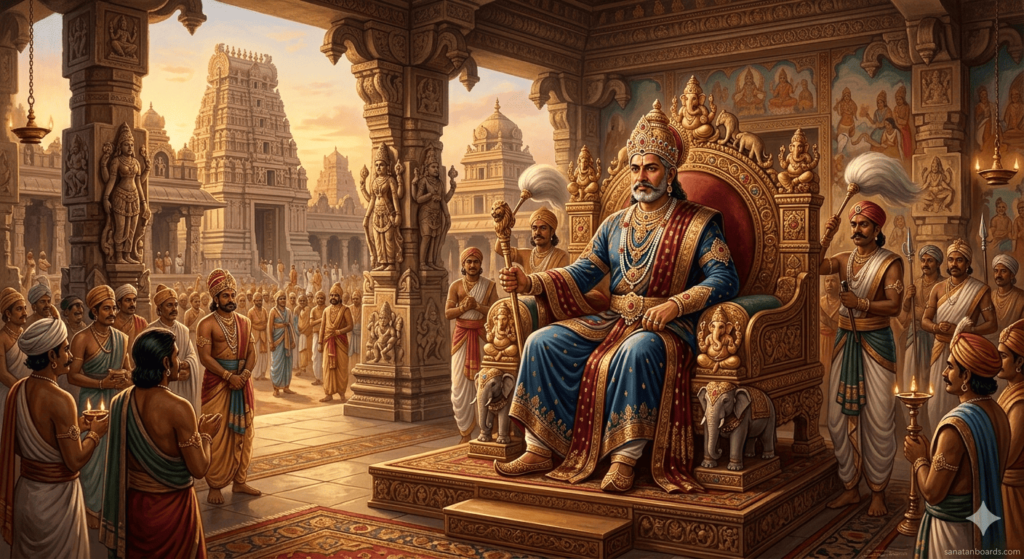
What Is Virupaksha Raya (Vijayanagar) ?
Virtually in history, most references to Virupaksha Raya point to Virupaksha Raya I, who briefly became Emperor (Raya) of the Vijayanagara Empire in 1404–1405 CE. He was a member of the Sangama dynasty, which had established Vijayanagara as a powerful Hindu imperial state in South India after its foundation in 1336 CE.
The term “Raya” itself means king or emperor, and the title Virupaksha identifies this particular ruler. It is important to distinguish him from later rulers with similar names — notably Virupaksha Raya II, who came onto the throne many decades later.
Virupaksha Raya I’s accession came at a time of dynastic dispute. Upon the death of his father, Emperor Harihara II, three brothers — Virupaksha, Bukka Raya II and Deva Raya I — vied for leadership. Virupaksha succeeded momentarily but failed to consolidate support, and his reign was short‑lived, ending amid internal family conflict.
During his rule, the empire is noted to have struggled diplomatically and militarily, losing strategic territories along the western coast such as Goa, Chaul and Dabhol to Muslim sultanates. Though his reign left no great reforms or achievements, its significance lies in demonstrating the fragility of dynastic power struggles within the empire’s overarching strength.
In later historiography, “Virupaksha Raya” may also refer to the ruler of 1465–1485 CE — Virupaksha Raya II — who inherited an empire under greater stress and whose reign reflects political decline within the later years of the Sangama line.
Together, these figures bearing the name show how leadership in Vijayanagara intersected with succession politics, military pressure from rival states and shifting power dynamics within one of South India’s most remarkable medieval empires.
Who Is Required Virupaksha Raya (Vijayanagar) ?
Interpreting “Who is required Virupaksha Raya” suggests an explanation of who Virupaksha Raya was — essentially mapping his identity, lineage and role within the empire. Virupaksha Raya I was born into the royal Sangama dynasty, a line that founded and ruled the Vijayanagara Empire. He was the son of Emperor Harihara II, making him a direct heir in a line of emperors who shaped early Vijayanagara power structures and governance.
His identity is rooted in being part of a succession crisis that followed his father’s death. This was not a peaceful transfer of power; rather, it was defined by competition among brothers — a common occurrence in pre‑modern kingdoms where primogeniture wasn’t strictly enforced and multiple claimants could emerge.
Virupaksha’s “requirement” as ruler stemmed from his bloodline position and perhaps alliances within the imperial court, but his short rule suggests his hold on authority was weak. Support among nobles, military leaders and regional governors was critical for any Vijayanagara emperor; Virupaksha failed to secure these loyalties effectively, leading to his removal within a year.
When Virupaksha Raya (Vijayanagar) Is Required ?
The timing and necessity of Virupaksha Raya’s reign correspond to a specific historical moment in the early 15th century when the Vijayanagara Empire — quickly rising in power and influence — faced internal challenges of succession. The empire was founded in 1336 CE and, by the early 1400s, had become a dominant force in Southern India, holding territory from the western coast to the eastern plains.
In 1404 CE, when Emperor Harihara II died, the throne passed into dispute. In hereditary monarchies like Vijayanagara, a ruler’s death necessitated a successor who could preserve continuity of governance, manage imperial affairs, and safeguard territorial integrity. Virupaksha, being one of Harihara II’s sons, was part of this immediate pool of successors.
This was a period when empires required robust leadership due to ongoing external pressures from Bahmani and other Sultanates, emerging threats to coastal forts and trade routes, and the need to maintain unity among diverse provinces. An emperor’s role was thus critical — not merely ceremonial but central to strategic defense and policy continuity.
Virupaksha’s accession was required in the immediate sense as part of the legal and ceremonial succession following his father’s death, ensuring that there was no power vacuum that could invite rebellion, fragmentation or foreign encroachment. However, the instability of his claim and his lack of broad support meant that he was unable to perform this necessary role effectively, and he was replaced within months.
In broader historical context, Virupaksha Raya II’s later reign (1465–1485 CE) was required at another pivotal moment — one of institutional weakness and provincial rebellion as rival noble houses and governors gained influence, and central authority waned towards the later years of the Sangama lineage. These phases illustrate moments when a ruler was needed not only for formal legitimacy but also for political stabilization and strategic leadersh
Where Virupaksha Raya (Vijayanagar) Is Required ?
The term “where Virupaksha Raya is required” refers to the geographical, political and cultural spaces in which his leadership was relevant within the Vijayanagara Empire. Fundamentally, the seat of his influence was the imperial heartland around Vijayanagara, located on the banks of the Tungabhadra River in present‑day Hampi, Karnataka, India — a sprawling and strategically situated city that served as one of the most powerful capitals in medieval South Asia.
Vijayanagara itself wasn’t simply a capital in the political sense; it was the nexus where military command, administrative governance, economic management and religious patronage converged. As emperor, Virupaksha Raya was required here to exercise authority during a critical transitional phase following his father’s death. This space was where courtly officials, generals and regional administrators gathered, debated and projected royal policy. The capacity to command support in this center often determined the durability of one’s reign.
Beyond the city walls, he was required in the surrounding provinces — regions that extended Vijayanagara’s influence across vast swaths of South India, from coastal ports to inland towns. These included strategic frontier zones such as Goa, Chaul, and Dabhol on the western coast, where competing forces from neighboring sultanates sought influence. Maintaining control of such areas was essential for trade revenue and military logistics.
Additionally, Virupaksha Raya was required in the context of the imperial administrative system, which relied on a network of governors (nayakas), landholders, religious institutions and merchant guilds. In these domains — temples, fortresses, townships, trade routes — his authority was expected to support social order, adjudicate disputes, and sustain economic flow.
Finally, religious and cultural centers were spaces where his role manifested. Vijayanagara rulers were not only political leaders; they were patrons of major temple complexes, artistic expression and ritual performance. Virupaksha Raya’s symbolic presence in temple endowments and court ceremonies reinforced the sacred nature of kingship and connected his rule to the broader spiritual life of the empire.
How Virupaksha Raya (Vijayanagar) Is Required ?
Understanding how Virupaksha Raya was required means exploring the mechanisms and functions through which his role as emperor was justified and enacted. Within the Vijayanagara Empire, kingship was not merely hereditary; it required active engagement in governance, military command, diplomacy and ritual authority.
First, in terms of succession, his claim was required through lineage. As the son of Emperor Harihara II, Virupaksha Raya’s right to rule was grounded in dynastic inheritance. In the prevailing political culture, rulers were expected to emerge from the royal family, invoking both bloodline and ceremony to legitimize their authority.
Second, he was required to command loyalty from nobles and military leaders. The Vijayanagara emperor depended on alliances with powerful nobles (often regional governors called nayakas) and the army’s leadership class. A ruler’s effectiveness depended on political negotiation, patronage, and sometimes force, to secure the allegiance of these influential figures. Virupaksha’s short reign revealed his limited success in this area, which contributed to his rapid displacement.
Third, military leadership was another requirement. Kings of Vijayanagara were expected to protect borders, lead armies and safeguard trade routes. During Virupaksha Raya’s rule, strategic coastal regions were under pressure from rival Sultanates, necessitating military strategy and logistical coordination — duties that his brief tenure did not allow him to fulfill effectively.
Fourth, ceremonial and religious leadership was integral. Vijayanagara kings were seen as protectors of dharma (righteous order), sponsors of temple construction and patrons of religious festivals. Their participation in rituals reinforced not only their piety but also their political legitimacy. This ceremonial requirement bound the emperor socially and spiritually to his people and to divine sanction.
Fifth, law and governance demanded his presence. The emperor dispensed justice, issued edicts, oversaw taxation and managed administrative frameworks. A king had to balance local officials’ interests with imperial priorities, maintaining coherence across distant provinces.
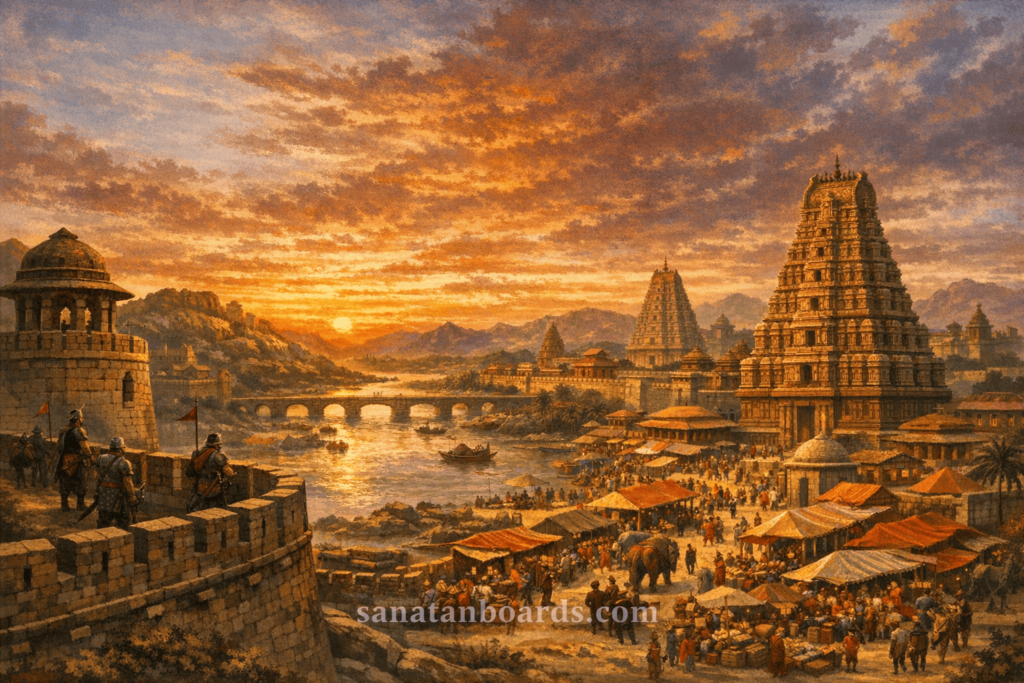
Case Study On Virupaksha Raya (Vijayanagar)
Background and Historical Context
The Vijayanagara Empire arose in 1336 CE to resist expansion from northern sultanates and to unify Southern India under a centralized Hindu state. It became a beacon of cultural patronage, economic wealth and military power. The empire is divided historically into several dynastic phases, with the Sangama dynasty marking the early foundational period.
Virupaksha Raya I ascended to power in 1404 CE following the death of his father, Emperor Harihara II. This succession occurred at a tense political moment — the empire was thriving but facing external pressures from neighboring Muslim Sultanates, especially along the western coastal regions. These areas were important for maritime trade with the Persian Gulf and Indian Ocean worlds. Control over ports like Goa, Chaul and Dabhol was economically and strategically significant.
Succession Crisis and Short Reign
Virupaksha Raya’s reign lasted less than a year, distinguishing his rule from many other Vijayanagara emperors. His accession was contested by his brothers — Bukka Raya II and Deva Raya I — reflecting a dynastic struggle rather than a smooth succession. In the absence of formalized primogeniture, such disputes were common when multiple princes had strong claims backed by noble factions.
His inability to consolidate support among key nobles and military leaders weakened his hold on power. In medieval Indian polities, monarchs depended heavily on courtly factions and armed retainers. Without broad loyalty, a ruler’s position could be extremely fragile. Within months, Virupaksha was displaced and succeeded by his brother Bukka Raya II.
Political Challenges and Strategic Failures
During his brief reign, the empire faced heightened pressure from surrounding Sultanates. Although exact military engagements during his rule are not detailed extensively in primary sources, historians note the loss of western coastal forts and territories during this period. These forts were crucial not only for military defense but also for controlling lucrative trade networks.
This challenge underscores a central theme: leadership in the Vijayanagara Empire required more than ceremonial authority. It required strategic foresight, military capabilities, and diplomatic negotiation. Virupaksha’s failure to secure these elements exposed the vulnerability of the empire when central authority was unsettled.
Cultural and Religious Dimensions
Although his reign was brief, Virupaksha Raya ascended a throne embedded within a rich cultural landscape. Vijayanagara kings were major patrons of temple building and artistic patronage. They invested in religious complexes, public works and monumental architecture — visible today in the ruins of Hampi, which reflect the empire’s high point.
Even short‑lived rulers participated in rituals and consecrations that reaffirmed their divine sanction. This religious dimension was essential to medieval kingship, where political authority was intertwined with spiritual legitimacy.
Lessons from the Case
The case of Virupaksha Raya illustrates key lessons in political systems:
- Dynastic Legitimacy Alone Is Insufficient: Hereditary claims must be reinforced through political alliances and administrative capacity.
- Leadership Requires Support Networks: Emperors who lose elite support often fail quickly, regardless of birthright.
- Strategic Governance Is Critical: Control over trade, military defense and provincial administration is vital during leadership transitions.
The brief reign of Virupaksha Raya thus becomes a case study in succession politics, illustrating how fragile emperorship can be even within powerful states when institutional stability is weak.
White Paper On Virupaksha Raya (Vijayanagar)
Executive Summary:
This paper analyzes the short rule of Virupaksha Raya I (1404–1405 CE) within the early history of the Vijayanagara Empire, assessing why his reign was brief and what this reveals about leadership, governance and political structure in pre‑modern empires.
Introduction:
The Vijayanagara Empire was one of medieval India’s most powerful kingdoms. Its early stability and expansion were enabled through strong rulers and institutional structures. However, Virupaksha Raya’s brief ascendancy highlights critical weaknesses in the empire’s political framework.
Background:
Founded in 1336 CE, the Vijayanagara Empire consolidated power across South India and engaged in both warfare and alliance building with neighboring sultanates and regional states. The central administration combined military authority, temple patronage and economic oversight.
Leadership Transition:
The death of Emperor Harihara II necessitated a successor. Virupaksha, as his son, was a claimant, but succession norms were not strictly defined — multiple princes could claim the throne. This absence of succession protocol created multiple contenders and intensified internal competition.
Political Alliances:
Virupaksha lacked sufficient backing from key nobles and military commanders. Medieval Indian empires relied heavily on coalitions supported by powerful provincial leaders. Without these networks, a ruler’s authority remained fragile.
Strategic Failures:
The empire lost valuable coastal territories during his reign — areas critical for revenue and maritime trade. This indicates either a failure of strategy or insufficient capacity to sustain defense, both of which eroded confidence in his leadership.
Institutional Weaknesses:
The case underscores a systemic vulnerability: an absence of structured succession protocols, overdependence on elite support and insufficient mechanisms to manage central authority transitions.
Recommendations:
- Establish Clear Succession Norms: Codified protocols to limit intra‑dynastic conflict.
- Strengthen Bureaucratic Institutions: Building administrative structures less reliant on individual rulers.
- Enhance Strategic Planning: Integrate military and economic planning teams to better prepare for transitions.
Conclusion:
Virupaksha Raya’s short rule offers valuable insights into how powerful states still falter without robust political frameworks. His reign emphasizes #virupaksharayavijaynagar the importance of succession norms, elite coalitions and strategic governance in sustaining long‑term statehood.
Industry Application Of Virupaksha Raya (Vijayanagar)
While Virupaksha Raya (Vijayanagar) is primarily a historical figure, lessons from his reign have indirect applications in modern industries, particularly in areas of leadership, governance, strategic management, and succession planning.
1. Leadership and Organizational Management
Virupaksha Raya’s short reign demonstrates how leadership without organizational support can lead to failure. In modern corporate or industrial settings, CEOs or managers cannot rely solely on positional authority; they require a strong network of stakeholder support, clear delegation structures, and trusted teams — much like an emperor depended on nobles, military leaders, and regional governors.
2. Succession Planning
His succession crisis highlights the importance of clear succession protocols. In industries, especially family-run businesses or startups, unclear succession planning can create power struggles, inefficiency, and operational disruptions. Companies can learn from Vijayanagara by ensuring transparent succession rules and preparing the next generation of leaders through mentorship and gradual responsibility transfer.
3. Strategic Risk Management
Virupaksha’s inability to secure the empire’s western coastal territories underscores the importance of strategic foresight and risk mitigation. In industry, this translates to proactive risk assessment, resource allocation, and contingency planning. For example, supply chain management, cybersecurity, or market expansion initiatives require leaders to anticipate challenges and respond decisively.
4. Cultural and Brand Influence
Even brief rulers like Virupaksha participated in religious and cultural patronage. For modern industries, this translates to brand stewardship and corporate social responsibility (CSR). Companies can maintain legitimacy and stakeholder trust by supporting societal values and cultural initiatives, creating goodwill and brand recognition — analogous to how kings reinforced legitimacy through temple patronage.
5. Lessons for Project and Crisis Management
The short reign demonstrates the need for adaptive leadership under pressure. Modern organizations facing market disruptions, competitive pressures, or mergers must ensure leaders can coordinate multiple teams, manage conflicting interests, and respond quickly to challenges — reflecting the emperor’s need to manage military, administrative, and religious obligations simultaneously.
Conclusion
Though centuries removed, Virupaksha Raya’s reign provides a blueprint for modern industries to understand how leadership, organizational support, #Sanatandharmaaccreditationboardsinmumbai succession planning, strategic risk management, cultural influence, and crisis response can determine success or failure. Businesses and #Sanatandharmaaccreditationboardsinvasai institutions can draw analogies from his story to reinforce resilience, coordination, and legitimacy in their operations.
source : StudyIQ IAS
ASK FAQ
Who was Virupaksha Raya in the Vijayanagar Empire?
Virupaksha Raya was a ruler of the Vijayanagar Empire, part of the Sangama dynasty, who briefly ascended the throne in 1404 CE after Emperor Harihara II. His reign was short due to internal dynastic disputes.
When did Virupaksha Raya rule Vijayanagar?
Virupaksha Raya I ruled Vijayanagar for a brief period around 1404–1405 CE, while Virupaksha Raya II ruled later between 1465–1485 CE.
Where was Virupaksha Raya’s capital?
His capital was Vijayanagara, located on the banks of the Tungabhadra River in present-day Hampi, Karnataka, India, the political and cultural center of the empire.
Why was Virupaksha Raya important in Vijayanagar history?
Virupaksha Raya’s reign highlights early Vijayanagar dynastic politics, succession struggles, and the importance of elite support in maintaining imperial authority and territorial control.
How did Virupaksha Raya influence Vijayanagar culture and administration?
Although his reign was short, Virupaksha Raya was part of the Sangama dynasty that patronized temples, rituals, and administrative frameworks, reinforcing cultural legitimacy and royal authority.
Table of Contents
DISCLAIMER
The information provided in this content is intended solely for educational, learning, and knowledge purposes. While historical sources and research have been used to compile the material, interpretations of historical events and figures such as Virupaksha Raya (Vijayanagar) may vary. This content is not intended as professional advice, investment guidance, or authoritative historical documentation. Readers are encouraged to consult primary sources and academic references for detailed research.