Vikramaditya I was one of the most significant kings of the Badami Chalukya dynasty, which ruled large parts of southern and central India in the 7th century CE. The name Vikramaditya itself is a prestigious royal title in Indian history, often associated with courage, wisdom, and kingship. Broken down, “Vikrama” means valour or prowess, and “Aditya” refers to the sun — representing royalty, brilliance, and supreme power. As a part of the Chalukya imperial tradition, this title signified not just political authority but also moral and cultural leadership.
Vikramaditya I rose to prominence in a challenging period for the Badami Chalukyas. After the death of his father Pulakeshin II, the empire faced invasions and fragmentation, especially from southern rivals like the Pallavas of Kanchipuram. During this turbulent period, Vikramaditya I distinguished himself as a capable leader who restored the Chalukya fortunes, reaffirmed control over Vatapi (modern Badami), and re-asserted the political stability that had been lost.
In contemporary inscriptions, he is described with several royal titles that underscore his supreme status among Indian monarchs of the time: Maharajadhiraja (“king of great kings”), Satyashraya (“refuge of truth”), and Shri-prithvi-vallabha (“beloved of the goddess of wealth and earth”). These honorifics reflect both his hereditary right to rule and his achievements as a sovereign who restored Chalukya power.
Vikramaditya I’s reign therefore represents both continuity and resurgence — a bridge between the glory of his father’s rule and the later expansions of the Chalukya line. His name continues to be cited in historical literature as a model of resilience, leadership, and military skill during a period of intense rivalry in early medieval southern India.
What Is Vikramaditya I (Chalukya) ?
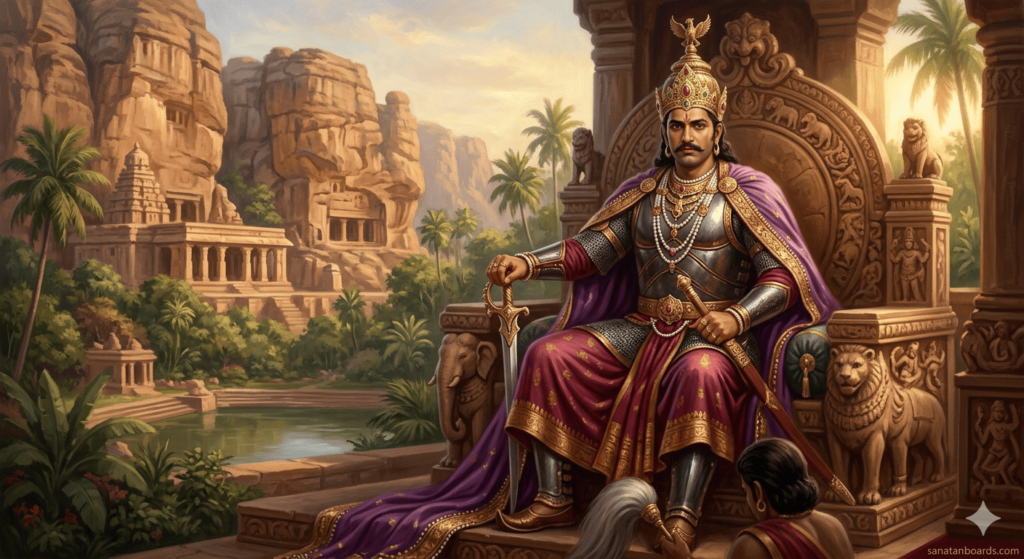
Vikramaditya I (c. 655–680 CE) was a Chalukya emperor who re‑established the power and prestige of the Badami Chalukya state following a period of turmoil after his father’s death. He was the third son of Pulakeshin II, one of the earliest and most powerful rulers of the dynasty, and inherited both the challenges and ambitions of his lineage.
After Pulakeshin II’s defeat by the Pallavas — an event that disrupted Chalukya control — the empire lacked firm leadership for over a decade. Vikramaditya I rose through military leadership and royal legitimacy to unify divided factions, rally loyal commanders, and eventually ascend the throne. His rule brought stability where there had been fragmentation and political uncertainty.
As ruler, Vikramaditya I focused on reasserting Chalukya dominance in the Deccan region. His notable military campaign included repelling the Pallava occupation of Vatapi (the Chalukya capital) and forcing the retreat of southern rivals. These actions revitalised Chalukya influence and restored confidence in its leadership.
Under Vikramaditya I, political authority was consolidated, administrative order reestablished, and external threats countered with measured force. His reign did not significantly expand the empire’s territories but was marked by relative peace and constructive governance — including temple building, social patronage, and renewed cultural life at court.
Historians view him as a transitional king who transformed a fractured realm back into a cohesive empire capable of defending its interests and projecting power. For the Chalukyas, Vikramaditya I became a symbol of recovery and resilience, an indispensable link between the early height of Chalukya glory and its later achievements in Indian history
Who Is Required Vikramaditya I (Chalukya) ?
Vikramaditya I (Chalukya) was required by the Chalukya dynasty, its nobles, and the people of the Deccan to restore political stability and defend against external invasions. Following the defeat of Pulakeshin II by the Pallavas, the empire experienced a power vacuum and territorial fragmentation. The absence of a strong, legitimate ruler left many regions vulnerable to raids and uprisings. It was in this context that the leadership of Vikramaditya I became critical.
The Chalukya aristocracy and military commanders needed a monarch capable of uniting the factions and ensuring loyalty among provincial governors. Without a strong central authority, administrative coherence and revenue collection were compromised, threatening the dynasty’s survival. Vikramaditya I provided that stabilizing presence, combining hereditary legitimacy with proven military skill.
The citizens and local communities of the Deccan also “required” Vikramaditya I in the sense of protection, law, and governance. His leadership guaranteed that trade routes, agrarian systems, and civic institutions could function with minimal disruption, restoring confidence after years of uncertainty.
Finally, the broader cultural and religious institutions benefited from his rule. As king, Vikramaditya I supported temples, commissioned inscriptions, and promoted cultural continuity, which helped re-establish the Chalukya identity. Therefore, he was required not only for military and administrative purposes but also for preserving the dynasty’s social, cultural, and religious fabric. His emergence as a ruler exemplified how necessity in a turbulent era can bring a capable leader to the forefront, fulfilling multiple roles vital to the survival and resurgence of an empire.
When Vikramaditya I (Chalukya) Is Required ?
Vikramaditya I’s rise to power was required in a very specific historical context, following a period of political instability in the 7th century CE. The immediate precursor to his reign was the death of Pulakeshin II, his father, who had been one of the most powerful rulers of the Badami Chalukya dynasty. Pulakeshin II’s defeat by the Pallavas at the Battle of Vatapi resulted in the temporary occupation of Chalukya territories and fragmentation of authority. This created a time when the Chalukya empire was highly vulnerable, and leadership was desperately needed to restore order.
During this period, the need for Vikramaditya I became particularly acute because multiple claimants and local governors were competing for control. Civil unrest threatened the agricultural economy, disrupted trade networks, and created uncertainty for the general population. Without a central figure with legitimacy and military capability, the empire risked permanent disintegration.
The historical “when” can be defined more broadly as a phase of restoration and consolidation. After the initial invasions and loss of territory, Vikramaditya I’s emergence around 655 CE marked a turning point. His leadership was required to launch counter-offensives against the Pallavas, re-establish the capital at Vatapi (Badami), and unify the factions that had splintered during the years of instability. The timing of his ascension was therefore crucial; had he not assumed power, the Chalukya dynasty may have lost its ability to recover and remain influential in the Deccan.
Furthermore, Vikramaditya I was also required during subsequent years to stabilize governance, manage diplomatic relations with neighboring states, and safeguard internal security. His reign coincided with a period when regional powers were expanding, and control of strategic locations such as the Tungabhadra river basin was essential. In summary, Vikramaditya I was required precisely at a historical moment defined by vulnerability, loss of authority, and the urgent need for both political legitimacy and military strength.
Where Vikramaditya I (Chalukya) Is Required ?
Vikramaditya I (Chalukya) was required primarily in the Deccan region of southern India, encompassing present-day Karnataka, parts of Maharashtra, and northern Telangana. The Chalukya dynasty’s power base was centered at Vatapi (modern Badami, Karnataka), which was both the administrative and symbolic capital. Control over Vatapi was essential for asserting sovereignty, managing regional administration, and projecting authority across the Deccan plateau.
He was required in areas under direct Chalukya control, such as the Raichur Doab and surrounding fertile river valleys, where agricultural productivity was critical to sustaining the empire. These territories had strategic significance because they allowed for secure supply lines, taxation, and mobilization of troops. Loss of control in these regions would have destabilized the empire and left it exposed to neighboring rivals such as the Pallavas to the south and other minor dynasties to the north.
Vikramaditya I was also required in frontier zones, especially the southern and eastern borders where Pallavas were pressing. These border regions demanded a leader who could organize defensive campaigns, maintain garrisons, and deter enemy advances. Historical inscriptions suggest that Vikramaditya I actively campaigned in these areas, ensuring the Chalukya presence was restored and symbolic authority reaffirmed.
Additionally, he was required in cultural and religious centers. Temples and institutions, particularly in Vatapi and surrounding towns, relied on royal patronage for construction, endowment, and protection. His presence and active role in these locations were necessary to maintain social cohesion and reinforce Chalukya legitimacy.
How Vikramaditya I (Chalukya) Is Required ?
Vikramaditya I (Chalukya) was required in multiple ways — militarily, administratively, and culturally — to restore and sustain the Chalukya empire. Militarily, he was needed to repel invaders, particularly the Pallavas, and reassert control over lost territories. His strategic planning and battlefield leadership enabled the recapture of Vatapi, the empire’s capital, which had been temporarily occupied. By organizing effective armies and leveraging loyalty among Chalukya commanders, he ensured the survival and revival of the dynasty.
Administratively, Vikramaditya I was required to reestablish governance structures disrupted by prior conflicts. This included reinstating local governors, collecting taxes, managing judicial functions, and ensuring law and order. By consolidating authority in the capital and provinces, he created a stable environment for agriculture, trade, and civic life to flourish.
He was also required culturally to reinforce dynastic legitimacy. Vikramaditya I commissioned inscriptions and temples that symbolized both religious devotion and political power. These acts communicated to subjects and rivals alike that the Chalukya dynasty had regained its rightful authority and remained a central figure in the socio-political landscape.
Diplomatically, he was required to negotiate with neighboring powers, balancing both military pressure and alliances. Maintaining peaceful relations with some states while confronting adversaries allowed the Chalukya empire to consolidate internally without being overextended.
Ultimately, Vikramaditya I was required as a unifying figure. His role was not only to reclaim lost territories but also to stabilize society, administer justice, protect religious institutions, and uphold the reputation of the Chalukya dynasty. His requirement was multi-dimensional: the empire the people, and the culture all depended on his leadership to survive and thrive during a critical historical juncture.
Case Study On Vikramaditya I (Chalukya)
The reign of Vikramaditya I (Chalukya) serves as a compelling case study in leadership, resilience, and the restoration of political authority during a period of crisis. Following the defeat of Pulakeshin II by the Pallavas, the Chalukya empire faced fragmentation, instability, and the threat of permanent decline. This context created a unique scenario where an effective leader could change the trajectory of a declining dynasty, demonstrating the strategic interplay between military prowess, administrative skill, and cultural legitimacy.
Vikramaditya I’s initial challenge was consolidating support among the Chalukya nobility. The empire had fractured into multiple regions under local governors and military commanders, many of whom were asserting autonomy. Historical records indicate that Vikramaditya I used a combination of diplomacy, personal charisma, and strategic appointments to unify these factions. By re-establishing loyalty to the central authority at Vatapi, he created a foundation for coordinated military and administrative operations.
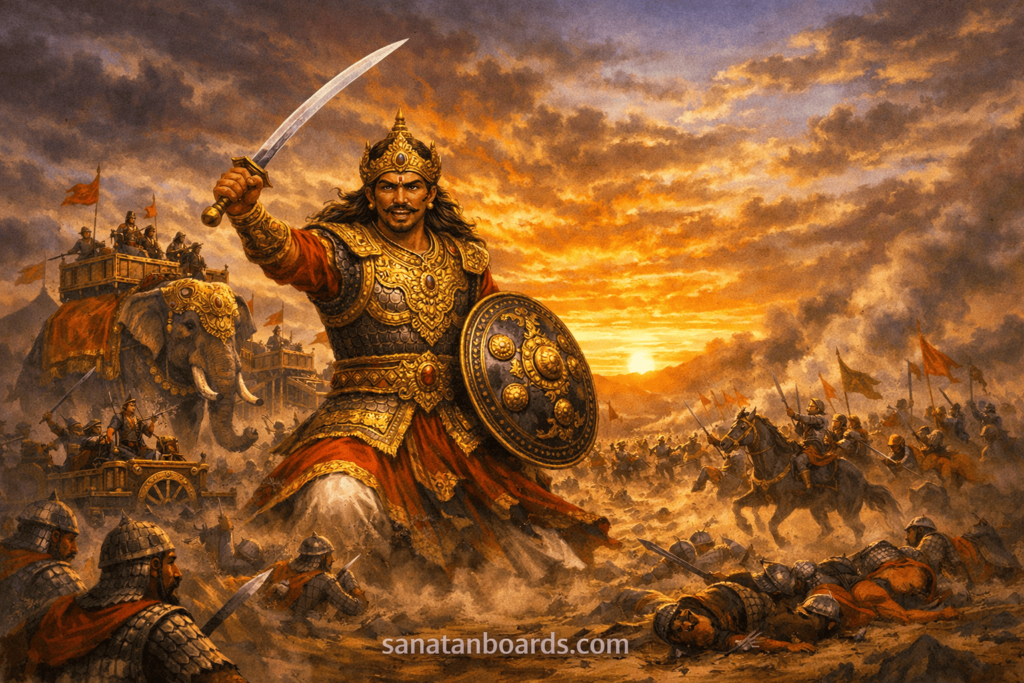
A central component of his case study involves military strategy. Vikramaditya I had to reclaim territory lost to the Pallavas, particularly the capital city of Vatapi. He leveraged intelligence, battlefield tactics, and the loyalty of seasoned generals to mount successful campaigns. His victories were not only tactical but also symbolic, signaling the restoration of Chalukya prestige in the region. The recapture of Vatapi illustrates how decisive leadership in a single strategic location can influence the broader stability of an empire.
Beyond the battlefield, Vikramaditya I’s administration focused on restoring governance structures. The decentralization of power during the period of instability had disrupted tax collection, legal administration, and social services. By instituting clear hierarchies, delegating authority to trusted officials, and maintaining regular oversight, Vikramaditya I ensured the continuity of governance. This administrative efficiency allowed agricultural production, trade, and civic life to resume, which reinforced both loyalty and economic stability.
Cultural and religious patronage was another critical aspect of his case study. Vikramaditya I commissioned inscriptions, temples, and public works that conveyed both spiritual authority and royal legitimacy. These actions reinforced social cohesion and demonstrated that the Chalukya dynasty continued to embody traditional values of justice, piety, and protection of the people.
From a historical perspective, the case study of Vikramaditya I demonstrates the integration of multiple leadership dimensions: military strategy, political acumen, administrative efficiency, and cultural stewardship. His reign provides insight into how a leader can restore order after crisis, unify fragmented factions, and establish a legacy that influences subsequent generations.
Vikramaditya I’s case exemplifies the concept of a “restorative ruler” — one who is required not only to defend territory but also to reestablish the moral, cultural, and administrative foundations of the state. For historians and leadership scholars, #vikramaditya1chalukya his reign offers a model of resilience, strategic thinking, and the importance of timing and legitimacy in successful governance.
White Paper On Vikramaditya I (Chalukya)
Abstract:
This white paper examines the reign of Vikramaditya I (Chalukya), highlighting the socio-political, military, and cultural dimensions of his rule. By analyzing historical inscriptions, contemporary records, and archaeological evidence, the paper outlines how Vikramaditya I restored the Chalukya empire’s authority after a period of decline, with implications for understanding leadership in crisis management.
Introduction:
The Badami Chalukya dynasty, under Pulakeshin II, had reached a zenith of power in the early 7th century CE. However, Pulakeshin II’s defeat by the Pallavas destabilized the region, leaving the empire fractured and vulnerable. The emergence of Vikramaditya I around 655 CE marked a critical juncture. The white paper explores how his leadership was required to restore order, consolidate political power, and ensure cultural continuity.
Political and Military Restoration:
Vikramaditya I’s reign focused on reasserting control over Vatapi and surrounding regions. Military campaigns against Pallava forces were essential in restoring sovereignty. Through strategic alliances with local governors, Vikramaditya I consolidated fragmented territories. Inscriptions such as the Aihole record detail his victories and highlight his ability to unite previously independent factions under a single authority. This period demonstrates the importance of legitimacy and leadership in re-establishing state power.
Administrative Reforms:
Following military consolidation, Vikramaditya I emphasized governance. Provincial administration was strengthened by appointing trusted officials, reviving revenue collection systems, and standardizing legal procedures. Efficient administration underpinned political stability and economic recovery. The restoration of agricultural productivity, trade networks, and urban centers reflected his systematic approach to governance.
Cultural and Religious Impact:
Cultural patronage played a strategic role in legitimizing Vikramaditya I’s rule. Temples, inscriptions, and public works were commissioned to reinforce moral authority. Religious institutions were supported not only as spiritual centers but also as symbols of dynastic legitimacy. His reign illustrates the interconnection between political power and cultural stewardship.
Lessons in Leadership:
Vikramaditya I exemplifies the model of a restorative leader. Key lessons include:
- Strategic timing: Recognizing when to assert authority to maximize impact.
- Military and administrative balance: Combining force with governance to ensure stability.
- Cultural legitimacy: Using religious and social structures to consolidate power.
- Faction management: Unifying competing groups through diplomacy and personal credibility.
Conclusion:
The reign of Vikramaditya I (Chalukya) serves as an enduring example of effective leadership under crisis. By combining military, administrative, and #Sanatandharmaaccreditationboardsinvasai cultural strategies, he not only restored the Chalukya empire but also set the stage for its continued influence in southern India. His legacy demonstrates the importance of holistic governance in ensuring the survival and prosperity of a state.
Industry Application On Vikramaditya I (Chalukya)
While Vikramaditya I ruled in the 7th century, modern industries can draw lessons from his leadership in management, crisis resolution, and organizational strategy. The following applications can be identified:
- Leadership in Crisis:
Vikramaditya I’s ability to stabilize a fractured empire provides a model for corporate crisis management. Organizations facing disruption, competitive threats, or internal fragmentation can emulate his approach by assessing vulnerabilities, unifying stakeholders, and deploying targeted interventions. - Strategic Planning:
His military campaigns demonstrate the importance of planning, intelligence, and timing. Companies can adopt similar frameworks for market entry, competitive analysis, and resource allocation, ensuring strategic objectives are met with minimal risk. - Governance and Administration:
The administrative reforms of Vikramaditya I highlight structured delegation, clear hierarchies, and performance monitoring. Modern enterprises benefit from defining roles, responsibilities, and accountability to enhance efficiency and productivity. - Cultural Stewardship:
Supporting cultural institutions strengthened his legitimacy. In contemporary settings, organizations can enhance corporate identity and brand value by supporting social initiatives, employee engagement, and corporate social responsibility programs. - Stakeholder Management:
Vikramaditya I managed competing nobles and governors effectively, balancing power dynamics. Similarly, businesses today must navigate complex stakeholder relationships — including investors, employees, regulators, and customers — to maintain harmony and ensure long-term sustainability. - Innovation under Constraints:
Vikramaditya I innovated in governance and military strategy despite limited resources. Industries can draw inspiration for innovative solutions in product development, process optimization, or market expansion during resource-constrained situations.
In essence, the leadership principles and organizational strategies demonstrated by Vikramaditya I (Chalukya) have enduring relevance across sectors #Sanatandharmaaccreditationboardsinmumbai such as management consulting, defense strategy, project management, and corporate governance. His example underscores the importance of resilience, strategic foresight, and multi-dimensional leadership.
source : StudyIQ IAS
ASK FAQ
Who was Vikramaditya I (Chalukya)?
Vikramaditya I was a 7th-century ruler of the Badami Chalukya dynasty who restored the empire’s power after his father Pulakeshin II’s defeat and repelled the Pallavas to stabilize the Deccan region.
When did Vikramaditya I (Chalukya) rule?
He ruled approximately from 655 CE to 680 CE, a period marked by political restoration and consolidation after regional instability.
What were the major achievements of Vikramaditya I (Chalukya)?
His key achievements include recapturing Vatapi, restoring Chalukya political authority, strengthening administration, and promoting cultural and religious institutions.
Why is Vikramaditya I (Chalukya) important in Indian history?
He is important for reviving the Chalukya dynasty after a crisis, demonstrating resilience, effective leadership, and setting a foundation for later Chalukya rulers in southern India.
Where did Vikramaditya I (Chalukya) rule and influence?
He ruled the Deccan region, mainly in present-day Karnataka, parts of Maharashtra, and northern Telangana, and influenced politics, culture, and religion across these territories.
Table of Contents
Disclaimer:
The content provided above is based on historical research, inscriptions, and secondary sources. It is intended for informational purposes and knowledge-building. While care has been taken to ensure accuracy, interpretations of historical events may vary, and readers should consult primary sources or academic research for scholarly purposes.