The Vijayanagara Empire was one of the most powerful and culturally rich empires in South Indian history. It was founded in 1336 by Harihara I and his brother Bukka Raya I. Established on the banks of the Tungabhadra River, the empire aimed to resist invasions and protect the traditions of South India.
Under their leadership, the empire grew rapidly in strength, administration, and military organization. However, the empire reached its golden age during the reign of Krishnadevaraya (1509–1529). He was known for his military success, efficient governance, and patronage of art and literature. His court was famous for scholars and poets, especially the “Ashtadiggajas.”
The Vijayanagara Empire became a center of trade, architecture, and cultural development. Magnificent temples, markets, and irrigation systems were built during this time. The empire played a crucial role in preserving Hindu traditions and promoting regional languages like Telugu Kannada, and Sanskrit.
Although it declined after the Battle of Talikota in 1565, the legacy of the Vijayanagara Empire remains significant in Indian history for its contributions to culture, administration, and architecture.
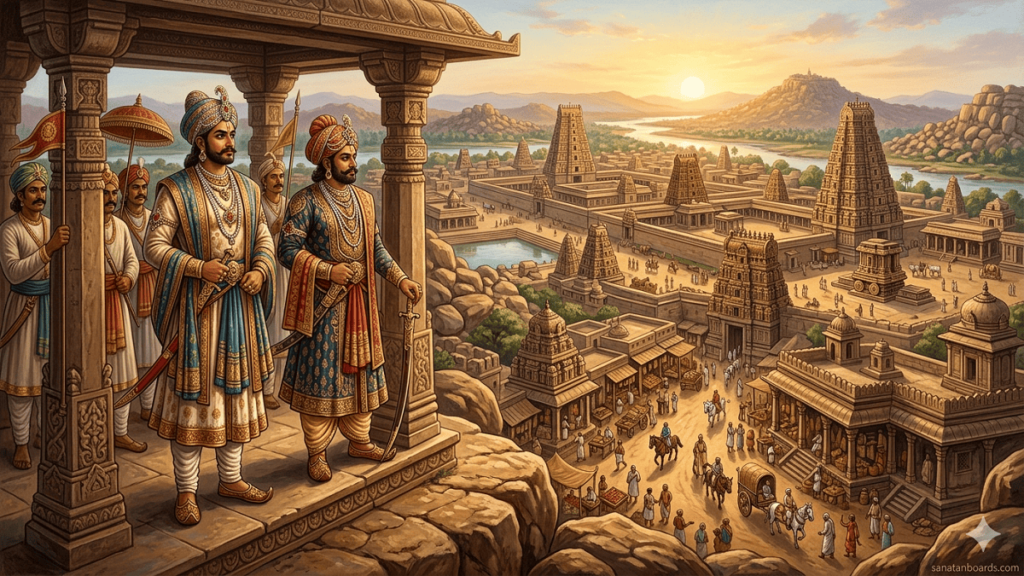
What Is Vijayanagara Empire – Harihara I, Bukka Raya I, Krishnadevaraya ?
The Vijayanagara Empire refers to a powerful South Indian kingdom established in the 14th century by Harihara I and Bukka Raya I. It emerged as a strong political and cultural force in response to the decline of earlier South Indian dynasties and the expansion of northern Sultanates. The empire was centered in the region of present-day Karnataka, with its capital at Hampi.
This empire is best understood as a symbol of resistance, revival, and growth. It unified various regions of South India under a single administrative system and created a stable political environment. Its rulers focused on strengthening military power, improving agriculture, and encouraging trade with foreign countries like Persia and Portugal.
The most remarkable phase of the Vijayanagara Empire came during the reign of Krishnadevaraya. Under his leadership, the empire reached its peak in terms of territorial expansion, economic prosperity, and cultural achievements. He was not only a great warrior but also a patron of literature and art. His support helped develop classical literature in Telugu and Sanskrit.
The empire is also known for its architectural excellence. Grand temples, stone sculptures, and well-planned cities were constructed. The ruins of Hampi today stand as a testimony to its glory.
Who Is Required Vijayanagara Empire – Harihara I, Bukka Raya I, Krishnadevaraya ?
The understanding of the Vijayanagara Empire requires knowledge of its key figures, especially Harihara I, Bukka Raya I, and Krishnadevaraya. These individuals are central to the establishment, growth, and success of the empire.
Harihara I is recognized as the founder who laid the political and administrative foundation of the empire. He worked to consolidate territories and establish a stable governance structure. Bukka Raya I, his brother, played an equally important role in expanding the empire and strengthening its military capabilities. Together, they ensured the survival and early growth of the kingdom.
Krishnadevaraya, on the other hand, represents the peak of Vijayanagara’s glory. He is required in this context as the most celebrated ruler whose contributions transformed the empire into a dominant power. His leadership in battles, administrative reforms, and support for culture made him a legendary figure in Indian history.
These three rulers are essential for understanding the evolution of the Vijayanagara Empire—from its foundation to its golden age. Without studying their roles, it is impossible to fully grasp the significance of the empire’s achievements in governance, military strategy, and cultural development.
When Vijayanagara Empire – Harihara I, Bukka Raya I, Krishnadevaraya Is Required ?
The study of the Vijayanagara Empire becomes particularly important when examining the medieval period of Indian history, especially between the 14th and 16th centuries. The empire was founded in 1336 by Harihara I and Bukka Raya I, marking the beginning of a new political era in South India.
This period was characterized by political instability and frequent invasions from northern Sultanates. Therefore, understanding the Vijayanagara Empire is required when analyzing how South India responded to these challenges. The empire served as a defensive and unifying force during this time.
The importance of this topic is also highlighted during the reign of Krishnadevaraya from 1509 to 1529. This era is considered the golden age of the empire, making it a crucial time frame for studying advancements in administration, economy, and culture.
Additionally, the empire is significant when studying the development of art and architecture in medieval India. Many temples and monuments built during this time still exist, offering valuable insights into historical construction techniques and cultural practices.
The topic is also required when examining the decline of major South Indian empires, especially after the Battle of Talikota in 1565, which led to the weakening of Vijayanagara power.
Thus, the Vijayanagara Empire is essential to study when focusing on medieval Indian history, cultural development, and political resistance during times of external threats.
Where Vijayanagara Empire – Harihara I, Bukka Raya I, Krishnadevaraya Is Required ?
The Vijayanagara Empire is primarily associated with South India, particularly in the region that is now the state of Karnataka. Its capital city, Hampi, serves as the most important geographical location linked to the empire.
Hampi was strategically located on the banks of the Tungabhadra River, providing natural protection and resources necessary for sustaining a large empire. It became a major center of administration, trade, and culture under rulers like Harihara I and Bukka Raya I.
The empire extended across a vast area, including parts of present-day Karnataka, Andhra Pradesh, Tamil Nadu, and Kerala. It controlled important trade routes and coastal regions, facilitating commerce with foreign traders from Arabia and Europe.
During the reign of Krishnadevaraya, the empire expanded further, strengthening its presence across South India. The geographical spread of the empire played a crucial role in its economic success and cultural diversity.
Today, the ruins of Hampi are recognized as a UNESCO World Heritage Site, attracting tourists and historians from around the world. These remains provide valuable evidence of the empire’s architectural brilliance and urban planning.
How Vijayanagara Empire – Harihara I, Bukka Raya I, Krishnadevaraya Is Required ?
The Vijayanagara Empire is understood through various aspects such as its administration, military strategies, economic policies, and cultural contributions. The foundation laid by Harihara I and Bukka Raya I provides insight into how the empire was structured and governed.
The rulers implemented an efficient administrative system that divided the empire into provinces, each managed by local governors. This system ensured effective governance and control over vast territories.
Military strength was another key factor. The empire maintained a strong army with infantry, cavalry, and war elephants. Under Krishnadevaraya, military campaigns were successfully conducted to expand and defend the empire.
Economically, the empire relied on agriculture, trade, and taxation. Advanced irrigation systems were developed to support farming, while trade relations with foreign countries boosted revenue. Markets in cities like Hampi were bustling with goods from different regions.
Culturally, the empire is studied through its contributions to literature, art, and architecture. Temples, sculptures, and literary works produced during this time reflect a high level of creativity and craftsmanship.
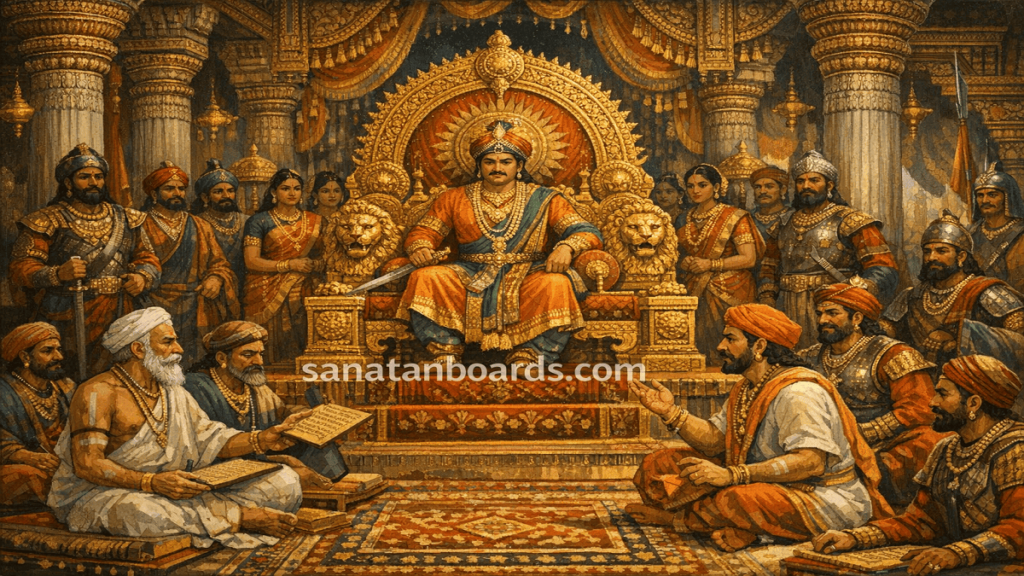
Case Study On Vijayanagara Empire – Harihara I, Bukka Raya I, Krishnadevaraya
The Vijayanagara Empire is one of the most significant examples of political strength, cultural richness, and administrative excellence in medieval Indian history. Founded in 1336 by Harihara I and Bukka Raya I, the empire emerged during a time of instability and external threats in South India. This case study explores how leadership, strategy, and governance contributed to the rise and success of the empire, especially under Krishnadevaraya.
Background and Formation
During the early 14th century, South India faced political fragmentation due to the decline of powerful dynasties like the Cholas and Hoysalas. In this context, Harihara I and Bukka Raya I established the Vijayanagara Empire with the support of spiritual leaders and local communities. Their objective was to create a stable and unified kingdom capable of resisting invasions and restoring cultural identity.
The capital city, Hampi, was strategically chosen due to its natural defenses, including rocky terrain and the Tungabhadra River. This location played a crucial role in protecting the empire from enemy attacks and supporting long-term development.
Leadership and Governance
The leadership of Harihara I and Bukka Raya I focused on building strong administrative systems. They divided the empire into provinces, each governed by trusted officials. This decentralized approach ensured efficient governance and better control over vast territories.
The rulers emphasized law, order, and taxation systems that supported economic growth. Local governance structures allowed communities to participate in decision-making, which strengthened loyalty to the empire.
Growth and Expansion
The empire expanded rapidly under its early rulers, but it reached its peak during the reign of Krishnadevaraya (1509–1529). He is considered one of the greatest rulers in Indian history due to his military success and visionary leadership.
Krishnadevaraya led several successful campaigns against rival kingdoms, including the Deccan Sultanates. His strategies and strong army ensured the empire’s dominance in South India. He also maintained diplomatic relations with foreign traders, which enhanced economic prosperity.
Economic Strength
The Vijayanagara Empire had a strong economic foundation based on agriculture, trade, and taxation. Advanced irrigation systems were developed to support farming, ensuring food security and surplus production.
Trade was another key factor in the empire’s success. Markets in Hampi were known for their wealth and diversity, attracting traders from Persia, Arabia, and Europe. The export of spices, textiles, and precious stones contributed significantly to the empire’s economy.
Cultural and Architectural Achievements
One of the most remarkable aspects of the Vijayanagara Empire was its cultural development. Krishnadevaraya was a patron of literature, art, and education. His court included famous poets known as the Ashtadiggajas.
The empire is also known for its architectural brilliance. Temples, palaces, and monuments built during this period reflect advanced engineering and artistic excellence. The ruins of Hampi today serve as a testament to this legacy.
Challenges and Decline
Despite its strength, the empire faced challenges from neighboring kingdoms. The Battle of Talikota in 1565 marked a turning point, leading to the decline of Vijayanagara power. The capital city was destroyed, and the empire gradually weakened.
Conclusion
This case study highlights how the Vijayanagara Empire succeeded through strong leadership, strategic planning, and cultural development. #bukkaraya 1 The contributions of Harihara I, Bukka Raya I, and Krishnadevaraya remain significant in understanding the #krishnadevaraya history of South India.
White Paper On Vijayanagara Empire – Harihara I, Bukka Raya I, Krishnadevaraya
Abstract
The Vijayanagara Empire represents a model of effective governance, economic stability, and cultural advancement in medieval India. Founded by Harihara I and Bukka Raya I, and later strengthened by Krishnadevaraya, the empire demonstrates how leadership and policy-making can shape long-term success.
Introduction
This white paper analyzes the structural, economic, and cultural aspects of the Vijayanagara Empire. It aims to provide insights into how the empire achieved stability and growth during a period of political uncertainty.
Administrative Framework
The empire’s administration was highly organized and efficient. Territories were divided into provinces, each governed by local officials who reported to the central authority. This ensured accountability and effective governance.
The rulers maintained a strong legal system that promoted justice and order. Taxation policies were designed to support state functions while ensuring the welfare of citizens.
Economic Policies
The economic success of the Vijayanagara Empire was based on agriculture, trade, and resource management. Irrigation systems such as canals and tanks were developed to support farming.
Trade networks connected the empire with international markets. Ports along the western and eastern coasts facilitated the exchange of goods with foreign traders. This contributed to economic growth and cultural exchange.
Military Strategy
The empire maintained a powerful military force to protect its territories and expand its influence. Under Krishnadevaraya, the army achieved several victories against rival states.
The use of advanced weapons, strategic planning, and strong leadership ensured military success. The empire’s ability to defend itself played a crucial role in its longevity.
Cultural Contributions
The Vijayanagara Empire is known for its contributions to art, literature, and architecture. Temples and monuments built during this period reflect a blend of religious devotion and artistic excellence.
Krishnadevaraya supported scholars and poets, leading to the development of regional languages and literature. This cultural growth enhanced the empire’s identity and legacy.
Analysis and Findings
The success of the Vijayanagara Empire can be attributed to:
- Strong leadership and vision
- Efficient administrative systems
- Economic stability and trade
- Cultural development and innovation
Conclusion
The Vijayanagara Empire serves as a historical #vijayanagaraempire model for governance and development. Its achievements continue to #harihara 1 provide valuable lessons for modern societies.
Industry Application On Vijayanagara Empire – Harihara I, Bukka Raya I, Krishnadevaraya
Leadership and Vision
In modern industries, leadership plays a critical role in success. Harihara I and Bukka Raya I demonstrated the importance of having a clear vision and long-term goals. They built a strong foundation for the empire, similar to how startups establish their core structure.
Krishnadevaraya’s leadership highlights the importance of adaptability, innovation, and decision-making. Modern business leaders can learn from his ability to manage challenges and achieve growth.
Organizational Structure
The administrative system of the Vijayanagara Empire can be compared to modern corporate structures. The division of responsibilities among officials ensured efficiency and accountability.
Companies today use similar hierarchical systems to manage operations and improve productivity. Decentralization allows organizations to respond quickly to local challenges.
Economic Management
The empire’s focus on agriculture, trade, and resource management provides insights into sustainable business practices. Efficient use of resources and diversification of income sources are key lessons for modern industries.
Global trade relations maintained by the empire can be compared to international business operations today. Building strong partnerships and expanding markets are essential for growth.
Innovation and Development
The Vijayanagara Empire invested in infrastructure such as irrigation systems and urban planning. This reflects the importance of innovation and development in achieving long-term success.
Modern industries can learn from this approach by investing in technology, research, and development. Continuous improvement is necessary to remain competitive.
Human Resource Management
Krishnadevaraya’s support for scholars and artists highlights the importance of nurturing talent. In today’s context, organizations must invest in employee development and creativity.
Encouraging innovation and providing opportunities for growth can lead to higher productivity and job satisfaction.
Risk Management and Resilience
The empire faced several challenges, including wars and external threats. Its ability to adapt and respond to these challenges demonstrates resilience.
Businesses today must develop risk management strategies to handle uncertainties. Flexibility and preparedness are essential for survival and growth.
Conclusion
The Vijayanagara Empire provides a valuable framework for #sanatandharmaaccreditationboardsinmumbai understanding leadership, management, and sustainability. Its principles can be applied to modern industries to #sanatandharmaaccreditationboardsinvijaynagara achieve success and long-term growth.
SOURCE : StudyIQ IAS
ASK FAQ
What was the Vijayanagara Empire?
The Vijayanagara Empire was a powerful South Indian kingdom founded in 1336 by Harihara I and Bukka Raya I, known for its cultural, economic, and military strength.
Who were Harihara I and Bukka Raya I?
Harihara I and Bukka Raya I were the founders of the Vijayanagara Empire who established a strong political base in South India.
Why is Krishnadevaraya important in the Vijayanagara Empire?
Krishnadevaraya was the greatest ruler of the empire, known for military victories, efficient administration, and support for art and literature.
Where was the Vijayanagara Empire located?
The empire was mainly located in South India, with its capital at Hampi, a major cultural and political center.
When did the Vijayanagara Empire decline?
The empire declined after the Battle of Talikota, which weakened its power and led to its gradual fall.
Table of Contents
Disclaimer
This content is created solely for educational learning and knowledge purposes. It is based on historical research and general academic understanding of the Vijayanagara Empire, including Harihara I, Bukka Raya I, and Krishnadevaraya. The information provided does not intend to mislead, offend, or promote any particular viewpoint. While efforts have been made to ensure accuracy, some details may vary based on different historical sources. Readers are encouraged to refer to academic books and verified sources for deeper understanding and research purposes.