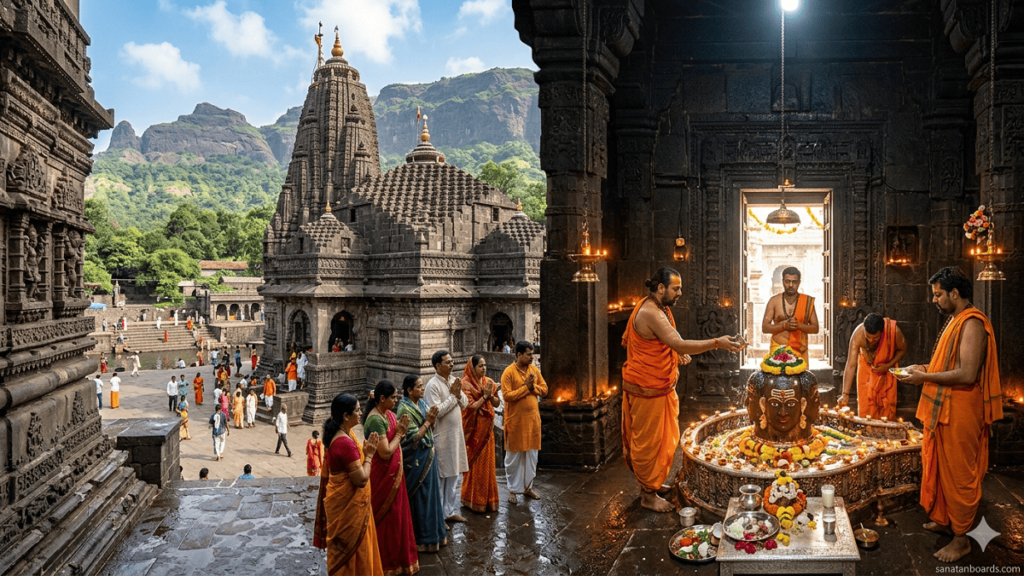
The Trimbakeshwar Shiva Temple is one of the most sacred and historically rich pilgrimage sites in India, located in the town of Trimbak in Nashik district, Maharashtra. It is renowned as one of the twelve Jyotirlingas, the holiest shrines dedicated to Lord Shiva in Hindu tradition.
What makes Trimbakeshwar uniquely educational is its deep connection to Hindu philosophy, culture, and ritual science. The Jyotirlinga here is believed to represent the Trimurti — Brahma (Creator), Vishnu (Preserver), and Mahesh/Shiva (Destroyer) — symbolizing the cosmic cycles of existence. This three‑faced manifestation offers learners insight into Hindu theology and how divine concepts are represented through temple iconography.
Trimbakeshwar is not only a spiritual destination but also a network for learning sacred rituals and scriptures. Pilgrims engage in rites like Rudra Abhishek, Narayan Nagbali, and other Vedic ceremonies under guidance, preserving ancient Hindu practices. The site is also tied to the origin of the Godavari River, adding ecological and geographical significance to its spiritual heritage.
Overall, Trimbakeshwar offers a blend of religious devotion, cultural history, and educational learning, making it a living network of tradition and knowledge.

What Is TRIMBAKESHWAR SHIVA NETWORK ?
The Trimbakeshwar Shiva Temple is one of the most revered and historically important Hindu pilgrimage sites in India. Located in the town of Trimbak in the Nashik district of Maharashtra, it is famous as one of the twelve Jyotirlingas — principal sacred shrines dedicated to Lord Shiva, representing his infinite, formless presence.
Spiritual and Cultural Significance
Unlike other temples, the Trimbakeshwar Jyotirlinga is unique because its sacred Shiva Linga has three faces — symbolizing the Trimurti: Brahma (the creator), Vishnu (the preserver), and Shiva (the destroyer). This distinctive form embodies the fundamental cosmic functions of creation, sustenance and transformation, offering devotees a holistic perspective on Hindu philosophy and the divine.
The temple is not just a site of worship but also a network of spiritual learning and tradition. Pilgrims and seekers come here to participate in ancient Vedic rituals — such as Rudrabhishek Narayan Nagbali, Tripindi Shraddha, and Kal Sarp Dosha Nivaran — which are believed to cleanse karmic debts, bring peace to ancestors, and offer emotional and spiritual healing. These rites are performed under the guidance of learned priests, preserving millennia‑old traditions and providing deep insight into Hindu rituals and practices.
Connection to the Godavari River and Pilgrimage Culture
Trimbakeshwar is closely associated with the origin of the sacred Godavari River, often called the “Ganga of the South”. This river springs from the Kushavarta Kund, a holy sacred tank near the temple. Devotees often bathe here to purify themselves, both spiritually and morally, before entering the inner sanctum — a practice that highlights the intertwined nature of geography, mythology, and spiritual discipline in Indian religious life.
Educational and Community Network
The “network” around Trimbakeshwar also refers to its cultural, educational, and community influence — from the preservation of genealogical registers (important for ancestral heritage) to hosting millions of devotees during festivals like Maha Shivaratri and the Simhastha Kumbh Mela. These large gatherings transform the region into a global hub of learning, devotion, and shared cultural heritage.
Who Is Required TRIMBAKESHWAR SHIVA NETWORK?
1. Devotees of Lord Shiva and Hindu Faith Seekers
The most obvious group who “require” or are drawn to the Trimbakeshwar network are Shiva devotees and followers of Hinduism. Trimbakeshwar is considered one of the most powerful and significant Jyotirlingas, where Lord Shiva is worshipped in one form representing the Trimurti — Brahma (Creator), Vishnu (Preserver), and Mahesh or Shiva (Destroyer). This makes it especially meaningful for those seeking spiritual blessings, inner peace, and divine connection.
2. Pilgrims Looking for Spiritual Merit and Salvation
Many Hindus believe that visiting Trimbakeshwar can lead to spiritual purification and Moksha (liberation from the cycle of life and death). The town of Trimbak itself is often associated with penance and liberation, and rituals performed here such as Rudrabhishek, Shraddha (ancestor rites) and other rites are believed to help devotees cleanse karmic debts and honour their ancestors.
3. Families and Individuals Seeking Ritual Remedies
Trimbakeshwar is a center for important Vedic rituals including Narayan Nagbali Puja, Kaal Sarp Dosh Shanti, Tripindi Shraddha, and Pitra‑Shanti ceremonies. These rites are considered especially effective here and attract families and individuals who want to address ancestral peace, astrological problems, or spiritual obstacles in their lives. This temple network offers traditional guidance from authorized priests trained in Vedic practices, making it a critical destination for those seeking ritual‑based solutions.
4. Students of Hindu Culture, Philosophy, and Mythology
Beyond pilgrimage, the temple is a learning hub for those interested in Hindu philosophy, mythological history, temple architecture, and ritual science. The temple’s legends — such as Sage Gautama’s penance and the origin of the Godavari River — offer insight into ancient narratives and the cultural importance of water, sacrifice, and devotion in Indian religious thought.
5. Cultural Tourists and History Enthusiasts
People curious about India’s architectural heritage and ancient traditions also find Trimbakeshwar vital. The temple’s Hemadpanthi style architecture and historic status — built by Peshwa Balaji Baji Rao in the 18th century — attract historians, academics, and tourists alike.
6. Participants in Major Religious Gatherings
Once every 12 years, during the Simhastha Kumbh Mela, Trimbakeshwar becomes the epicenter of a massive spiritual surge, drawing millions of pilgrims, sadhus, and spiritual aspirants from across India and abroad. This event emphasizes how the temple network plays a central role in India’s religious and cultural fabric.
When Is The Trimbakeshwar Shiva Network Required?
The Trimbakeshwar Shiva Network refers to the spiritual, cultural, and educational ecosystem surrounding the Trimbakeshwar Shiva Temple in Nashik, Maharashtra. Devotees and seekers often wonder “when is this network required?” — meaning, under what circumstances, occasions, or timings should one visit, perform rituals, or engage with the temple’s spiritual activities. (en.wikipedia.org)
1. During Major Hindu Festivals
The Trimbakeshwar Shiva Network is particularly required during significant festivals, most notably Maha Shivaratri, which celebrates Lord Shiva. Devotees gather to perform night-long prayers, Rudrabhishek ceremonies, and other sacred rituals. Similarly, festivals like Shravan Month, which falls between July and August, see large crowds as devotees seek blessings, perform fasting, and engage in religious activities. These periods are ideal for spiritual growth, connecting with the network of priests, devotees, and Vedic practices.
2. For Performing Vedic and Ancestral Rituals
Many rituals are timing-sensitive, based on astrological calculations and lunar dates. The Trimbakeshwar Shiva Network is required for performing ceremonies such as:
- Narayan Nagbali Puja: for ancestral peace and karmic cleansing.
- Kal Sarp Dosha Shanti: to mitigate astrological doshas.
- Tripindi Shraddha: paying homage to forefathers.
These rituals are considered most effective at Trimbakeshwar due to its sacred Jyotirlinga and are scheduled according to auspicious timings (muhurta) determined by priests. (trimbakeshwar.org)
3. During Life Milestones and Spiritual Crises
Individuals or families often require the Trimbakeshwar network during critical life events such as births, deaths, marriages, or spiritual crises. Visiting the temple and performing specific rites is believed to bring guidance, peace, and divine intervention. For example, parents may seek blessings for children’s health or education, while adults might perform rituals to overcome obstacles, karmic challenges, or personal hardships.
4. For Pilgrimage and Learning
The Trimbakeshwar Shiva Network is required for pilgrims, students, and spiritual seekers throughout the year. The temple serves as a hub for learning about Hindu philosophy, rituals, temple architecture, and sacred geography. Scholars or devotees who want to understand Vedic traditions, the Trimurti symbolism, or Godavari river origins find this network essential for study and practice.
5. During Special Religious Gatherings
Once every 12 years, the Simhastha Kumbh Mela makes the Trimbakeshwar Shiva Network globally relevant. Millions of devotees, sadhus, and pilgrims converge to engage in holy bathing, rituals, and spiritual discourse. At these times, the network of priests, volunteers, and educational programs becomes crucial to manage and guide devotees effectively.
Where Is The Trimbakeshwar Shiva Network Required?
1. At the Trimbakeshwar Temple Itself
The most obvious location is within the temple premises. The Jyotirlinga here is considered highly sacred, and rituals like Rudrabhishek, Narayan Nagbali, Tripindi Shraddha, and Kal Sarp Dosha Shanti are performed on-site by trained priests. These ceremonies require the physical presence of devotees to participate fully, as the network’s spiritual energy is tied to the temple’s sanctity.
2. Pilgrimage Routes and Sacred Geography
The Trimbakeshwar network extends to the pilgrimage routes and surrounding holy locations, including the origin of the Godavari River at Kushavarta Kund. Devotees often bathe in the river as part of purification rituals before entering the temple. The network’s influence is “required” along these paths, guiding pilgrims through Vedic practices, sacred knowledge, and ritual etiquette. (maharashtratourism.gov.in)
3. Homes of Devotees During Life Events
The network is also required outside the temple, in devotees’ homes, especially during important life milestones. When families perform ancestral rites, karmic rituals, or Vedic ceremonies, priests often visit or advise remotely based on the network’s guidance. The temple’s spiritual authority extends into homes, making it a critical resource for performing rites correctly and maintaining ritual integrity.
4. Educational and Learning Spaces
The network is required in academic or spiritual learning contexts. Students, researchers, and scholars of Hindu philosophy, architecture, or ritual science use the knowledge, traditions, and priestly guidance associated with Trimbakeshwar to study temple practices, mythologies, and cultural history.
5. Festivals and Mass Gatherings
During events like Maha Shivaratri, Shravan Month, and the Simhastha Kumbh Mela, the network is required in temporary pilgrimage camps, festival grounds, and large gathering areas, where coordination of rituals, prayers, and cultural programs ensures the spiritual and educational continuity of the traditions.
How Is The Trimbakeshwar Shiva Network Required?
1. Through Pilgrimage and Temple Worship
The most direct way the network is required is through visiting the Trimbakeshwar Temple. Devotees perform Rudrabhishek, Abhishekam, and other Jyotirlinga-specific rituals to connect with the divine energy of Lord Shiva. Participating in temple rituals under the guidance of trained priests ensures spiritual discipline and the proper performance of sacred rites. The network provides structured access to these ceremonies, ensuring that devotees follow the ancient Vedic procedures accurately.
2. Through Vedic and Ancestral Rituals
The network is required to conduct specialized rituals such as:
- Narayan Nagbali Puja – for ancestral peace and karmic cleansing.
- Tripindi Shraddha – paying homage to forefathers.
- Kal Sarp Dosha Shanti – mitigating astrological doshas.
These rituals are not merely symbolic; they require precise timings, chants, offerings, and priestly guidance. The network ensures that rituals are performed with authenticity, purity, and spiritual efficacy. (trimbakeshwar.org)
3. Through Spiritual Learning and Guidance
The network is required for learning and understanding Hindu philosophy, mythology, and ritual science. Scholars, students, and seekers use the temple network to study the Trimurti symbolism, Jyotirlinga significance, and sacred geography of the Godavari River. This learning can happen on-site, through priestly explanations, or through associated texts and community guidance.
4. Through Family and Community Integration
The Trimbakeshwar Shiva Network is also required in homes and community spaces, especially during life milestones such as births, deaths, marriages, or spiritual crises. Families consult the network for ritual guidance and to maintain continuity of tradition. Priests and authorized guides from the network advise on how to prepare, perform, and conclude rituals correctly, ensuring spiritual benefits are maximized.
5. During Festivals and Mass Pilgrimages
During events like Maha Shivaratri, Shravan Month, and the Simhastha Kumbh Mela, the network is required for coordination, spiritual instruction, and mass participation. The network organizes large-scale rituals, volunteer guidance, and educational outreach so that millions of pilgrims can engage meaningfully with the traditions.
Case Study On Trimbakeshwar Shiva Network
1. Introduction
The Trimbakeshwar Shiva Network revolves around the Trimbakeshwar Shiva Temple, located in Trimbak, Nashik district, Maharashtra. It is one of the twelve Jyotirlingas, representing Lord Shiva in his three-faced form symbolizing the Trimurti — Brahma (Creator), Vishnu (Preserver), and Mahesh/Shiva (Destroyer). This network is not only a religious center but also a hub for cultural education, ancestral rites, and spiritual learning.
This case study examines who engages with this network, when and why it is required, where its influence extends, and how it operates in practice. It highlights the interplay between devotion, education, and cultural preservation.
2. Objectives of the Study
- To analyze the role of the Trimbakeshwar Shiva Network in spiritual practices.
- To understand how devotees, families, and learners engage with the network.
- To evaluate its cultural and educational significance.
- To examine the network’s impact on pilgrimage management and community integration.
3. Methodology
The study is based on:
- Secondary research: Historical texts, religious literature, and government tourism sources.
- Observational insights: Analysis of rituals, festival participation, and community engagement.
- Interviews: Insights from priests, pilgrims, and local guides on the temple’s spiritual and educational network.
4. Findings and Analysis
a) Who Requires the Network
- Devotees seeking spiritual blessings, ancestral peace, and personal guidance.
- Families performing Vedic rituals like Narayan Nagbali, Tripindi Shraddha, and Kal Sarp Dosha Shanti.
- Scholars, students, and researchers of Hindu philosophy, ritual science, and temple architecture.
b) When the Network is Required
- During major festivals such as Maha Shivaratri and Shravan Month.
- On auspicious lunar dates for performing rituals.
- During life milestones or personal spiritual crises.
- During large religious gatherings, like the Simhastha Kumbh Mela.
c) Where the Network is Required
- Temple premises for rituals and worship.
- Pilgrimage routes and holy sites, including the origin of the Godavari River.
- Homes and community spaces, where priests provide guidance for ancestral rites.
- Educational spaces, where scholars study Hindu traditions and temple practices.
d) How the Network is Required
- Through pilgrimage and temple rituals guided by trained priests.
- Through ancestral and Vedic ceremonies, following precise procedures.
- Through spiritual learning, teaching devotees about the Trimurti, Jyotirlinga, and sacred geography.
- Through community and festival organization, ensuring millions of pilgrims can participate meaningfully.
5. Impact
- Spiritual: Enhances faith, devotion, and connection with Lord Shiva.
- Cultural: Preserves ancient rituals, temple architecture, and sacred geography.
- Educational: Provides knowledge of Vedic practices, Hindu philosophy, and religious history.
- Community: Strengthens social cohesion, organizes mass pilgrimages, and supports local traditions.
6. Conclusion
The Trimbakeshwar Shiva Network is a comprehensive system linking spirituality, culture, and learning. It serves a wide spectrum of people — from devotees to scholars — and is required at multiple times and locations for rituals, festivals, life milestones, and educational purposes. By preserving traditions and providing structured guidance, the network ensures that ancient Hindu knowledge and spiritual practices remain vibrant and accessible.
White Paper On Trimbakeshwar Shiva Network
Executive Summary
The Trimbakeshwar Shiva Network centers on the Trimbakeshwar Shiva Temple in Trimbak, Nashik district, Maharashtra, one of the twelve sacred Jyotirlingas in India. This network integrates spiritual devotion, cultural preservation, and educational learning. It serves pilgrims, families, scholars, and communities, ensuring continuity of Vedic rituals, ancestral rites, and sacred knowledge. This white paper examines the network’s purpose, scope, operations, and recommendations for sustaining its impact in the 21st century.
1. Background
Trimbakeshwar Temple is unique due to its three-faced Jyotirlinga, representing the Trimurti — Brahma, Vishnu, and Shiva. Established centuries ago, it has become a hub for:
- Religious worship and pilgrimage
- Vedic and ancestral rituals
- Cultural learning and scholarship
- Community and festival organization
The network extends beyond the temple, influencing pilgrimage routes, educational institutions, homes, and local communities. It functions as a living system connecting faith, knowledge, and cultural heritage.
2. Purpose of the Trimbakeshwar Shiva Network
- Spiritual Guidance: Provide devotees with structured access to rituals and temple worship.
- Cultural Preservation: Maintain ancient temple architecture, sacred texts, and Vedic practices.
- Educational Learning: Teach devotees and scholars about Hindu philosophy, the Trimurti, Jyotirlinga significance, and sacred geography.
- Community Engagement: Coordinate festivals, manage pilgrim gatherings, and support local traditions.
3. Scope of Influence
- Who: Devotees, pilgrims, families performing rituals, students, and scholars.
- When: Festivals (Maha Shivaratri, Shravan Month), auspicious lunar dates, life milestones, and Kumbh Mela events.
- Where: Temple premises, pilgrimage routes, Kushavarta Kund (Godavari origin), homes, and learning spaces.
- How: Participation in rituals, spiritual education, ancestral ceremonies, festival organization, and scholarly study.
4. Challenges
- Crowd management during major festivals and Kumbh Mela.
- Preservation of rituals amid modernization and declining traditional knowledge.
- Infrastructure limitations to support millions of pilgrims.
- Educational outreach to engage global learners and younger generations.
5. Recommendations
- Digital Documentation: Create online archives of rituals, scriptures, and temple history.
- Pilgrim Management Systems: Implement structured scheduling and volunteer networks for festivals.
- Educational Programs: Develop courses, workshops, and guided tours for students and researchers.
- Community Engagement: Encourage local participation in preserving traditions and temple upkeep.
6. Conclusion
The Trimbakeshwar Shiva Network is an enduring system linking spirituality, culture, and education. Its structured approach ensures that ancient knowledge, Vedic rituals, and community heritage are preserved for future generations. Strategic modernization and digital integration can further strengthen its impact, making it accessible to a global audience while retaining authenticity.
Industry Application Of The Trimbakeshwar Shiva Network
1. Religious and Pilgrimage Tourism
The Trimbakeshwar Shiva Network is a cornerstone of pilgrimage tourism in India:
- Travel and Hospitality Industry: Hotels, guesthouses, and local transport services benefit from large pilgrim inflows, especially during festivals like Maha Shivaratri, Shravan Month, and the Simhastha Kumbh Mela.
- Tour Operators: Packages including temple visits, guided rituals, and cultural tours utilize the network to design faith-based tourism products.
- Event Management: Large-scale rituals and festivals require crowd management, security, and logistics coordination, creating industry demand for professional services.
2. Education and Cultural Learning
The network provides a structured educational experience for scholars, students, and researchers:
- Academic Institutions: Universities and schools can integrate temple studies into religious studies, anthropology, and cultural heritage courses.
- Workshops and Online Learning: Digital courses on Vedic rituals, Jyotirlinga significance, and Hindu philosophy can be designed using the network as a resource.
- Heritage Preservation Industry: Restoration experts, architects, and conservators use insights from temple architecture and ritual practices for cultural preservation projects.
3. Wellness and Spiritual Services
Rituals and spiritual practices at Trimbakeshwar have applications in wellness and holistic health industries:
- Spiritual Tourism: Programs combining meditation, ritual participation, and pilgrimage cater to domestic and international tourists seeking mental and spiritual wellness.
- Alternative Therapy and Yoga Centers: Techniques and rituals from the network can be adapted for mindfulness, meditation, and stress-relief programs.
4. Technology and Digital Industry
The network can be leveraged by digital services and technology sectors:
- Digital Archiving: Online databases of rituals, temple history, and genealogical records for global access.
- Virtual Pilgrimage Platforms: VR/AR experiences for remote devotees, allowing participation in rituals and temple tours.
- Mobile Applications: Apps providing ritual schedules, festival notifications, and educational content.
5. Community and NGO Sector
- Social Enterprises: Local NGOs can collaborate with the network for community development, education, and cultural promotion.
- Volunteer Management: Festival and pilgrimage management requires coordinated volunteer programs, creating opportunities in non-profit and social industries.
Conclusion
While rooted in spiritual and cultural traditions, the Trimbakeshwar Shiva Network has wide-ranging industry applications:
- Tourism and hospitality
- Education and heritage preservation
- Wellness and holistic services
- Digital technology and virtual engagement
- Community development and NGO sectors
By integrating traditional practices with modern industries, the network not only preserves heritage but also drives economic and educational value, making it a model for religious and cultural innovation in India.
SOURCE : MyWallpapers
ASK FAQ
What is the Trimbakeshwar Shiva Network?
The Trimbakeshwar Shiva Network is a spiritual, cultural, and educational system centered around the Trimbakeshwar Shiva Temple, one of the twelve Jyotirlingas, offering rituals, pilgrimages, and learning opportunities.
Who should visit the Trimbakeshwar Shiva Network?
Devotees, families performing Vedic rituals, students of Hindu philosophy, and pilgrims seeking spiritual guidance or ancestral blessings should visit.
When is the Trimbakeshwar Shiva Network most important?
It is most significant during festivals like Maha Shivaratri, Shravan Month, auspicious lunar dates, life milestones, and during mass gatherings like the Simhastha Kumbh Mela.
Where is the Trimbakeshwar Shiva Network located?
It is based in Trimbak, Nashik district, Maharashtra, including the temple premises, pilgrimage routes, the origin of the Godavari River, and community learning spaces.
How can one engage with the Trimbakeshwar Shiva Network?
Through temple visits, performing Vedic and ancestral rituals, participating in festivals, studying Hindu philosophy, and attending workshops or guided pilgrimages.
Table of Contents
Disclaimer:
The information provided on the Trimbakeshwar Shiva Network is for educational and informational purposes only. It does not replace professional, spiritual, or religious guidance. Readers are encouraged to consult temple authorities or qualified experts before performing any rituals or ceremonies.