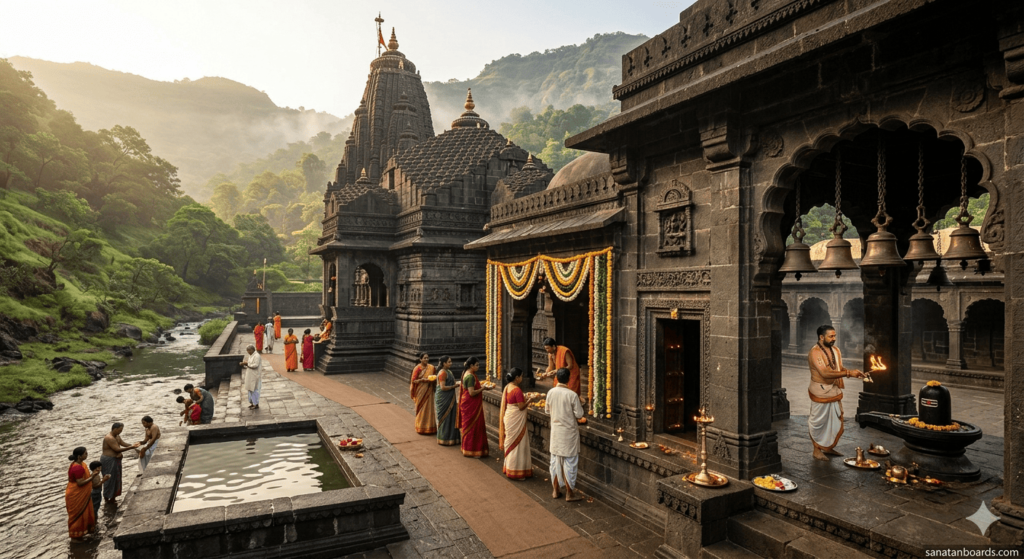
Trimbakeshwar is one of the most significant spiritual and cultural destinations in India, located in the Nashik district of the state of Maharashtra. It is widely known for the sacred Trimbakeshwar Shiva Temple, which is one of the twelve Jyotirlingas dedicated to Lord Shiva. The place holds immense religious importance and attracts millions of devotees, pilgrims, and spiritual seekers every year.
The town of Trimbakeshwar is situated near the Brahmagiri hills, which are considered the origin point of the holy Godavari River, one of the most sacred rivers in India. The natural surroundings of hills, forests, and flowing water add to the divine atmosphere of the region. The spiritual energy of this place is believed to be very powerful, making it a center for various Hindu rituals and ceremonies.
Trimbakeshwar is not just a religious site but also a cultural heritage location that reflects ancient Indian traditions, temple architecture, and Vedic practices. The temple is known for its unique Shiva Lingam, which represents the trinity of Brahma, Vishnu, and Mahesh (Shiva), making it different from other Jyotirlingas.
The town also serves as a major center for performing rituals such as Narayan Nagbali, Kalsarpa Shanti, and Pitru Dosh Puja. These rituals are believed to help individuals overcome ancestral curses planetary doshas, and spiritual obstacles in life.
Over the years, Trimbakeshwar has also developed as a tourism destination where people come not only for religious purposes but also to experience peace, spirituality, and cultural richness. Its connection with ancient scriptures and Hindu mythology makes it one of the most respected pilgrimage sites in India.
What Is Trimbakeshwar (Maharashtra) ?
Trimbakeshwar is a sacred pilgrimage town located in Maharashtra, India, primarily known for the Trimbakeshwar Shiva Temple. It is one of the twelve Jyotirlingas, which are considered the most holy shrines of Lord Shiva in Hindu tradition. A Jyotirlinga represents the infinite nature of Shiva, and visiting these shrines is believed to bring spiritual liberation and divine blessings.
The main temple in Trimbakeshwar is architecturally unique and spiritually powerful. Unlike other Shiva temples, the lingam here represents the trinity of Hinduism—Brahma (the creator), Vishnu (the preserver), and Shiva (the destroyer). This makes the temple highly significant in Hindu philosophy.
Trimbakeshwar is also geographically important because it is the origin of the Godavari River, which is often referred to as the “Ganga of the South.” This adds to the sacred value of the location, making it a major center for purification rituals.
Apart from the temple, Trimbakeshwar is also known for its ritual practices. Many people visit to perform ceremonies like Kalsarpa Shanti, Narayan Nagbali, and Pitru Dosh remedies. These rituals are performed under the guidance of trained priests and are believed to resolve karmic issues and ancestral problems.
The town is surrounded by natural beauty, including the Brahmagiri hills, which enhance its spiritual environment. The combination of mythology, nature, and religious practices makes Trimbakeshwar a unique place in India.
Who Is Required Trimbakeshwar (Maharashtra) ?
Trimbakeshwar is required for individuals who are seeking spiritual guidance, religious fulfillment, and solutions to specific life problems through Vedic rituals and worship. It is especially important for Hindu devotees who follow Shiva worship and believe in Jyotirlinga traditions.
People who are facing ancestral issues or believe they are affected by Pitru Dosh often visit Trimbakeshwar. This includes individuals who experience repeated failures, financial instability, or unexplained obstacles in life, which are traditionally linked to ancestral karma in Hindu belief systems.
It is also required for those suffering from astrological doshas such as Kalsarpa Dosh, which is believed to occur due to planetary alignments in a horoscope. Devotees come to perform Kalsarpa Shanti Puja to reduce its negative effects.
Families who wish to perform rituals for deceased ancestors, such as Narayan Nagbali or Shraddha ceremonies, also require Trimbakeshwar. These rituals are believed to bring peace to departed souls and blessings to the family.
Spiritual seekers, saints, and pilgrims also visit Trimbakeshwar for meditation, worship, and spiritual awakening. The sacred environment supports deep religious practices and devotion.
Additionally, people who want to strengthen their faith, experience divine energy, or seek blessings for health, prosperity, and harmony in life also consider visiting this sacred site necessary.
When Trimbakeshwar (Maharashtra) Is Required ?
Trimbakeshwar is considered required at different stages of life depending on spiritual, astrological, and personal circumstances. It is not limited to a fixed time but is associated with specific life events and challenges.
One of the most common times when Trimbakeshwar is required is during major life obstacles. When individuals face continuous failures in career, business losses, health issues, or family disputes, they often visit this sacred place to perform rituals for relief and spiritual guidance.
It is also required during important astrological periods. When horoscopes show doshas such as Kalsarpa Dosh or Pitru Dosh, individuals are advised to perform corrective pujas at Trimbakeshwar. These rituals are often performed on specific lunar days or auspicious Hindu calendar dates to maximize their spiritual effect.
Another important time is after the death of a family member. Families visit Trimbakeshwar to perform Shraddha rituals and other ancestral ceremonies to ensure peace for departed souls. This is usually done during Pitru Paksha or other spiritually significant periods.
Trimbakeshwar is also required during personal milestones such as marriage, childbirth, or new beginnings. Many people visit the temple to seek blessings from Lord Shiva for a smooth and successful life journey.
Pilgrims also visit during religious festivals like Maha Shivaratri, Shravan month, and other Shiva-related celebrations. These times are considered highly powerful for worship and spiritual practices.
Additionally, it is required when individuals feel mentally disturbed, spiritually disconnected, or emotionally unstable. The peaceful environment and sacred rituals are believed to restore inner balance and clarity.
Thus, Trimbakeshwar is not tied to one specific moment but is required whenever a person seeks divine intervention, spiritual cleansing, or relief from karmic and astrological challenges.
Where Trimbakeshwar (Maharashtra) Is Required ?
Trimbakeshwar is required primarily in the spiritual and religious landscape of India, especially within Hindu pilgrimage circuits. Geographically, it is located in Trimbak town in the Nashik district of Maharashtra, near the Brahmagiri hills, which are considered sacred in Hindu mythology.
It is required at the Trimbakeshwar Shiva Temple, which is one of the twelve Jyotirlingas. This temple is the central location where devotees gather to perform worship, rituals, and prayers dedicated to Lord Shiva. The temple complex is the main hub of religious activity in the region.
The surrounding areas of Nashik and the Godavari river origin point also form an important spiritual zone. Pilgrims often perform rituals along the riverbanks, believing that the water carries purifying and divine properties.
Trimbakeshwar is also required in the broader context of Hindu ritual practices across India. Priests trained in Vedic traditions often travel or guide devotees from different parts of the country to this location for specific pujas that cannot be performed elsewhere with the same religious significance.
It is also required in spiritual tourism circuits, where people from Maharashtra, Gujarat, Madhya Pradesh, Karnataka, and other states visit as part of pilgrimage journeys.
In a cultural sense, Trimbakeshwar is required wherever Hindu traditions, ancestral rituals, and Jyotirlinga worship are practiced or respected. Many families include it as a mandatory pilgrimage destination in their spiritual planning.
The location also plays a role in astrology-based remedies, where individuals are specifically advised to travel to Trimbakeshwar to perform certain rituals under priest guidance.
Thus, Trimbakeshwar is required not just as a physical destination but as a sacred space where geography, spirituality, and tradition converge.
How Trimbakeshwar (Maharashtra) Is Required ?
Trimbakeshwar is required through structured religious procedures, rituals, and devotional practices performed under the guidance of experienced priests. The process of engaging with Trimbakeshwar’s spiritual significance is deeply rooted in Vedic traditions.
Devotees typically begin by visiting the Trimbakeshwar Shiva Temple and offering prayers to Lord Shiva. Ritual offerings such as flowers, milk, water, and bilva leaves are commonly used in worship.
For specific doshas like Kalsarpa Dosh or Pitru Dosh, rituals are performed in a systematic manner. Priests conduct detailed pujas involving mantra chanting, havan (fire rituals), and offerings to ancestors and deities. These rituals are believed to balance planetary influences and reduce negative karmic effects.
Ancestral rituals such as Narayan Nagbali or Shraddha are performed in designated areas around Trimbakeshwar. These require preparation, including fasting, purification, and following strict spiritual guidelines.
The process also includes taking a holy bath in nearby sacred water bodies, especially the origin region of the Godavari River, which is believed to purify the body and soul before rituals.
Devotees often consult local priests or astrologers to determine the correct timing (muhurat) for performing rituals. The effectiveness of these practices is believed to depend on proper timing and adherence to traditional procedures.
Spiritual engagement at Trimbakeshwar also involves meditation, chanting of Shiva mantras, and participation in temple ceremonies. These practices help individuals connect with higher spiritual energy.
In modern times, arrangements are also made through registered priests who guide visitors step-by-step in performing rituals correctly.
Thus, Trimbakeshwar is required through disciplined religious action, devotion, and structured Vedic practices that combine faith, ritual precision, and spiritual discipline.
Case Study On Trimbakeshwar
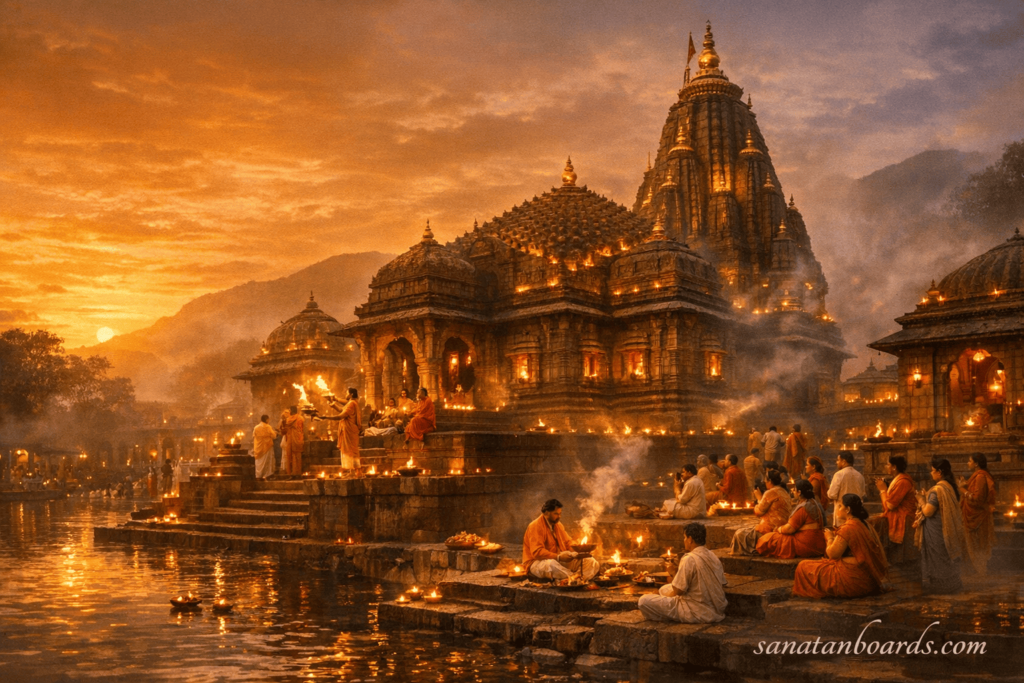
A case study on Trimbakeshwar can be understood through the spiritual journey of a group of pilgrims from different parts of India who visited the sacred site to perform ancestral and astrological remedies.
A middle-class family from Maharashtra experienced repeated financial instability and health issues over several years. Despite medical treatment and financial planning, their problems persisted. After consulting an astrologer, they were advised to perform Pitru Dosh and Kalsarpa Shanti rituals at Trimbakeshwar.
Upon arrival in Trimbakeshwar, the family was guided by local priests who explained the significance of the temple and the rituals. They were instructed to follow purification steps, including fasting and taking a holy bath in sacred water.
The rituals were conducted over several hours, involving chanting of mantras, fire offerings, and symbolic offerings to ancestors. The priests explained that these rituals are based on ancient Vedic traditions designed to bring spiritual balance.
After completing the rituals, the family reported a sense of mental peace and emotional relief. While their external circumstances did not change immediately, they felt a psychological shift and renewed hope.
Another group of pilgrims from Gujarat visited Trimbakeshwar for religious tourism. They were primarily interested in understanding the Jyotirlinga tradition and the spiritual importance of Shiva worship. They participated in temple darshan and local guided explanations about mythology and temple architecture.
They also observed how Trimbakeshwar serves not only as a place of worship but also as a center for cultural education and heritage preservation.
A third case involved a spiritual seeker from Karnataka who spent several days meditating near the Brahmagiri hills. The individual described experiencing deep mental clarity and emotional stability after engaging in meditation and chanting practices.
This case highlights Trimbakeshwar as a multidimensional spiritual ecosystem where rituals, belief systems, and personal transformation intersect.
Across all cases, the common outcome was not necessarily material change but psychological relief, spiritual satisfaction, and strengthened faith.
Trimbakeshwar thus functions as a spiritual intervention point where individuals seek solutions to intangible problems through structured religious systems.
The case study demonstrates that the significance of #Sanatanboardsinmumbai Trimbakeshwar extends beyond rituals; it also plays a role in emotional healing, cultural identity, and spiritual reinforcement.
White Paper On Trimbakeshwar
Trimbakeshwar represents a unique integration of spirituality, cultural heritage, ritual science, and pilgrimage economics within India’s religious ecosystem. This white paper examines its multidimensional significance from religious, sociocultural, and experiential perspectives.
From a religious standpoint, Trimbakeshwar is one of the twelve Jyotirlingas of Lord Shiva, making it a critical node in Hindu devotional geography. The presence of the Shiva Lingam representing the trinity adds theological depth, distinguishing it from other pilgrimage sites.
The temple functions as a center for Vedic ritual preservation. Traditional practices such as Narayan Nagbali, Kalsarpa Shanti, and Pitru Dosh remedies are conducted here with strict adherence to ancient scriptures. These rituals form a structured system of spiritual problem-solving within Hindu belief frameworks.
Socioculturally, Trimbakeshwar serves as a convergence point for diverse communities across India. Pilgrims from different states and backgrounds come together, creating a shared cultural and religious experience. This fosters unity within diversity, a key characteristic of Indian spiritual tradition.
Economically, Trimbakeshwar contributes significantly to local livelihoods through pilgrimage tourism. Priests, guides, lodging providers, and local vendors depend on the continuous influx of visitors. This creates a sustainable ecosystem centered around religious tourism.
From an experiential perspective, visitors report psychological and emotional benefits such as peace, clarity, and reduced anxiety. While these outcomes are subjective, they contribute to the perceived value of the site.
The geographical positioning near the Brahmagiri hills and the origin of the Godavari River enhances its symbolic importance. Water, mountains, and temple architecture together create a holistic sacred environment.
Trimbakeshwar also plays a role in astrological remediation practices. Many individuals visit based on horoscope analysis, reflecting the intersection of spirituality and traditional astrology.
However, the system also faces challenges such as overcrowding during festivals, commercialization of rituals, and lack of standardized information for pilgrims. These issues highlight the need for better management and structured guidance systems.
In conclusion, Trimbakeshwar functions as a multi-layered #Sanatanboardsinvasai institution combining faith, tradition, economy, and cultural continuity. Its relevance continues to grow as both a spiritual destination and a cultural heritage site.
Industry Application On Trimbakeshwar
Trimbakeshwar, located in Maharashtra, is not only a major religious destination but also a significant contributor to various industries. Its importance as one of the twelve Jyotirlingas of Lord Shiva makes it a powerful center for economic, cultural, and service-based activities.
1. Tourism Industry
Trimbakeshwar is a core hub of religious tourism in India. It attracts millions of pilgrims every year from different states and countries. Travel agencies develop customized pilgrimage packages that include Trimbakeshwar along with Nashik and nearby spiritual destinations. Seasonal festivals like Maha Shivaratri and Shravan month further increase tourist inflow, strengthening the tourism economy.
2. Hospitality Industry
The continuous arrival of visitors supports a strong hospitality sector. Hotels, lodges, guest houses, dharamshalas, and homestays operate to accommodate pilgrims. Many establishments focus on affordable stays, group accommodation, and proximity to the temple, ensuring convenience for spiritual travelers. This sector provides employment opportunities for local residents.
3. Spiritual Services Industry
Trimbakeshwar is widely known for specialized Vedic rituals such as Kalsarpa Shanti, Narayan Nagbali, and Pitru Dosh pujas. This has created a structured spiritual services industry involving trained priests, astrologers, and ritual coordinators. These services are an important part of the local economy and attract devotees seeking religious solutions.
4. Transportation Industry
The steady flow of pilgrims boosts demand for transportation services. Indian Railways, Maharashtra State Road Transport buses, private taxis, and tour operators benefit from continuous travel activity. During peak seasons, transportation networks experience significantly higher usage.
5. Retail and Local Business Industry
Local shops, flower vendors, souvenir sellers, food stalls, and religious item stores thrive due to pilgrim spending. This micro-economy supports many families in the Trimbakeshwar region and surrounding villages.
6. Media and Content Industry
Trimbakeshwar is frequently featured in documentaries, devotional content, travel vlogs, blogs, and educational videos. Media organizations and digital creators use it as a subject to explore Hindu traditions, temple architecture, and pilgrimage culture.
7. Wellness and Spiritual Tourism Industry
Many visitors come seeking mental peace, meditation, and emotional healing. This has indirectly supported wellness tourism, yoga practices, and spiritual retreat services in nearby regions.
Conclusion
Trimbakeshwar acts as a multi-sector economic driver. #Sanatanboardsintrimbakeshwar It strengthens tourism, supports local livelihoods, preserves cultural traditions, and promotes spiritual service industries, making it an important religious and economic landmark in Maharashtra.
source : Yatra Mitra
ASK FAQ
What is Trimbakeshwar in Maharashtra famous for?
Trimbakeshwar is famous for the Trimbakeshwar Shiva Temple, one of the twelve Jyotirlingas of Lord Shiva. It is also known for religious rituals like Kalsarpa Shanti and Narayan Nagbali.
Where is Trimbakeshwar located?
Trimbakeshwar is located in the Nashik district of Maharashtra, India, near the Brahmagiri hills, which are considered the origin of the Godavari River.
Why do people visit Trimbakeshwar Temple?
People visit Trimbakeshwar for spiritual blessings, to perform Vedic rituals, to remove doshas like Pitru Dosh and Kalsarpa Dosh, and to seek peace and prosperity.
Which rituals are performed in Trimbakeshwar?
Major rituals include Kalsarpa Shanti Puja, Narayan Nagbali, Rudrabhishek, and Pitru Dosh Nivaran rituals performed by trained priests.
When is the best time to visit Trimbakeshwar?
The best time to visit Trimbakeshwar is during the Shravan month and Maha Shivaratri, when religious activities and temple significance are at their peak.
Table of Contents
Disclaimer
The information provided above is intended solely for educational, informational, and learning purposes. It is based on cultural, religious, and traditional beliefs associated with Trimbakeshwar and should not be interpreted as scientific fact or guaranteed outcome. Spiritual practices and rituals mentioned are part of faith-based traditions and may vary according to regional customs and priestly guidance.