The Sudarshan Chakra is a legendary weapon from Hindu mythology, associated with Lord Vishnu, depicted as a spinning, disc-like weapon capable of destroying evil and protecting righteousness. Symbolically, it represents vigilance, power, and precision. In modern India, the term has been adopted for Mission Sudarshan Chakra, a cutting-edge national defence initiative that functions as a “knowledge network” by integrating radars, satellites, artificial intelligence, and missile systems. This network collects, analyzes, and acts on real-time data to detect and neutralize aerial threats such as drones and missiles, effectively creating a multi-layered protective shield for the nation. Just as the mythological chakra was omnipresent and unstoppable, the modern Sudarshan Chakra aims to provide continuous, intelligent protection using advanced technology.

What Is Sudarshan Chakra Knowledge?
The Sudarshan Chakra Knowledge is India’s advanced defence intelligence network, inspired by Lord Vishnu’s mythological Sudarshan Chakra. Acting as a real-time, multi-layered shield, it integrates radars, satellites, drones, interceptor missiles, and artificial intelligence to detect and respond to aerial threats. The system collects and analyzes data to provide actionable intelligence, protecting critical infrastructure, military bases, and cities, especially during geopolitical tensions or major national events. Beyond defence, its technologies—AI, predictive analytics, and secure communications—also benefit aerospace, smart infrastructure, and industrial safety. Essentially, it is a knowledge-powered shield safeguarding India with precision and vigilance.
WHO IS REQUIRED FOR SUDARSHAN CHAKRA KNOWLEDGE?
The Sudarshan Chakra Knowledge—essentially India’s integrated, knowledge-driven defence network—relies on a range of skilled personnel and experts to function effectively. It is not just about technology; it’s about people who can collect, analyze, and act on intelligence. Key roles include:
- Defense Scientists & Engineers – Specialists from organizations like DRDO (Defence Research and Development Organisation) develop and maintain radars, missiles, satellite systems, and AI platforms that form the backbone of the network.
- Satellite and Space Experts – To operate, monitor, and interpret satellite data for early threat detection, space scientists and analysts are crucial.
- Radar & Sensor Operators – Skilled personnel are required to monitor ground-based radars and sensors, ensuring accurate detection of incoming threats like drones or missiles.
- Data Analysts & AI Specialists – The knowledge network generates massive amounts of data. Analysts and AI experts process this data, predict threats, and recommend actions in real-time.
- Command & Control Officers – These individuals coordinate the network’s defensive responses, ensuring that missiles, interceptor systems, and alerts are activated effectively.
- Cybersecurity Professionals – Protecting the network from cyberattacks is essential, so cybersecurity experts are required to secure all systems and communication channels.
- Policy & Strategic Experts – Military strategists and policy planners integrate the knowledge network into broader national defense strategies.
When Sudarshan Chakra Knowledge Is Required?
The Sudarshan Chakra Knowledge represents India’s modern, intelligence-driven defence network, inspired by the mythological Sudarshan Chakra of Lord Vishnu. In mythology, the Sudarshan Chakra was a spinning, disc-like weapon capable of striking anywhere to destroy evil and protect righteousness. Translating this symbolism into the modern era, India’s Sudarshan Chakra Knowledge Network functions as a real-time, multi-layered shield that combines advanced technology with human expertise to safeguard the nation. It collects and analyzes data from a variety of sources, including radars, satellites, drones, and other sensors. Artificial intelligence and predictive analytics process this data, helping command centers make rapid, accurate decisions, ensuring threats are neutralized effectively.
The Sudarshan Chakra Knowledge is required at all times, as it provides continuous vigilance over India’s airspace and critical infrastructure. It becomes especially crucial when enemy aircraft, missiles, or drones approach national borders, allowing immediate detection and coordinated interception. During periods of geopolitical tension or border conflicts, the network helps anticipate hostile actions before they occur. It is also vital for protecting sensitive sites such as military bases, nuclear plants, and major cities, as well as during large-scale national events like elections, international summits, or public gatherings, when security risks are higher.
In essence, the network is both proactive and reactive, analyzing real-time data to identify potential threats, predict patterns, and coordinate defensive measures. Just as the mythological Sudarshan Chakra was ever-present and ready to strike at evil, the modern knowledge network acts as a continuous, intelligent shield, turning information into actionable defense intelligence. It ensures that India is always prepared to protect its citizens, infrastructure, and sovereignty from immediate dangers and long-term security challenges.
Where Sudarshan Chakra Knowledge Is Required?
The Sudarshan Chakra Knowledge is required across multiple strategic and critical areas to ensure India’s national security and airspace protection. It is essential at border regions, where surveillance of enemy aircraft, drones, and missiles is critical for early threat detection. This knowledge network is also necessary for military installations, airbases, and naval facilities, where real-time intelligence helps coordinate defense systems and safeguard sensitive equipment and personnel.
Critical infrastructure sites, such as nuclear power plants, dams, energy grids, and government buildings, also rely on Sudarshan Chakra Knowledge for monitoring and proactive protection. The network extends to major cities and population centers, ensuring the safety of civilians from aerial threats or security breaches. During large-scale national events, such as elections, international summits, or public gatherings, the knowledge network becomes particularly important to detect unusual activity and coordinate rapid responses.
Additionally, it is required in strategic military operations and defense planning, where data from radars, satellites, and sensors is analyzed to predict threats, optimize response strategies, and strengthen India’s long-term defense posture. Essentially, wherever there is a need to monitor, analyze, and respond to potential threats in real-time, the Sudarshan Chakra Knowledge Network is deployed.
How Sudarshan Chakra Knowledge Is Required?
The Sudarshan Chakra Knowledge is required through a systematic, integrated approach that combines technology, human expertise, and real-time data analysis to protect the nation. It is not just a tool but a networked intelligence system that functions 24/7 to detect, assess, and respond to threats.
Firstly, it relies on advanced surveillance technologies such as ground-based radars, satellites, and drones to continuously monitor airspace, borders, and critical infrastructure. These sensors collect vast amounts of data on potential threats, from missiles and aircraft to unmanned drones.
Secondly, the knowledge network uses artificial intelligence and analytics to process this information rapidly. AI algorithms identify patterns, predict possible threats, and prioritize responses, transforming raw data into actionable intelligence.
Thirdly, the network requires command and control centers where trained officers interpret the data and coordinate defensive measures. This includes activating interceptor systems, issuing alerts, and managing responses across multiple layers of defense.
Fourthly, human expertise is essential—defense scientists, engineers, cybersecurity professionals, and strategists all contribute to maintaining, updating, and improving the system. Cybersecurity specialists protect the network from digital attacks, while strategic planners ensure that intelligence is applied effectively in real-world scenarios.
In essence, the Sudarshan Chakra Knowledge is required by functioning as a seamless, multi-layered defense system, where technology and human intelligence work together. It ensures that threats are detected early, analyzed accurately, and neutralized efficiently, creating a continuous, intelligent shield that protects India from immediate and long-term security challenges.
Case Study On Sudarshan Chakra Knowledge Network
Background & Rationale
The Sudarshan Chakra Mission is India’s ambitious effort to build a nationwide, integrated air‑defence and knowledge network, inspired by the mythological Sudarshan Chakra — a divine weapon symbolizing protection and precision. Announced by the Prime Minister on 15 August 2025, this initiative aims to protect the nation against modern aerial threats using advanced technology and strategic intelligence.
Objective
The core objective of the Sudarshan Chakra Knowledge Network is to provide real‑time situational awareness, rapid threat identification, and coordinated defensive responses by fusing data from multiple sensors and weapons systems across the country. The network aims to shield military and civilian infrastructure against drones, missiles, aircraft, and other airborne threats by 2035.
Key Components
- Surveillance & Detection Systems – Thousands of ground‑based radars including over‑the‑horizon (OTH) radars and satellite sensors will monitor airspace far beyond national borders.
- Integrated Command & Control – A centralised network will connect sensor data with decision systems to create a Recognised Air Situation Picture (RASP) and guide responses in real time.
- Multi‑Layer Defence Assets – Integrated elements include indigenous missiles (like Akash, QRSAM), longer‑range interceptors, anti‑drone systems, and directed energy weapons (e.g., laser systems) to neutralise threats at different ranges.
- Advanced Technologies – Artificial intelligence, big‑data analytics, and quantum computing are applied to process massive streams of data, prioritise threats, and automate responses.
Operational Integration
The network taps into existing defence assets (e.g., IACCS — Integrated Air Command & Control System) to link sensors, radars, fighter aircraft, and missile systems. This ensures continuous information flow between air, land, and naval domains to coordinate threat responses effectively.
Real‑World Insights
Although the full Sudarshan Chakra Network is still under development, elements of India’s missile and air‑defence systems have already been tested in conflicts. For example, during Operation Sindoor in 2025, integrated air‑defence assets intercepted drones and missiles, demonstrating the importance of integrated systems in real conflict scenarios.
Strategic Importance
The Sudarshan Chakra Knowledge Network represents a shift from isolated defence systems to a unified, technology‑driven shield that can detect, analyse, and respond to threats proactively. It reflects India’s focus on self‑reliance (Atmanirbhar Bharat) by primarily developing indigenous technologies while integrating global systems where necessary.
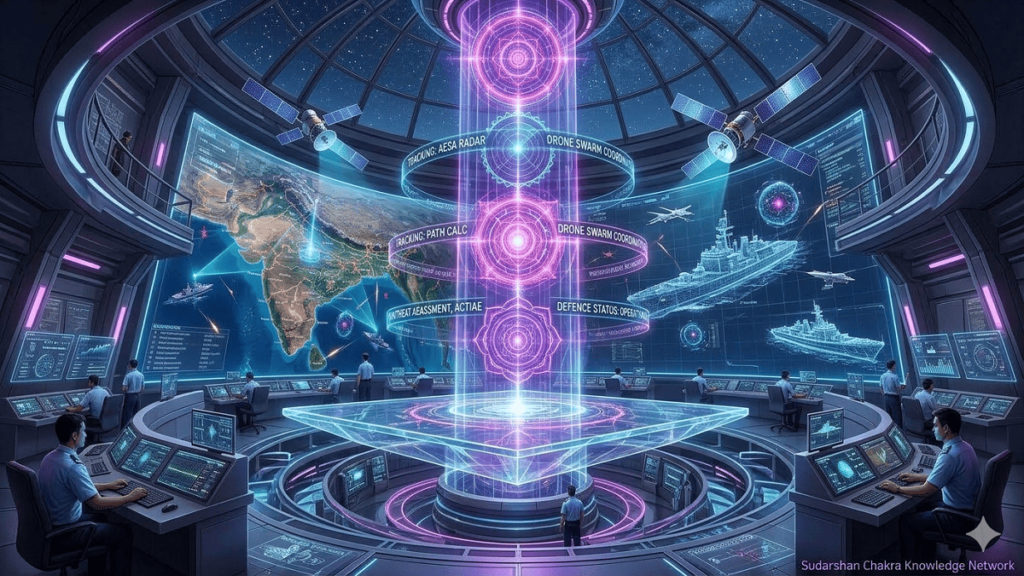
white paper on sudarshan chakra knowledge network
ndia’s Next‑Generation Integrated Air and Missile Defence Architecture
1. Executive Summary
The Sudarshan Chakra Knowledge Network represents a transformative defence initiative by the Government of India to build a comprehensive, multi‑layered, networked air and missile defence shield across the nation. Inspired by the mythological Sudarshan Chakra — symbolizing vigilance, precision, and omnidirectional protection — this initiative seeks to integrate advanced sensors, weapons systems, command‑and‑control infrastructure, and artificial intelligence into one seamless knowledge‑driven defence architecture by 2035. The combined goal is to detect, analyse, and counter diverse aerial threats — from drones and cruise missiles to ballistic missiles and fighter aircraft — while safeguarding military assets, critical infrastructure, and civilian populations.
2. Vision & Strategic Context
India’s strategic environment is evolving with increased threats from advanced aerial platforms, unmanned systems, and long‑range precision strike weapons. To address this risk landscape, the Sudarshan Chakra Knowledge Network aims to transform India’s defence paradigm from isolated systems to an integrated knowledge ecosystem, enabling real‑time situational awareness, rapid response coordination, and unified defence action across all domains — land, air, sea, and space.
3. Core Objectives
The Sudarshan Chakra Knowledge Network is designed to:
- Provide Persistent Surveillance & Early Warning: Using a combination of ground‑based, over‑the‑horizon radars and space‑based sensors.
- Enable Rapid Data Fusion & Threat Evaluation: With AI and analytics processing massive data streams for actionable intelligence.
- Coordinate Multi‑Layered Defence Responses: Through integrated command‑and‑control that synchronises interceptor systems, electronic warfare, and directed energy weapons.
- Defend All Strategic Domains: Including military bases, urban centres, transportation hubs, energy infrastructure, and maritime approaches.
4. Network Architecture Components
4.1 Sensor & Surveillance Layer
A distributed array of surveillance assets will provide early detection and tracking of aerial threats:
- ~6,000–7,000 ground‑based radars including Over‑the‑Horizon (OTH) systems.
- Space‑based platforms under the Space‑Based Surveillance Programme, with planned constellations by 2030.
- Integrated drone detection and long‑range tracking sensors.
4.2 Command & Control Layer
A centralised, networked command and control grid will fuse sensor data into a Recognised Air Situation Picture (RASP). AI‑augmented decision tools will prioritise responses and allocate weapons systems in real time, reducing human latency in critical scenarios.
4.3 Defensive & Offensive Systems Layer
Multiple defence assets form the kinetic and non‑kinetic response backbone:
- Kinetic Interceptors: Quick Reaction Surface‑to‑Air Missiles (QRSAM), Medium Range SAMs, long‑range interceptors such as Project Kusha variants.
- Legacy & Modern Systems: Integration of platforms like Akash SAMs, MRSAMs, and S‑400 in layered defence grids.
- Directed Energy Weapons (DEWs): High‑power lasers and non‑kinetic systems to defeat drones and inbound threats.
- Air Defence Guns & CIWS: Short‑range rapid response guns such as AK‑630s.
5. Operational Framework
The network operates as a 24/7 persistent defensive shield — constantly scanning, evaluating, and responding to aerial threats. Through coordinated protocols, any detected hostile object can trigger automated alerts, AI threat scoring, and sequenced deployment of interceptors or countermeasures within seconds.
6. Technological Enablers
To achieve the required real‑time capabilities, the Sudarshan Chakra Knowledge Network integrates:
- Artificial Intelligence & Machine Learning for predictive risk assessment.
- Big Data Analytics for rapid threat classification.
- Secure Communication Networks linking sensors, command centres, and weapon systems.
- Cyber Defence Systems to protect the network against digital incursions.
7. Implementation Roadmap
India plans a phased rollout: initial integration of existing defence assets and sensor grids in the short term, accelerated indigenous development and deployment of advanced systems by 2030, and full network realisation by 2035.
8. Strategic Impact
Once operational, the Sudarshan Chakra Knowledge Network will provide India with a comprehensive defensive umbrella, enhance strategic deterrence, and expand self‑reliance in critical defence technologies — reflecting a shift toward resilient, data‑driven military operations.
9. Conclusion
The Sudarshan Chakra Knowledge Network represents a paradigm shift in India’s defence doctrine. By fusing cutting‑edge technology with synchronized command and operational coherence, it seeks to provide an intelligent, responsive and enduring shield for the nation’s security in an era of evolving threats.
Industry Applications Of The Sudarshan Chakra Knowledge Network:
The Sudarshan Chakra Knowledge Network, while primarily a defence initiative, has significant applications across multiple industries due to its reliance on advanced technologies like artificial intelligence, big data analytics, satellite systems, and real-time sensor networks.
1. Defence and Security Industry
- The most direct application is in national defence, where the network enhances surveillance, threat detection, missile interception, and command-and-control operations.
- Private defence manufacturers and startups can contribute to radar systems, missile technology, UAVs, and AI-powered threat analytics.
2. Aerospace and Satellite Industry
- The network relies on satellites for early warning and tracking, creating opportunities in space research, satellite manufacturing, launch services, and orbital surveillance technologies.
- Companies involved in remote sensing and geospatial intelligence can leverage this network to improve precision and monitoring.
3. Artificial Intelligence and Big Data Analytics
- Processing real-time data from multiple sources requires AI, machine learning, and predictive analytics, which can be applied in industries like logistics, transportation, smart cities, and urban security management.
- Algorithms developed for threat detection can also optimize industrial process monitoring, predictive maintenance, and emergency response systems.
4. Telecommunications and Network Security
- The knowledge network depends on secure communication channels, which promotes innovations in cybersecurity, encrypted networking, and secure IoT systems.
- These technologies are highly relevant to financial services, healthcare, and critical infrastructure management.
5. Energy and Infrastructure
- Surveillance and predictive monitoring systems can be applied to nuclear plants, power grids, and large infrastructure projects to protect against threats or operational failures.
source : Cosmic Vaani
What is the Sudarshan Chakra Knowledge Network?
The Sudarshan Chakra Knowledge Network is India’s next-generation defence initiative that integrates radars, satellites, drones, missiles, and AI-powered analytics to provide a multi-layered, real-time protective shield. Inspired by the mythological Sudarshan Chakra of Lord Vishnu, the network collects, analyzes, and acts on intelligence to safeguard the nation from aerial threats.
When and why is the Sudarshan Chakra Knowledge Network required?
It is required 24/7, especially during periods of geopolitical tension, border conflicts, and national events. The network ensures continuous surveillance of India’s airspace and critical infrastructure, detecting threats such as drones, missiles, or enemy aircraft and enabling rapid, coordinated defensive responses.
Who is involved in operating the Sudarshan Chakra Knowledge Network?
A combination of defence scientists, engineers, AI specialists, radar operators, cybersecurity experts, and strategic planners work together to maintain and operate the network. Their roles include monitoring threats, analyzing real-time data, coordinating defensive systems, and ensuring secure communication across all layers of the network.
Where is the Sudarshan Chakra Knowledge Network deployed?
The network is deployed across border regions, military installations, critical infrastructure sites, major cities, and strategic zones. It provides comprehensive protection for sensitive areas such as nuclear plants, airbases, urban centres, and during major national events where security risks are higher.
What are the industry applications of the Sudarshan Chakra Knowledge Network?
Beyond defence, its technologies apply to aerospace, satellite systems, AI and big data analytics, cybersecurity, smart infrastructure, and energy sector monitoring. Innovations in predictive analytics, real-time surveillance, and secure communication enhance multiple industries, including urban security, industrial safety, and critical infrastructure management.
Table of Contents
Disclaimer: This content is for informational and educational purposes only. The details about the Sudarshan Chakra Knowledge Network are based on publicly available sources. The blog does not disclose classified or sensitive defence information and is not affiliated with or endorsed by any government or defence organization.