King Ramkhamhaeng stands as one of the most influential figures in the history of Thailand, particularly during the era when the region was known as Siam. His reign in the 13th century marked a transformative period for the Sukhothai Kingdom, often considered the first unified Thai state. Under his leadership, Siam experienced political stability, cultural advancement, and significant territorial expansion, laying the foundation for future Thai identity.
The importance of King Ramkhamhaeng lies not only in his administrative capabilities but also in his cultural contributions. He is widely credited with the creation of the Thai script, which played a crucial role in unifying the language and preserving knowledge across generations. This innovation enabled communication, governance, and education to flourish, shaping the intellectual landscape of Siam.
During his reign, the kingdom became a hub of trade and diplomacy, establishing connections with neighboring regions such as China and other Southeast Asian states. His governance style was often described as paternalistic, where he ruled with a sense of responsibility and care toward his people. This approach earned him respect and loyalty, strengthening internal unity.
King Ramkhamhaeng’s legacy continues to influence modern Thailand, especially in terms of language, governance, and national identity. His contributions are remembered as a golden age of prosperity and harmony in Siam. Understanding his role provides valuable insight into how early leadership shaped the social, cultural and political fabric of Thailand. His story remains a cornerstone in the study of Southeast Asian history and leadership.

What Is Siam (Thailand) – King Ramkhamhaeng ?
SIAM (Thailand) – King Ramkhamhaeng refers to the historical period and leadership associated with one of the most prominent rulers of the Sukhothai Kingdom. It represents a significant era in Southeast Asian history when Siam began to establish itself as a unified and culturally rich civilization. King Ramkhamhaeng’s reign is often viewed as the golden age of Sukhothai, characterized by prosperity, innovation, and strong governance.
This concept encompasses both the individual contributions of the king and the broader transformation of Siam under his leadership. It highlights the development of political systems, cultural identity, and economic growth during the 13th century. King Ramkhamhaeng’s governance model was unique in that it combined authority with accessibility, allowing citizens to directly appeal to the king for justice.
One of the defining aspects of this era is the introduction of the Thai alphabet. This innovation not only standardized communication but also strengthened cultural identity and administrative efficiency. It allowed the kingdom to document laws, religious teachings, and historical events, ensuring continuity and stability.
Additionally, the term reflects the expansion of Siam’s influence through diplomacy and trade. The kingdom maintained peaceful relations with neighboring states while also benefiting from economic exchanges. This openness contributed to the spread of ideas, technologies, and cultural practices.
Overall, SIAM (THAILAND) – King Ramkhamhaeng represents a foundational period that shaped the identity of modern Thailand. It symbolizes progress, unity, and visionary leadership, making it a key subject of historical and cultural study.
Who Is Required Siam (Thailand) – King Ramkhamhaeng ?
The relevance of SIAM (THAILAND) – King Ramkhamhaeng extends to a wide range of individuals and groups who seek to understand historical development, leadership, and cultural evolution. Historians and researchers are among the primary audiences, as they analyze his reign to gain insights into early state formation and governance in Southeast Asia. His leadership provides valuable case material for studying how societies evolve under effective rulers.
Students and educators also benefit significantly from this topic. It serves as an important part of academic curricula related to world history, Asian studies, and political science. By examining King Ramkhamhaeng’s contributions, learners can understand how language, governance, and culture intersect to shape a nation.
Policy makers and leaders may also find relevance in this subject. The king’s approach to governance—marked by accessibility, fairness, and cultural investment—offers lessons in leadership that remain applicable today. His emphasis on public welfare and communication reflects principles that modern administrations strive to achieve.
Cultural enthusiasts and travelers interested in Thailand’s heritage are another group for whom this topic is important. Understanding the legacy of King Ramkhamhaeng enhances appreciation for Thai traditions, language, and historical landmarks.
In addition, linguists and scholars of language study his role in the creation of the Thai script. This development is crucial for understanding the evolution of written communication in the region.
Overall, SIAM (THAILAND) – King Ramkhamhaeng is relevant to anyone interested in history, governance, culture, and societal development, making it a widely applicable and significant subject.
When Siam (Thailand) – King Ramkhamhaeng Is Required ?
The study and understanding of SIAM (THAILAND) – King Ramkhamhaeng become particularly important in various contexts where historical insight and cultural awareness are essential. One of the primary situations where this topic is required is in academic research and education. Students studying Southeast Asian history or global civilizations often encounter this subject as it represents a key turning point in the development of early Thai society.
It is also required when analyzing the evolution of governance systems. King Ramkhamhaeng’s leadership style offers a model of inclusive and responsive governance, which can be compared with modern political systems. Researchers and scholars frequently refer to his reign when discussing early democratic tendencies and administrative innovations.
The topic is equally important in cultural preservation efforts. Understanding the origins of the Thai script and cultural practices helps maintain and promote national identity. Museums, cultural institutions, and heritage organizations often rely on this knowledge to present accurate historical narratives.
In tourism and heritage interpretation, this subject becomes highly relevant. Visitors to historical sites in Thailand, particularly those related to the Sukhothai period, benefit from understanding the significance of King Ramkhamhaeng’s contributions. This enhances their experience and appreciation of the country’s rich past.
Additionally, the topic is required in leadership and management studies. His governance approach provides lessons in communication, public engagement, and ethical leadership. These principles are applicable in modern organizational and political contexts.
Where Siam (Thailand) – King Ramkhamhaeng Is Required ?
The relevance of SIAM (THAILAND) – King Ramkhamhaeng is evident across multiple domains where historical understanding, cultural identity, and leadership studies are important. One of the primary areas where this topic is required is in academic institutions. Schools, colleges, and universities include the study of King Ramkhamhaeng within history, political science, and Asian studies programs. It helps students understand the early formation of Thailand and the development of governance systems.
Another key area is in cultural and heritage institutions. Museums, historical parks, and preservation centers—especially those connected to the Sukhothai Kingdom—require this knowledge to present accurate historical narratives. Exhibitions often showcase artifacts, inscriptions, and architectural achievements from his reign, making it essential to understand his contributions.
The tourism industry is another major field where this topic is required. Tour guides, travel planners, and cultural interpreters rely on knowledge about King Ramkhamhaeng to explain the significance of historical landmarks. Visitors exploring ancient sites gain a deeper appreciation when they understand the historical context behind them.
In government and public administration sectors, this topic is required for understanding traditional leadership models. Policymakers and administrators study his governance style to draw lessons about communication, fairness, and citizen engagement. These insights are useful in shaping modern administrative practices.
The field of linguistics also requires this topic, particularly in the study of language development. King Ramkhamhaeng’s role in creating the Thai script is a significant milestone, making his contributions essential for researchers analyzing the evolution of written communication in Southeast Asia.
Additionally, this subject is relevant in international relations and regional studies. Scholars examining Southeast Asian history and diplomacy often refer to his reign to understand early trade networks and cross-cultural interactions.
Overall, SIAM (THAILAND) – King Ramkhamhaeng is required in education, cultural preservation, tourism, governance, linguistics, and research sectors. Its application across these areas highlights its importance in understanding both historical and modern perspectives of societal development.
How Siam (Thailand) – King Ramkhamhaeng Is Required ?
The application of SIAM (THAILAND) – King Ramkhamhaeng is carried out through various methods across academic, cultural, and professional fields. In education, it is incorporated into curricula through textbooks, lectures, and research projects. Students analyze historical records, inscriptions, and archaeological findings to understand the impact of his reign.
In cultural contexts, the topic is presented through museums, exhibitions, and heritage sites. Artifacts and historical monuments associated with the Sukhothai period provide tangible evidence of his contributions. These resources help individuals connect with history in a meaningful way.
In governance and leadership studies, the principles derived from his reign are applied through case analysis and theoretical frameworks. His approach to communication and public engagement is studied to develop modern leadership strategies.
Technology also plays a role in how this topic is utilized. Digital platforms, documentaries, and online resources make information about King Ramkhamhaeng accessible to a global audience. This ensures that his legacy continues to be studied and appreciated.
In research, scholars use interdisciplinary methods to explore various aspects of his reign, including linguistics, economics, and political science. This comprehensive approach allows for a deeper understanding of his impact.
Overall, the topic is applied through education, cultural preservation, leadership studies, and research, demonstrating its versatility and importance.
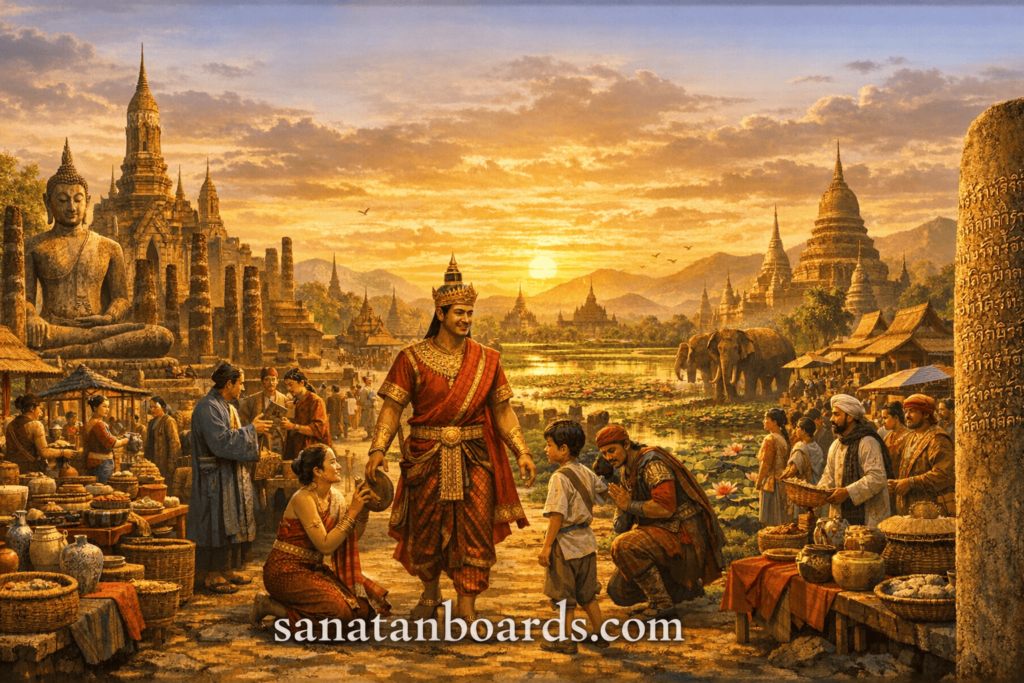
Case Study On Siam (Thailand) – King Ramkhamhaeng
The reign of King Ramkhamhaeng in the Sukhothai Kingdom represents a landmark period in the development of early Siam, now known as Thailand. This case study explores how his leadership shaped political stability, cultural identity, and economic growth, making his reign a model of effective governance in Southeast Asian history.
One of the central achievements of King Ramkhamhaeng was the creation of the Thai script. Before this innovation, communication and record-keeping were inconsistent and limited. By introducing a standardized writing system, he enabled the preservation of laws, cultural traditions, and religious teachings. This development significantly strengthened administrative efficiency and cultural unity within the kingdom. It also laid the foundation for future intellectual and literary growth in Thailand.
Another important aspect of this case study is his governance style. King Ramkhamhaeng is often described as a paternalistic ruler who maintained close relationships with his subjects. Historical accounts suggest that citizens could directly present grievances to the king, reflecting a system based on accessibility and fairness. This approach fostered trust and loyalty among the population, contributing to internal stability.
Economically, the Sukhothai Kingdom flourished under his rule. The kingdom became a center for regional trade, engaging with neighboring areas such as China and other Southeast Asian regions. The open trade policies encouraged the exchange of goods, ideas, and technologies. This not only improved the economy but also enhanced cultural diversity and innovation.
Diplomatic relations were another strength of his reign. King Ramkhamhaeng maintained peaceful ties with neighboring states, which helped ensure security and stability. His diplomatic strategies allowed the kingdom to expand its influence without constant conflict, demonstrating a balance between power and cooperation.
Culturally, his reign is often referred to as a golden age. Art, architecture, and religious practices flourished during this period. The promotion of Buddhism played a significant role in shaping societal values and ethical frameworks. Temples and monuments constructed during this time continue to reflect the artistic and spiritual achievements of the era.
This case study highlights how visionary leadership can transform a society. King Ramkhamhaeng’s focus on communication, governance, and cultural development created a strong and lasting foundation for Siam. His ability to integrate innovation with tradition ensured both progress and continuity.
In conclusion, the reign of King Ramkhamhaeng serves as an exemplary model of leadership that balances political authority, cultural advancement, and economic development. His contributions remain relevant in modern discussions of governance and national identity.
White Paper On Siam (Thailand) – King Ramkhamhaeng
The historical period associated with King Ramkhamhaeng represents a transformative era in the evolution of Siam. This white paper examines the structural, cultural, and economic contributions of his reign in the Sukhothai Kingdom, emphasizing their long-term significance for modern Thailand.
A key area of focus is linguistic development. The introduction of the Thai script under King Ramkhamhaeng marked a turning point in communication and administration. This standardized system enabled the recording of legal frameworks, religious doctrines, and historical events. As a result, it improved governance efficiency and ensured the preservation of cultural heritage.
From a governance perspective, his leadership model was characterized by inclusivity and responsiveness. Unlike rigid hierarchical systems, his approach allowed for direct interaction between the ruler and his subjects. This created a sense of accountability and trust, which are essential components of stable governance. The model demonstrates how leadership can influence social cohesion and public satisfaction.
Economically, the Sukhothai Kingdom experienced significant growth during his reign. Trade networks expanded across Southeast Asia, connecting Siam with regional and international markets. This facilitated the exchange of goods, ideas, and technologies, contributing to innovation and prosperity. The economic policies implemented during this period highlight the importance of openness and collaboration in achieving sustainable development.
Cultural advancement was another defining feature of his rule. The promotion of Buddhism played a central role in shaping societal values and ethical standards. Artistic and architectural developments flourished, reflecting a society that valued creativity and spiritual expression. These cultural elements continue to influence Thai identity and heritage.
This white paper also considers the broader implications of his leadership. The integration of language, governance, and economic policies created a holistic framework for development. His reign illustrates how different aspects of society can work together to achieve progress and stability.
Furthermore, the legacy of King Ramkhamhaeng provides valuable insights for modern policymakers and scholars. His emphasis on communication, inclusivity, and cultural preservation offers lessons that remain relevant in contemporary contexts. By studying his reign, it is possible to understand the foundational principles that contribute to effective governance and societal development.
In conclusion, the era of King Ramkhamhaeng represents a critical phase in the history of Siam. His contributions to language, governance, economy, #Sanatandharmaaccreditationboardsinvasai and culture have had a lasting impact, making his reign an essential subject of study for understanding the development of Thailand.
Industry Application On Siam (Thailand) – King Ramkhamhaeng
The principles derived from the reign of King Ramkhamhaeng in the Sukhothai Kingdom have practical applications across multiple industries in modern Thailand and beyond.
In the field of leadership and management, his governance style is used as a model for building trust, transparency, and effective communication. Organizations apply these principles to improve employee engagement, decision-making processes, and overall organizational culture.
In education, his contributions are integrated into academic curricula to teach history, cultural development, and leadership. Educational institutions use his legacy to demonstrate how innovation and governance can shape societies.
The tourism industry significantly benefits from this topic. Historical sites associated with the Sukhothai period attract global visitors. Knowledge of King Ramkhamhaeng enhances the value of cultural tourism, allowing guides and institutions to provide meaningful interpretations of heritage sites.
In linguistics and communication, the creation of the Thai script serves as a case study in language standardization and development. Researchers and professionals analyze this achievement to understand how communication systems evolve and influence society.
In public administration, his leadership principles are applied to improve governance systems. Concepts such as accessibility, fairness, and accountability are used to design policies that prioritize citizen welfare.
In cultural industries, including art, media, and heritage conservation, his reign inspires creative works and preservation efforts. His legacy provides a foundation for promoting national identity and cultural pride.
Overall, the industry applications of SIAM (THAILAND) – King Ramkhamhaeng demonstrate its relevance beyond historical study. The principles derived from #Sanatandharmaaccreditationboardsinmumbai his reign continue to influence modern practices across diverse sectors.
source : Business Insider
ASK FAQ
1. Who was King Ramkhamhaeng?
King Ramkhamhaeng was a 13th-century ruler of the Sukhothai Kingdom and is considered one of the greatest kings in Thailand. He is known for his strong leadership, expansion of the kingdom, and cultural contributions.
2. Why is King Ramkhamhaeng important in Thai history?
King Ramkhamhaeng is important because he created the Thai script, strengthened governance, and promoted trade and diplomacy. His reign is often called the golden age of early Siam due to peace and prosperity.
3. What did King Ramkhamhaeng contribute to Siam (Thailand)?
He introduced the Thai alphabet, improved administration, expanded trade networks, and supported Buddhism. These contributions helped shape the cultural and political identity of Thailand.
4. When did King Ramkhamhaeng rule the Sukhothai Kingdom?
King Ramkhamhaeng ruled during the late 13th century, around 1279 to 1298. This period marked significant growth and stability in the Sukhothai Kingdom.
5. How did King Ramkhamhaeng influence modern Thailand?
His influence is seen in the Thai language, governance principles, and cultural traditions. The script he created is still used today, making his legacy vital to Thailand’s identity.
Table of Contents
Disclaimer
This content is intended for informational purposes only. While efforts have been made to present accurate and structured information, it may not include all historical interpretations or scholarly perspectives. Readers are encouraged to consult additional academic sources and expert references for deeper research and validation.