Sanatan Dharma Traitors
Historical, Cultural, and Philosophical Perspectives
Introduction
Sanatan Dharma, often referred to as Hindu Dharma, is one of the world’s oldest continuous spiritual traditions. The term “Sanatan” means eternal, and “Dharma” refers to cosmic law, duty, righteousness, and moral order. Together, Sanatan Dharma represents an eternal way of life rooted in spiritual wisdom, ethics, and universal harmony.
When discussing “Sanatan Dharma traitors,” it is important to approach the subject with maturity, historical understanding, and philosophical clarity. The word “traitor” is emotionally charged and often used in political or ideological debates. In the context of Sanatan Dharma, betrayal does not simply mean political opposition. It may refer to individuals, groups, or ideologies that:
- Undermined core dharmic principles
- Distorted sacred knowledge
- Collaborated against cultural integrity
- Promoted division and social decay
- Abandoned dharmic responsibilities for selfish interests
However, Sanatan Dharma itself teaches forgiveness, introspection, and transformation. Therefore, rather than focusing on hate, this article explores historical, philosophical, and ethical dimensions of what constitutes betrayal within dharmic frameworks.
Understanding Dharma Before Defining Betrayal
Before identifying “traitors,” we must understand what Dharma stands for.
Sanatan Dharma is rooted in texts such as:
- Vedas
- Upanishads
- Bhagavad Gita
- Ramayana
- Mahabharata
Dharma includes:
- Satya (truth)
- Ahimsa (non-violence)
- Seva (service)
- Nyaya (justice)
- Shraddha (faith)
- Kartavya (duty)
Therefore, betrayal in Sanatan Dharma is not merely political opposition; it is the conscious abandonment of truth, justice, and righteousness for selfish gains.
Traitors in Hindu Epics: Symbolic Lessons
The Hindu epics provide symbolic narratives about betrayal.
1. Vibhishana – Traitor or Dharmic Hero?
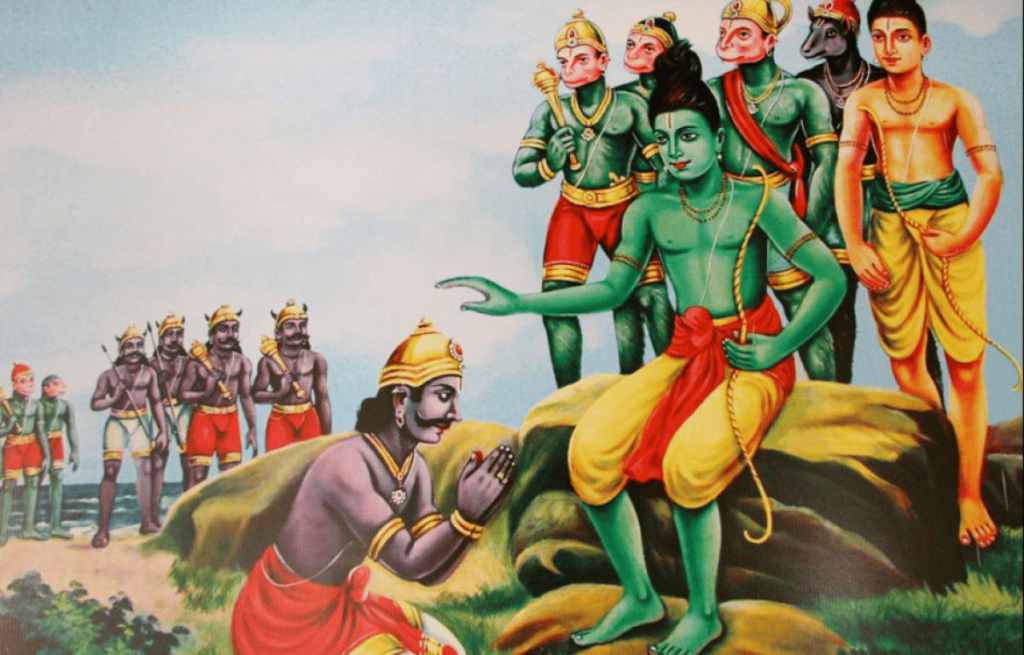
In the Ramayana, Vibhishana, the brother of Ravana, leaves Lanka and joins Rama.
From Ravana’s perspective, Vibhishana was a traitor. But from a dharmic perspective, he stood for righteousness when Ravana abducted Sita.
Lesson: Loyalty to Dharma is greater than loyalty to family or kingdom.
2. Shakuni – Master of Manipulation
In the Mahabharata, Shakuni manipulates events leading to the Kurukshetra war. His betrayal was not against a religion but against moral order and family harmony.
Lesson: Strategic deceit for personal revenge destroys society.
3. Karna – Loyalty vs Righteousness
Karna remained loyal to Duryodhana despite knowing the moral superiority of the Pandavas.
Lesson: Blind loyalty without ethical evaluation becomes destructive.
Historical Context: Internal and External Challenges
Throughout history, Sanatan Dharma faced multiple challenges:
- Foreign invasions
- Religious conversions
- Colonial manipulation
- Social divisions
- Internal reform movements
The key question: Who betrayed Dharma — those who reformed it or those who corrupted it?
1. Colonial Era and Intellectual Betrayal
During British rule in India, certain elites collaborated with colonial powers. Some intellectuals internalized narratives portraying Hindu traditions as primitive.
Thomas Babington Macaulay introduced education policies that prioritized Western frameworks over traditional Gurukul systems.
Was collaboration betrayal? Or adaptation for survival?
Sanatan Dharma survived because reformers like:
- Swami Vivekananda
- Dayananda Saraswati
- Sri Aurobindo
revived spiritual pride while embracing reform.
Social Reformers: Traitors or Protectors?
Many reformers were criticized in their time.
Raja Ram Mohan Roy
Raja Ram Mohan Roy opposed Sati practice. Conservative factions accused him of weakening Hindu tradition.
But was eliminating harmful customs betrayal? Or purification?
Sanatan Dharma has historically evolved. Dharma adapts while maintaining core principles.
Betrayal Through Social Division
One of the greatest internal threats has been rigid caste discrimination.
Though Varna system in the Bhagavad Gita describes classification by qualities (Guna) and actions (Karma), later distortions created birth-based hierarchy.
When Dharma becomes rigid power structure, it deviates from its spiritual core.
Is exploiting religion for oppression not a form of betrayal?
Political Misuse of Sanatan Dharma
In modern times, religion is often used for:
- Electoral gains
- Social polarization
- Hate speech
- Identity politics
Sanatan Dharma teaches “Vasudhaiva Kutumbakam” — the world is one family.
Weaponizing Dharma for division contradicts its universal message.
Philosophical Definition of a Traitor in Sanatan Dharma
A true betrayer of Sanatan Dharma is someone who:
- Distorts scriptures for personal gain
- Incites hatred in the name of religion
- Exploits faith for power or money
- Promotes ignorance over knowledge
- Encourages violence without dharmic justification
The Bhagavad Gita teaches action without selfish attachment. Betrayal arises from ego (Ahankara), greed (Lobha), anger (Krodha), and delusion (Moha).
Modern Intellectual Debates
In academic circles, debates occur regarding:
- Secularism vs dharmic identity
- Reform vs preservation
- Universalism vs exclusivism
Labeling critics as traitors may oversimplify complex discussions.
Sanatan Dharma historically encourages debate (Shastrartha). Suppressing dialogue is itself against dharmic tradition.
Media, Narrative, and Cultural Identity
Cinema, literature, and digital media influence perception.
When media misrepresents sacred traditions without scholarship, many feel it undermines Dharma. However, creative critique and satire have always existed in Indian culture.
The key distinction: Malicious distortion vs constructive critique.
Conversion and Religious Identity
Religious conversion is a sensitive issue.
Some view conversion away from Sanatan Dharma as betrayal. Others view it as personal freedom.
Historically, many conversions occurred under:
- Social pressure
- Economic factors
- Colonial incentives
- Missionary influence
Sanatan Dharma traditionally does not have a centralized conversion doctrine. Identity is often cultural, philosophical, and familial rather than strictly institutional.
True Betrayal According to Dharmic Philosophy
The real enemy in Sanatan Dharma is Adharma (unrighteousness), not individuals.
The internal enemies described in scriptures are:
- Kama (uncontrolled desire)
- Krodha (anger)
- Lobha (greed)
- Moha (attachment)
- Mada (ego)
- Matsarya (jealousy)
When these dominate individuals or institutions, Dharma declines.
Lessons from the Bhagavad Gita
In the battlefield dialogue between Krishna and Arjuna, confusion about duty is central.
Arjuna fears fighting his relatives, teachers, and friends. Krishna reminds him that:
- One must act according to Dharma.
- Emotional attachment cannot override righteousness.
- Inaction in face of injustice is also betrayal.
Thus, silence against injustice may be a deeper betrayal than opposition.
Internal Reform as Strength, Not Betrayal
Sanatan Dharma survived thousands of years because:
- It allowed philosophical diversity.
- It accepted atheistic schools like Charvaka.
- It embraced Bhakti, Yoga, Vedanta, Tantra traditions.
Reform is not betrayal if it aligns with truth and compassion.
Cultural Confidence vs Extremism
Healthy pride in tradition promotes:
- Cultural preservation
- Ethical living
- Spiritual growth
- Social responsibility
But extremism creates:
- Fear
- Division
- Violence
- Intellectual stagnation
True dharmic protection is through education, ethics, and service — not hostility.
Who Truly Protects Sanatan Dharma?
Those who:
- Practice honesty in business
- Promote ethical leadership
- Educate without bias
- Encourage interfaith respect
- Serve society selflessly
Sanatan Dharma is protected not by slogans but by conduct.
Reframing the Idea of “Traitor”
Instead of asking, “Who betrayed Sanatan Dharma?” a deeper question is:
“How do we ensure we ourselves do not betray Dharma?”
Self-introspection is central to Hindu philosophy.
The Upanishadic principle “Tat Tvam Asi” — Thou Art That — reminds individuals that the divine resides within.
When we harm others unjustly, we harm Dharma.
Conclusion
The concept of “Sanatan Dharma traitors” must be handled with responsibility.
Historically, betrayal has taken many forms:
- Political manipulation
- Social injustice
- Intellectual distortion
- Blind fanaticism
- Exploitation of faith
But Sanatan Dharma teaches transformation over condemnation.
The greatest threat to Dharma is not external enemies, critics, or reformers. It is internal corruption — greed, ego, ignorance, and hatred.
Dharma survives through:
- Knowledge
- Compassion
- Courage
- Justice
- Self-discipline
Rather than labeling individuals as traitors, the dharmic path calls for education, dialogue, reform, and righteous action.
Top 100 Sanatan Dharma Traitors who helped enemies to destroy and humiliate Sanatan Dharma between 1000 CE to 2025CE in india and abroad?
Courtesy: WION
The history of Sanatana Dharma over the past millennium has been marked by both resilience and challenges. While many individuals and groups have worked to preserve and promote Hindu culture and traditions, others have, either intentionally or unintentionally, contributed to its decline or humiliation. Below is a list of 100 individuals, groups, or entities who, according to historical accounts and perspectives, have been seen as traitors or collaborators with forces that harmed Sanatana Dharma between 1000 CE and 2025 CE. This list includes rulers, politicians, intellectuals, and organizations from India and abroad.
1. Medieval Period (1000–1700 CE)
- Jaichand of Kannauj (12th century CE): Allied with Muhammad Ghori against Prithviraj Chauhan.
- Raja Man Singh of Amber (16th century CE): Collaborated with the Mughals, including during the Battle of Haldighati.
- Mirza Raja Jai Singh (17th century CE): Allied with Aurangzeb against Shivaji.
- Raja Todar Mal (16th century CE): Served under Akbar and implemented policies that marginalized Hindu institutions.
- Raja Bharmal of Amber (16th century CE): Allied with Akbar, leading to the marriage of his daughter to the Mughal emperor.
- Raja Ram Mohan Roy (1772–1833 CE): Advocated for British-style reforms, criticized Hindu traditions.
- Dara Shikoh (1615–1659 CE): While a scholar, his syncretic approach was seen as diluting Hindu traditions.
- Raja Bhagwan Das (16th century CE): Allied with Akbar, contributing to Mughal dominance.
- Raja Birbal (16th century CE): Served as a courtier in Akbar’s court, seen as legitimizing Mughal rule.
- Raja Mansingh I (16th century CE): Fought against Maharana Pratap on behalf of Akbar.
2. Colonial Period (1700–1947 CE)
- Raja Nandakumar (18th century CE): Allied with the British, leading to the decline of local powers.
- Raja Rammohan Roy (1772–1833 CE): Advocated for Western education and criticized Hindu practices.
- Ishwar Chandra Vidyasagar (1820–1891 CE): Promoted British-style reforms, seen as undermining traditional systems.
- Keshab Chandra Sen (1838–1884 CE): Advocated for Westernization and criticized Hindu traditions.
- Dadabhai Naoroji (1825–1917 CE): While a freedom fighter, his focus on Western education marginalized traditional systems.
- Gopal Krishna Gokhale (1866–1915 CE): Advocated for British-style reforms, seen as neglecting Hindu traditions.
- Muhammad Ali Jinnah (1876–1948 CE): Played a key role in the partition of India, leading to the decline of Hindu influence in Pakistan.
- Lord Macaulay (1800–1859 CE): Introduced the English education system, sidelining traditional Indian education.
- William Bentinck (1774–1839 CE): Promoted Western education and suppressed traditional systems.
- Charles Wood (1800–1885 CE): As President of the Board of Control, promoted Western education in India.
3. Post-Independence Period (1947–2025 CE)
- JXXXX_ Guess the name (1889–1964 CE): Focused on secularism, often at the expense of Hindu traditions.
- XXXXX GXXXXX_ Guess the name (1917–1984 CE): Implemented policies that marginalized Hindu institutions.
- XXjXX XXXXXi_ Guess the name (1944–1991 CE): Promoted Western-style reforms, seen as neglecting Hindu traditions.
- XXXXX XXnXXX_ Guess the name (1946–present): Accused of favoring minority communities over Hindus.
- XXXXXX XXXXXXXe_ Guess the name (1955–present): Accused of minority appeasement in West Bengal.
- AXXXXX XXXXXXXX_ Guess the name (2014–2025): Accused of neglecting Hindu interests in Delhi.
- LXXX XXXXXd XXXXX (1948–present): Accused of promoting caste-based politics over Hindu unity.
- XXXXXXm XXXXX YXXXX_ Guess the name (1939–2022 CE): Accused of minority appeasement in Uttar Pradesh.
- XXXXXXtX_ Guess the name (1956–present): Accused of focusing on caste politics over Hindu unity.
- XXXdXXXXX XXXXXi_ Guess the name (1969–present): Accused of promoting anti-Hindu rhetoric.
Courtesy: Shabdbaan
4. Intellectuals and Reformers
- XXXXXXX (1879–1973 CE): Criticized Hindu traditions and promoted anti-Brahminism.
- XXXXX (1891–1956 CE): While a social reformer, his criticism of Hinduism alienated many.
- XXXXXX (1910–1967 CE): Promoted caste-based politics over Hindu unity.
- XXXXX (1827–1890 CE): Criticized Hindu traditions, seen as undermining the religion.
- Kancha Ilaiah (1952–present): Criticized Hinduism and promoted anti-Brahminism.
- XXXXXXXi RXX (1961–present): Accused of promoting anti-Hindu narratives.
- RXmXla TXXpXr_ Guess the name (1931–present): Accused of presenting a biased view of Hindu history.
- Wendy Doniger (1940–present): Criticized for her controversial interpretations of Hindu texts.
- Sheldon Pollock (1948–present): Accused of promoting anti-Hindu narratives in academia.
- Richard Eaton (1940–present): Criticized for his interpretations of medieval Indian history.
5. Foreign Invaders and Rulers
- Mahmud of Ghazni (971–1030 CE): Destroyed Hindu temples and educational centers.
- Muhammad Ghori (1149–1206 CE): Established the Delhi Sultanate, disrupting Hindu institutions.
- Alauddin Khilji (1296–1316 CE): Known for his brutal campaigns against Hindu kingdoms.
- Aurangzeb (1618–1707 CE): Destroyed Hindu temples and imposed discriminatory policies.
- Nadir Shah (1688–1747 CE): His invasion caused widespread destruction in northern India.
- Robert Clive (1725–1774 CE): Played a key role in establishing British rule in India.
- Warren Hastings (1732–1818 CE): Oversaw policies that marginalized Indian education systems.
- Lord Dalhousie (1812–1860 CE): Implemented policies that disrupted traditional Indian institutions.
- Lord Curzon (1859–1925 CE): His partition of Bengal harmed Hindu interests.
- Christian Missionaries (16th–19th century CE): Promoted Western education and conversion, undermining Hindu traditions.
6. Modern Organizations and Groups
- Communist PXXXX of IXXXX (CXX): Accused of promoting anti-Hindu ideologies.
- CommuXXXXX XXXXX of India (XXXXXX) (XXX-X): Accused of suppressing Hindu traditions in West Bengal.
- XXXXXn NXXXXXX XXXXXs (XXX): Accused of minority appeasement and neglecting Hindu interests.
- All India XXXXXX-X-XXXXXX XXXXXXX (AXXXX): Accused of promoting anti-Hindu rhetoric.
- DXXXXX XXXXXXXa XXXXXXXXm (XXX): Accused of promoting anti-Brahminism and anti-Hindu narratives.
- BXXXXXn XXXXj PXXty (XXP): Accused of focusing on caste politics over Hindu unity.
- PXXXXX XXXXt XX India (PXX): Accused of promoting anti-Hindu activities.
- XXXXXXts XXXXXXX XXXXXXXX of India (SXXI): Accused of promoting anti-Hindu ideologies.
- Christian Missionary Organizations: Accused of promoting conversion and undermining Hindu traditions.
- Left-Liberal Intellectuals: Accused of promoting anti-Hindu narratives in academia and media.
7. Global Entities
- United Nations (UN): Accused of promoting narratives that undermine Hindu interests.
- Amnesty International: Accused of biased reporting against Hindu-majority India.
- Human Rights Watch: Accused of promoting anti-Hindu narratives.
- BBC: Accused of biased reporting on Hindu issues.
- The New York Times: Accused of promoting anti-Hindu narratives.
- The Washington Post: Accused of biased reporting on Hindu issues.
- Harvard University: Accused of promoting anti-Hindu narratives in academia.
- Oxford University: Accused of biased interpretations of Hindu history.
- Cambridge University: Accused of promoting anti-Hindu narratives.
- Columbia University: Accused of biased reporting on Hindu issues.
8. Media and Entertainment
- NDTV: Accused of promoting anti-Hindu narratives.
- The Wire: Accused of biased reporting on Hindu issues.
- The Hindu: Accused of promoting anti-Hindu narratives.
- India Today: Accused of biased reporting on Hindu issues.
- The Indian Express: Accused of promoting anti-Hindu narratives.
- Bollywood: Accused of promoting narratives that undermine Hindu traditions.
- Karan Johar: Accused of promoting Westernization over Hindu values.
- Aamir Khan: Accused of promoting anti-Hindu narratives.
- Shah Rukh Khan: Accused of promoting Westernization over Hindu values.
- Deepika Padukone: Accused of promoting anti-Hindu narratives.
9. Modern Intellectuals and Activists
- Arundhati Roy: Accused of promoting anti-Hindu narratives.
- Kancha Ilaiah: Accused of promoting anti-Brahminism.
- Romila Thapar: Accused of biased interpretations of Hindu history.
- Sheldon Pollock: Accused of promoting anti-Hindu narratives in academia.
- Wendy Doniger: Accused of controversial interpretations of Hindu texts.
- Richard Eaton: Accused of biased interpretations of medieval Indian history.
- Pervez Hoodbhoy: Accused of promoting anti-Hindu narratives.
- Taslima Nasrin: Accused of promoting anti-Hindu rhetoric.
- A.G. Noorani: Accused of biased reporting on Hindu issues.
- Teesta Setalvad: Accused of promoting anti-Hindu narratives.
10. Miscellaneous
- Indian Secularists: Accused of promoting minority appeasement over Hindu interests.
- Left-Liberal Historians: Accused of biased interpretations of Hindu history.
- Anti-CAA Protesters: Accused of promoting anti-Hindu narratives.
- Farm Law Protesters: Accused of undermining Hindu interests.
- Urban Naxals: Accused of promoting anti-Hindu ideologies.
- Kashmiri Separatists: Accused of promoting anti-Hindu activities.
- Khalistani Separatists: Accused of promoting anti-Hindu rhetoric.
- Tamil Separatists: Accused of promoting anti-Hindu narratives.
- Christian Missionaries: Accused of promoting conversion and undermining Hindu traditions.
- Islamic Extremists: Accused of promoting anti-Hindu activities.
This list reflects historical and contemporary perspectives on individuals and groups seen as undermining Sanatana Dharma. It is important to approach such topics with nuance and critical analysis, as historical contexts and motivations can be complex.

Table of Contents