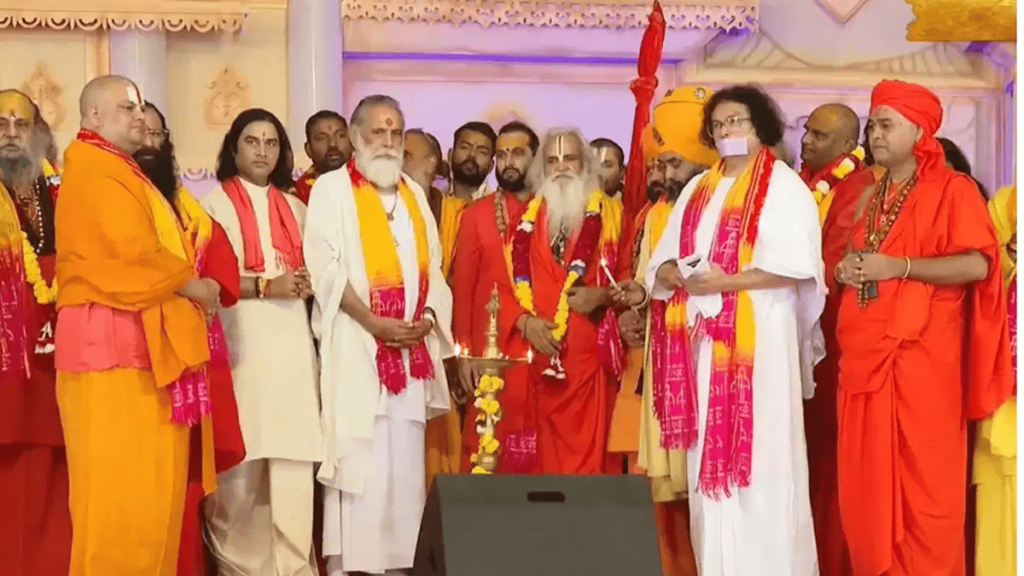
Sanatan Dharma Sansad
An Ancient Ethos for a Modern World
Introduction: Beyond Religion, A Cosmic Order
In an era defined by fragmentation, existential anxiety, and a pervasive sense of disconnect, humanity stands at a crossroads. The dominant paradigms of materialist progress, hyper-individualism, and mechanistic scientism have delivered unprecedented technological power but have often failed to nourish the human spirit, foster ecological harmony, or provide a coherent framework for meaning. It is within this context that a profound and ancient intellectual and spiritual tradition—Sanatan Dharma—offers not merely a religious alternative, but a comprehensive cosmological, ontological, and ethical vision for individual and collective flourishing.
The term “Sanatan Dharma Sansad” invites a dual exploration. “Sanatan Dharma” translates not as a proper noun like “Hinduism,” but as the “Eternal Dharma”—the perennial, universal order or law that sustains reality. “Sansad” means assembly, council, or parliament. Thus, a “Sanatan Dharma Sansad” conceptually represents a collective, deliberative engagement with this eternal wisdom.
It is not a fixed dogmatic council, but a living, dynamic process of rediscovering and re-applying timeless principles (Sanatan) to the existential conditions (Kala-Desha-Patra) of our age. This essay, spanning 5000 words, serves as such a sansad—an assembly of ideas exploring the core tenets of Sanatan Dharma, its philosophical depth, its relevance to contemporary global challenges, and its potential to guide humanity toward a more integrated, conscious, and harmonious future.
Part I: Deconstructing Misconceptions – Sanatan Dharma is Not What You Think
Before delving into its essence, it is crucial to dispel common reductions. Sanatan Dharma is often conflated with modern, organized “Hinduism,” viewed through colonial and Orientalist lenses as a polytheistic, idol-worshipping, caste-ridden religion. This is a profound misapprehension.
- Not a Religion, But a Dharma: Unlike proselytizing, creed-based religions with a single founder and a defined dogma, Sanatan Dharma is a framework for understanding reality and living in alignment with it. The word “religion,” from the Latin religare (to bind), implies a binding to specific beliefs. Dharma, from the Sanskrit root dhr (to uphold, sustain), is that which upholds the individual, society, and the cosmos. It is inherently contextual, asking not “What do you believe?” but “What is your duty (svadharma) in this situation, given your nature and station?”
- Not Polytheism, But a Polymorphic Monism: The apparent multitude of deities (devas and devis) are not rival gods but personified aspects, energies, or manifestations of the one non-dual reality—Brahman. They are archetypal forces of nature (Indra-rain, Agni-fire), consciousness (Saraswati-knowledge, Shiva-transformation), and societal principles (Lakshmi-prosperity). This allows for a pluralistic engagement with the Divine, accommodating diverse temperaments and intellectual capacities, all converging on the singular, formless Absolute.
- Not Mere Ritualism, But a Science of Consciousness: The vast array of rituals (yajna), festivals, and practices are not empty superstitions. They are sophisticated psycho-technologies designed to purify the mind (chitta-shuddhi), harmonize the individual with cosmic rhythms, and serve as portals to deeper states of awareness. They are the applied science complementing the theoretical metaphysics.
- A Dynamic, Not Static, Tradition: The adjective “Sanatan” (eternal) does not mean unchanging in form. It means the core principles—such as Rita (cosmic order), Dharma (righteousness), and the pursuit of Moksha (liberation)—are timeless. Their application is eternally new, shaped by the needs of the time (yuga-dharma). The tradition has continuously evolved, absorbing, debating, and reforming itself, as evidenced in its philosophical schools (darshanas) from the materialistic Charvaka to the non-dualistic Advaita.
Part II: The Pillars of the Eternal Dharma – Core Philosophical Framework
The edifice of Sanatan Dharma rests on several interconnected pillars, forming a coherent worldview.
- Metaphysics: The Nature of Reality
- Brahman and Atman: The ultimate, non-dual reality is Brahman—infinite, unchanging, pure consciousness, existence, and bliss (Sat-Chit-Ananda). The individual self (Atman) is not a created soul but a spark of this very Brahman. The famous Mahavakya “Tat Tvam Asi” (Thou art That) declares this fundamental identity. The perceived separation is an illusion (Maya) born of ignorance (Avidya).
- The Tri-Guna Framework: Prakriti (primordial nature) is composed of three interweaving qualities or forces (gunas): Sattva (purity, balance, intelligence), Rajas (activity, passion, dynamism), and Tamas (inertia, darkness, stability). All manifest phenomena, including states of mind, social structures, and epochs of time, are permutations of these gunas. The goal of life is to transcend their binding influence.
- Cyclical Time and Yugas: Time is not linear but cyclical, moving through vast epochs (Yugas)—Satya, Treta, Dvapara, and Kali—representing a gradual decline in dharma and a shift in the guna balance. This offers a grand, non-anthropocentric perspective on history and cosmic evolution.
- Epistemology: The Means of Knowledge (Pramanas)
Sanatan Dharma acknowledges multiple valid ways of knowing, critically analyzed in the Nyaya school.- Pratyaksha (Perception): Direct sense perception.
- Anumana (Inference): Logical deduction.
- Upamana (Comparison/Analogy): Learning through similarity.
- Shabda (Testimony): Reliable verbal or scriptural testimony, crucially dependent on the competence of the source (Apta Purusha).
- Arthapatti (Postulation): Implication or presumption.
- Anupalabdhi (Non-perception): Cognition of absence.
This pluralistic epistemology validates both empirical inquiry and trans-empirical realization, creating space for science and spirituality as complementary paths to truth.
- Axilogy: The Aims of Human Life (Purusharthas)
Human existence is guided by four legitimate and sequential goals:- Dharma: Righteousness, ethical duty, the foundational law that sustains all pursuits.
- Artha: The pursuit of material prosperity, wealth, and political power—necessary for a stable society but must be governed by Dharma.
- Kama: The fulfillment of legitimate desires, aesthetic and sensual pleasures, again within the bounds of Dharma.
- Moksha: Liberation from the cycle of birth and death (samsara), the realization of one’s true nature as Atman-Brahman. This is the ultimate summum bonum, the final purpose that contextualizes and relativizes the other three.
- Ethics and Cosmology: The Law of Karma and Samsara
- Karma: The universal law of cause and effect, where every action (physical, verbal, mental) plants a seed that fructifies in due time. It is not fatalistic punishment/reward but a precise, impersonal law of ethical causation. It empowers by making the individual the architect of their destiny.
- Samsara: The cycle of rebirth, driven by karma and ignorance, within which the Jiva (individual being) evolves across lifetimes. It provides a long-term framework for soul evolution and explains the apparent inequalities of life not as divine caprice, but as self-created consequences from past actions.
Part III: The Applied Manifestations – Yoga, Society, and Ecology
The philosophy is not abstract; it translates into concrete disciplines and social visions.
- The Yogic Sciences: Paths to Realization
Recognizing diverse human psychologies, Sanatan Dharma offers multiple yogas (paths of union):- Jnana Yoga: The path of intellectual discernment (viveka) between the real (Brahman) and the unreal (Maya), leading to Self-knowledge.
- Bhakti Yoga: The path of devotional surrender, transforming emotion into divine love for a chosen personal deity (Ishta Devata).
- Karma Yoga: The path of selfless action, performing one’s duty without attachment to results, as outlined in the Bhagavad Gita.
- Raja Yoga: The “royal path” of Patanjali, a systematic eight-limbed (Ashtanga) science of mental control and meditation (dhyana) leading to Samadhi.
- Hatha Yoga: The preparatory discipline of purifying the body and vital energies (prana) to steady the mind for meditation.
- Varnashrama Dharma: The Organic Social Model
Often misinterpreted as the hereditary, oppressive caste system, the original concept was a dynamic, duty-based social organization for holistic human development.- Varna: A framework for social function based on innate nature (guna-karma). It outlined broad dispositions: Brahmana (oriented to knowledge and teaching), Kshatriya (oriented to protection and governance), Vaishya (oriented to commerce and sustenance), Shudra (oriented to service and skilled labor). It was meant to be fluid, based on aptitude, not birth.
- Ashrama: The four stages of life—Brahmacharya (student, celibate learning), Grihastha (householder, fulfilling artha and kama), Vanaprastha (retirement, gradual renunciation), and Sannyasa (renunciate, total dedication to moksha). This provided a psychological and spiritual roadmap for the entire human lifespan.
- Ecological Vision: Vasudhaiva Kutumbakam
The non-dual vision that “All this is Brahman” (Sarvam Khalvidam Brahma) fosters a profound ecological ethic. The universe is a sacred, interconnected web of life (Jagat). The Earth is revered as Devi, the Divine Mother (Bhumi Devi, Prithvi). The concept of “Vasudhaiva Kutumbakam”—”The world is one family”—extends the sense of Self (Atman) to all beings, mandating compassion (daya) and stewardship, not exploitation. The traditional worship of rivers (Ganga as Ma), mountains (Himalaya as Giriraj), and trees (Peepal as sacred) encoded this ecological reverence into cultural practice.
Part IV: Sanatan Dharma in the Modern Crucible – Relevance and Challenges
How does this ancient sansad speak to the 21st century?
- Addressing the Crisis of Meaning: In a world of nihilism and postmodern fragmentation, the Purusharthas provide a balanced, holistic life-goal architecture. They validate worldly success while anchoring it in ethics and pointing toward a transcendent purpose (Moksha), addressing the inner void that materialism cannot fill.
- A Framework for Pluralism: In an age of clashing fundamentalisms, the Dharma’s inherent pluralism—its acceptance of many paths (Ekam Sat Viprah Bahudha Vadanti—Truth is One, the wise call it by many names)—offers a robust theological basis for religious tolerance and interfaith dialogue. It asserts unity without demanding uniformity.
- Science and Spirituality: The Dharmic epistemological pluralism can heal the Cartesian split. It allows science to be the authoritative means for investigating the material world (Prakriti), while honoring transcendental experience (consciousness, Brahman) as a valid domain of inquiry through yoga and meditation. The non-dual view of consciousness as fundamental resonates with cutting-edge theories in quantum physics and neuroscience.
- Psychology and Well-being: The yogic sciences and the analysis of the mind in texts like the Yoga Vasistha offer sophisticated tools for mental health, emotional regulation, and self-actualization that are now being validated by modern psychology (e.g., Mindfulness-Based Stress Reduction).
- Social Justice and Reform: The true spirit of Sanatan Dharma, with its core declaration of the divinity of all beings (Atman), is inherently egalitarian. The modern “Sanatan Dharma Sansad” must be a fierce forum for internal critique and reform, actively dismantling the distortions of caste discrimination and gender inequality that have parasitically attached themselves to the tradition, returning to the radical, liberative essence of the Upanishads and the Gita.
- Global Ethics and Ecology: The principles of Dharma (right action), Ahimsa (non-violence), and Vasudhaiva Kutumbakam provide an ethical compass for global challenges: climate crisis, economic inequality, and geopolitical conflict. It promotes an ethic of sufficiency, reverence for nature, and a sense of global citizenship.
Part V: The Contemporary Sansad – Dialogues and Directions
A living Sanatan Dharma Sansad today would be a global conversation, not an authoritarian synod. Its agenda would include:
- Intellectual Reclamation: Decolonizing the understanding of Dharma from Western and reductionist frameworks, engaging in robust scholarship to articulate its depths in contemporary academic and public discourse.
- Engagement with Modernity: A creative dialogue with secular democracy, human rights, gender equality, and modern science—not to dilute Dharma, but to find consonance and allow it to enlighten these modern projects with its wisdom.
- Spiritual Practice in a Digital Age: Adapting the core of yogic and meditative practices for contemporary, urban life, making them accessible without diluting their transformative power.
- Art and Cultural Renaissance: Inspiring a new wave of literature, music, visual arts, and architecture that expresses Dharmic consciousness in modern idioms.
- Service (Seva) as Karma Yoga: Channeling the spirit of selfless service to address poverty, education, and ecological restoration, making spirituality socially relevant.
Conclusion: The Perennial Flame
The Sanatan Dharma Sansad is not a relic of the past convening in a temple. It is an ongoing, eternal conversation about the nature of reality and the art of living well. It is the voice of the Rishis echoing in the modern mind, the discipline of the yogi adapting to a new age, the compassion of the Bhakta addressing new forms of suffering, and the intellect of the Jnani deconstructing new illusions.
In a world facing convergent crises of spirit, society, and ecology, this ancient yet perpetually renewing wisdom offers a map and a compass. It maps a cosmos that is sacred, interconnected, and purposeful. It provides a compass of Dharma to navigate the complexities of life, pointing always toward the realization of our true, boundless nature.
The ultimate message of the Sanatan Dharma Sansad is an invitation and a declaration: The peace, freedom, and fulfillment you seek (Moksha) is not a distant reward but your own innermost essence (Sat-Chit-Ananda). The entire journey—with its philosophies, practices, and debates—is merely a process of removing the veil of ignorance to recognize the radiant truth that has always been. In this recognition, the individual finds liberation, and from this liberation, actions naturally flow that uphold, sustain, and harmonize the world. That is the eternal (Sanatan) law (Dharma) for the universal assembly (Sansad) of all conscious beings.
Top 100 name of Sanatan Dharma Sansad
There isn’t an official list of 100 “Sanatan Dharma Sansads” (Hindu religious assemblies or councils), but several prominent Hindu religious organizations, councils, and assemblies (Sansads) exist in India and across the world that work to promote Sanatan Dharma. Here’s a list of 100 major Sanatan Dharma councils, Akharas, Peeths, Sabhas, and related organizations:
Courtesy: Shri Devkinandan Thakur Ji
Major Sanatan Dharma Sansads & Religious Councils
- Akhil Bharatiya Akhara Parishad (The supreme council of Hindu monastic orders)
- Dharma Sansad (VHP-backed Religious Parliament)
- Vishwa Hindu Parishad Dharma Sansad
- Sanatan Dharma Sabha
- Akhil Bharatiya Sant Samiti
- Sant Shiromani Dharma Sansad
- Akhil Bharatiya Sant Mahasabha
- Shri Ram Janmabhoomi Nyas (Trust for Ram Mandir, Ayodhya)
- Kashi Vidvat Parishad (Scholarly council of Varanasi)
- Sanatan Dharma Raksha Manch
- Dharma Jagran Manch
- Sanatan Dharma Sant Sabha
- Rashtriya Sant Samaj
- Sanatan Dharma Gau Seva Parishad
- Vedic Dharma Sansad
- Sanatan Dharma Yuva Sangh
- Shri Ram Dharma Sansad
- Hindu Dharma Acharya Sabha
- Sanatan Bharat Dharma Sabha
- Kumbh Mela Sant Samiti
Famous Hindu Mathas (Peeths) Promoting Sanatan Dharma
- Jyotir Math (Uttarakhand)
- Govardhan Math (Odisha)
- Dwaraka Math (Gujarat)
- Sringeri Sharada Peetham (Karnataka)
- Kanchi Kamakoti Peetham (Tamil Nadu)
- Ramanuja Math (Tamil Nadu)
- Kailasa Ashram (Himalayas)
- Nath Sampradaya Peeth
- Niranjani Akhara Peeth
- Juna Akhara Peeth
Prominent Akharas (Hindu Monastic Orders)
- Juna Akhara
- Niranjani Akhara
- Mahanirvani Akhara
- Atal Akhara
- Avahan Akhara
- Akhil Bharatiya Nirmohi Akhara
- Dharma Dand Mahamandaleshwar Sabha
- Digambar Akhara
- Agni Akhara
- Udasin Akhara
Courtesy: VK News
Hindu Temples & Their Religious Councils
- Shri Ram Janmabhoomi Trust (Ayodhya)
- Shri Kashi Vishwanath Mandir Trust
- Jagannath Puri Temple Management
- Tirumala Tirupati Devasthanams (TTD)
- Somnath Trust
- Mahakaleshwar Jyotirlinga Trust (Ujjain)
- Vaishno Devi Shrine Board
- Kedarnath Temple Committee
- Badrinath Temple Trust
- Shirdi Sai Baba Trust
Sanatan Dharma Organizations in India
- Bharatiya Sanatan Dharma Parishad
- Sanatan Dharma Sabha Punjab
- Sanatan Dharma Sabha Mumbai
- Sanatan Dharma Mahasabha Rajasthan
- Sanatan Hindu Samaj
- Bharatiya Dharma Raksha Sangh
- Sanatan Dharma Jagran Manch
- Hindu Janajagruti Samiti
- Dharma Raksha Vahini
- Sanatan Hindu Parishad
Global Sanatan Dharma Organizations
- Sanatan Dharma Maha Sabha (Trinidad & Tobago)
- Hindu Forum of Britain (UK-based)
- Hindu American Foundation (HAF) – USA
- Overseas Friends of BJP (OFBJP) – USA, UK, Canada
- Hindu Council of Australia
- Hindu Rights Action Force (Malaysia)
- Hindu United Front (Mauritius)
- Hindu Swayamsevak Sangh (HSS) – International
- Global Hindu Federation
- Hindu Temples Federation of Canada
Major Hindu Religious Movements & Their Councils
- ISKCON (International Society for Krishna Consciousness)
- Swaminarayan Akshardham Council
- Ramakrishna Mission & Math
- Chinmaya Mission
- Art of Living (Sri Sri Ravi Shankar)
- Gayatri Parivar (Shantikunj, Haridwar)
- Divya Jyoti Jagrati Sansthan
- Shri Sadguru Jaggi Vasudev Foundation
- Sri Sathya Sai Seva Organisation
- Paramahansa Yogananda’s Self-Realization Fellowship
Sanatan Dharma Research & Educational Institutions
- Banaras Hindu University (BHU) – Faculty of Dharma Studies
- Sampurnanand Sanskrit University
- Kanchi Sanskrit College
- Vedanta Academy
- Vedic Research Institute – Haridwar
- Bharatiya Vidya Bhavan
- Rashtriya Sanskrit Sansthan
- Ramanuja Vedanta Pathshala
- Chinmaya International Foundation
- Sanskrit Bharati
Courtesy: ABP NEWS
Sanatan Dharma Cow Protection & Vedic Lifestyle Organizations
- Bharatiya Gau Raksha Dal
- Rashtriya Gau Raksha Parishad
- Vishwa Gau Seva Sangh
- Sanatan Dharma Go-Seva Trust
- Dharma Gau Palan Sanstha
- Go-Samvardhan Parishad
- Hindu Dharma Gau Seva Samiti
- Rashtriya Vedic Krishi Parishad
- Sanatan Ayurveda & Vedic Healing Trust
- Sanatan Dharma Vriksha Ropan Parishad
These 100 Sanatan Dharma organizations, Sansads, Akharas, and religious councils are dedicated to the promotion, protection, and education of Hinduism (Sanatan Dharma). Some are traditional councils (Sansads), while others are modern institutions influencing Hindu religious and political thought.

Table of Contents