Sanatan Dharma Famous Mela
A Journey Through the Sacred Melas of Sanatan Dharma
Introduction: The Sacred Confluence
In the vast and intricate tapestry of Sanatan Dharma (often referred to as Hinduism), the concept of time is not merely linear but cyclical, punctuated by moments of profound spiritual significance. Among these moments, the Mela stands as a colossal, living testament to the faith’s enduring vitality, philosophical depth, and breathtaking cultural plurality. A Mela, literally meaning “a gathering” or “a fair,” transcends these simple definitions.
It is a pilgrimage of millions, a temporary city of devotion, a cosmic transaction between the human and the divine, and a vibrant spectacle of faith that has pulsed through the Indian subcontinent for millennia. These are not mere festivals; they are the heartbeat of a living tradition, where the eternal (sanatan) truths of Dharma are experienced, not just discussed. From the thunderous Kumbh Mela, the largest peaceful gathering on Earth, to the intimate village jatras, these events weave together mythology, astronomy, geography, sociology, and raw spiritual yearning into an unparalleled human phenomenon.
The Philosophical and Cosmological Foundation
To understand the Mela is to first understand the cosmic clock that governs it. Sanatan Dharma’s conception of time, as outlined in texts like the Puranas and Jyotisha Shastra (Vedic astrology), is monumental. Time cycles through four Yugas (epochs), with the current age being the Kali Yuga. Within these vast cycles, the alignments of celestial bodies—particularly the Sun, Moon, and Jupiter—create windows of heightened spiritual potency. A Mela is almost always timed to such an auspicious yoga (combination).
The most critical concept is that of the Tirtha (crossing place). A Tirtha is a sacred ford, usually a river confluence (sangam), a mountain, or a temple site, where the veil between the material and spiritual worlds is considered thin. It is a portal for liberation (moksha). The Mela transforms a Tirtha from a geographical location into a dynamic, time-bound field of spiritual energy.
The belief is that during the specific astrological moment of the Mela, the waters of the sacred rivers themselves turn into amrita (the nectar of immortality). Thus, the pilgrimage and the ritual bath (snan) become acts of participating in a divine celestial event, a chance to wash away not just physical dirt but the karmic impurities (paap) of lifetimes.
This is deeply tied to the doctrine of Karma and rebirth. The arduous journey to a Mela, facing hardships and surrendering comforts, is itself a form of tapasya (austerity), generating positive merit (punya). The sight (darshan) of holy saints and the sacred site, the participation in collective chanting and rituals, and the charitable acts performed there are believed to accelerate spiritual progress and mitigate negative karma, guiding the soul toward liberation.
The Crown Jewel: The Kumbh Mela
The undisputed king of all Melas is the Kumbh Mela, a UNESCO Intangible Cultural Heritage event. Its scale defies imagination: a pop-up city larger than many of the world’s capitals, built on sandy riverbanks from scratch, hosting over 100 million people over the course of its auspicious days. It rotates between four sacred riverine sites: Prayagraj (confluence of the Ganga, Yamuna, and mythical Saraswati), Haridwar (the Ganga), Nashik (the Godavari), and Ujjain (the Shipra).
Mythological Origin:
The origin lies in the Samudra Manthan, the churning of the cosmic ocean. When the pot (kumbh) of amrita emerged, a 12-day celestial battle ensued between devas (gods) and asuras (demons). During the fight, drops of amrita fell at these four earthly locations, sanctifying them forever. Since one celestial day equals one human year, the Mela is celebrated at each site in a 12-year cycle (Ardh Kumbh every 6 years, Maha Kumbh every 12, and Purna Kumbh every 144 years at Prayagraj).
The Sociology of the Sangam:
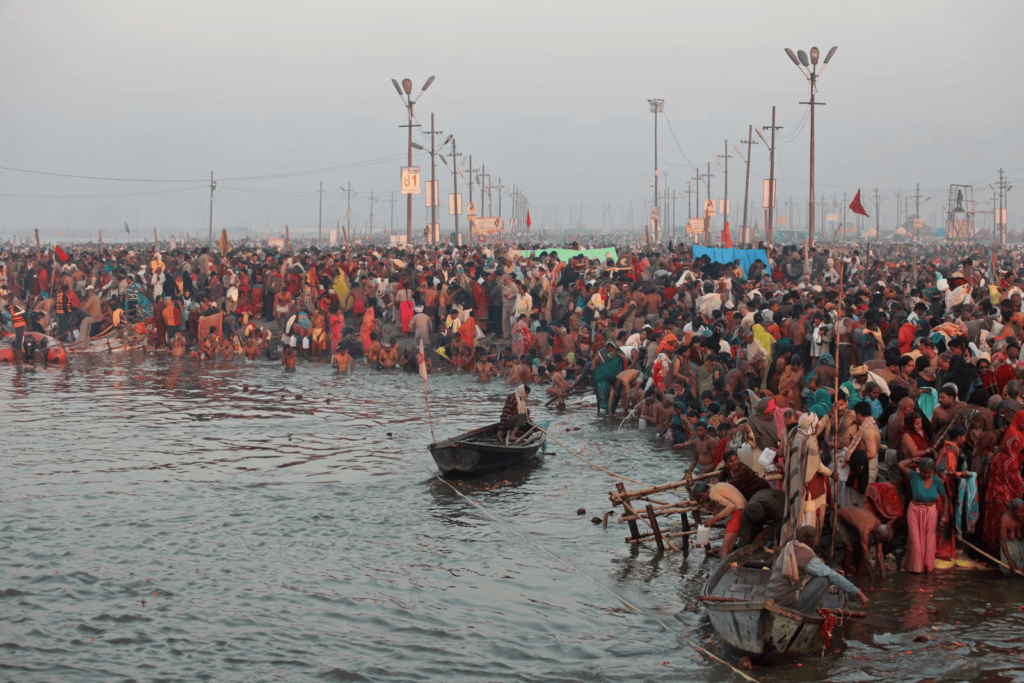
At Prayagraj, the heart of the Mela is the sangam. At the crack of dawn, a seemingly endless river of humanity, clad in simple loincloths or wet saris, flows towards the water. They come from every corner of India and the world: village farmers, urban professionals, widows fulfilling final vows, families with young children. The air is thick with chants of “Har Har Gange!” and “Ganga Maiya Ki Jai!” The bath is not a leisurely swim; it is a fierce, focused act of devotion. People plunge in, offering prayers, scattering flowers, and emerging with expressions of ecstatic relief, as if a great weight has been lifted.
The Akharas: Keepers of the Martial-Spiritual Tradition:
The most iconic figures of the Kumbh are the Naga Sadhus, naked ascetics smeared in ash, with matted dreadlocks, belonging to various akharas (martial monastic orders). These akharas, like the Juna, Niranjani, and Atal, have a history dating back over a millennium, formed to protect Hindu sanctuaries and saints from historical invasions. Their processions (shahi snan) are the Mela’s grand spectacles. They march with royal insignia, swords, tridents, and flags, a fierce display of renunciation and power. Their entry into the waters is the signal for millions that the most auspicious moment has arrived. They represent the radical, world-renouncing path of sannyasa, a living bridge to ancient Shaivite traditions.
The Living Marketplace of Ideas:
Beyond the bath, the Kumbh is a grand symposium. In countless tents (pandals), discourses (pravachan) are held round the clock. A seeker can listen to a Shankaracharya expound on Advaita Vedanta, a Ramanandi monk discuss devotion to Rama, a modern yoga guru teach asanas, or a scientist draw parallels between quantum physics and Vedanta. It is a place where debates on scripture, philosophy, and social reform happen openly. Charitable organizations run massive kitchens (langars) feeding hundreds of thousands daily, embodying the principle of seva (selfless service). The entire ecosystem—from the pious pilgrim to the scholarly saint, from the humble tea-seller to the volunteering doctor—forms a self-sustaining microcosm of Dharma in action.
Other Major Melas: A Diverse Panorama
While the Kumbh is the most massive, the subcontinent is dotted with numerous other major Melas, each with its unique flavor and theological significance.
The Magh Mela (Prayagraj): An annual “mini-Kumbh” held every year during the Hindu month of Magh (January-February) at the same sangam. It follows a similar, though smaller, pattern and is especially significant for those who observe the Kalpavasa—living a month of austerity in tents on the riverbank, performing daily rituals and baths.
The Simhastha Kumbh (Ujjain and Nashik): This is the Kumbh Mela’s manifestation on the Shipra (Ujjain) and Godavari (Nashik) rivers. Ujjain’s Mela is deeply linked to the legend of the drops of amrita and the city’s status as a prime meridian in ancient Indian astronomy. The bathing rituals and the presence of the akharas are as central here as in Prayagraj.
The Ganga Sagar Mela (Sagar Island, West Bengal): Where the holy Ganga finally meets the Bay of Bengal. Taking a dip here on Makar Sankranti (mid-January) is believed to grant the blessings of all previous pilgrimages. The journey involves a ferry ride, adding an element of adventure and peril, symbolizing the final passage.
The Pushkar Mela (Pushkar, Rajasthan): A unique and colorful Mela centered around Pushkar’s Brahma Temple (one of the very few in the world) and its sacred lake. It combines intense pilgrimage with one of the world’s largest camel and livestock fairs. The desert backdrop, the trading of animals, the vibrant attire of the Rajasthani people, and the evening aarti by the lake create a mesmerizing fusion of devotion and culture.
The Ambubachi Mela (Kamakhya Temple, Assam): Rooted in the powerful Tantric traditions of Shaktism (Goddess worship). It celebrates the annual menstruation of Goddess Kamakhya, a symbol of the Mother Earth’s fertility. The temple remains closed for three days as the Goddess is believed to be in her resting phase, and then reopens amidst grand celebrations. It attracts tantric practitioners (tantriks), ascetics, and devotees, highlighting the tradition’s reverence for the cosmic feminine principle and the cycles of nature.
The Rath Yatra (Puri, Odisha): While a procession more than a stationary Mela, it creates a massive, moving pilgrimage. The deities Jagannath, Balabhadra, and Subhadra are taken in colossal chariots from their temple to another temple. The pulling of the chariots by millions of devotees, irrespective of caste or creed, is the ultimate act of devotion and equality before God. The sight of the gigantic wooden structures rolling through the streets is awe-inspiring.
Life Inside the Mela: An Anthropological View
Stepping into a major Mela is an assault on the senses, a lesson in organized chaos and profound order.
The Temporary Mega-City: A barren riverbank transforms. A grid of streets, neighborhoods (sectors), police stations, hospitals, and markets emerges. There are designated areas for different akharas, for specific states (e.g., “Gujarat Nagar,” “Maharashtra Camp”), and for different spiritual organizations. A complex, temporary bureaucracy administers it all.
The Economy of Devotion: An entire economy springs up. Pandals rent out space, shops sell ritual items (pooja samagri), coconuts, flowers, and souvenirs. Porters (kahars) carry luggage and elderly pilgrims on palanquins. Barbers shave heads for the ritual mundan. Photographers capture sacred moments. This economy is not seen as crass commercialism but as an enabling ecosystem for the pilgrimage, a yajna (sacrifice) in which everyone plays a part.
The Soundscape and Visual Feast: The sound is a constant symphony: temple bells, conch shells, devotional songs blaring from loudspeakers, the drone of chanting, the calls of vendors. Visually, it is a riot of color: the saffron and ochre of sadhus, the bright saris of women, the fluttering pennants of the akharas, the smoke of sacred fires (yajna), and the glittering ornaments on the idols during processions.
The Social Leveler: Perhaps the most powerful aspect is its radical egalitarianism. In the sacred waters, the billionaire industrialist and the landless laborer stand side-by-side. Traditional social hierarchies are suspended. The only identity that matters is that of a seeker (shraddhalu). This is Dharma’s democratic ideal made manifest.
Challenges and Evolution in the Modern Era
The ancient tradition of the Mela faces unprecedented challenges in the 21st century.
Logistical and Environmental Pressure: Managing crowds of tens of millions poses immense security, sanitation, and health challenges. Stampedes, like the tragic one at the 1954 Kumbh, are a constant threat, leading to highly sophisticated crowd management using technology, barricades, and extensive planning. The environmental footprint is enormous, with concerns about river pollution from flowers, plastics, and human waste. Recent Melas have seen major initiatives in waste management, biodegradable materials, and river cleaning drives, attempting to reconcile devotion with ecological responsibility (Prakriti Raksha).
Commercialization and Authenticity: The line between facilitating service and rampant commercialization is thin. Critics point to VIP packages, expensive private camps, and aggressive marketing. The challenge is to preserve the Mela’s spiritual core while managing its unavoidably massive scale in a market-driven world.
The Digital Mela: Technology is now an integral part. Apps provide real-time crowd maps, lost-and-found services, and schedules. Live streams allow global participation. Social media amplifies its reach but also brings scrutiny. The eternal Mela is learning to navigate the digital age.
Political and Social Dimensions: Given their scale, Melas are inevitably spaces of soft power and social messaging. They become platforms for political statements, social reform movements (e.g., promoting cleanliness, women’s rights, environmental awareness), and displays of national as well as Hindu identity. This politicization is a contentious modern layer added to the ancient spiritual fabric.
The Enduring Significance: Why the Mela Matters
Despite the challenges, the Mela’s power only seems to grow. In an age of hyper-individualism and digital isolation, it offers a profound counter-narrative.
An Experiential Universe of Dharma: One does not simply learn about Sanatan Dharma at a Mela; one lives it. The philosophy of unity in diversity (Vasudhaiva Kutumbakam—the world is one family) is not a slogan but a lived reality. The doctrines of karma, dharma, seva, and moksha are enacted every moment.
A Sanctuary for the Seeker: It provides a time-out from worldly life (samsara), a designated period for introspection and spiritual recharge. For many, it is the culmination of a lifelong dream, a final act of devotion before death.
A Cultural Genome: The Mela is a living repository of intangible cultural heritage—from the specific rituals of the akharas and the chanting styles to the folk arts, crafts, and culinary traditions that congregate there. It is a self-sustaining ecosystem that renews and transmits tradition to each new generation.
A Testament to Human Resilience and Faith: The sheer will of millions to undertake hardship for an intangible goal is a humbling spectacle. It speaks to a deep, universal human yearning for transcendence, for connection to something larger than oneself.
Conclusion: The Eternal Return
The Sanatan Dharma Mela is more than an event; it is a kshetra—a field of energy and action. It is where the cosmic myth (Purana) touches the earth (Bhumi), where the celestial calendar (Panchang) dictates human movement, and where individual devotion (bhakti) merges into a collective ocean of faith. It is chaotic yet deeply ordered, ancient yet dynamically modern, intensely personal yet spectacularly collective.
As the sadhus emerge from the waters, their bodies glistening, their tridents held high, and as the millions of pilgrims turn their faces towards the sun, dripping with the sacred waters, one witnesses a scene that has repeated itself for thousands of years. It is the eternal (sanatan) return to the source, a massive, rhythmic heartbeat of a civilization that continues to seek the divine in the confluence of rivers, the alignment of stars, and the gathering of its people.
The Mela endures because it answers a perennial need: to step out of the stream of ordinary life, to plunge into the sacred, and to emerge, if only for a moment, cleansed, connected, and reminded of the immortal essence within. It is, in its sprawling, magnificent, and overwhelming entirety, Sanatan Dharma incarnate—not as a text or a dogma, but as a living, breathing, flowing experience of the eternal.
Top 100 name of Sanatan Dharma Famous Mela
Here is a list of 100 Famous Melas (Fairs) in Sanatan Dharma celebrated across India with great devotion and cultural significance.
🔱 1. The 4 Kumbh Melas (Largest Spiritual Gatherings)
- Haridwar Kumbh Mela (Uttarakhand) – Held on the banks of the Ganga
- Prayagraj Kumbh Mela (Uttar Pradesh) – Confluence of Ganga, Yamuna & Saraswati
- Ujjain Kumbh Mela (Madhya Pradesh) – Held on the banks of Shipra River
- Nashik Kumbh Mela (Maharashtra) – Held on the banks of Godavari
Courtesy: National Geographic India
🕉️ 2. Ardh Kumbh Mela (Held Every 6 Years)
- Haridwar Ardh Kumbh Mela
- Prayagraj Ardh Kumbh Mela
🌊 3. Magh Mela (Annual Mini Kumbh at Prayagraj)
- Magh Mela, Prayagraj (Uttar Pradesh) – January-February, on the Sangam banks
🙏 4. Major Shiva Mela
- Mahashivratri Mela, Ujjain (Madhya Pradesh) – Mahakaleshwar Temple
- Maha Shivratri Mela, Somnath (Gujarat)
- Maha Shivratri Mela, Kashi Vishwanath (Varanasi, UP)
- Sundernath Mela, Bihar
- Panchkula Mela, Haryana
- Maha Shivratri Mela, Bhavnath (Junagadh, Gujarat)
🔥 5. Major Shakti Peetha Mela
- Vaishno Devi Mela (Jammu & Kashmir)
- Kamakhya Devi Mela (Assam)
- Jwalamukhi Mela (Himachal Pradesh)
- Naina Devi Mela (Himachal Pradesh)
- Chamunda Devi Mela (Himachal Pradesh)
- Chhinnamasta Devi Mela (Jharkhand)
- Tara Tarini Mela (Odisha)
- Mehandipur Balaji Mela (Rajasthan)
🦁 6. Durga Puja & Navratri Melas
- Durga Puja Mela, Kolkata (West Bengal)
- Navratri Mela, Gujarat (Garba & Dandiya Festival)
- Navratri Mela, Himachal Pradesh
- Chaitra Navratri Mela, Vaishno Devi
🎆 7. Deepavali & Govardhan Mela
- Deepavali Mela, Ayodhya (Uttar Pradesh)
- Deepavali Mela, Jaipur (Rajasthan)
- Govardhan Puja Mela, Mathura (Uttar Pradesh)
🐮 8. Krishna Janmashtami Melas
- Krishna Janmashtami Mela, Mathura (Uttar Pradesh)
- Krishna Janmashtami Mela, Dwarka (Gujarat)
🌳 9. Holi Melas
- Lathmar Holi, Barsana (Uttar Pradesh)
- Holi Mela, Vrindavan (Uttar Pradesh)
- Shantiniketan Holi Mela (West Bengal)
🦢 10. Other Major River Melas
- Ganga Sagar Mela (West Bengal)
- Chhat Puja Mela (Bihar, Uttar Pradesh, Jharkhand)
- Kartik Purnima Mela (Varanasi, Uttar Pradesh)
🏇 11. Famous Rural & Traditional Melas
- Pushkar Camel Fair (Rajasthan)
- Nagaur Cattle Fair (Rajasthan)
- Sonepur Cattle Fair (Bihar)
- Bateshwar Fair (Uttar Pradesh)
🎭 12. Famous Ramlila & Dussehra Melas
- Ramlila Mela, Varanasi (Uttar Pradesh)
- Dussehra Mela, Kullu (Himachal Pradesh)
- Ramlila Mela, Delhi
- Ramlila Mela, Ayodhya (Uttar Pradesh)
Courtesy: Daily Decoding
📿 13. Major Sikh & Guru Nanak Jayanti Melas
- Guru Nanak Jayanti Mela, Golden Temple (Punjab)
- Hola Mohalla Mela, Anandpur Sahib (Punjab)
🏹 14. Famous Tribal & Cultural Melas
- Hornbill Festival, Nagaland
- Bastar Dussehra, Chhattisgarh
- Bhavnath Mahadev Mela, Gujarat
📜 15. Other Religious & Pilgrimage Melas
- Gangotri Mela, Uttarakhand
- Yamunotri Mela, Uttarakhand
- Rameshwaram Mela, Tamil Nadu
- Tirupati Brahmotsavam (Andhra Pradesh)
- Puri Rath Yatra (Odisha)
- Jagannath Mela, Gujarat
- Jageshwar Mela, Uttarakhand
- Sapt Rishi Mela, Haridwar (Uttarakhand)
- Hemkund Sahib Mela, Uttarakhand
- Amarnath Yatra Mela (Jammu & Kashmir)
- Kedarnath Mela (Uttarakhand)
- Badrinath Mela (Uttarakhand)
🌊 16. Famous Bathing Festivals (Snan Mela)
- Somvati Amavasya Snan Mela, Haridwar
- Makar Sankranti Snan Mela, Prayagraj
- Sharad Purnima Snan Mela, Pushkar
🐘 17. Important Rath Yatra & Chariot Melas
- Rath Yatra, Puri (Odisha)
- Rath Yatra, Ahmedabad (Gujarat)
🎉 18. Major Fairs in South India
- Mysore Dasara (Karnataka)
- Pongal Mela (Tamil Nadu)
- Meenakshi Temple Mela (Tamil Nadu)
- Sabarimala Mela (Kerala)
- Karthigai Deepam Mela (Tamil Nadu)
🌙 19. Famous Sufi & Interfaith Melas
- Ajmer Sharif Urs Mela (Rajasthan)
- Nagaur Urs Mela (Rajasthan)
🌄 20. Miscellaneous Major Religious & Cultural Melas
- Makar Sankranti Mela, Triveni Sangam
- Chandraprabha Mela, Maharashtra
- Dev Deepawali, Varanasi
- Tungnath Mela, Uttarakhand
- Nag Panchami Mela, Maharashtra
- Mahakumbh of Kaal Bhairav, Ujjain
- Mahakali Mela, Gujarat
- Neelkanth Mahadev Mela, Rishikesh
- Chitrakoot Mela, Madhya Pradesh
- Mandhar Devi Mela, Maharashtra
- Parshuram Jayanti Mela, UP
- Kaleshwaram Mela, Telangana
- Adiyogi Mela, Tamil Nadu
- Bhadrachalam Mela, Telangana
- Venkateswara Swamy Mela, Andhra Pradesh
- Bhavani Amman Mela, Tamil Nadu
- Sun Temple Mela, Modhera (Gujarat)
- Khatu Shyam Mela, Rajasthan
- Datta Jayanti Mela, Karnataka
- Kartik Swami Mela, Uttarakhand
- Amarkantak Mela, Madhya Pradesh
- Bhima Shankar Mela, Maharashtra
- Kalighat Mela, Kolkata
- Varahi Devi Mela, Gujarat
- Mukteshwar Mela, Odisha
- Siddheshwar Mela, Maharashtra
- Gangapur Dattatreya Mela, Maharashtra
These melas are not just religious gatherings but also reflect India’s rich cultural heritage and spiritual legacy.

Table of Contents