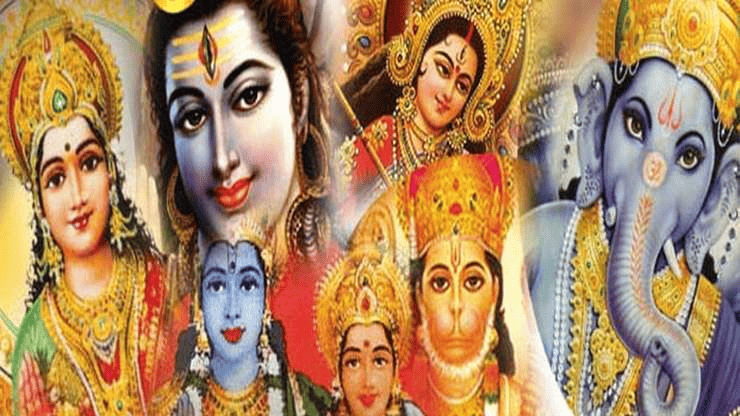
Sanatan Dharma Devi & Devta
An Exploration of the Divine Feminine and Masculine in Hinduism
Introduction: The Eternal Dharma and Its Divine Pantheon
Sanatan Dharma, often translated as the “eternal order” or “eternal law,” is the original and self-given name for what is popularly known as Hinduism. Unlike religions with a single founder or a fixed doctrinal core, Sanatan Dharma is a cosmic, holistic worldview encompassing philosophy, ethics, spirituality, and a profound understanding of the universe’s rhythm (rita). At the heart of this expansive tradition lies a rich, complex, and vibrant pantheon of divine beings—Devis (Goddesses) and Devtas (Gods).
These are not merely mythological characters but are multifaceted representations of the singular, formless, all-pervading Supreme Reality (Brahman). They are saguna (with attributes) forms of the nirguna (without attributes) Absolute, providing devotees with tangible, relatable aspects of the divine to love, worship, and emulate.
This exploration delves into the conceptual framework, the major deities, their symbology, philosophical significance, and the living traditions of worship that make the Devi-Devta paradigm not a relic of polytheism, but a sophisticated theology of immanence, a map of consciousness, and a guide to righteous living.
I. Philosophical Foundation: The One and the Many
The apparent plurality of deities in Sanatan Dharma can be perplexing to the outsider. The key to understanding lies in its core non-dualistic (Advaita) and panentheistic philosophy.
- Brahman: The ultimate, impersonal, incomprehensible ground of all existence. It is Sat-Chit-Ananda (Existence-Consciousness-Bliss).
- Ishvara: The personal aspect of Brahman, the Supreme Lord from whom the universe emanates, is sustained, and into whom it dissolves. Ishvara is the source of all divine forms.
- Devis and Devtas: These are specific manifestations of Ishvara’s infinite powers (shaktis) and qualities (gunas). Each deity embodies a particular aspect of the cosmic function, consciousness, or natural principle.
- The Iconic Verse: The Rig Veda (1.164.46) proclaims, “Ekam Sat, Viprah Bahudha Vadanti” — “Truth is One, the wise call it by many names.” This is the theological bedrock. The myriad deities are different names, forms, and channels to approach the same Ultimate Truth, tailored to the aspirant’s temperament (bhava) and spiritual capacity.
II. The Trimurti: The Cosmic Functions of the Divine Masculine
The triad of Brahma, Vishnu, and Shiva represents the fundamental cyclical processes of the universe: creation, preservation, and dissolution/transformation. They are not competing lords but complementary aspects of one cosmic sovereignty.
1. Brahma – The Creator
- Role: The secondary creator (the primary cause being Brahman/Ishvara) who fashions the universe from the cosmic substance.
- Iconography: Four heads (representing the four Vedas, four directions, four yugas), four arms holding a scepter, rosary, water pot, and the Vedas. He rides a swan (hamsa), symbolizing discrimination.
- Consort: Goddess Saraswati, the embodiment of knowledge, music, and arts. Creation requires the power of wisdom (Saraswati’s shakti).
- Worship: Interestingly, Brahma has very few temples dedicated to him. Mythologically, this is often attributed to a curse. Philosophically, it signifies that the act of creation is a singular, past event for a given cycle; sustenance and transformation are the ongoing processes requiring our engagement.
2. Vishnu – The Preserver
- Role: The sustainer, protector, and restorer of cosmic order (dharma). He descends to Earth in various incarnations (avatars) whenever dharma is threatened.
- Iconography: Dark or blue-skinned, symbolizing infinity like the sky/ocean. Four arms holding the conch (Panchajanya, representing primordial sound), discus (Sudarshana Chakra, representing the mind and time), mace (Kaumodaki, representing mental and physical strength), and lotus (Padma, representing purity and liberation). He reclines on the serpent Shesha, floating on the cosmic ocean.
- Consort: Goddess Lakshmi, the embodiment of prosperity, fortune, and grace. Preservation requires the power of abundance and auspiciousness.
- Major Avatars: The ten primary avatars (Dashavatara) depict an evolutionary journey: Matsya (fish), Kurma (tortoise), Varaha (boar), Narasimha (man-lion), Vamana (dwarf), Parashurama (warrior sage), Rama (ideal king/hero of the Ramayana), Krishna (divine statesman and teacher of the Bhagavad Gita), Buddha (the enlightened one, often included to assimilate his teachings), and Kalki (the future warrior).
- Worship: Vaishnavism is one of the major theistic traditions. Devotees (Vaishnavas) practice loving devotion (bhakti) to Vishnu and his avatars, especially Rama and Krishna.
3. Shiva – The Transformer (The Auspicious One)
- Role: The ascetic deity of dissolution, destruction of ignorance, and regenerative transformation. He is both the destroyer and the regenerative force, the great yogi and the householder.
- Iconography: As Nataraja, the Lord of Dance, performing the cosmic dance of creation, preservation, and destruction within a ring of fire. Smeared with ash (vibhuti), symbolizing transcendence. Wears a crescent moon and the Ganga in his matted locks. Third eye (eye of wisdom). Holds a trident (trishul) and damaru (drum). Rides Nandi, the bull.
- Consort: The Goddess in her multiple forms, most prominently as Parvati (the gentle aspect), Durga (the warrior), and Kali (the transformative force of time).
- Symbolism: Shiva represents the principle of tapa (austerity), inner renunciation, and the raw, untamed power of consciousness that breaks boundaries.
- Worship: Shaivism is another major theistic path. Devotees (Shaivas) revere Shiva as the Supreme Being, often worshiping him in the form of the Shiva Linga, a non-anthropomorphic symbol of his formless, generative energy.
III. The Divine Feminine: Shakti as the Supreme Power
In Sanatan Dharma, the feminine aspect of the divine is not subordinate; it is the active, dynamic energy (Shakti) without which the masculine principle (consciousness, represented by Shiva) is inert. This theology, known as Shaktism, elevates the Goddess to the status of the Supreme Brahman herself.
1. The Tridevi: The Feminine Counterparts
Corresponding to the Trimurti are their Shaktis:
- Saraswati (Consort of Brahma): Goddess of knowledge (jnana), speech (vac), music, and all arts. She is depicted in white, holding a veena (lute), a book, and a rosary, seated on a white lotus or swan. She represents the clarity and purity required for true creation and learning.
- Lakshmi (Consort of Vishnu): Goddess of wealth (both material and spiritual), prosperity, fertility, and royal power. She is depicted standing or seated on a lotus, often with gold coins flowing from her hands. She is the grace that makes preservation fruitful and life abundant.
- Parvati (Consort of Shiva): The daughter of the mountain king Himavan, she represents the gentle, nurturing, and devoted aspect of the Goddess. Through intense tapas, she won Shiva as her husband, symbolizing the union of consciousness (Shiva) and power (Shakti). She is the mother of Ganesha and Kartikeya.
2. The Warrior Goddess: Durga
- Origin: Created from the combined radiance (tejas) of all gods to defeat the buffalo demon Mahishasura, who could not be killed by any male deity.
- Iconography: A fierce but beautiful goddess with many arms, each holding a weapon gifted by a god. She rides a lion or tiger, symbolizing mastery over power and the ego. Her victory (celebrated as Durga Puja/Navaratri) represents the triumph of divine, collective energy over individual, arrogant power (adharma).
3. The Ultimate Reality: Kali
- Role: The most transformative and terrifying aspect of the Goddess. She is time (kala) itself, the devourer of all things. She destroys ego, ignorance, and attachments.
- Iconography: Dark or blue-black skin, standing on the prone body of Shiva (symbolizing she is active power, while consciousness lies beneath). A garland of skulls (50 letters of the Sanskrit alphabet), a skirt of severed arms, tongue lolling out. She holds a severed head and a sword. Her imagery is meant to confront the devotee with the raw reality of death, time, and the need to transcend fear.
- Philosophy: In Shaktism and Tantra, Kali is revered as the ultimate Mother who liberates her children from the illusion of the world. Her terrifying form is a compassionate shock therapy to break worldly bonds.
4. Other Major Forms of the Devi:
- Sita: The consort of Rama, embodiment of devotion, purity, sacrifice, and wifely virtue, but also inner strength and resilience.
- Radha: The consort of Krishna, representing the soul’s intense, selfless, and ecstatic love (prema) for the divine.
- Annapurna: The aspect of Parvati as the goddess of nourishment and food.
- Mahadevi: The “Great Goddess” concept that synthesizes all goddesses as manifestations of one singular, supreme feminine reality.
IV. The Sons and the Celestial Host: A Divine Ecosystem
The pantheon extends to a vast array of other beings, each with a specific domain and significance.
- Ganesha: The elephant-headed god of wisdom, intellect, and the remover of obstacles (Vighnaharta). Son of Shiva and Parvati. Worshipped first before any undertaking. His form is a symbolic lesson: the big head for thinking big, large ears for listening, small mouth for speaking less, and the broken tusk to write the Mahabharata, signifying sacrifice for a higher cause.
- Kartikeya (Murugan/Skanda): The god of war and commander of the divine armies, representing valor, youth, and leadership. Son of Shiva and Parvati.
- Hanuman: The monkey god, epitome of devotion (bhakti), strength, humility, and selfless service to Lord Rama. A central figure in the Ramayana.
- Surya: The sun god, the visible form of the divine that nourishes all life.
- Indra: The king of the heavens (Svarga) and lord of rains and thunderstorms. While a major Vedic deity, his importance in the Puranic era diminishes, often representing temporal power and ego that is humbled by greater divine forces.
- The Navagrahas: The nine planetary deities (Surya, Chandra, Mangal, Budha, Brihaspati, Shukra, Shani, Rahu, Ketu) whose influence is acknowledged in Hindu astrology (Jyotisha).
- Ashta Dikpalas: The eight guardians of the cardinal and intermediate directions.
V. Symbolism, Iconography, and Anthropology of the Divine
Every aspect of a deity’s depiction is a symbolic language (pratima lakshana).
- Multiple Arms: Represent omnipotence and the ability to perform many tasks simultaneously.
- Vehicles (Vahanas): Each deity’s mount is symbolic. Shiva’s bull (Nandi) is dharma; Durga’s lion is power; Saraswati’s swan is discrimination between good and bad.
- Weapons and Objects: Represent the destruction of negative qualities and the bestowal of positive ones. Vishnu’s chakra is the mind; Shiva’s trident represents the three gunas (sattva, rajas, tamas) or the past, present, and future.
- Mudras (Hand Gestures): Convey specific meanings like blessing (varada), fearlessness (abhaya), and granting boons.
- Color Symbolism: Blue (infinity, divinity), red (activity, passion), white (purity, knowledge), yellow (knowledge, learning), black (the unmanifest, time).
VI. Worship (Puja), Ritual, and Bhakti: The Living Relationship
The theology of Devi and Devta comes alive in daily practice.
- Puja: The ritual of offering (lights, flowers, food, incense) to the deity’s image (murti). The murti is not an idol but a sacred focal point (alamaba) for concentration, a vessel for inviting the divine presence (avahana).
- Darshan: The core act of Hindu worship is “seeing and being seen by the deity.” It is a reciprocal, intimate visual communion.
- Bhakti Yoga: The path of loving devotion. It emphasizes a personal, emotional relationship with a chosen deity (Ishta Devata). This democratized spirituality, making the divine accessible to all, regardless of caste or gender.
- Festivals: The calendar is filled with celebrations for different deities: Diwali (Lakshmi, also Rama), Holi (Krishna), Navaratri/Durga Puja (Durga), Maha Shivaratri (Shiva), Ganesh Chaturthi (Ganesha), Janmashtami (Krishna).
VII. The Devi-Devta Paradigm as a Mirror of Human Psychology and Society
The pantheon serves as a profound psychological and sociological map.
- Archetypes: The deities represent universal human archetypes: the creator (Brahma), the preserver/caregiver (Vishnu/Lakshmi), the destroyer/renewer (Shiva/Kali), the wise counselor (Saraswati), the overcomer of obstacles (Ganesha), the devoted friend (Hanuman).
- Integration of Opposites: Shiva (ascetic) and Parvati (householder); Vishnu’s serene preservation and his avatars’ fierce battles; Kali’s terrifying appearance and her role as loving mother—all teach the integration of life’s dualities.
- Social Values: Rama as the ideal king, Sita as the ideal wife (though modern readings critique and reinterpret these roles), Lakshmi as the ideal of shared prosperity, Yudhishthira (a Pandava from the Mahabharata) as the pillar of dharma. They provide cultural and ethical touchstones.
VIII. Modern Context and Relevance
In the contemporary world, the Devi-Devta tradition remains vibrantly relevant.
- Environmental Resonance: Rivers are goddesses (Ganga, Yamuna); Earth is a goddess (Bhumi Devi); the sun is a god (Surya). This instills a sacred, respectful relationship with nature.
- Feminist Reclamation: The concept of Shakti has empowered feminist theological discourse, highlighting the strength, autonomy, and primacy of the feminine divine.
- Personal Spirituality: The idea of an Ishta Devata allows for a highly personalized spiritual path suited to the individual’s nature.
- Art and Culture: The stories and forms of deities continue to inspire vast amounts of art, music, dance, literature, and cinema across India and the diaspora.
- Philosophical Depth: They offer a framework to understand change (Shiva), sustainability (Vishnu), and the cyclical nature of existence, providing solace and perspective in a rapidly changing world.
Conclusion: A Cosmic Symphony of the Sacred
The Devis and Devtas of Sanatan Dharma are far more than a colorful pantheon; they constitute a living, breathing theological system—a cosmic symphony where each divine form is a unique instrument, playing its part in expressing the inexpressible melody of Brahman. This symphony is not a static composition but a dynamic, ever-unfolding revelation, accessible to every seeker. The deities are not distant rulers but intimate bridges between the finite human mind and the infinite divine, serving as sacred pathways (margas) for the pilgrim soul. They function as mirrors, reflecting both the cosmos’s majestic grandeur and the profound depths of the human psyche, revealing that the macrocosm and microcosm are inseparably linked.
This divine tapestry maps a universe that is fundamentally alive, sacred, and interconnected. From the serene wisdom of Saraswati to the protective grace of Vishnu, from the transformative fury of Kali to the compassionate valor of Durga, and from the ascetic power of Shiva to the benevolent intelligence of Ganesha—each aspect of the divine illuminates a facet of existence and consciousness.
Saraswati teaches us that true creation springs from knowledge; Vishnu and Lakshmi model a stewardship of harmony and abundance; Shiva and Shakti together embody the perpetual dance of consciousness and energy, dissolution and regeneration. Durga and Kali confront us with the necessary forces that destroy ignorance and ego, not out of malice, but as an act of ultimate maternal compassion, clearing the way for liberation.
To engage with these forms is therefore to engage with a timeless, sophisticated technology of the spirit. It is an attempt to comprehend the nature of reality itself—a reality that is simultaneously one and manifold, transcendent and immanent. The pantheon provides a symbolic language to navigate life’s complexities, offering archetypal energies to invoke for strength, wisdom, peace, or transformation. It democratizes spirituality, allowing the farmer to pray to the rain-bearing Indra, the student to Saraswati, the merchant to Lakshmi, and the ascetic to Shiva, all while recognizing a unified divine source.
Ultimately, this entire cosmic symphony is orchestrated towards one supreme goal: moksha—liberation from the cycles of birth and death and the realization of one’s unity with the Absolute. The Devis and Devtas, in their boundless love and play (lila), guide the soul through attachment, duty, knowledge, and devotion, gradually preparing it to see the divine in all and, finally, to transcend all forms.
In understanding them, one does not merely learn about mythology; one is invited into a participatory sacred drama, a living tradition that asserts that the divine is not a remote abstraction but a palpable presence, as varied, vibrant, and profound as life itself. Thus, Sanatan Dharma, through its embodied divinities, offers a perpetual invitation: to recognize the sacred symphony resonating within and around us, and to find our own unique note within its eternal harmony.
Top 100 name of Sanatan Dharma Devi / Devta
Sanātana Dharma (Hinduism) has a vast pantheon of Devi (goddesses) and Devta (gods). Here are 100 important names:
Courtesy: Vaishnavi-TheStoryteller
Devi (Goddesses)
- Durga
- Parvati
- Lakshmi
- Saraswati
- Kali
- Chandi
- Chamunda
- Bhairavi
- Jagdamba
- Sati
- Gauri
- Mahalakshmi
- Mahasaraswati
- Mahakali
- Annapurna
- Lalita Tripura Sundari
- Gayatri
- Savitri
- Uma
- Bhavani
- Kanyakumari
- Vaishno Devi
- Vindhyavasini
- Matangi
- Kamakhya
- Dhumavati
- Bhuvaneshwari
- Radha
- Rukmini
- Sita
- Tulsi
- Santoshi Mata
- Sheetla Mata
- Mangala Gauri
- Tara
- Chhinnamasta
- Baglamukhi
- Vajreshwari
- Nanda Devi
- Vana Durga
- Shitala Devi
- Maheshwari
- Narayani
- Vishalakshi
- Ekadashi Devi
- Manasa Devi
- Renuka Devi
- Kurukulla
- Yogmaya
- Shodashi
Courtesy: The Divine Tales
Devta (Gods)
- Vishnu
- Shiva
- Brahma
- Indra
- Agni
- Varuna
- Yama
- Surya
- Chandra
- Kartikeya
- Ganesha
- Hanuman
- Narasimha
- Vamana
- Krishna
- Rama
- Parashurama
- Matsya
- Kurma
- Dhanvantari
- Hayagriva
- Kalki
- Vayu
- Shani
- Kuber
- Kamadeva
- Ashwini Kumaras
- Bhairava
- Nandi
- Daksha
- Ananta Shesha
- Garuda
- Vasuki
- Jalandhara
- Hiranyaksha
- Hiranyakashipu
- Ravana (worshipped in some traditions)
- Balarama
- Dattatreya
- Sudarshana
- Skanda
- Rishi Vashishta
- Rishi Vishwamitra
- Markandeya
- Rishi Narada
- Vyasa
- Jamadagni
- Atri
- Kapila
- Bharata

Table of Contents