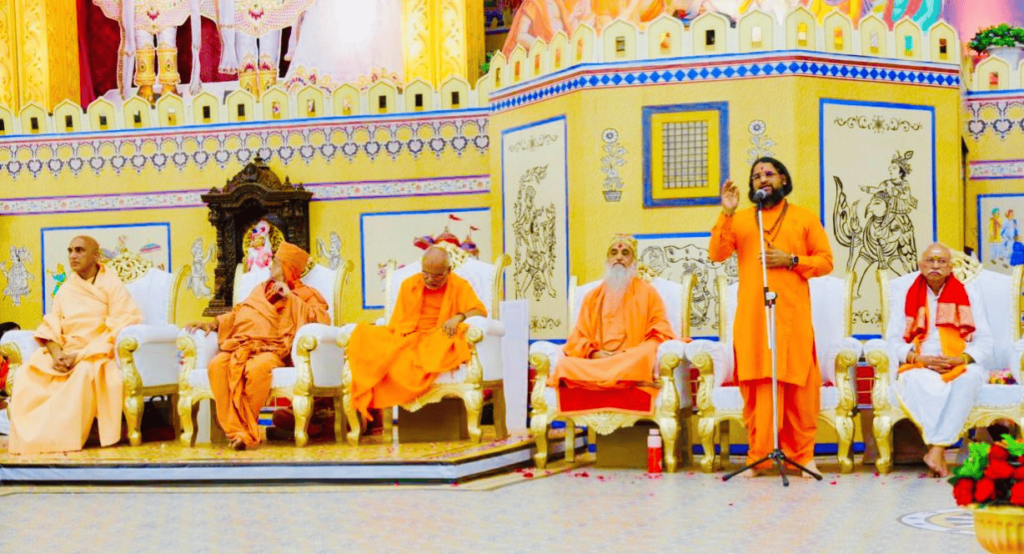
Sanatan Dharma Acharya
The Eternal Guide in an Ephemeral World
I. The Timeless Seeker and the Timely Guide: An Introduction
In the vast, intricate tapestry of Sanatana Dharma—the eternal, universal law or way of life known colloquially as Hinduism—the figure of the Acharya stands as a cornerstone of spiritual continuity, intellectual rigor, and lived wisdom. Unlike transient roles defined by temporal authority, the Acharya embodies a timeless principle: the indispensable human conduit of divine knowledge (Brahma Vidya) and righteous conduct (Dharma). In a tradition that proclaims, “Ekam sat, vipraha bahudha vadanti” (Truth is one, the wise call it by many names), the Acharya is the one who guides the seeker through the many names, forms, and paths toward that One Truth.
The term ‘Acharya’ (आचार्य) derives from the Sanskrit root ‘achar’ (आचर्), meaning ‘to practice,’ ‘to conduct oneself,’ or ‘to follow closely.’ Thus, an Acharya is not merely a theoretical instructor (Shikshaka) or a learned scholar (Pandita). He or she is the one who embodies the teachings, whose very life is the curriculum. The ancient text Yajnavalkya Smriti defines an Acharya as “the one who performs the Upanayana sanskara, imparts the Veda along with its limbs (Vedanga) and the secret doctrines (Upanishads), and provides the means of livelihood.” This classical definition, while specific, hints at the broader, profound responsibility: initiation into a disciplined life, transmission of sacred knowledge, revelation of liberating wisdom, and compassionate care for the disciple’s holistic well-being.
In a world increasingly characterized by information overload and spiritual fragmentation, the authentic Acharya’s role becomes not obsolete but critically essential. This exposition delves into the philosophical foundations, historical evolution, multifaceted roles, personal qualifications, the sacred Guru-Shishya Parampara (teacher-disciple lineage), contemporary challenges, and the enduring relevance of the Sanatana Dharma Acharya.
II. Philosophical Underpinnings: Why a Guru is Indispensable
Sanatana Dharma’s spiritual worldview necessitates a guide. This is not a dogmatic imposition but a logical and experiential conclusion drawn from the nature of the spiritual quest itself.
- The Imperfections of Individual Intellect (Buddhi): The human mind, clouded by Maya (the cosmic illusion), Avidya (ignorance at an individual level), and the swirling Gunas (Sattva, Rajas, Tamas), is an unreliable instrument for self-inquiry when unaided. As a mirror covered in dust cannot reflect clearly, the mind conditioned by desires, prejudices, and past impressions (Samskaras) cannot apprehend the Atman (the true Self) or Brahman (the ultimate Reality). The Acharya, having cleansed his own mirror, helps polish the disciple’s.
- The Depth of the Scriptures (Shastras): The Vedas, Upanishads, Agamas, and other scriptures are profound, cryptic, and multi-layered. They contain Mantras (sacred sounds), Aranyakas (forest treatises), and philosophical expositions that can be easily misunderstood. As the Katha Upanishad (I.ii.8) declares, “The Self is not attained by study, nor by intellect, nor by much hearing. It is attained by him whom It chooses. To him, the Self reveals Its true nature.” The Acharya is the chosen conduit of that revelation, the living key to the written word.
- The Danger of Spiritual Delusion (Moha): The path is strewn with subtle pitfalls—spiritual ego (Garva), Siddhi-obsession (attachment to psychic powers), mistaking preliminary experiences for final realization, and quietism masquerading as renunciation. The Acharya, from the vantage point of experience, steers the disciple away from these delusions, just as a seasoned mountaineer guides a novice away from hidden crevasses.
- The Need for Personalised Transmission (Aropa): Dharma is not a one-size-fits-all formula. It respects Adhikara (spiritual competency). What is medicine for an advanced seeker may be poison for a beginner. The Acharya assesses the disciple’s temperament, capacity, and stage of life (Ashrama) and prescribes the appropriate path (Jnana, Bhakti, Karma, or Yoga), deity (Ishta Devata), and practice (Sadhana). This personalized transmission is the heart of the Parampara.
The Mundaka Upanishad (I.ii.12) gives the iconic metaphor: “To know That, seek a Guru, one with vision, who has known Brahman. The knowledge received from an Acharya, as prescribed in the scriptures, is productive of the highest good. This knowledge shines forth in the one who serves the Guru with reverence, faith, and devotion.”
III. The Historical Evolution: From Vedic Rishis to Global Gurus
The archetype of the Acharya has evolved through the epochs of Sanatana Dharma, adapting to societal changes while preserving its core essence.
- The Vedic Seer (Rishi): In the earliest period, the Acharya was often a Rishi—a “seer” of the Mantras. He was not a composer but a discoverer of eternal truths. Figures like Vasishta, Vishwamitra, and Atri were Acharyas to royal and common disciples alike, imparting both worldly and spiritual knowledge in Gurukulas (residential schools). The relationship was deeply intimate, as seen in the story of Aruni mastering the watercourse for his Guru.
- The Upanishadic Sage (Muni): During the Upanishadic era, the focus shifted from ritual mastery to metaphysical inquiry. Acharyas like Yajnavalkya, Uddalaka Aruni, and Pippalada engaged in deep dialogues (Brahma-vichara) with disciples in forest retreats. The Chandogya Upanishad’s iconic phrase “Tat Tvam Asi” (Thou art That) was not a public lecture but a transformative instruction from Guru Uddalaka to his son-disciple Shvetaketu.
- The Sectarian Preceptor (Guru) of the Puranic & Agamic Age: With the rise of theistic traditions centered on Shiva, Vishnu, and Shakti, the Acharya became the ordained initiator into a specific Sampradaya (tradition). The Shankaracharyas (of the Advaita Vedanta mathas), the Sri Vaishnava Acharyas (like Ramanujacharya), the Madhva Sampradaya, and the tantric lineages of Kashmir Shaivism and Shaktism developed formal systems of succession (Guru Parampara). Here, the Acharya was not just a teacher but a representative of the divine, bestowing Mantra Diksha (initiation) and mediating grace.
- The Medieval Saint-Poet (Sant): The Bhakti movement democratized the role. Acharyas emerged from all castes—Ramananda, Kabir, Mirabai, Chaitanya Mahaprabhu, the Sikh Gurus. They emphasized love, devotion, and the Guru as the very form of God. Their teachings were in vernacular languages, making spirituality accessible. The Guru’s word (Guru-vani) became as sacred as scripture.
- The Modern Global Guide (Yogi/Acharya): In the 19th and 20th centuries, figures like Sri Ramakrishna Paramahamsa, Swami Vivekananda, Sri Aurobindo, Ramana Maharshi, and Paramahansa Yogananda responded to the challenges of science, materialism, and global dialogue. They presented Dharma’s eternal truths in a modern, universal idiom, establishing global institutions. The Acharya became a world teacher, integrating ancient wisdom with contemporary needs.
IV. The Multifaceted Roles of an Acharya: A Sacred Tapestry of Duties
The responsibilities of an Acharya are as comprehensive as they are profound, touching every aspect of the disciple’s being.
- The Imparter of Knowledge (Vidya Data): This is the primary function. The Acharya systematically imparts the Shastras—Vedas, Upanishads, Darshanas (philosophical systems), Itihasas (epics), and Puranas. This is not dry scholarship; it is the enlivening of the word through commentary, explanation, and insight (Bhashya, Vritti, Vartika).
- The Bestower of Initiation (Diksha Guru): In the tantric and devotional traditions, the Acharya performs Diksha—a ritual and energetic initiation that awakens the disciple’s spiritual potential, transmits a sacred Mantra, and establishes a psychic link (Guru-shishya sambandha). This is considered a second birth (Dwija).
- The Exemplar of Conduct (Shiksha Data): The Acharya’s life is the primary textbook. His/her conduct in thought, word, and deed—simplicity, integrity, compassion, equanimity—provides a living model of Dharma. As the Taittiriya Upanishad instructs in the Shikshavalli, the student learns through “Achara” (right conduct).
- The Spiritual Friend and Confidant (Kalyanamitra): The Acharya is a compassionate friend on the path (Sadhana-marga). The disciple confides struggles, doubts, and experiences, receiving not judgment but empathetic guidance. The Bhagavad Gita (Chapter 4) arises from Arjuna’s confession of his inner conflict to his Acharya, Sri Krishna.
- The Physician of the Soul (Antahkarana Vaidya): The Acharya diagnoses the spiritual ailments of the disciple—ego, attachment, aversion—and prescribes the appropriate remedy: meditation, prayer, selfless service, study. This requires profound psychological insight.
- The Guardian of Tradition (Parampara Rakshaka): The Acharya is a vital link in the unbroken chain of transmission. He/she safeguards the purity of the teachings, ensuring they are passed on without dilution or distortion, while also allowing for dynamic interpretation relevant to the age (Yuga Dharma).
V. The Qualifications of an Acharya: The Bar of Excellence
Not every learned person is fit to be an Acharya. Ancient texts prescribe rigorous qualifications, emphasizing being over knowing.
- Shrotriya: One who is deeply learned in the Shastras, having studied them through the traditional method under a Guru.
- Brahmanishtha: Establised in Brahman, having direct experiential knowledge (Anubhava) of the Truth. Scholarship without realization is considered a hollow vessel.
- Swayam Acharati: One who personally practices what he preaches. His life is in perfect harmony with his teachings.
- Nishkama and Aparigraha: Free from personal desire and possessiveness. The Acharya teaches not for wealth, fame, or followers, but out of compassion (Karuna) and a sense of duty (Dharma).
- Samadarshinah: Seeing the same Atman in all beings, thus free from prejudice based on birth, gender, or social status. As the Bhagavad Gita (V.18) says of the wise seer: “The humble sage, by virtue of true knowledge, sees with equal vision a learned and gentle Brahmin, a cow, an elephant, a dog, and a dog-eater.”
- Prashanta and Dhiro: Peaceful, patient, and steadfast, with mastery over the senses and mind.
- Anukampa-bahulah: Abounding in compassion. The drive to teach must spring from love for the suffering of others trapped in ignorance (Samsara).
The Bhagavata Purana succinctly states, “The real Guru is he whose mere contact (Sparsha) or remembrance (Smarana) awakens the divine consciousness within the disciple.”
VI. The Guru-Shishya Parampara: The Sacred Symbiosis
The relationship between Acharya and Shishya is the bedrock of Dharma’s continuity. It is a sacred covenant, not a commercial contract.
- The Role of the Disciple (Shishya): The process begins with the earnest seeker (Mumukshu). Key qualities include:
- Viveka: Discriminative intellect to seek a true Guru.
- Vairagya: Dispassion toward worldly ephemera.
- Shraddha: Reverential faith in the Guru and the teachings.
- Shushrusha: Eagerness to serve the Guru selflessly, which purifies the ego.
- Vinaya: Humility, the essential soil in which wisdom grows.
- The Process of Learning: Education in the Parampara is holistic, occurring through:
- Sravana: Listening attentively to the Guru’s teachings.
- Manana: Reflecting deeply upon them, removing doubts through inquiry.
- Nididhyasana: Meditating on the truths until they become one’s lived reality.
This triad is the classical method for attaining Brahma Jnana.
- The Guru’s Grace (Kripa): Beyond methodology, there is the element of divine grace, transmitted through the Guru. This is considered the catalytic force that accelerates the disciple’s evolution. Stories of Dakshinamurti enlightening the Sanakaadi Rishis in silence, or Ramana Maharshi’s silent gaze bringing about realization, underscore this transcendent dimension.
VII. Contemporary Challenges and the Acharya’s Crucible
The modern world presents unique tests for the institution of the Acharya.
- Commercialization and the “Instant Guru” Phenomenon: In a market-driven age, spirituality can be packaged and sold. Self-proclaimed gurus, lacking authentic lineage and realization, exploit seekers’ vulnerabilities. Distinguishing a genuine Acharya from a charismatic charlatan is a critical challenge.
- The Digital Dilemma: Can a Guru-disciple relationship, requiring profound personal connection and subtle energy transmission, be authentically cultivated online? While technology can disseminate teachings widely (a positive), it risks reducing the sacred bond to a consumer-content provider dynamic.
- Crisis of Credibility: Scandals involving moral lapses by religious leaders have eroded public trust. This underscores the non-negotiable need for the Acharya’s impeccable character (Achara).
- The Democratization of Knowledge: With scriptures available online and teachings from many traditions accessible, the seeker may question the need for a single personal guide. The contemporary Acharya must therefore be a synthesizer and integrator, helping navigate this ocean of information.
- Addressing Global Suffering: The modern Acharya must speak to universal issues—ecological crisis, social injustice, mental health epidemics, and interfaith conflict—rooting solutions in Dharmic principles like interconnectedness (Advaita), duty (Svadharma), and inner peace (Shanti).
VIII. The Enduring Relevance: The Acharya as the Lighthouse
Despite these challenges, the need for the authentic Acharya has never been greater.
- Anchor in a Relative World: In a postmodern world of shifting truths and identities, the Acharya represents an anchor in the absolute, a witness to a reality beyond the fleeting.
- Integrator of Fractured Lives: The modern individual is often fragmented—professional, personal, spiritual selves are disconnected. The Acharya provides an integrated vision of life (Purushartha: Dharma, Artha, Kama, Moksha), where all aspects are harmonized toward the ultimate goal.
- Guide Through Inner Complexity: Modern psychology maps the mind; the Acharya, from the Dharmic perspective, provides the tools to transcend it. Techniques of meditation, mindfulness, and self-inquiry (Vichara) offered by the tradition are now scientifically validated for well-being.
- Custodian of Sacred Technology: Sanatana Dharma possesses a sophisticated “technology of consciousness”—Yoga, Tantra, Mantra, Yajna. The Acharya is the qualified technician who can safely and effectively guide a seeker in their use.
- Embodiment of Hope and Transformation: The very existence of a realized being—peaceful, compassionate, free—is a living testament that liberation (Moksha) is not a myth but a tangible possibility. The Acharya is the proof of the promise.
IX. Conclusion: The Eternal Flame
The Sanatana Dharma Acharya is not a relic of a bygone age but a perpetual flame illuminating the human condition. He or she is the bridge between the finite and the infinite, the temporal and the eternal, the seeker and the Sought. From the Vedic Rishis composing hymns under the canopy of stars to the modern sage addressing a global audience via satellite, the essence remains unchanged: a life fully realized, offered in service to lift others from the darkness of ignorance (Tamasa Ma Jyotir Gamaya).
In the final analysis, the Acharya’s greatest teaching is not found in words but in his or her state of being. As the disciple matures, he realizes, as the Upanishads imply, that the true Guru is not the outer form but the inner Atman, the Self, which was seemingly externalized in the person of the teacher to facilitate the journey. The outer Acharya guides the seeker to the indwelling Acharya—the light of consciousness itself.
Thus, the journey culminates in the profound realization that the Guru, the disciple, and the goal were never separate. This ultimate non-dual wisdom, made accessible through the grace of a qualified guide, is the timeless gift of the Sanatana Dharma Acharya to a world eternally in search of light, meaning, and liberation.
Top 100 name of Sanatan Dharma Acharya
Here is a list of 100 renowned Acharyas (Spiritual Teachers) of Sanatan Dharma (Hinduism) from ancient to modern times:
Courtesy: Acharya Prashant
Ancient & Classical Acharyas
- Adi Shankaracharya (Advaita Vedanta)
- Ramanujacharya (Vishishtadvaita Vedanta)
- Madhvacharya (Dvaita Vedanta)
- Vallabhacharya (Shuddhadvaita Vedanta)
- Nimbarkacharya (Dvaitadvaita Vedanta)
- Bhaskaracharya (Astrology & Mathematics)
- Satyabhijnanashram Swami (Advaita Vedanta)
- Vidyaranya Swami (Advaita & Vijayanagar Empire Minister)
- Bhagavatpada Gaudapadacharya (Guru of Adi Shankaracharya)
- Swami Chandrasekhara Bharati (Sringeri Math)
- Swami Sivananda Saraswati (Divine Life Society)
- Swami Vidyaranya (Advaita, Vijayanagar Empire)
- Raghunatha Siromani (Navya-Nyaya School)
- Kumārila Bhaṭṭa (Mimamsa Philosophy)
- Prabhakara Mishra (Mimamsa Philosophy)
- Harsha Vardhana (Philosopher King)
- Vasugupta (Founder of Kashmir Shaivism)
- Abhinavagupta (Kashmir Shaivism & Tantra)
- Lakshmana Desika (Advaita Vedanta)
- Jayatirtha (Dvaita Vedanta)
- Vyasatirtha (Dvaita Vedanta)
- Raghavendra Swami (Dvaita Vedanta)
- Shriharsha (Advaita Vedanta & Poetry)
- Shankarananda Saraswati (Advaita Vedanta)
- Bhavabhuti (Advaita & Sanskrit Dramas)
Bhakti Movement Acharyas
- Sant Tulsidas (Ramcharitmanas, Rama Bhakti)
- Sant Surdas (Krishna Bhakti)
- Sant Kabir Das (Nirguna Bhakti)
- Sant Mirabai (Krishna Bhakti)
- Sant Eknath (Bhakti Movement, Marathi Literature)
- Sant Namdev (Varkari Sampradaya)
- Sant Tukaram (Varkari Tradition)
- Guru Nanak Dev (Founder of Sikhism)
- Sant Ramdas (Mentor of Shivaji Maharaj)
- Sant Dnyaneshwar (Bhakti & Jnaneshwari Gita)
- Sant Basaveshwara (Lingayat Tradition)
- Sant Chaitanya Mahaprabhu (Gaudiya Vaishnavism)
- Sant Purandara Dasa (Father of Carnatic Music)
- Sant Vallabha Acharya (Pushtimarg Tradition)
- Sant Narsi Mehta (Gujarati Bhakti Poet)
Courtesy: Acharya Prashant
Vedic & Smriti Acharyas
- Maharishi Vyasa (Mahabharata, Vedas, Puranas)
- Maharishi Valmiki (Ramayana)
- Maharishi Patanjali (Yoga Sutras)
- Maharishi Bharadvaja (Vedic Rishi)
- Maharishi Atri (One of Saptarishis)
- Maharishi Bhrigu (Bhrigu Samhita)
- Maharishi Agastya (Tamil Siddha Tradition)
- Maharishi Vasishtha (Guru of Lord Rama)
- Maharishi Kapila (Samkhya Philosophy)
- Maharishi Gautama (Nyaya Philosophy)
- Maharishi Kanada (Vaisheshika Philosophy)
- Maharishi Jaimini (Mimamsa Philosophy)
- Maharishi Panini (Sanskrit Grammar)
- Maharishi Yajnavalkya (Smriti & Upanishads)
- Maharishi Narada (Bhakti & Devotional Songs)
Modern Acharyas (19th-21st Century)
- Swami Vivekananda (Vedanta Revivalist)
- Swami Dayananda Saraswati (Arya Samaj)
- Swami Chinmayananda (Chinmaya Mission)
- Swami Rama Tirtha (Vedanta & Poetry)
- Swami Krishnananda (Divine Life Society)
- Swami Yogananda Paramahansa (Kriya Yoga)
- Swami Ranganathananda (Ramakrishna Mission)
- Swami Satchidananda (Integral Yoga)
- Swami Narayan (Sahajanand Swami) (Swaminarayan Sampradaya)
- Swami Prabhupada (ISKCON, Gaudiya Vaishnavism)
- Swami Mahesh Yogi (Transcendental Meditation)
- Swami Brahmananda Saraswati (Advaita Vedanta)
- Swami Omkarananda (Advaita Vedanta)
- Swami Tejomayananda (Chinmaya Mission)
- Swami Bhaktivedanta Narayan Maharaj (Gaudiya Vaishnavism)
- Sri Ramakrishna Paramahamsa (Kali Bhakti & Vedanta)
- Sri Aurobindo (Integral Yoga)
- Mata Amritanandamayi (Spiritual Leader)
- Sadguru Jaggi Vasudev (Isha Foundation)
- Sri Sri Ravi Shankar (Art of Living)
Regional Acharyas & Saints
- Thiruvalluvar (Tamil Siddha Poet)
- Avvaiyar (Tamil Poetess)
- Nayanmars (Tamil Shaivite Saints)
- Alvars (Tamil Vaishnavite Saints)
- Vemana (Telugu Saint & Poet)
- Guru Raghavendra Swami (Dvaita Vedanta)
- Bhaktisiddhanta Sarasvati (Gaudiya Vaishnavism)
- Sri Yukteswar Giri (Kriya Yoga)
- Gajanan Maharaj (Shegaon)
- Samarth Ramdas Swami (Mentor of Shivaji)
- Swami Samarth (Akkalkot Maharaj)
- Shirdi Sai Baba (Spiritual Guru)
- Siddharameshwar Maharaj (Navnath Sampradaya)
- Nisargadatta Maharaj (Advaita Vedanta)
- Raman Maharshi (Jnana Yoga)
Other Influential Acharyas
- Sri Anandamayi Ma (Spiritual Mother)
- Neem Karoli Baba (Guru of Ram Dass & Steve Jobs)
- Swami Muktananda (Kundalini Yoga)
- Swami Lakshman Joo (Kashmir Shaivism)
- Swami Rama (Himalayan Tradition)
- Yogi Ramsuratkumar (Tamil Siddha)
- Osho (Rajneesh) (Neo-Vedanta)
- Swami Shankaracharya of Kanchi (Chandrasekarendra Saraswati)
- Swami Jayendra Saraswati (Kanchi Math)
- Baba Ramdev (Yoga & Ayurveda)
This list includes philosophers, saints, and spiritual leaders from different traditions of Sanatan Dharma, covering Vedanta, Yoga, Bhakti, Tantra, and Vedic sciences.

Table of Contents