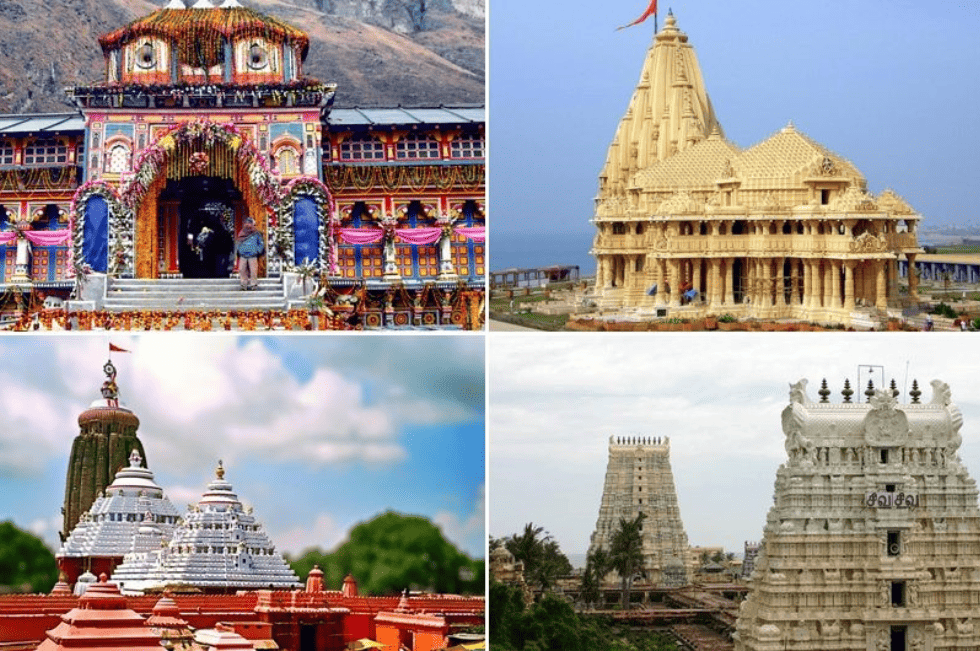
Sanatan Dharma 4 Dham
A Pilgrimage to the Axis of the Universe
Introduction: The Call of the Sacred
In the vast and intricate tapestry of Sanātana Dharma (the eternal law, often termed Hinduism), the concept of pilgrimage—tīrtha-yātrā—holds a place of profound significance. It is not merely a journey through geographic space, but a transformative voyage through inner spiritual terrain, a walking meditation that aligns the individual soul (jīvātman) with the cosmic order (ṛta). Among the multitude of sacred sites that dot the Indian subcontinent like luminous stars in a spiritual galaxy, four stand apart as the ultimate compass points of the Hindu sacred geography: the Chār Dhām, or the Four Abodes.
The traditional Chār Dhām, established by the great 8th-century philosopher-saint Ādi Śaṅkarācārya, comprises Badrinath in the north, Puri in the east, Rameswaram in the south, and Dwarka in the west. These are not random selections. They form a mandala, a sacred circle encompassing the entirety of India, and symbolically, the entire cosmos. They represent the integration of the major sectarian traditions—Vaishnavism and Shaivism—and are intrinsically linked to the narrative of the divine descent, the avatāra, particularly that of Lord Vishnu. A pilgrimage to these four dhāms is believed to grant mokṣa (liberation), purifying the pilgrim of all sins and breaking the cycle of rebirth.
This essay will embark on a detailed exploration of each of these four dhāms, delving into their mythology, history, theology, unique rituals, and the transformative experience of the pilgrimage itself. We will journey from the icy heights of the Himalayas to the coastal shores of the Indian Ocean, tracing a path that millions have walked for over a millennium in search of the divine.
1. Badrinath (Uttarakhand): The Northern Abode in the Realm of Snow
Nestled in the Garhwal Himalayas at an altitude of over 3,100 meters, flanked by the majestic peaks of Nar and Narayana, lies Badrinath (Badrīnātha). Dedicated to Lord Vishnu in his form as Badrīnārāyaṇa, this dhām is a place of austere, majestic beauty, where the divine is perceived in the raw, overwhelming power of nature.
Mythology and Significance:
The name Badrinath derives from the Badrī (Indian berry or jujube) tree. Mythology states that Lord Vishnu, in his incarnation as the sage Nara and Nārāyaṇa, performed severe penance here for the welfare of all beings. His consort, Goddess Lakshmi, took the form of the Badrī tree to provide him shade. Thus, the site symbolizes both intense asceticism (tapas) and nurturing protection.
The temple is also intimately connected to the Bhāgavata Purāṇa. It is believed to be the place where the sage Vyāsa composed the epic Mahābhārata and the Purāṇas. The hot water springs of Tapt Kund, where pilgrims bathe before entering the temple, are said to be infused with medicinal properties and spiritual potency. The presiding deity is a svayambhū (self-manifested) black stone śālagrāma idol of Lord Badrīnārāyaṇa, seated in a meditative posture, which was discovered by Ādi Śaṅkarācārya in the Alaknanda River and enshrined in the 8th century.
Theological Essence:
Badrinath represents Jñāna (Knowledge) and Tapas (Austerity). The harsh, remote environment underscores the path of vairāgya (dispassion) and the single-minded focus required for spiritual realization. As the northern dhām, it is associated with the direction governed by Kubera, the god of wealth, yet here, the true wealth sought is spiritual wisdom, not material riches. It is the realm of transcendence, pointing the pilgrim toward the ultimate reality beyond the material world.
Unique Rituals and Experience:
The pilgrimage season is limited to about six months (April/May to October/November) due to extreme winter weather when the deity is moved ceremonially to Joshimath. The ritual bath in Tapt Kund is a mandatory purificatory act. The temple’s rawal (chief priest) is traditionally a Nambudiri Brahmin from Kerala, a tradition set by Śaṅkarācārya to symbolize the unity of India. The aarti performed against the backdrop of the snow-clad Himalayas is an awe-inspiring spectacle. The journey itself, through treacherous mountain roads, is a test of faith and endurance, mirroring the inner climb toward self-realization.
2. Puri (Odisha): The Eastern Abode of the Lord of the Universe
On the eastern coast of India, along the shores of the Bay of Bengal, lies Puri (Pūrī), home to Jagannātha (Lord of the Universe), a form of Krishna/Vishnu. If Badrinath is austere and remote, Puri is vibrant, populous, and deeply engaged with the world. The temple complex is a bustling microcosm of life itself.
Mythology and Significance:
The legend of Jagannātha is unique. The deities—Lord Jagannātha, his brother Balabhadra, and sister Subhadra—are carved from wood in a distinctly tribal, iconic form with large, round eyes and stumped limbs. The story goes that the original image of Vishnu was found as an indestructible blue jewel (nīlamaṇi). King Indradyumna, instructed by Lord Vishnu in a dream, had the divine carpenter-god Viśvakarma carve the idols on the condition that he not be disturbed. The impatient king interrupted, leaving the deities unfinished. This form is deeply connected to tribal (Ādivāsī) worship traditions, specifically the Sabara people, and represents the synthesis of Vedic and indigenous spiritual streams.
The temple is also one of the few where non-Hindus were historically barred, emphasizing its intense, protected sanctity. The most famous festival is the Rath Yatra (Chariot Festival), where the three deities are placed on colossal chariots and pulled by thousands of devotees to the Gundicha Temple. This act symbolizes Lord Jagannātha’s journey to give darśana (sacred sight) to all, especially those who cannot enter the temple.
Theological Essence:
Puri represents Bhakti (Loving Devotion) and Sevā (Selfless Service). The theology of Puri is centered on the concept that the Lord is not a distant, transcendent figure but an accessible, living presence who partakes in the human condition. The deities are believed to fall ill, take baths, and eat meals (bhoga). The offering of food (mahāprasāda) is considered supremely sanctified; it is said that the cooking pots are placed in such a way that the breeze from the flag atop the temple touches them, signifying the Lord’s blessing. The egalitarian spirit of the prasāda, where all castes partake of the same food, is a powerful social and spiritual statement.
Unique Rituals and Experience:
The daily ritual schedule (niṭyā paddhati) of the temple is elaborate, treating the deity as a living king. The Rath Yatra is a monumental event of cosmic significance. The pilgrim’s experience in Puri is one of joyous immersion in divine play (līlā). The sight of the towering temple spire, the sound of the ocean, the taste of the mahāprasāda, and the pull of the chariot ropes collectively create a sense of participatory devotion that is both overwhelming and intimate.
3. Rameswaram (Tamil Nadu): The Southern Abode of the Lord of Rama
At the southernmost tip of India, on the island of Pamban in Tamil Nadu, is Rameswaram (Rāmeśvaram). This dhām is a bridge between the epic and the devotional, intimately tied to the Rāmāyaṇa and dedicated to Lord Shiva. It is a place of purification and expiation, where the pilgrim confronts the consequences of action and seeks absolution.
Mythology and Significance:
Rameswaram’s origin story is set in the climax of the Rāmāyaṇa. Lord Rama, on his return to Ayodhya after defeating the demon-king Ravana in Lanka, stopped here. Since Ravana was a Brahmin, Rama was guilty of the sin of Brahma-hatyā (killing a Brahmin). To expiate this sin, he wished to worship Lord Shiva. He instructed his devoted lieutenant, Hanuman, to fetch a liṅga from Mount Kailash. As Hanuman was delayed, Sita fashioned a liṅga of sand. This is the primary deity, the Rāmanāthasvāmī Liṅga.
When Hanuman returned, he was disappointed. To appease him, Rama ordained that the liṅga he brought (the Viśvaliṅga) would also be worshipped, and that worship would be performed first. This ritual sequence continues to this day. The temple is also the starting point of the mythical bridge to Lanka, Rāma Setu, remnants of which are believed to exist.
Theological Essence:
Rameswaram represents Karma (Action) and Prayaśchitta (Atonement). It is the dhām of purification par excellence. Its primary ritual—bathing in the 22 sacred wells (tīrthas) within the temple corridor—is a physical act symbolizing the washing away of sins (pāpa). As the southern dhām, it is associated with the direction of Yama, the god of death and dharma. The pilgrimage here is thus a confrontation with one’s own karmic account, a preparation for a righteous death and liberation.
Unique Rituals and Experience:
The pilgrimage to Rameswaram is defined by the Tīrtha Snāna. Pilgrims, guided by temple priests, take baths in each of the 22 wells, each with a different name, salinity, and purported spiritual benefit. The water is drawn and poured by the priests; the pilgrim simply receives it. This act signifies surrendering one’s sins to the sacred geography itself. The temple boasts the longest corridor among all Hindu temples, a breathtaking architectural marvel of over 1,200 meters of intricately carved pillars. The experience is one of ritualistic precision, profound humility, and cathartic cleansing.
4. Dwarka (Gujarat): The Western Abode of the Divine Kingdom
On the western shore of India, where the Gomti river meets the Arabian Sea, lies Dwarka (Dvārakā), the legendary kingdom of Lord Krishna. It is the dhām of divine sovereignty, mystical disappearance, and enduring faith. The present-day city is believed to be the seventh Dwarka, with earlier versions submerged by the sea.
Mythology and Significance:
According to the Mahābhārata, Harivaṃśa, and Purāṇas, Krishna established his splendid, fortified city of Dwarka after leaving Mathura. It became the center of his political and spiritual mission. After Krishna’s departure from the earth (nirvāṇa), the city is said to have been swallowed by the sea, marking the end of the Dvapara Yuga and the onset of the Kali Yuga.
The main temple, Dwarkadhish (King of Dwarka), is a five-storied structure supported by 72 pillars, located on the banks of the Gomti. The deity is a beautiful, four-armed black stone image of Krishna as the majestic ruler. The temple flag, bearing the symbols of the sun and moon, is changed five times a day. The original temple is believed to have been built by Krishna’s great-grandson, Vajranabha, over the hari-grīha (Lord’s residential place).
Theological Essence:
Dwarka represents Rājya (Sovereignty) and Māyā (Divine Illusion/Power). It is the dhām of the Lord in his role as a king, administrator, and protector of dharma. Yet, its submergence symbolizes the transient nature of all material creation, even a divine city. It teaches the lesson of vairāgya through the spectacle of glory lost. The search for the lost city in modern archaeology parallels the spiritual seeker’s quest for the hidden, eternal divine amidst the ruins of the temporal world.
Unique Rituals and Experience:
The aarti offered at the Dwarkadhish temple, especially at dawn, is renowned for its grandeur. The pilgrimage involves visiting Beyt Dwarka, an island reached by boat, believed to be Krishna’s personal residence. The act of sailing to the island echoes the journey to the lost city. Another key ritual is the offering of water from the Gomti to the deity. The experience in Dwarka is one of regal devotion and poignant mysticism, feeling the presence of Krishna as both a powerful king and an elusive, transcendent reality.
The Pilgrimage as a Unified Journey: Symbolism and Synthesis
Ādi Śaṅkarācārya’s genius lay not just in identifying four powerful sites, but in weaving them into a single, coherent spiritual map.
- A Spiritual Perimeter: The four dhāms create a pradakṣiṇā (circumambulation) of India, sanctifying the land as a divine body (Bhārata Mātā). Traditionally, the pilgrimage begins at Puri (east), proceeds clockwise to Rameswaram (south), then Dwarka (west), and culminates at Badrinath (north), following the sun’s path.
- Integration of Sects: The circuit harmoniously integrates the two major traditions: the Vaishnava dhāms (Badrinath, Puri, Dwarka) and the Shaiva dhām (Rameswaram). This reflects the Advaitic (non-dual) vision that Vishnu and Shiva are different manifestations of the same supreme reality (Brahman).
- The Cycle of Life and Liberation: Each dhām addresses a core aspect of human spiritual striving:
- Puri (East, Birth): The joyous, engaged life of devotion and service.
- Rameswaram (South, Life): The necessary process of purification and atonement for actions.
- Dwarka (West, Death): The dissolution of worldly attachments and kingdoms.
- Badrinath (North, Liberation): The ascetic pursuit of transcendental knowledge and eternal peace.
- A Microcosm of the Cosmos: Together, they represent the four puruṣārthas (goals of human life): Dharma (righteousness, Puri), Artha (prosperity, Dwarka), Kāma (desire, Rameswaram’s context of action), and Mokṣa (liberation, Badrinath).
The Pilgrim’s Transformation:
Undertaking the Chār Dhām Yatra is a monumental commitment, often done in later life. It involves traversing diverse landscapes, climates, and cultures. The pilgrim (yātrī) leaves behind identity, comfort, and attachment. The physical hardship—the mountain climbs, the sea voyages, the long walks—becomes a form of tapas. The encounter with millions of fellow pilgrims from all walks of life fosters a sense of unity and humility. The sequential darśana of the deities, each with a distinct energy, progressively strips away layers of the ego, guiding the soul from engaged devotion, through purgation and renunciation, toward ultimate knowledge.
Conclusion: The Eternal Return
The Chār Dhām of Sanātana Dharma are more than historic temples. They are living, breathing portals where myth converges with geography, history with ritual, and the individual soul with the cosmic divine. They anchor the Hindu spiritual imagination in the physical land of India while pointing tirelessly beyond it.
In an age of rapid change, the timeless call of the Chār Dhām endures. Whether undertaken physically by the devout, contemplated philosophically by the seeker, or revered culturally by millions, this sacred quartet continues to define the axis of the Hindu universe. It is a journey that maps the outer world to chart the inner, leading the pilgrim from the shores of temporal existence to the snow-clad peaks of eternal truth, completing a circle that, like Sanātana Dharma itself, has neither beginning nor end. The dhāms stand as eternal witnesses, reminding humanity that the ultimate pilgrimage is the one that leads the ātmā back to its source, from the many to the One.
Top 100 name of Sanatan Dharma 4 Dham
Sanatan Dharma recognizes the Chaturdham (Four Dhams) as the most sacred pilgrimage sites in Hinduism. These four temples, established by Adi Shankaracharya, are located in four different directions of India and are believed to provide moksha (liberation) to devotees who visit them.
🛕 The 4 Dhams (Main) of Sanatan Dharma
- Badrinath Dham (Uttarakhand – North) → Dedicated to Lord Vishnu
- Dwarka Dham (Gujarat – West) → Dedicated to Lord Krishna
- Jagannath Puri Dham (Odisha – East) → Dedicated to Lord Jagannath (Krishna)
- Rameswaram Dham (Tamil Nadu – South) → Dedicated to Lord Shiva
Courtesy: StudyIQ IAS
🛕 Top 100 Names Related to the 4 Dhams in Sanatan Dharma
🏔️ Badrinath Dham (North – Vishnu)
- Narayan Temple
- Tapta Kund
- Brahma Kapal
- Charan Paduka
- Mana Village (Last village before Tibet)
- Vasudhara Falls
- Mata Murti Temple
- Satopanth Tal
- Bhavishya Badri
- Yogadhyan Badri
- Adi Badri
🏰 Dwarka Dham (West – Krishna)
- Dwarkadhish Temple
- Rukmini Devi Temple
- Bet Dwarka
- Gomti Ghat
- Sudama Setu
- Gopi Talav
- Nageshwar Jyotirlinga
- Shankaracharya Math
- Ranchhodrai Temple
- Moola Dwarka
🌊 Jagannath Puri Dham (East – Krishna)
- Jagannath Temple
- Gundicha Temple
- Ananda Bazaar
- Narendra Tank
- Chakra Tirtha
- Atharanala Bridge
- Sakshi Gopal Temple
- Lokanath Temple
- Markandeya Tank
- Bedi Hanuman Temple
🌊 Rameswaram Dham (South – Shiva)
- Ramanathaswamy Temple
- Agniteertham
- Pamban Bridge
- Dhanushkodi
- Five-faced Hanuman Temple
- Villoondi Tirtham
- Gandhamadhana Parvatham
- Sugreevar Temple
- Kothandaramaswamy Temple
- Satchi Hanuman Temple
🛕 Other Associated Sacred Places Related to Char Dham
🔱 Jyotirlingas Connected to the 4 Dhams
- Somnath Jyotirlinga (Near Dwarka)
- Kashi Vishwanath (Connected to Puri)
- Ramanathaswamy (Rameswaram itself)
- Kedarnath Jyotirlinga (Near Badrinath)
Courtesy: Global Photography Hub
🚩 Other Divya Desams & Temples Associated with the 4 Dhams
- Tirupati Balaji Temple
- Udupi Krishna Temple
- Sri Rangam Ranganathaswamy Temple
- Guruvayur Krishna Temple
- Vithoba Temple (Pandharpur)
- Trimbakeshwar Temple
- Kamakhya Temple
- Mahakal Temple (Ujjain)
- Chidambaram Nataraja Temple
- Ekambareswarar Temple
🛕 Sapta Moksha Puris (7 Holy Cities Related to Char Dham)
- Ayodhya
- Mathura
- Haridwar
- Kashi (Varanasi)
- Kanchipuram
- Ujjain
- Dwaraka
🌿 Holy Rivers Associated with the 4 Dhams
- Ganga River (Badrinath, Haridwar)
- Yamuna River (Near Badrinath)
- Saraswati River (Near Dwarka)
- Gomti River (Dwarka)
- Godavari River (Rameswaram connection)
- Tungabhadra River (Jagannath Puri connection)
- Mahanadi River (Jagannath Puri)
- Sindhu River (Dwarka ancient connection)
🛕 Important Pilgrimage Circuits Connected to Char Dham
- Chhota Char Dham (Kedarnath, Badrinath, Yamunotri, Gangotri)
- Sapta Badri (7 Vishnu Temples in Uttarakhand)
- Panch Prayag (5 Confluences in Uttarakhand)
- Panch Kedars (5 Shiva Temples in Uttarakhand)
- Navagraha Temples (Temples of 9 Planets, Tamil Nadu)
🔥 Major Yatras & Festivals of 4 Dhams
- Kumbh Mela (Haridwar, Prayagraj, Nashik, Ujjain)
- Rath Yatra (Jagannath Puri)
- Chandan Yatra (Jagannath Puri)
- Krishna Janmashtami (Dwarka, Mathura, Vrindavan)
- Diwali (Ayodhya, Dwarka, Badrinath Closing Festival)
- Maha Shivratri (Rameswaram, Jyotirlingas)
- Chhath Puja (Puri, Bihar, UP, Nepal)
- Navratri (Kamakhya, Dwarka, Vaishno Devi)
🏔️ Other Temples & Places Connected to Char Dham Legends
- Mana Village (Badrinath – Last Indian Village)
- Panchvati (Ramayana Connection, Nashik)
- Ram Setu (Rameswaram)
- Neelkanth Mahadev (Rishikesh)
- Mukteshwar Temple (Odisha)
- Shri Krishna Janmabhoomi Temple (Mathura)
- Govardhan Hill (Vrindavan)
- Shri Radha Raman Temple (Vrindavan)
- Shri Banke Bihari Temple (Vrindavan)
- Prem Mandir (Vrindavan)
- Ananthashayana Vishnu Temple (Kerala)
- Kanyakumari Bhagavathi Amman Temple
- Omkareshwar Temple (Madhya Pradesh)
🌍 Conclusion
The 4 Dhams of Sanatan Dharma are not just pilgrimage sites but represent the spiritual geography of Hinduism. They connect devotees to Shiva, Vishnu, Krishna, and Shakti, symbolizing Dharma, Moksha, and Bhakti. These 100 sacred places, rivers, temples, and festivals highlight the vast spiritual traditions linked to the Char Dham Yatra.

Table of Contents