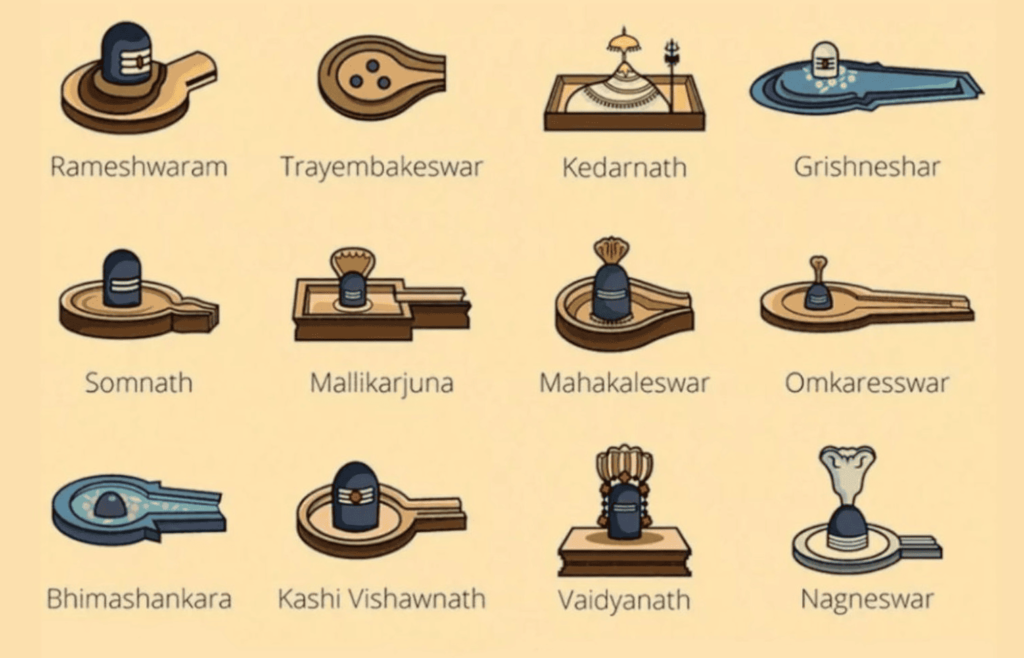
Sanatan Dharma 12 Jyotirlinga
A Pilgrimage to the Pillars of Light
Introduction: The Primordial Pillar of Light
In the vast and profound tapestry of Sanatan Dharma (often called Hinduism), the concept of the divine manifests in countless forms—personal deities, abstract principles, and an all-pervading consciousness. Within this rich spectrum, the Jyotirlingas holds a unique and paramount position. It is not merely a symbol but a living, radiant embodiment of the formless, infinite Supreme Reality—Lord Shiva—in his aspect as the unchanging, limitless pillar of primordial light (Jyoti meaning radiance, Linga meaning sign or mark).
The Jyotirlinga represents the very moment when the transcendent Shiva chose to reveal his immanent, accessible form to his devotees. It is the point where the unmanifest (Nirguna Brahman) condenses into a manifest, yet aniconic, presence (Saguna Brahman). To embark on a pilgrimage to the 12 Jyotirlingas scattered across the Indian subcontinent is to undertake a spiritual journey (yatra) tracing the geography of the sacred.
It is a voyage that moves the seeker from external devotion to internal realization, from diversity of form to the unity of the one source light. These twelve sites are believed to be where Shiva appeared as a column of fire, establishing himself as the axis of the universe. This essay delves into the mythology, significance, individual lore, and spiritual essence of each of these twelve sacred lingas of light.
The Mythological Origin: The Endless Contest of Light
The origin of the Jyotirlinga is narrated in the Shiva Purana, within the story of the cosmic contest between Lord Brahma (the creator) and Lord Vishnu (the preserver). A dispute arose regarding supremacy—who was the greater of the two? As their argument intensified, a tremendous, infinite pillar of fire (Tejo-Linga) erupted before them, piercing the three worlds—the heavens, the earth, and the netherworld. Its light was blinding, its energy unfathomable.
Astonished, the two deities decided to find its ends. Lord Vishnu took the form of Varaha (the boar) and plunged downward to find the base. Lord Brahma took the form of a swan (Hamsa) and soared upward to find the summit. After an immeasurable length of time, Vishnu returned, humbled, admitting he could not find the beginning. Brahma, however, encountered a Ketaki flower (screwpine) falling from above. When asked, the flower falsely testified that it had been falling from the top of the pillar for an aeon. Seizing this opportunity, Brahma returned with the Ketaki as a false witness, claiming he had reached the summit.
At that moment, the formless light revealed itself as Lord Shiva, the all-pervading consciousness. He declared Brahma a liar for his deceit and cursed him that he would not be widely worshipped. He blessed Vishnu for his truthfulness. The Ketaki flower was banned from being used in Shiva’s worship. Shiva then manifested himself in the form of the Jyotirlinga—a finite, accessible representation of that infinite pillar—for the benefit of devotees. The twelve places where this fiery pillar is believed to have touched the earth became the sites of the 12 Jyotirlingas. The Ketaki flower, however, is offered only to one Jyotirlinga—Somnath—as part of its unique legend.
Philosophical and Spiritual Significance
The Jyotirlinga is a profound metaphysical symbol. The linga (often represented as an ellipsoid) set on a yoni (circular base) represents the union of the transcendent masculine principle (Purusha) with the immanent feminine principle (Prakriti), the unmanifest source with the manifest creation. As a Jyotirlinga, it emphasizes that this union, this source of all creation, is fundamentally light-consciousness (Prakasha).
- The Formless Form: Unlike iconic (murti) worship, the linga has no anthropomorphic features. It directs the mind away from a personality to the essence—the formless, attributeless (Nirguna) reality. It is Shiva as Sadashiva (eternal Shiva), the substratum of existence.
- The Axis Mundi: Each Jyotirlinga is considered a axis mundi—a spiritual axis connecting heaven, earth, and the underworld. It is the center of the universe for the devotee, a point where the divine energy is most accessible.
- The Cosmic Seed: The linga is also seen as a bija (seed), the point from which the entire cosmos germinates, is sustained, and into which it dissolves. The Jyotirlinga is thus the seed of luminous consciousness from which all universes arise.
- Pilgrimage as Transformation: The pilgrimage (Tirtha Yatra) to these sites is a spiritual discipline. The physical journey, with its hardships, mirrors the inner journey of the soul seeking its source. Visiting all twelve is believed to destroy the great sins of all lifetimes and lead to Moksha (liberation). The sequence of the traditional pilgrimage route is designed to purify the body, calm the mind, and awaken the spirit.
The 12 Jyotirlingas: Individual Lore, Significance, and Pilgrimage
The traditional list, often recited in hymns, begins with Somnath and ends with Grishneshwar. Each has a unique narrative (Sthala Purana), a distinct form of the linga, and a specific spiritual blessing associated with it.
1. Somnath – The Lord of the Moon (Veraval, Gujarat)
- Legend: This is the first among the twelve, symbolizing the eternal cycle of destruction and reconstruction. The moon-god Chandra, cursed by his father-in-law Daksha to wane, performed severe penance here. Pleased, Shiva manifested as Somnath (Lord of the Moon) and cured him, decreeing that Chandra would wax and wane cyclically. The temple is also intrinsically linked with the recurring theme of destruction by foreign invaders (notably by Mahmud of Ghazni in 1026 CE) and its repeated resurrection by the faith of devotees, symbolizing the indomitable spirit of Sanatan Dharma.
- Significance: It represents Shiva as the healer, the restorer of balance in nature and life. The present temple, rebuilt after India’s independence, stands as a powerful symbol of resilience and faith. The linga is believed to be self-manifested (Swayambhu).
2. Mallikarjuna – The Lord White as Jasmine (Srisailam, Andhra Pradesh)
- Legend: This Jyotirlinga is associated with the familial devotion of Shiva and Parvati’s sons, Kartikeya and Ganesha. After a contest for a divine fruit, Ganesha was declared the wiser. Kartikeya, feeling slighted, left for Mount Kravunja. Grieving, Shiva and Parvati assumed the forms of Mallikarjuna (Shiva) and Bhramaramba (Parvati) and reside at Srisailam to be near him. It is also one of the 18 Shakti Peethas.
- Significance: It embodies Shiva as the compassionate parent, prioritizing familial love and attachment. The pilgrimage to Srisailam, nestled in the Nallamala hills, is considered particularly arduous and spiritually rewarding, combining the worship of both Jyotirlinga and Shakti.
3. Mahakaleshwar – The Lord of Time and Death (Ujjain, Madhya Pradesh)
- Legend: In the ancient city of Ujjain, a demon named Dushana tormented the pious. A young devotee boy named Shrikar was moved by their prayers. Impressed by his intense devotion, Shiva emerged from the earth in a fierce form and destroyed the demon, establishing himself as Mahakaleshwar—the great Lord of Time (Kala).
- Significance: Mahakaleshwar is the only Swayambhu (self-manifested) Jyotirlinga facing south (Dakshinamurti), a direction associated with death. He is the ruler of time, the destroyer of death itself. The famous Bhasma Aarti, where the linga is adorned with ashes from a freshly cremated body, is a stark, daily reminder of the inevitability of death and Shiva’s mastery over it.
4. Omkareshwar – The Lord of the Sacred Sound ‘Om’ (Mandhata Island, Madhya Pradesh)
- Legend: Situated on an island in the Narmada River shaped like the primordial sound ‘ॐ’ (Om), this site’s legend involves the Vindhya mountains and the sage Narada. The Vindhyas, once humble, grew arrogant in height due to the penance of the demon kings Vindhya and Vindhyavali. To subdue their ego, sage Narada tricked them. The gods then prayed to Shiva, who manifested as Omkareshwar and Omkar Mandhata to bless the region and restore balance.
- Significance: It represents Shiva as the very source of cosmic vibration, the Pranava (Om), from which all creation emanates. The island’s natural shape makes it a giant, geographical yantra (mystical diagram), and the confluence of the spiritual symbol with the physical landscape is profound.
5. Kedarnath – The Lord of the Field of Liberation (Uttarakhand Himalayas)
- Legend: After the Kurukshetra war, the Pandavas sought Shiva’s blessing to atone for the sin of fratricide. Shiva, unwilling to forgive easily, eluded them and took the form of a bull in the Himalayas. When Bhima tried to catch him, the bull dove into the ground, reappearing in parts: the hump at Kedarnath, the arms at Tungnath, the face at Rudranath, the navel at Madhyamaheshwar, and the hair at Kalpeshwar (collectively, the Panch Kedar).
- Significance: Kedarnath, situated at over 3,580 meters near the source of the Mandakini River, represents Shiva as the grantor of liberation (Moksha). The severe, majestic environment symbolizes the ascetic, detached aspect of Shiva. It is a testament to faith’s power to thrive in the harshest conditions.
6. Bhimashankar – The Lord Who Destroyed Bhima (Near Pune, Maharashtra)
- Legend: This Jyotirlinga is associated with the destruction of the demon Bhima, son of Kumbhakarna. After his father’s death at the hands of Rama, Bhima performed penance to please Brahma and gain invincibility. Empowered, he began destroying worlds and imprisoned a devout king, Kamarupeshwar. The king’s steadfast prayers to Shiva culminated in a great battle where Shiva reduced the demon to ashes, manifesting as Bhimashankar.
- Significance: It symbolizes Shiva as the protector of devotees and the destroyer of inflated, destructive ego born of arrogance (asuric power). The temple, nestled in the Sahyadri ranges, is also a biodiversity hotspot, reflecting Shiva’s presence in the heart of nature.
7. Kashi Vishwanath – The Lord of the Universe (Varanasi, Uttar Pradesh)
- Legend: Kashi (Varanasi) is considered the oldest living city on earth, created by Shiva and Parvati as their eternal abode. The Shiva Purana states that Shiva’s Jyotirlinga manifested here as the king (Vishwanath) of the entire cosmos. The city itself is believed to rest on Shiva’s trident, held aloft during periods of cosmic dissolution.
- Significance: Kashi Vishwanath is the most revered of all. It represents Shiva as the supreme sovereign, the cosmic center. To die in Kashi, under the gaze of Vishwanath, is believed to grant instant liberation from the cycle of rebirth. The linga is the embodiment of jnana (knowledge) and mukti (liberation). The temple has been destroyed and rebuilt several times, with the current structure built by Ahilyabai Holkar in the 18th century.
8. Trimbakeshwar – The Lord of the Three Peaks (Near Nashik, Maharashtra)
- Legend: This site is the source of the Godavari River, the Ganga of the South. The sage Gautama, living on the Brahmagiri hill, secured a divine pit from Varuna which provided endless grain. Other sages, envious, sent a cow into his field. When Gautama tried to shoo it away, it died. To atone for the sin of Go-hatya (cow slaughter), he prayed to Shiva to bring the Ganga to purify the land. Shiva, pleased, released the Ganga from his matted locks. As she was too forceful, he requested her to flow gently as the Godavari. He then manifested as Trimbakeshwar.
- Significance: The unique feature here is the linga, which has a depression with three small lingas representing Brahma, Vishnu, and Shiva (the Trimurti). It symbolizes Shiva as the source of all purifying waters and the absolver of the gravest sins. The ritual of Narayan Nagbali is performed here for resolving ancestral issues.
9. Vaidyanath – The Lord of Physicians (Deoghar, Jharkhand)
- Legend: The most popular legend connects it to the Samudra Manthan (churning of the ocean). When the demon king Ravana extracted the Atma Linga (the soul-linga) from Shiva to take it to Lanka, Shiva gave it with a condition: it must never touch the ground. Tricked by the gods, Ravana placed it down at this site, and it became fixed. Another legend associates it with the demon king Ravana’s penance, where he cut off his ten heads as an offering. Shiva, pleased, restored them, acting as the divine physician (Vaidya).
- Significance: It represents Shiva as the supreme healer (Maha Vaidya), who cures not just physical ailments but the ultimate disease of worldly bondage (samsara). The temple complex is also a major Shakti Peetha (where Sati’s heart fell).
10. Nageshwar – The Lord of Serpents (Near Dwarka, Gujarat)
- Legend: A demon named Daaruka, with the help of his wife Daaruki (who had a boon that she could possess forests), imprisoned a Shiva devotee named Supriya in the forest of Darukavana. Undeterred, Supriya continued chanting the Shiva mantra. Shiva appeared in the form of a Jyotirlinga, vanquishing the demons and establishing himself as Nageshwar, the lord of serpents (Naga).
- Significance: It symbolizes Shiva as the protector of devotees from all poisons—physical, mental, and spiritual. The linga faces south, and a large statue of Shiva in a seated meditation pose is a prominent feature. It is a reminder that sincere devotion can invoke divine intervention even in the most desperate circumstances.
11. Rameshwaram – The Lord of Rama (Tamil Nadu)
- Legend: Enshrined in the epic Ramayana, this Jyotirlinga was established by Lord Rama himself. On his journey to Lanka to rescue Sita, Rama stopped at this shoreline. To absolve himself of the sin of killing Ravana (a Brahmin), he wished to worship Shiva. He sent Hanuman to fetch a linga from Kashi. When Hanuman was delayed, Sita made a linga of sand. This primal linga is worshipped as Ramanathaswamy (Lord of Rama). The linga brought by Hanuman is also installed beside it as Hanuman-linga.
- Significance: It uniquely represents Shiva being worshipped by his own devotee-incarnation (Rama, an avatar of Vishnu), signifying the non-dual essence of the divine. It emphasizes the importance of ritual worship and penance, even for the divine in human form. The temple’s magnificent corridors and the practice of taking a purifying bath in the ocean and temple tanks (Teerthas) make it a central pilgrimage site.
12. Grishneshwar – The Lord of Compassion (Near Ellora, Maharashtra)
- Legend: A devout woman named Kusuma used to worship a linga daily by immersing it in a nearby tank. Her sister’s husband, jealous, killed Kusuma’s son. Undeterred in her worship, Kusuma continued her rituals. When she immersed the linga, her son was miraculously restored to life. Pleased by her unwavering faith, Shiva manifested here as Grishneshwar (the lord of compassion, from Grishna, meaning compassion).
- Legend: It represents Shiva as the fulfiller of deepest desires and the rewarder of steadfast, selfless devotion. Located near the UNESCO World Heritage site of the Ellora caves, it symbolizes the culmination of the pilgrimage—where pure devotion (bhakti) evokes the Lord’s boundless grace.
Conclusion: The One in the Twelve
The pilgrimage to the 12 Jyotirlingas is a microcosm of the spiritual journey prescribed by Sanatan Dharma. It traverses diverse landscapes—from the western shores of Somnath to the Himalayan heights of Kedarnath, from the holy city of Varanasi to the southern tip of Rameshwaram. Each site, with its distinct legend, addresses different human aspirations: healing (Somnath, Vaidyanath), protection (Bhimashankar, Nageshwar), liberation (Kedarnath, Kashi), knowledge (Omkareshwar), familial love (Mallikarjuna), mastery over time (Mahakaleshwar), purification (Trimbakeshwar), divine harmony (Rameshwaram), and ultimate grace (Grishneshwar).
Yet, the underlying truth, echoed in the Shiva Mahimna Stotra, is: “They are all the same, the one Lord, though spoken of as many for the sake of the devotees.” The twelve pillars are not twelve separate entities but twelve
Top 100 name of Sanatan Dharma 12 Jyotirlinga
In Sanatan Dharma, the 12 Jyotirlingas are the most sacred shrines dedicated to Lord Shiva. Each represents a self-manifested form of Shiva as a pillar of divine light (Jyoti = Light, Linga = Shiva’s Form). Here are the 12 Jyotirlingas with their locations:
12 Jyotirlingas & Their Locations
- Somnath Jyotirlinga – Prabhas Patan, Gujarat
- Mallikarjuna Jyotirlinga – Srisailam, Andhra Pradesh
- Mahakaleshwar Jyotirlinga – Ujjain, Madhya Pradesh
- Omkareshwar Jyotirlinga – Khandwa, Madhya Pradesh
- Kedarnath Jyotirlinga – Uttarakhand
- Bhimashankar Jyotirlinga – Pune, Maharashtra
- Kashi Vishwanath Jyotirlinga – Varanasi, Uttar Pradesh
- Trimbakeshwar Jyotirlinga – Nashik, Maharashtra
- Vaidyanath Jyotirlinga (Baidyanath Dham) – Deoghar, Jharkhand
- Nageshwar Jyotirlinga – Dwarka, Gujarat
- Rameshwar Jyotirlinga – Rameswaram, Tamil Nadu
- Grishneshwar Jyotirlinga – Aurangabad, Maharashtra
Additional Names & 100 Associated Names of Jyotirlingas
Each Jyotirlinga is also known by several other names based on legends, mythology, and location. Here are 100 names linked to the 12 Jyotirlingas:
1. Somnath Jyotirlinga (Gujarat)
- Someshwar
- Bhairaveshwar
- Chandra Mouliswar
- Prabhaspati
- Shashishekhara
- Somanatha
- Shiva Surya
- Amriteshwar
- Vratya Shiva
- Kshetrapati
Courtesy: sanatan Gyan katha
2. Mallikarjuna Jyotirlinga (Andhra Pradesh)
- Mallikarjuna
- Parvati Vallabha
- Rudrapriya
- Vrishabheshwar
- Tripuranthaka
- Gopala Pati
- Karunakar
- Dakshinamurthy
- Nataraja
- Dronachaleshwar
3. Mahakaleshwar Jyotirlinga (Madhya Pradesh)
- Mahakala
- Rudra Kaleshwar
- Shiva Kalpavriksha
- Adi Maheshwar
- Shri Mahadeva
- Chandrasekhara
- Avinash
- Bhootnath
- Kshipreshwar
- Kalantaka
4. Omkareshwar Jyotirlinga (Madhya Pradesh)
- Omkaranath
- Shiva Omkareshwar
- Parameshwar
- Atmalingeshwar
- Shivalinga Murti
- Gauripati
- Rudradeva
- Vrishabhadri
- Trishuladhari
- Maheshwar
5. Kedarnath Jyotirlinga (Uttarakhand)
- Kedarnath
- Himalaya Natha
- Gauripriya
- Bhagirath Nath
- Rudrapriya
- Mandakini Nath
- Adi Yogi
- Shankara
- Kedara Linga
- Giri Raja
Courtesy: Kanishk Gupta
6. Bhimashankar Jyotirlinga (Maharashtra)
- Bhimashankar
- Shankara Bhima
- Sahyadri Nath
- Vana Raja
- Dakini Pati
- Rudra Murti
- Mahadev Bhima
- Bhooteshwar
- Rakta Kanta
- Girijapriya
7. Kashi Vishwanath Jyotirlinga (Uttar Pradesh)
- Vishwanatha
- Annapurna Pati
- Mahadeva Kashi
- Avimukta
- Bhavani Pati
- Rudra Kashi
- Kaal Bhairava Pati
- Ganga Pati
- Jyotirlingeshwar
- Trilokinath
8. Trimbakeshwar Jyotirlinga (Maharashtra)
- Trimbakeshwar
- Gautameshwar
- Brahmagiri Nath
- Tryambaka Shiva
- Kushavarta Nath
- Rudranath
- Shivalaya Tryambaka
- Amrutalinga
- Rameshwara
- Bhagirathi Nath
9. Vaidyanath Jyotirlinga (Jharkhand)
- Vaidyanath
- Baidyanath
- Jyotirlingeshwar
- Kamana Linga
- Shivacharya
- Shiva Amritesha
- Parvati Vallabha
- Rudra Kamadhenu
Significance of the 12 Jyotirlingas
- They are self-manifested Shiva Lingas, unlike those installed by humans.
- Each Jyotirlinga represents a different aspect of Lord Shiva (e.g., Vishwanath as the ruler of the universe, Kedarnath as the lord of the Himalayas).
- Worshiping all 12 Jyotirlingas is believed to grant moksha (liberation) and removal of sins.

Table of Contents