Sanatan Dharam Institutions
Critically, the search results do not provide a single, centralized directory of all institutions. Instead, they reveal a deep chasm between historical, orthodox organizations (often called Sanatan Dharma Sabhas) founded in the 19th century to preserve caste hierarchies, and contemporary, NGO-style trusts registered in the last 5 years focused on development work. Furthermore, the most detailed organizational profile available pertains not to India, but to the Sanatan Dharma Maha Sabha of Trinidad and Tobago .
Note on Result Limitations: The search results are heavily skewed toward the colonial history of the Sabhas and a specific government directory of NGOs. There is a distinct lack of detailed information on many mid-sized institutions mentioned in passing (such as the specific functioning of Om Sanatan Nyas or the educational outcomes of Pancham Dham), requiring the analysis to focus on the nature of these gaps and the ideological diversity present in the results.
The Genealogy and Landscape of Sanatan Dharam Institutions: From Colonial Orthodoxy to Global Diaspora and Modern Trusts
1. Introduction: The Institutionalization of the “Eternal”
The concept of Sanatana Dharma (the eternal duty) implies a system without beginning or end. However, as scholar Christophe Jaffrelot notes, “its main organisation, the Sanatan Dharma Sabha is not — and not that old” . The institutionalization of Sanatan Dharma was a direct reaction to modernity, colonialism, and reformist movements. Today, an institution operating under the “Sanatan” banner could refer to a strict orthodox trust established in 1887 to defend the Varnashrama system, a Vedic summer camp in South India adapting to post-globalization Hinduism, a massive school-building apparatus in the Caribbean, or a small 2022 trust in Vrindavan focused on food processing and water .
This analysis examines the available data to map these distinct phases and typologies. The evidence suggests that while the name remains constant, the institutional DNA has mutated significantly across geographies and centuries.
2. The Foundational Era: The Bharat Dharma Mahamandal and the Defence of Hierarchy
2.1 The Birth of the Sabha Movement
The first organized Sanatanist institutions emerged in the late 19th century not merely to “preserve” tradition, but specifically to combat the Arya Samaj. The Arya Samaj’s advocacy for Shuddhi (reconversion/purification of Dalits) and its refusal to identify as “Hindu” in the Census threatened the social dominance of orthodox, high-caste landowners .
The architect of this movement was Din Dayalu. Rather than creating a single monolithic entity, he federated local Sanatan Dharma Sabhas across North India into the Bharat Dharma Mahamandal in 1887. This is arguably the first major Sanatan institution of the modern era. Its exclusivity was encoded in its DNA: at its first session in Haridwar, Dayalu “invited only Brahmins, Kshatriyas and Vaishyas, leaving out the Shudras and the Dalits”.
To understand the institutional mindset, one need only look at the name of his ancillary organization: The Gau Varnashrama Hitaishini Ganga Dharma Sabha (The Religious Association for the Benefit of the Cow, Varna Order, and the Holy Ganges). For these institutions, the defense of varna vyavastha (caste order) was synonymous with the defense of Sanatan Dharma.
2.2 The Educational Arm: BHU as a Sanatanist Project
A critical finding in the search results is the direct link between the Sanatan Dharma Sabha movement and the establishment of Banaras Hindu University (BHU) . While BHU is now a central university, its genesis was deeply Sanatanist. Madan Mohan Malaviya, described as an “archetypal orthodox Brahmin” who would not accept food from any person outside his own jati, used the 1906 session of the Hindu Samaj to push for the University .
The ideological justification for this institution, as recorded in the search results, is striking. Malaviya attributed the “decadence of Indian society” to the decline of Varna vyavastha. He explicitly advocated for a society founded on “hereditary social functions” where specific duties were assigned to specific castes. The search result quotes Malaviya’s framing of society as an “organism” served by its constituent castes, directly invoking the Rig Vedic myth of the Virat Purusha where Shudras originate from the feet . This provides a crucial data point: a major Indian educational institution was founded on an ideological platform explicitly endorsing caste-based hereditary labor.
3. The Diasporic Giant: The Sanatan Dharma Maha Sabha of Trinidad and Tobago
If one is seeking the single most operationally powerful “Sanatan Dharam Institution” documented in the search results, it is undoubtedly the Sanatan Dharma Maha Sabha (SDMS) of Trinidad and Tobago . This represents a distinct genre of institution—one born of indenture, colonial pressure, and the need for ethnic consolidation.
3.1 Genesis: Merger and Political Muscle
Unlike the Indian Sabhas which were elite-driven responses to reform, the Trinidadian SDMS was a response to disorganization and the missionary zeal of the Arya Samaj in the Caribbean. The search results detail a fragmented landscape in the early 20th century, with groups like the Trinidad Hindu Maha Sabha and the Sanatan Dharma Prabartakh Sabha failing to gain traction .
The turning point was 1952. Bhadase Sagan Maraj, a self-made millionaire and sugar union leader, engineered the merger of the two rival orthodox bodies: the Sanatan Dharma Association (incorporated 1932) and the Sanatan Dharma Board of Control (incorporated 1932). This merger created a “much more powerful pressure group” .
3.2 Institutional Footprint and Strategy
The SDMS profile reveals an institution that has successfully leveraged education as a tool for community advancement and preservation. Its operational statistics are as follows:
- Education: Over 50 schools (built 31 between 1952-1956 alone).
- Temples: 150 affiliated mandirs.
- Clergy: 200 affiliated pundits (Parishad).
- Media: Radio Jaagriti 102.7 FM and TV Jaagriti .
Analysis: This represents a shift from the Indian template. While Malaviya’s BHU was about restoring a theoretical ancient constitution, the SDMS’s school building program was pragmatic. It viewed education as “the key to promoting Hindu unity… and to provide Indians with greater opportunities for social advancement” in a colonial/post-colonial society . This is an institution focused on minority survival and uplift, rather than the preservation of strict ritual purity laws.
4. The Contemporary Indian Landscape: The NGO-ification of Sanatan
A significant portion of the search results points to a radical shift in the typology of Sanatan institutions in the 21st century. The government’s NGO Darpan portal lists numerous “Sanatan” trusts registered recently . These bear little resemblance to the 1887 Mahamandal.
4.1 Sectoral Analysis of Modern Trusts
A review of the registration data (2021-2024) shows that modern Sanatan institutions are diversifying into development sectors:
- Sanatan Foundation Educational Trust (Jharkhand): Focuses on Dalit Upliftment, ICT, Sports, and Rural Development .
- Sanatan Hindu Charitable Trust (Lucknow): Operates in HIV/AIDS, Human Rights, Micro Finance, and Biotechnology .
- Sanatan Jeevo Uthan Seva Trust (Ghaziabad): A 2021 trust working on 39 sectors including Prisoner’s Issues, Labour & Employment, and Minority Issues .
- Sanatan Raksha Dal (Ghaziabad): A 2020 trust focused on Water Resources, Disaster Management, and Youth Affairs .
Critical Observation: This represents a significant semantic expansion. In 1887, a “Sanatan Raksha Dal” would likely have been an armed guard to protect temple ritual purity. In 2020, it is an NGO focused on disaster management. The term “Sanatan” is increasingly functioning as a brand of cultural legitimacy applied to secular welfare activities.
4.2 The Pancham Dham Model: Revivalism and Mass Mobilization
A contrasting contemporary model is presented by Pancham Dham. Founded in 2017 by Dr. Sailesh Lachu Hiranandani, this organization represents a shift toward large-scale ritual performance as institutional activity. Their “Bihar Sanatan Sankalp Yatra” (2024-2025) aims to reach crores of people through Mahayagyas .
Institutional Characteristics of Pancham Dham:
- Alignment: Explicitly aligned with RSS values and supported by RSS veteran Indresh Kumar.
- Methodology: Massive Vedic rituals (Mahamrityunjaya Yagya in 108 Shiva temples).
- Social Messaging: Notably, this organization claims to “raise its voice against the evils of caste system” by venerating Saint Ravidas .
Tension: This creates an interesting paradox. The original Sanatan Dharma Sabha was founded specifically to oppose the uplift of the castes associated with Ravidas. A modern Sanatan institution now claims to venerate Ravidas to oppose casteism. This demonstrates the “pliability” of the Sanatan label .
5. Regional and Niche Institutions: Assam and Nepal
5.1 Guwahati Harisabha: A Symbol of Syncretism
The Guwahati Harisabha (Sanatan Dharma Sabha), founded in 1913, offers a regional variation that challenges the North Indian orthodox template . Unlike Malaviya’s exclusivity, the Harisabha Trust was deliberately composed of two members each from the Assamese and Bengali communities and one from the Marwari community.
Its institutional activities were remarkably progressive for a Sanatan body of that era:
- Education: Established the first girls’ school in the town (Kumari Vidyalaya).
- Nationalism: Trained boys and girls in sword and stick fighting for self-defence during the Swadeshi movement (notably, the British never raided the premises despite monitoring them).
- Culture: Served as a venue for both Bengali jatras and Assamese bhaonas, hosting artists like Hemanta Mukherjee .
This serves as a vital corrective. While Jaffrelot’s piece defines Sanatan institutions primarily through the lens of caste defence, the Assam example shows that regional Sanatan Sabhas could function as broad-based, culturally syncretic, and anti-colonial community centers.
5.2 Nepalese Expansion: Sanatan Dharm Seva Samiti
The search results also provide a snapshot (dated 1988) of the Sanatan Dharm Seva Samiti in Nepal . Founded in 1966, this institution took on an “umbrella” role, coordinating activities between Hindus, Buddhists, Sikhs, and Jains. Its institutional growth was significant: 38 branches in Nepal and 10 in India, along with a publishing arm (Dharm Sandesh). This represents the export of the “Sanatan” institutional model to the Himalayan kingdom during its period of modernization.
6. Contemporary Debates and Ideological Contestation
6.1 The Caste Question
The search results indicate that the “institution” of Sanatan Dharma itself is currently under fire for its historical relationship with caste. The Wire article argues that the version of Sanatan propagated today is a “small tributary” of a much larger, self-renewing cultural flow, and that the current institutional emphasis on orthodoxy represents a static, “Manuvadi” variety .
Conversely, the academic panel at ECSAS 2025 notes that even within hegemonic discourses, Sanatan is being “reworked and adjusted to new agendas (such as social justice and environmental crisis)” . The example of Pancham Dham venerating Ravidas, or the NGO Sanatan Foundation Educational Trust listing “Dalit Upliftment” as a primary sector, suggests that contemporary institutions are actively trying to rebrand away from the legacy documented in .
6.2 The Delhi Summit (2025): The Push for Globalization
The most recent event captured in the search results is the Sanatan Sant Sammelan-2025 at Bharat Mandapam, Delhi . Organized by Om Sanatan Nyas, this was less a “trust” in the charitable sense and more of a convening body. The event highlights the current priorities of major Sanatan institutions:
- Unification: Swami Govind Dev Giri’s call to “unite to re-establish Sanatan across the globe.”
- Youth: Specific emphasis on connecting youth with Sanatan values.
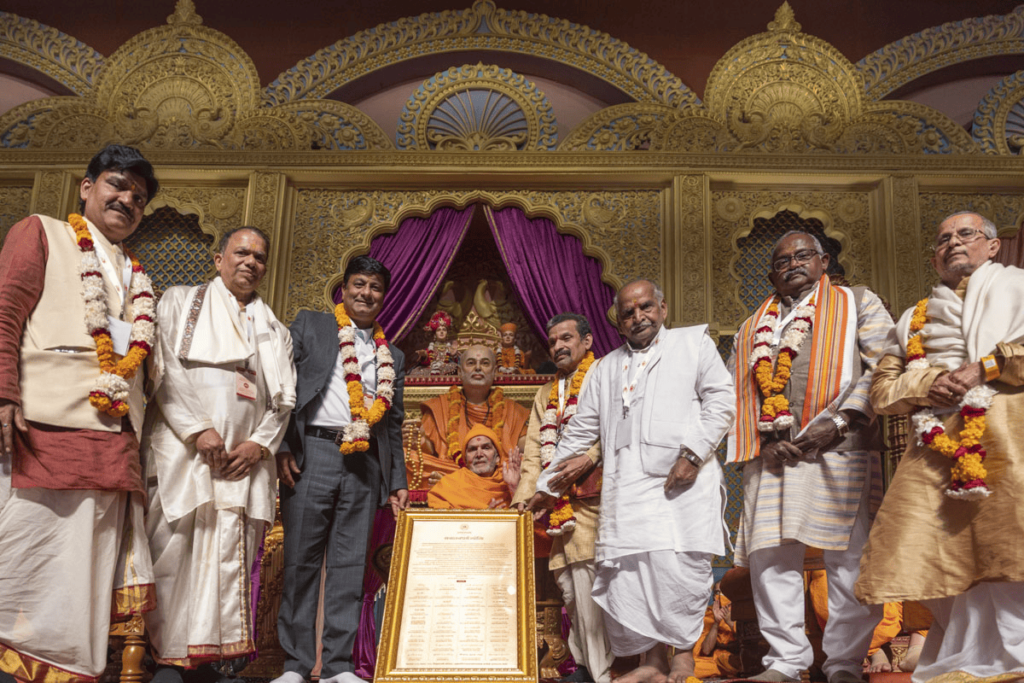
- Inclusivity Signaling: Presence of Sardar Paramjit Singh Ji (SGPC advisor) to demonstrate interfaith harmony .
7. Conclusion: A Taxonomy of Institutions
Based strictly on the search results provided, “Sanatan Dharam Institutions” cannot be defined as a single entity. They are best understood as four distinct layers:
| Layer | Era | Characteristics | Example |
|---|---|---|---|
| 1. Orthodox Sabhas | 1887 – 1947 | Defence of Varna, Elite/Caste-led, Anti-Reform | Bharat Dharma Mahamandal [1], Malaviya’s BHU [1] |
| 2. Diasporic Survival | 1952 – Present | Educational focus, Political lobbying, Cultural preservation | SDMS Trinidad [6] |
| 3. Syncretic Regional | 1913 – Present | Community integration, Anti-colonial activity | Guwahati Harisabha [4] |
| 4. Modern NGO/Trust | 2017 – Present | Development sectors, Dalit upliftment (rhetoric), Mass Yagyas | Pancham Dham [3], Sanatan Hindu Charitable Trust [10] |
Final Assessment: The search results indicate that the term “Sanatan Dharam Institution” has undergone a complete semantic reversal in some contexts (from defender of caste hierarchy to NGO for Dalit upliftment) while remaining rigidly orthodox in others (the four Shankaracharya Mutts referenced indirectly in ).
Top 100 name of Sanatan Dharam Institutions
Here is a list of 100 Sanatan Dharma-inspired institution names, suitable for schools, universities, hospitals, research centers, dharamshalas, and spiritual organizations.
Courtesy: umesh ram
1-25: Educational Institutions (Schools, Universities, Gurukuls)
- Sanatan Dharma Gurukul
- Sanatan Vidya Peeth
- Vedic Wisdom Academy
- Rigveda Knowledge Institute
- Upanishad Learning Center
- Bhagavad Gita Institute of Studies
- Vasishtha Gurukul
- Maharishi Valmiki Sanskrit University
- Vedanta Institute of Higher Studies
- Panini Sanskrit University
- Swami Vivekananda Knowledge Center
- Patanjali Yoga & Vedic University
- Acharya Chanakya Management Institute
- Shri Ram International School of Dharma
- Brahma Vidya Institute
- Dronacharya Gurukul
- Rishi Kashyap Science Academy
- Markandeya Rishi Research Institute
- Taittiriya Vedic Studies Center
- Sanatan Dharma Shiksha Kendra
- Mahabharata Learning Academy
- Sanatan Jyoti School of Spirituality
- Adi Shankaracharya Wisdom Academy
- Saraswati Vidya Mandir
- Satyam Shivam Sundaram Knowledge Hub
26-50: Spiritual & Religious Institutions (Ashrams, Temples, Research Centers)
- Sanatan Dharma Peeth
- Gayatri Mantra Research Center
- Bhakti Yoga Ashram
- Sanatan Dharma Heritage Trust
- Jagannath Dharma Institute
- Ramayan Pathshala
- Vedanta Consciousness Center
- Himalayan Rishi Ashram
- Shiva Shakti Meditation Center
- Panchatantra Research Foundation
- Tirupati Balaji Spiritual University
- Somanath Jyotirlinga Spiritual Institute
- Kurukshetra Dharma Academy
- Saptarishi Vedic Studies Institute
- Ganga-Saraswati Vedic Research Center
- Prayagraj Dharmic Institute
- Haridwar Yoga & Meditation Center
- Omkareshwar Temple Trust
- Dwapara Yuga Heritage Foundation
- Treta Yuga Research Institute
- Kashi Vishwanath Religious Studies Center
- Rameshwaram Jyotirlinga Learning Academy
- Vaishno Devi Shakti Peeth Trust
- Sanatan Dharma Temple & Cultural Trust
- Dwarka Krishna Consciousness Center
Courtesy: Mies Institute
51-75: Healthcare & Wellness Institutions (Hospitals, Ayurveda, Yoga Centers)
- Dhanvantari Ayurveda Hospital
- Charaka Ayurveda Medical Institute
- Sushruta Wellness & Surgery Institute
- Panchakarma Healing Center
- Amrita Sanjivani Health Trust
- Ayurveda Siddhanta Medical College
- Yoga & Naturopathy Wellness Center
- Sanatan Health & Wellness Trust
- Dharma Ayurvedic Research Center
- Chakra Healing & Meditation Institute
- Pranayama Therapy Hospital
- Mahadev Ayurvedic Wellness Center
- Soma Ras Therapy & Wellness Institute
- Shri Ram Holistic Healing Center
- Hanuman Traditional Medicine Hospital
- Vedic Science & Wellness Research Institute
- Arogya Sanatan Hospital
- Rishi Agastya Natural Healing Center
- Himalayan Ayurveda Research Institute
- Bhishma Pitamah Orthopedic Hospital
- Soma Veda Ayurveda Research Center
- Shri Vishnu Panchakarma Clinic
- Kedarnath Wellness & Yoga Institute
- Ayodhya Dharmic Healing Center
- Brahma Vidya Alternative Medicine Center
76-100: Charitable Institutions (Dharamshalas, Bhandaras, Cultural Trusts)
- Sanatan Dharma Seva Trust
- Shri Ram Charitable Foundation
- Krishna Bhakt Annapurna Bhandara
- Sita Mata Nari Seva Sansthan
- Bhakta Prahlad Free Meal Center
- Annapurna Devi Food Distribution Trust
- Ganga Mata Dharmic Charity Trust
- Haridwar Ganga Seva Sansthan
- Kumbh Mela Free Service Trust
- Mahadev Anna Danam Seva
- Shri Krishna Gaushala & Welfare Trust
- Vasudhaiva Kutumbakam Community Center
- Dharma Jyoti Free Education Trust
- Tirupati Temple Annadana Seva
- Kashi Vishwanath Bhandara Sewa
- Ayodhya Roti Bank
- Kurukshetra Rishi Langar Trust
- Vedic Heritage Conservation Trust
- Bhagavad Gita Knowledge Foundation
- Sanskrit Language Revival Institute
- Satyug Spiritual Welfare Trust
- Sri Yantra Research & Study Center
- Rishi Markandeya Free Shelter Home
- Puranic Text Preservation Society
- Moksha Spiritual Awareness Foundation
Summary
These institution names cover education, healthcare, wellness, spirituality, charity, and cultural preservation within the Sanatan Dharma tradition.
OUR GROUP OF INSTITUTIONS

Vrindawan skill Development Center
Your skills matters

Vrindawan Boarding School
Complete Education and Green School

Vrindawan Coaching Center
Ahead in competition

Vrindawan University
Innovation and You

Vrindawan e-University
Digital University

Vrindawan Computer Institute
Innovation by computer

Vrindawan Academy
Academy for Jobs

Vrindawan Group of Institutions
Complete Education

Vrindawan Integrated School
Innovative School

Vrindawan School
Vrindawan School

International Institute of Quality
Quality Matters

International Institute of Entrepreneurship
Nurturing Entrepreneurs

Six Sigma Quality International
Nurturing Entrepreneurs

International Institute of e-commerce
Sell Online

Internatinal Institute of Technology
Innovation by Technology
Vrindawan Groups
For Holistic Development
Vrindawan Computer Institute
For Innovation
Table of Contents