The Samudra Manthan Churning Network is a fascinating concept rooted in Indian mythology but applied in modern technology, knowledge sharing, and collaborative networks. Inspired by the legendary tale of Samudra Manthan—where the gods (Devas) and demons (Asuras) churned the ocean to obtain Amrit, the nectar of immortality—this network symbolizes a collaborative ecosystem designed to extract value through systematic effort.
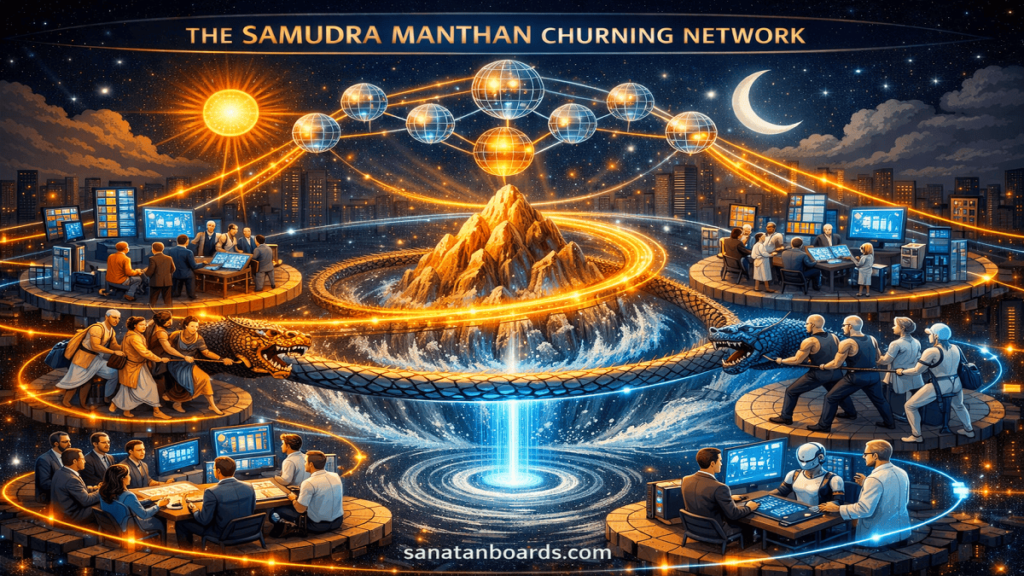
In today’s educational and technological context, the Samudra Manthan Churning Network represents a structured system where multiple entities—like organizations, researchers, or machines—interact and contribute to a common goal. Each participant plays a unique role, akin to the Devas and Asuras, ensuring that the network can derive optimal results.
This network emphasizes collaboration, innovation, and resource optimization. By “churning” through data, resources, and expertise, it allows participants to uncover insights and solutions that would be impossible individually. The concept is highly relevant in sectors like knowledge management, artificial intelligence, data analytics, and blockchain technology.
Ultimately, the Samudra Manthan Churning Network serves as a metaphor for teamwork, persistence, and strategic alignment. For students and professionals, understanding this network provides insights into building collaborative systems that maximize efficiency, knowledge extraction, and problem-solving capabilities in real-world applications.
What Is Samudra Manthan Churning Network ?
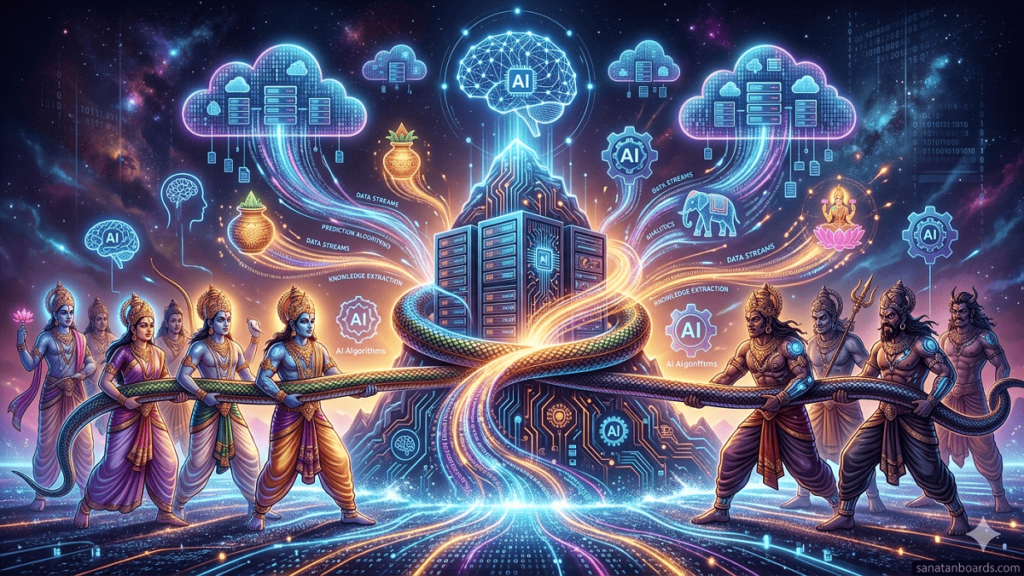
The Samudra Manthan Churning Network is an advanced collaborative system inspired by the mythological Samudra Manthan story, symbolizing the extraction of valuable resources through joint effort. In mythology, gods and demons churned the ocean to obtain precious treasures. Similarly, in the modern context, this network represents an ecosystem where multiple participants or nodes contribute to achieve a shared objective.
At its core, this network is designed for systematic “churning” of resources—be it data, knowledge, or computational power. Participants in the network share their expertise, tools, or resources to collaboratively generate outcomes that surpass individual capabilities. The process is iterative, dynamic, and emphasizes balance among contributors, ensuring that all nodes benefit from collective effort.
Technologically, this concept finds application in distributed systems, data analytics networks, AI-driven collaborative platforms, and knowledge management systems. For example, in a data-driven Samudra Manthan Churning Network, multiple organizations might pool datasets to train AI models more efficiently. Each participant contributes unique inputs, while the “churning” process ensures that insights, predictions, or solutions are optimized for accuracy and relevance.
The network also has educational and research applications, where multiple institutions collaborate to produce high-impact research outputs or innovative solutions. By replicating the churning process, knowledge gaps are identified, experiments are refined, and solutions are co-created.
Who Is Required Samudra Manthan Churning Network ?
The Samudra Manthan Churning Network is particularly relevant for individuals, organizations, and institutions seeking to maximize value through collaboration and knowledge sharing. Primarily, research institutions, universities, and corporate R&D departments can benefit from this network, as it allows them to combine resources and expertise to tackle complex challenges.
Educational organizations require this network to foster collaborative learning environments. By “churning” ideas, data, and insights collectively, students and researchers can gain a deeper understanding of subjects, uncover new perspectives, and develop innovative solutions. The network also supports cross-disciplinary collaboration, which is crucial in modern education, where fields like AI, biotechnology, and data science intersect.
Industries that handle large-scale data, such as healthcare, finance, and technology, also require this network. By connecting multiple nodes, organizations can share datasets, analytical tools, and computational resources. This collaborative effort ensures improved outcomes, such as more accurate predictive models, faster problem-solving, and innovation that would be difficult to achieve individually.
Non-profit organizations and community-driven projects can leverage the Samudra Manthan Churning Network to pool knowledge and resources for social good. It allows them to identify effective solutions collaboratively while minimizing duplication of efforts.
Even governments and policy-making bodies can benefit from this network. By integrating data and expertise from multiple departments or external experts, policies can be more informed, effective, and responsive.
When Samudra Manthan Churning Network Is Required ?
The Samudra Manthan Churning Network is required whenever complex challenges arise that demand collaborative intelligence and resource pooling. In today’s fast-paced world, many problems cannot be solved by a single organization, institution, or individual. The network becomes necessary when the scale, complexity, or diversity of a task requires a synergistic approach.
In research and development, this network is required when multiple perspectives are needed to explore innovative solutions. For instance, developing new medical treatments or cutting-edge technologies often requires datasets, expertise, and resources from various organizations. Individually, each participant may have limited scope, but together, they can achieve comprehensive solutions faster and more effectively.
Educational institutions also require this network during interdisciplinary projects. When students, teachers, and researchers from different fields come together, they “churn” knowledge, blending insights to develop novel ideas or approaches. The network becomes crucial in collaborative research programs, international academic collaborations, and innovation-driven curricula.
Industries need this network during data-intensive operations. Companies dealing with big data, artificial intelligence, and analytics require shared computational resources and datasets to optimize models and predictions. The Samudra Manthan Churning Network allows multiple companies to collaborate securely, ensuring better outcomes for all parties.
The network is also necessary in crisis management and governance. In times of global emergencies, such as pandemics or environmental disasters, pooling knowledge, data, and expertise ensures informed decision-making and coordinated action. Governments, NGOs, and healthcare organizations can rely on the network to create efficient strategies.
Furthermore, it is required in community development and social innovation. Complex social issues, like poverty alleviation or sustainable development, require collective intelligence, diverse perspectives, and resource-sharing mechanisms. Here, the network facilitates collaboration among communities, organizations, and experts to design scalable and impactful solutions.
Where Samudra Manthan Churning Network Is Required ?
The Samudra Manthan Churning Network finds its application across diverse locations and environments, wherever collaboration, knowledge sharing, and resource optimization are essential. Its relevance is not restricted to a single domain but spans education, industry, governance, research, and community initiatives. Understanding “where” it is required helps organizations and individuals position themselves to benefit maximally from such a collaborative ecosystem.
In educational institutions, the network is required in universities, colleges, and research centers where interdisciplinary learning is emphasized. For example, when multiple departments collaborate on AI-driven healthcare projects, pooling data, expertise, and computational resources mirrors the churning process. By establishing such networks, institutions located anywhere in the world can break geographical barriers and work toward shared educational goals.
In the corporate sector, it is required in offices, research labs, innovation hubs, and co-working spaces. Industries handling large-scale data, like fintech, biotechnology, or e-commerce, benefit from creating internal or external churning networks to integrate knowledge from multiple teams. By establishing secure data-sharing platforms, companies ensure insights and analytics are efficiently extracted from collaborative efforts, no matter where the teams are physically located.
The network is also required in government and policymaking bodies. Departments, agencies, and think tanks situated across different cities or regions can leverage this network to integrate data, feedback, and expert opinion for policy design and implementation. National and international networks are especially valuable during crises, such as environmental disasters or health emergencies, where rapid, coordinated decision-making is critical.
Non-profit and community organizations require such networks within urban, rural, or remote areas. By connecting multiple stakeholders—local communities, NGOs, experts, and donors—churning networks help address social challenges like education, healthcare, and sustainability more effectively. The distributed nature of the network ensures that participants can contribute regardless of their location, creating a decentralized yet synchronized collaborative framework.
Finally, in global research collaborations, the network is required across continents, linking laboratories, universities, and organizations. Whether it’s climate research, space exploration, or AI development, the Samudra Manthan Churning Network enables participants worldwide to contribute to shared objectives, creating a true global knowledge ecosystem.
How Samudra Manthan Churning Network Is Required ?
The Samudra Manthan Churning Network is required through a carefully structured process of collaboration, resource sharing, and iterative knowledge extraction. Its implementation depends on designing systems that allow participants to contribute effectively while benefiting collectively. Understanding how it is required involves examining its operational, technological, and strategic aspects.
At the operational level, the network requires participants to identify their roles and responsibilities clearly. Just like in the mythological churning of the ocean, each node contributes uniquely—some provide data, others offer computational resources, and some bring expertise or analytical skills. Establishing protocols for participation ensures that the “churning” process yields tangible outputs. For educational and research networks, this could mean joint research programs, shared datasets, and co-authored studies. In corporate environments, it involves integrated project teams, cross-department collaboration, and shared knowledge repositories.
At the technological level, the network requires infrastructure that enables secure and efficient information exchange. This includes platforms for data integration, collaborative tools, cloud-based computation, and AI-driven analytics. For example, distributed computing systems or blockchain-enabled data networks allow multiple participants to input and access data while maintaining integrity and privacy. The churning process here is automated and iterative, producing insights that no single participant could achieve independently.
From a strategic perspective, the network is required by setting shared goals, defining metrics of success, and implementing governance mechanisms. Participants must align objectives, create feedback loops, and establish reward structures that ensure fairness and sustained engagement. This strategic alignment mirrors the mythological cooperation between Devas and Asuras, emphasizing that structured teamwork enhances output while minimizing conflicts or redundancy.
In social and community projects, the network is required by connecting multiple stakeholders, including NGOs, local communities, policymakers, and experts. Workshops, collaborative platforms and communication channels enable “churning” ideas and solutions, ensuring that diverse perspectives are included and actionable outcomes are achieved.
Overall, the Samudra Manthan Churning Network is required through a combination of clear roles, robust technological infrastructure, and strategic governance. By following these methods, organizations, educational institutions, governments, and communities can maximize collective intelligence, extract knowledge efficiently, and achieve complex objectives that would be impossible alone.
Case Study On Samudra Manthan Churning Network
Background:
The Samudra Manthan Churning Network framework was implemented by a consortium of universities, technology firms, and research institutions to address the growing challenge of climate change modeling. Individually, these organizations possessed limited datasets, fragmented computational resources, and isolated expertise, which constrained their ability to produce accurate predictive models for environmental planning.
Objective:
The goal of the case study was to demonstrate how a collaborative, structured network—modeled after the concept of Samudra Manthan—could integrate resources, knowledge, and technology to achieve superior outcomes than individual efforts.
Implementation:
The project began by mapping the capabilities of each participant. Universities contributed extensive climate research data, including historical temperature trends, ocean current patterns, and greenhouse gas measurements. Technology firms provided cloud-based computational platforms and AI algorithms capable of processing large-scale datasets. Research institutions offered specialized expertise in predictive modeling, statistical analysis, and climate science.
The network applied iterative “churning cycles” to refine outputs. Raw datasets were pooled and cleaned collaboratively, AI models were trained and tested across multiple platforms, and insights were reviewed by cross-institutional expert panels. Feedback loops were established to ensure continuous improvement, with each cycle enhancing the accuracy and relevance of predictive outputs.
Outcomes:
The Samudra Manthan Churning Network enabled participants to produce highly accurate climate models that could predict regional and global #samudramanthanchurningnetworkindwaraka environmental changes up to ten years in advance. Research outputs were published collaboratively, with data and insights shared transparently among all network members. #samudramanthanchurningnetwork The initiative also accelerated innovation, leading to the development of new analytical tools and visualization techniques that were later adopted by other climate research projects.
Key Takeaways:
- Collaboration maximizes the value of distributed knowledge and resources.
- Structured iterative processes, akin to the mythological churning, ensure continuous improvement.
- Diverse participation—from universities to tech companies—enhances problem-solving capacity.
- The framework is scalable and adaptable to other domains, including healthcare, finance, and AI research.
This case study exemplifies how the Samudra Manthan Churning Network transforms individual efforts into collective intelligence, producing outcomes that are impossible to achieve in isolation.
White Paper On Samudra Manthan Churning Network
Abstract:
The Samudra Manthan Churning Network is a conceptual and operational framework designed to optimize resource utilization, knowledge sharing, and collaborative problem-solving. Inspired by the mythological churning of the ocean by Devas and Asuras to obtain Amrit (nectar of immortality), this network translates the concept into modern contexts of technology, research, and education.
Introduction:
Modern organizations, educational institutions, and governments face challenges that are too complex for isolated efforts. The Samudra Manthan Churning Network provides a systematic approach for integrating distributed knowledge, expertise, and computational resources to generate high-value outcomes.
Framework and Methodology:
- Participant Mapping: Identify stakeholders, including universities, companies, NGOs, or government agencies, and define their contributions, such as data, computational power, or expertise.
- Infrastructure Setup: Deploy technological platforms for secure data sharing, analytics, and collaboration. Cloud systems, AI frameworks, and blockchain-enabled networks are commonly utilized.
- Iterative Churning Process: Conduct cycles of data integration, analysis, and feedback, similar to churning the ocean, to extract insights and optimize solutions.
- Governance and Alignment: Establish shared objectives, performance metrics, and reward structures to maintain engagement and ensure fairness among participants.
Applications:
- Education: Cross-institutional research, collaborative learning, and interdisciplinary projects.
- Industry: AI development, big data analytics, supply chain optimization, and predictive modeling.
- Healthcare: Collaborative diagnostics, research on treatments, and AI-assisted patient care.
- Governance: Policy formulation, crisis response, and community-based projects.
Benefits:
- Accelerates innovation through shared expertise.
- Optimizes use of resources, including data, computational tools, and human knowledge.
- Enhances decision-making in complex scenarios.
- Scalable across local, national, and global contexts.
Conclusion:
The Samudra Manthan Churning Network exemplifies the power of collaborative intelligence. By adopting this framework, participants can transform distributed #samudramanthanchurningnetworkinmumbai efforts into meaningful, high-impact outcomes. Its adaptability across education, research, industry, and governance makes it a transformative model for solving today’s most #samudramanthanchurningnetworkinvasai complex challenges, embodying the principle that collective effort produces far greater results than isolated action.
Industry Application Of Samudra Manthan Churning Network
The Samudra Manthan Churning Network has far-reaching applications across industries, serving as a framework for collaboration, resource optimization, and iterative knowledge extraction. Inspired by the mythological ocean churning, this network transforms dispersed efforts into high-value outcomes by enabling organizations to pool expertise, data, and technological resources.
1. Technology and IT Industry:
In software development, artificial intelligence, and big data analytics, the network allows multiple organizations to collaborate on complex projects. For instance, several AI firms can share anonymized datasets and computational models to create more accurate machine learning systems. This collaborative churning enhances predictive accuracy, reduces duplication of effort, and accelerates innovation cycles. Cloud platforms, distributed computing systems, and secure collaboration tools are integral to implementing these networks in the IT sector.
2. Healthcare and Biotechnology:
Hospitals, research institutions, and pharmaceutical companies can use the network to improve diagnostics, treatment planning, and drug development. By pooling clinical data, genomic datasets, and research findings, participants can train predictive AI models that identify disease patterns or suggest optimized treatment strategies. The churning network also supports collaborative vaccine research and multi-institutional clinical trials, enhancing the speed and reliability of results.
3. Education and Research:
Universities and academic institutions employ the network to facilitate interdisciplinary research and collaborative learning. Multiple departments or institutions can combine resources, datasets, and expertise to tackle global challenges like climate change, renewable energy, or sustainable agriculture. Students and researchers benefit from enhanced knowledge exchange, mentorship, and access to sophisticated computational and analytical tools, creating a richer learning environment.
4. Finance and Banking:
Financial organizations utilize the network to enhance fraud detection, risk assessment, and predictive analytics. By securely sharing anonymized transaction data and machine learning models, banks and fintech companies can identify fraudulent activity more effectively, optimize credit risk models, and gain insights into market trends. This collective intelligence approach ensures faster and more reliable financial decision-making.
5. Governance and Public Policy:
Government agencies and NGOs can use the network for evidence-based policymaking and crisis management. By integrating data from multiple departments, research bodies, and local communities, policymakers can design responsive solutions for public health, disaster response, and urban planning. During emergencies, such as pandemics or natural disasters, the network allows rapid coordination among stakeholders, ensuring timely and effective interventions.
6. Manufacturing and Supply Chain:
Industries use the network to optimize production efficiency, resource allocation, and logistics. By sharing real-time supply chain data, production metrics, and maintenance information among manufacturers, suppliers, and distributors, organizations can anticipate disruptions, improve forecasting, and implement predictive maintenance. Collaborative problem-solving reduces costs, enhances operational efficiency, and strengthens resilience across the supply chain.
7. Energy and Environmental Sectors:
Renewable energy companies and environmental research organizations apply the network to integrate sensor data, predictive models, and resource management insights. Churning this collective data helps forecast energy demand, optimize the distribution of renewable resources, and implement sustainable practices more efficiently. Collaboration ensures scalable solutions for climate mitigation and energy efficiency projects.
Conclusion:
Across industries, the Samudra Manthan Churning Network empowers organizations to achieve more through collaboration, iterative refinement, #sanatandharmaaccreditationboardsinmumbai and shared intelligence. By pooling data, expertise, and resources, companies, governments, and research institutions can solve complex problems faster, innovate effectively,#sanatandharmaaccreditationboardsinvasai and create scalable, high-impact solutions. This network transforms individual contributions into collective success, reflecting the timeless principle that coordinated effort yields the richest rewards.
source : Sanatan AI Films
ASK FAQ
What is the Samudra Manthan Churning Network?
A collaborative framework inspired by mythology, designed to extract knowledge, resources, and insights through structured teamwork.
Who can benefit from the Samudra Manthan Churning Network?
Educational institutions, research organizations, industries, governments, and community projects can all leverage it for collaboration and innovation
How does the Samudra Manthan Churning Network work?
Participants contribute resources, data, or expertise in iterative cycles, collectively producing optimized outcomes and insights.
Where is the Samudra Manthan Churning Network applied?
It’s applied in universities, R&D labs, corporate offices, government bodies, and global research collaborations.
Why is the Samudra Manthan Churning Network important?
It enables collaborative problem-solving, maximizes efficiency, and creates solutions that individual efforts cannot achieve alone.
Table of Contents
Disclaimer: This content is for educational and knowledge purposes only and is not intended as professional advice or guidance.