Rudrama Devi, one of the most remarkable rulers of medieval India, stands out in history as a fearless and formidable female monarch of the Kakatiya dynasty. Born into a lineage of powerful kings in the Deccan region of South India, she ascended the throne at a time when female rulers were extremely rare. Her reign in the 13th century not only challenged gender norms but also established her legacy as a leader with extraordinary courage, administrative ability, military skill, and strategic vision. The Kakatiya dynasty, which ruled over large parts of present-day Telangana and Andhra Pradesh, witnessed some of its greatest achievements under Rudrama Devi’s leadership.
From the beginning, Rudrama Devi faced skepticism and opposition simply because of her gender. In an era dominated by male rulers and warrior chiefs, many questioned whether a woman could lead armies, administer a kingdom, and command respect among nobles. However, she proved her detractors wrong time and again. Known historically as “Rudradeva Maharaja,” she adopted a male title to reinforce her authority and to assert her position in the eyes of both her subjects and her enemies. She skillfully balanced political diplomacy with military action, strengthening her kingdom while expanding its influence.
Rudrama Devi’s rule was marked by her deep involvement in matters of justice, taxation, irrigation, and temple administration. She is credited with ensuring stability, prosperity, and architectural progress in her kingdom. Today, Rudrama Devi is remembered not only as a powerful ruler but also as a symbol of strength and resilience. Her life continues to inspire writers, artists, scholars, and leaders across India and around the world.
What Is Rudrama Devi (Kakatiya, Female Warrior Queen) ?
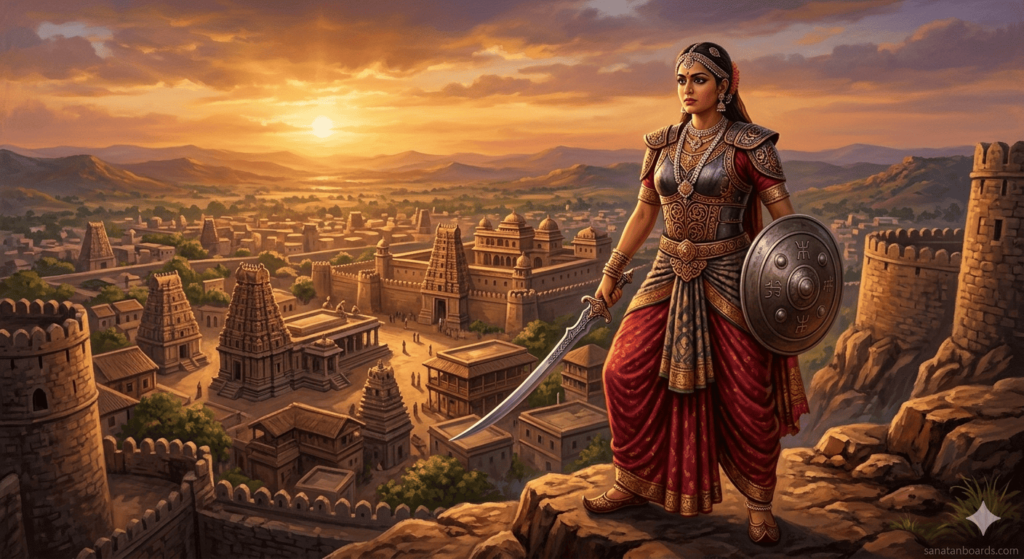
Rudrama Devi was a monarch of the Kakatiya dynasty, which rose to prominence in the Deccan region of India during the 12th and 13th centuries. Her reign, which began around 1262 CE and lasted until her death in 1289 CE, is one of the most celebrated and documented eras in South Indian history. She was the daughter of King Ganapati Deva, a powerful ruler who expanded the Kakatiya kingdom and strengthened its governance. Unlike traditional succession that favored sons, Ganapati Deva chose Rudrama Devi to succeed him, largely due to her demonstrated intelligence, leadership qualities and capability to rule.
Rudrama Devi is widely known as a warrior queen because, in addition to overseeing state administration, she personally led military campaigns to defend and expand her kingdom. Historians describe her as a brilliant strategist who managed to quell rebellions and protect her territories against rival kingdoms and invading forces. She was given the honorary title of “Rudradeva Maharaja,” a masculine form used in inscriptions to signify her authority and legitimacy as ruler.
Under her leadership, the Kakatiya kingdom prospered. She implemented revenue reforms, improved irrigation systems, and promoted trade and agriculture in her realm. Rudrama Devi was also a patron of art and temple-building, contributing to the cultural vitality of the region. Her governance style was inclusive — she worked closely with ministers, military generals, and local chieftains to build consensus and maintain unity.
Above all, Rudrama Devi’s life challenges common assumptions about leadership and gender roles in medieval history. She remains an enduring symbol of female power, courage, and stewardship in Indian history, and her story continues to be studied for its cultural and historical significance.
Who Is Required Rudrama Devi (Kakatiya, Female Warrior Queen) ?
When discussing the question “who is Rudrama Devi,” it is important to understand not only her identity but also who benefits from studying her life and legacy. Rudrama Devi is not simply a historical figure; she represents a powerful example of leadership, resilience, and equality. She is required in the narratives of history, culture, gender studies, leadership studies, and societal development — not merely as a queen of the past but as an influential role model for people of all ages and backgrounds today.
Rudrama Devi is required by students and scholars who wish to understand the dynamics of power in medieval South Asia, especially in a period where patriarchal norms dominated political discourse. Her story provides insight into how women could rise to positions of supreme authority despite systemic barriers. Historians require her legacy to reframe narratives about women’s roles in premodern societies. By studying her, learners uncover how dynastic politics, governance structures, military strategies, and cultural practices functioned during her time.
Beyond academic study, Rudrama Devi is required by leaders and policymakers who seek inspiration from historical female leadership. She offers a model for decision-making under pressure, strategic planning, and collaborative governance. Her reign shows that leadership effectiveness does not depend on gender but on integrity, vision, and resilience.
Rudrama Devi is also required by cultural storytellers, filmmakers, authors, and educators. Her life encourages creative retellings that honor diversity, strength, and the complexity of human history. Finally, she is required by communities who aim to preserve and celebrate regional heritage. In Telangana and Andhra Pradesh especially, Rudrama Devi’s story fosters pride and cultural continuity.
In all these ways, Rudrama Devi is not only a historical queen but a continuing presence across disciplines, narratives, and cultures.
When Rudrama Devi (Kakatiya, Female Warrior Queen) Is Required ?
Rudrama Devi’s life and reign are required at various points across time, particularly when society seeks examples of courage, governance, and gender equality in historical leadership. Her legacy becomes especially relevant during times of reflection, education, and social transformation.
Firstly, Rudrama Devi is required in academic curricula, particularly in history and gender studies. Her reign offers critical perspectives on the roles women played in politics and warfare during medieval India. Students studying ancient and medieval Indian history encounter her story when exploring the political structures and cultural norms of the Deccan region in the 13th century. At this point of learning, her reign is required to demonstrate that women were not absent from power but were active agents shaping political landscapes.
Secondly, Rudrama Devi is required during commemorations of women’s achievements, such as International Women’s Day, conferences, and cultural festivals that celebrate female empowerment. Her example resonates strongly as a historical precedent for women’s leadership and bravery. When societies worldwide focus on gender equality and women’s rights, Rudrama Devi’s story offers inspiration and historical grounding.
As societies debate issues of representation and inclusion, Rudrama Devi’s reign becomes an essential point of reference. For policymakers and thought leaders discussing barriers to leadership opportunities for women, Rudrama Devi’s rule provides evidence that women have successfully governed complex political entities in difficult times. This makes her life required in dialogues that seek change in political representation and leadership inclusion.
Her legacy is also required in cultural heritage preservation and tourism development, particularly in the regions of Telangana and Andhra Pradesh. Archaeologists, historians, and government agencies involved in preserving temples, forts, and inscriptions from the Kakatiya period frequently reference Rudrama Devi to authenticate and interpret historical sites.
Additionally, Rudrama Devi is required in popular media and storytelling — books, films, and theatrical productions that aim to portray strong historical characters. Her life story, filled with challenges, battles, governance, and social change, provides rich material for creative adaptations.
Finally, Rudrama Devi is required in personal narratives of individuals seeking role models who embody resilience and leadership. Her name is invoked when encouraging youth, especially young women, to pursue ambitions boldly. In these moments — in classrooms, cultural forums, media, policy debates, and personal reflections — Rudrama Devi’s legacy continues to be required and celebrated.
Where Rudrama Devi (Kakatiya, Female Warrior Queen) Is Required ?
Rudrama Devi’s influence is required across multiple geographical, social, and institutional contexts. Her legacy is most strongly rooted in the Deccan region of India, especially in present-day Telangana and Andhra Pradesh, where she ruled. Her administration strengthened urban centers, fortified towns, and improved irrigation infrastructure, leaving a tangible mark on the landscape. In these regions, her story is required in schools, universities, museums, and cultural centers to connect local history to the broader narrative of Indian heritage.
Her legacy is required in historical research institutions that study the Kakatiya dynasty, medieval Indian politics, and female leadership. Scholars analyze her rule to understand patterns of governance, diplomacy, and military strategy, drawing lessons relevant even in contemporary policy studies. Additionally, her life is required at archaeological and heritage sites where temples, forts, and inscriptions commissioned during her reign exist. These sites are not only educational but also form part of cultural tourism, where Rudrama Devi’s history provides context and meaning.
Beyond India, Rudrama Devi’s story is required in global forums discussing women in leadership and history. Universities and conferences around the world use her as a case study to illustrate early examples of female empowerment, challenging stereotypes about leadership in premodern societies. Her example is particularly required in contexts that explore the intersection of gender, power, and culture, serving as a bridge between regional history and universal human themes.
Her legacy is also required in popular culture and media. Films, literature, and television series dramatizing her life bring her story to audiences far beyond her native region. These portrayals inspire viewers and readers, creating cultural awareness and reinforcing the idea that leadership transcends gender norms.
Finally, Rudrama Devi is required in policy and leadership training programs that encourage learning from historical role models. Leaders and managers study her strategies to extract lessons in negotiation, conflict resolution, and governance. In essence, she is required wherever historical examples of effective, courageous, and innovative leadership are celebrated.
How Rudrama Devi (Kakatiya, Female Warrior Queen) Is Required ?
Rudrama Devi is required through practical, symbolic, and inspirational methods. Practically, her legacy is required by historians and researchers who examine inscriptions, coins, and architectural monuments from the Kakatiya era. These physical artifacts provide direct evidence of her rule and administrative practices. Scholars analyze her governance methods, taxation systems, and military campaigns to understand how she managed a kingdom during a period when female rulers were rare.
Symbolically, Rudrama Devi is required as a cultural icon of empowerment and resilience. Her life serves as a narrative tool to inspire women and men alike, demonstrating that leadership is not defined by gender but by vision, courage, and competence. Educational institutions often use her story to foster discussions about equality, perseverance, and strategic thinking.
Rudrama Devi is also required in media and storytelling. Documentaries, films, novels, and stage plays reinterpret her life, making her story accessible to broader audiences. Through visual and literary narratives, people learn not only about historical events but also about the personal courage and determination that defined her reign.
She is required in policy and leadership studies, where her reign is studied for lessons in crisis management, diplomacy, and military strategy. Her approaches to administration, conflict resolution, and social welfare provide insights for modern governance and organizational leadership.
Additionally, Rudrama Devi is required in community and heritage programs that preserve cultural memory. Local festivals, museums, and cultural projects celebrate her achievements, reinforcing historical identity and pride. Through these initiatives, she becomes a living part of community consciousness, connecting past to present.
Finally, Rudrama Devi is required as a moral and ethical guide. Her dedication to justice, people’s welfare, and kingdom prosperity serves as a template for ethical leadership. In these multiple contexts—academic, cultural, organizational, and symbolic—Rudrama Devi is required as both a historical figure and a continuing source of inspiration.
Case Study On Rudrama Devi (Kakatiya, Female Warrior Queen)
Rudrama Devi’s reign offers a unique case study in medieval Indian governance, military strategy, and gender dynamics. Ascending the throne around 1262 CE, Rudrama Devi inherited a kingdom that required consolidation, strategic defense, and administrative refinement. Her father, Ganapati Deva, had expanded the Kakatiya territories, and Rudrama Devi’s primary challenge was maintaining this stability while asserting her authority in a male-dominated political environment.
Leadership Style: Rudrama Devi combined diplomacy and military action. She recognized that her gender might be questioned by nobles, rival kings, and local chieftains. To reinforce her authority, she adopted the title “Rudradeva Maharaja” and wore male attire in official ceremonies, asserting both strength and legitimacy. Her leadership style was participatory; she consulted ministers, generals, and advisors, fostering loyalty and minimizing resistance.
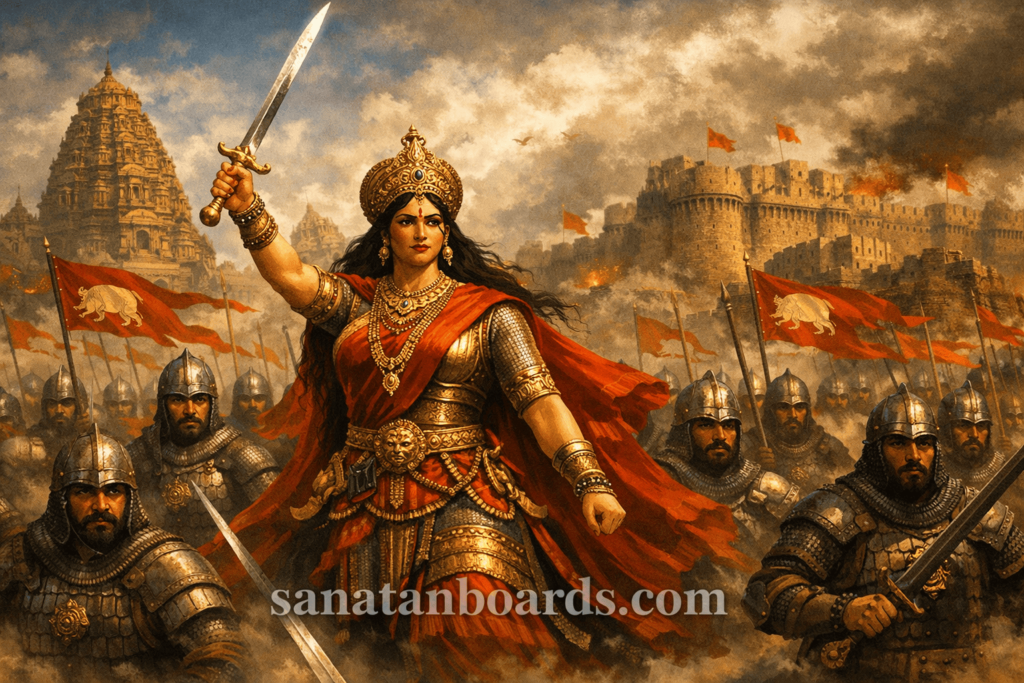
Military Strategy: Rudrama Devi personally led campaigns to suppress rebellions and protect borders. She faced multiple threats, including attempts by rival chieftains to take advantage of perceived weaknesses. Records suggest she strategically deployed troops, fortified towns, and employed intelligence networks to anticipate enemy movements. Her military decisions reflect deep knowledge of terrain, logistics, and troop morale, demonstrating a sophisticated understanding of warfare.
Administrative Reforms: Rudrama Devi streamlined governance through improved revenue collection, fair taxation policies, and expanded irrigation systems, ensuring agricultural productivity. She supervised temple administration and encouraged art and culture, balancing economic growth with social welfare. Her rule strengthened urban centers and trade routes, providing long-term stability to her kingdom.
Challenges: Despite her abilities, Rudrama Devi faced constant opposition due to her gender. Some nobles resisted her authority, while neighboring rulers questioned her military capability. She overcame these challenges by demonstrating competence, decisiveness, and courage in both political and battlefield scenarios.
Legacy and Cultural Impact: Rudrama Devi’s reign left a lasting imprint on South Indian history. Her leadership challenged traditional gender roles and inspired subsequent generations. Temples, forts, and inscriptions from her era continue to be studied for insights into Kakatiya architecture, governance, and culture. In modern times, her story has been adapted into films, literature, and educational materials, making her a symbol of female empowerment.
Key Lessons: The case study of Rudrama Devi highlights critical lessons in leadership: adaptability in the face of adversity, balancing diplomacy and force, #Sanatandharmaaccreditationboardsinvasai prioritizing social welfare alongside political power, and redefining societal norms. Her reign exemplifies how visionary leadership, even in restrictive contexts, can achieve enduring success.
White Paper On Rudrama Devi (Kakatiya, Female Warrior Queen)
This white paper examines Rudrama Devi as a model of strategic leadership, governance, and gender equity. By analyzing historical data, inscriptions, and cultural records, we assess her reign’s implications for modern leadership and organizational theory.
Introduction: Rudrama Devi, a 13th-century ruler of the Kakatiya dynasty, demonstrates how strategic vision and operational excellence can overcome societal limitations. As a female ruler in a patriarchal society, she utilized both symbolic and practical measures to secure her authority, ensuring the prosperity of her kingdom.
Governance and Administration: Rudrama Devi implemented systematic revenue reforms and land management policies, promoting agricultural growth and social stability. She encouraged civic infrastructure, irrigation projects, and temple administration, which contributed to cultural and economic prosperity. Her administrative approach highlights decentralized decision-making, emphasizing collaboration with local leaders while maintaining centralized authority.
Military Leadership: Rudrama Devi’s military campaigns illustrate effective battlefield leadership and strategic foresight. She managed resources, anticipated threats, and demonstrated resilience against repeated challenges. Her campaigns exemplify modern principles of risk management, strategic planning, and morale building in high-stakes environments.
Gender and Leadership: Rudrama Devi’s reign challenges conventional gender norms. By adopting male titles and assuming public authority, she navigated societal biases while establishing legitimacy. This case underscores the importance of representation, strategic branding, and confidence in leadership effectiveness irrespective of gender.
Cultural and Social Impact: Beyond administration, Rudrama Devi’s patronage of art, architecture, and religious institutions cemented her legacy. Her reign strengthened regional identity, preserved cultural heritage, and inspired subsequent generations.
Implications for Modern Leadership: Contemporary leaders can draw lessons from Rudrama Devi’s tenure: resilience in adversity, integration of strategic and operational planning, stakeholder engagement, and adaptability in navigating cultural norms. Her reign also provides a template for inclusive governance, demonstrating the importance of empowerment and merit-based authority.
Conclusion: Rudrama Devi exemplifies how visionary leadership can overcome societal constraints, manage complex organizations, and #Sanatandharmaaccreditationboardsinmumbai achieve lasting impact. Her story informs historical research, leadership studies, gender discourse, and cultural preservation efforts.
Industry Application On Rudrama Devi (Kakatiya, Female Warrior Queen)
The case study of Rudrama Devi provides lessons that can be applied across various modern industries, showing how historical leadership, strategy, and resilience translate into contemporary organizational contexts.
1. Leadership and Management Training
- Application: Rudrama Devi’s governance and military strategy serve as case studies in leadership development programs.
- Industry: Corporate training, executive coaching, and business schools.
- Benefit: Her example teaches resilience, strategic planning, and decision-making under uncertainty—qualities essential for modern executives.
2. Gender Diversity and Inclusion Initiatives
- Application: Organizations can use Rudrama Devi’s example to promote women’s empowerment and inclusive leadership.
- Industry: HR departments, NGOs, governmental gender programs.
- Benefit: Highlights the historical impact of women leaders, encouraging policies that support equal representation and leadership opportunities.
3. Cultural Tourism and Heritage Industry
- Application: Monuments, forts, temples, and historical sites associated with Rudrama Devi attract tourists and researchers.
- Industry: Tourism boards, heritage management, travel agencies.
- Benefit: Drives regional economic development and preserves cultural heritage through curated tours, exhibitions, and educational programs.
4. Media and Entertainment
- Application: Films, documentaries, books, and web series based on her life.
- Industry: Film studios, digital content platforms, publishing houses.
- Benefit: Creates engaging narratives that educate audiences while promoting historical storytelling, inspiring content development in history-based entertainment.
5. Educational Industry
- Application: Incorporating Rudrama Devi’s case study into school and university curricula.
- Industry: Academic institutions, e-learning platforms, educational publishers.
- Benefit: Provides students with historical examples of leadership, strategy, and gender equality, enriching lessons in history, social studies, and ethics.
6. Strategic Consulting and Crisis Management
- Application: Her strategic military campaigns and administrative reforms can be used as lessons in risk assessment and crisis response.
- Industry: Consulting firms, defense training academies, organizational strategy workshops.
- Benefit: Offers insights into leadership under pressure, resource management, and conflict resolution.
7. Branding and Corporate Identity
- Application: Companies seeking to align with traits like courage, resilience, and visionary leadership can draw inspiration from Rudrama Devi.
- Industry: Marketing, brand strategy, corporate storytelling.
- Benefit: Establishes strong brand narratives that resonate with values of empowerment and strategic excellence.
8. Technology and Digital Archives
- Application: Digitization of inscriptions, artifacts, and historical records associated with her reign.
- Industry: Digital heritage platforms, AI-driven historical research, virtual reality tourism.
- Benefit: Preserves history digitally, increases accessibility, and enables interactive educational tools for global audiences.
source : Amish Tripathi
ASK FAQ
Who was Rudrama Devi of the Kakatiya dynasty?
Rudrama Devi was a 13th-century female warrior queen of the Kakatiya dynasty in South India, known for her courage, leadership, and military strategy.
What were the achievements of Rudrama Devi as a ruler?
She expanded her kingdom, strengthened governance, led military campaigns, improved irrigation, promoted trade, and supported art and temple construction.
Why is Rudrama Devi considered a symbol of female empowerment?
She broke gender norms in a male-dominated era by ruling as a strong monarch, commanding armies, and making strategic political decisions.
When did Rudrama Devi rule the Kakatiya kingdom?
Rudrama Devi ruled approximately from 1262 CE to 1289 CE, during the height of the Kakatiya dynasty’s power in the Deccan region.
How does Rudrama Devi’s legacy influence modern society?
Her leadership inspires education, gender equality initiatives, leadership programs, cultural tourism, and historical storytelling in media and academia.
Table of Contents
Disclaimer
The information presented here is compiled for historical, cultural, and knowledge purposes. It is based on historical records, inscriptions, and scholarly research. Interpretations of events, dates, and narratives are subject to academic debate and may vary according to sourc