The Rigveda Knowledge Network is a pioneering initiative aimed at preserving, studying, and disseminating the ancient wisdom contained in the Rigveda, one of the oldest texts in human history. The Rigveda, written in Sanskrit, contains hymns, philosophies, and guidance on spirituality, society, and science from thousands of years ago. Its teachings have influenced not only Indian culture but also global philosophical thought.
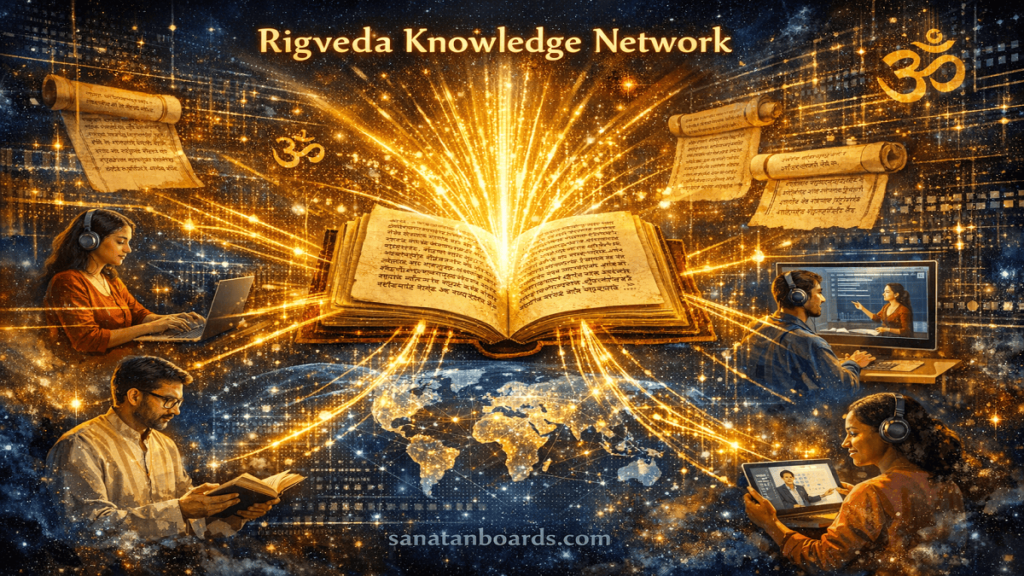
The Rigveda Knowledge Network functions as a digital and educational platform that connects scholars, students, and enthusiasts from across the world. Through this network, users can access Rigvedic texts, translations, commentaries, and scholarly research. It serves as a bridge between traditional knowledge systems and modern learning methodologies, promoting research, discussion, and interpretation of Rigvedic principles in a contemporary context.
By providing structured learning resources, interactive forums, and https://sanatanboards.com/collaborative opportunities, the network fosters a deeper understanding of the Rigveda’s significance. Whether for academic research, spiritual exploration, or cultural study, the Rigveda Knowledge Network empowers learners to engage with ancient texts meaningfully, ensuring that the knowledge is not just preserved but actively studied and applied in today’s world.
What Is Rigveda Knowledge Network ?
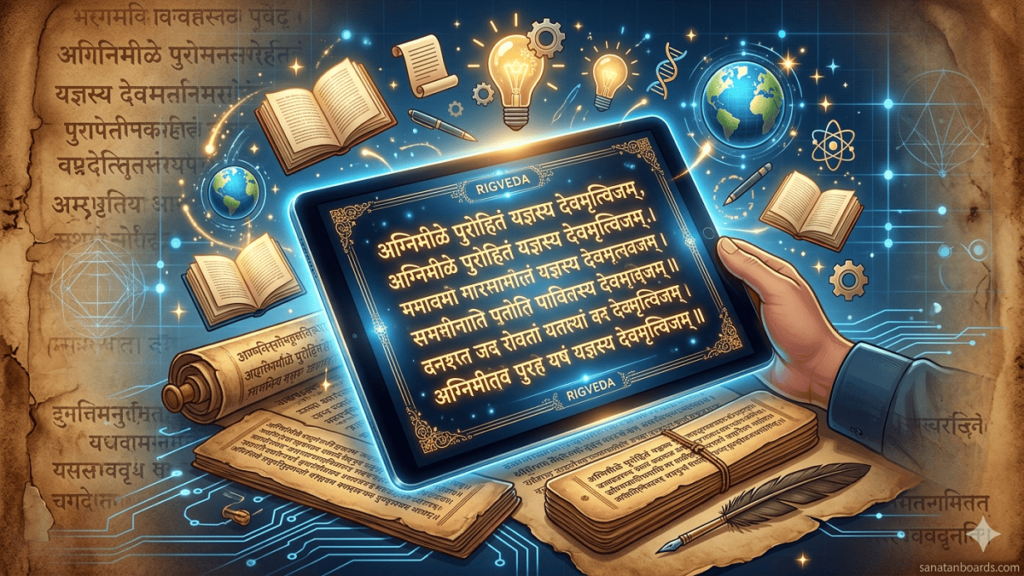
The Rigveda Knowledge Network (RKN) is an educational and research-oriented platform designed to centralize knowledge related to the Rigveda. The Rigveda itself is the oldest of the four Vedas, consisting of hymns, rituals, and philosophical teachings that provide insight into early human thought, spirituality, and social structure. The RKN provides a structured way to explore these ancient texts, combining classical scholarship with modern learning tools.
Primarily, the network functions as a comprehensive repository of Rigvedic literature. Users can access digitized versions of original texts in Sanskrit along with translations in multiple languages. It also includes commentaries by traditional scholars and modern researchers, allowing for a comparative study of interpretations. By bringing these resources together, the network facilitates both textual analysis and contextual understanding.
The RKN also emphasizes collaborative learning. Through forums, webinars and discussion groups, participants can engage with experts, ask questions, and share insights. This interaction fosters a dynamic learning environment where traditional Vedic knowledge can be explored alongside contemporary academic methodologies.
Moreover, the network serves as a bridge between ancient wisdom and modern applications. It explores how Rigvedic principles relate to science, philosophy, ethics, and even leadership. By doing so, it highlights the timeless relevance of the Rigveda in personal development, education, and cultural understanding.
In essence, the Rigveda Knowledge Network is more than just an archive; it is a vibrant educational ecosystem. It ensures that the wisdom of the Rigveda remains accessible, interpretable, and applicable to learners worldwide, making it an essential resource for anyone interested in understanding one of humanity’s oldest knowledge systems.
Who Is Required Rigveda Knowledge Network ?
The Rigveda Knowledge Network caters to a diverse audience interested in education, research, spirituality, and cultural studies. Scholars of Indology, Sanskrit literature, philosophy, and ancient history are among the primary users, as the network provides authoritative texts, translations, and commentaries necessary for in-depth research. Students pursuing academic degrees related to Indian culture, philosophy, or religious studies can also benefit significantly from the structured resources provided.
Beyond academia, spiritual seekers and practitioners are natural users of the network. The Rigveda contains hymns and mantras that have been used for meditation, rituals, and personal reflection for centuries. Access to accurate translations and interpretations allows spiritual learners to engage deeply with these practices while understanding their historical and philosophical context.
Educators and teachers are another important group who require this network. The Rigveda Knowledge Network equips them with teaching tools, lesson plans, and curated material to introduce students to Vedic knowledge effectively. By bridging the gap between traditional texts and modern pedagogy, it helps educators foster meaningful engagement with ancient wisdom.
Even enthusiasts with a general interest in culture, history, and philosophy benefit from the network. In a world increasingly disconnected from traditional knowledge systems, the RKN provides a reliable platform to explore the origins of Indian thought, societal organization, and philosophical inquiry.
Ultimately, anyone seeking to understand the Rigveda—whether for academic research, personal growth, teaching, or cultural appreciation—requires the Rigveda Knowledge Network. Its comprehensive resources and interactive learning opportunities make it indispensable for ensuring authentic engagement with one of humanity’s oldest and most profound sources of knowledge.
When Is Rigveda Knowledge Network Required ?
The Rigveda Knowledge Network becomes essential whenever there is a need to access, study, or apply the knowledge contained in the Rigveda. For centuries, the Rigveda has been a cornerstone of spiritual, cultural, and intellectual traditions in India. Today, its study remains relevant not just in religious contexts but also in modern education, philosophy, and comparative studies.
Students and researchers require the network whenever they are engaging in academic work related to Vedic literature. Whether preparing for examinations, writing research papers, or conducting comparative studies, the network provides accurate texts, translations, and scholarly commentaries. Its digital infrastructure ensures that these resources are available at any time, making research more efficient and comprehensive.
The network is also required by educators when designing curricula or lesson plans about ancient Indian texts. Teachers often seek authentic materials to provide students with a clear understanding of the Rigveda’s significance. The Rigveda Knowledge Network allows educators to access structured resources, including explanations of hymns, historical context, and cultural interpretations, all of which can be adapted for classroom learning.
Spiritual practitioners and seekers turn to the network whenever they wish to explore the Rigveda’s hymns and mantras for meditation, rituals, or personal development. The correct understanding of Sanskrit verses, their meanings, and their applications often requires guidance from credible sources. The Rigveda Knowledge Network provides such guidance, making it crucial for anyone seeking a deep spiritual experience grounded in authentic knowledge.
The network is also required in contemporary discussions about philosophy, ethics, and leadership. Many of the Rigveda’s teachings on duty, morality, and societal organization remain relevant in modern contexts. Professionals, thinkers, and enthusiasts seeking insight from ancient wisdom can consult the network to extract practical lessons for today’s challenges.
Finally, the network is indispensable whenever there is a need to preserve and transmit knowledge across generations. With the digitization of texts and interactive learning tools, the Rigveda Knowledge Network ensures that this ancient wisdom remains accessible, accurate, and relevant. In essence, whenever learning, teaching, research, spiritual exploration, or cultural understanding is involved, the Rigveda Knowledge Network is required.
Where Is Rigveda Knowledge Network Required ?
The Rigveda Knowledge Network is required in multiple contexts where access to Rigvedic knowledge is necessary, both physically and digitally. First and foremost, it is vital in educational institutions such as universities, colleges, and research centers. Departments of Sanskrit, Indology, Philosophy, and Religious Studies rely on the network to provide students and faculty with accurate texts, translations, and scholarly insights. Libraries and learning centers use the network as a reference point for sourcing authentic materials that are otherwise difficult to access.
It is equally required in spiritual and cultural centers. Temples, Vedic schools (pathshalas), and meditation centers often use Rigvedic knowledge in rituals and teachings. Having access to the network ensures that the hymns, mantras, and interpretations used in these settings are accurate, preserving the integrity of traditional practices.
The network is also necessary in homes for personal study and spiritual practice. Modern learners, regardless of their geographic location, can access Rigvedic knowledge online through the network. This accessibility is especially important for the diaspora and enthusiasts living far from traditional centers of Vedic learning.
Globally, the Rigveda Knowledge Network serves as a platform for scholars, researchers, and students who wish to engage with ancient Indian wisdom without being physically present in India. Online access makes it possible for anyone, anywhere, to study Rigvedic texts, participate in webinars, or join discussion forums.
Additionally, the network is required in professional and interdisciplinary contexts. Researchers in anthropology, history, comparative religion, and philosophy often need reliable sources from the Rigveda to support their work. By centralizing resources in one network, scholars can ensure authenticity and accuracy.
How Is Rigveda Knowledge Network Required ?
The Rigveda Knowledge Network is required through a combination of digital access, educational tools, and collaborative learning processes. Its requirement arises from the need to make ancient knowledge available, understandable, and applicable in modern contexts.
First, it is required in research and academic study. Scholars and students access the network to consult digitized Rigvedic texts, compare translations, and read scholarly commentaries. The network provides tools for textual analysis, linguistic study, and contextual interpretation, which are essential for accurate academic work. Researchers can search for specific hymns, themes, or references, making the study of Rigveda more efficient than traditional methods.
Second, it is required in education and teaching. Educators use the network to design curricula and lesson plans that make Rigvedic knowledge accessible to learners of different levels. Interactive tools, such as discussion forums, webinars, and multimedia content, help students engage deeply with the material. Teachers can integrate these resources into classrooms, workshops, and online courses, bridging the gap between ancient texts and modern pedagogy.
Third, the network is required in spiritual practice. Practitioners seeking to recite or understand Rigvedic hymns benefit from accurate translations, pronunciation guides, and explanations of philosophical concepts. The network ensures that rituals, meditations, and recitations are performed with understanding and respect for traditional knowledge.
Fourth, it is required in cultural preservation and global learning. Digitization ensures that Rigvedic texts are preserved and accessible worldwide. Individuals, cultural organizations, and educational platforms use the network to promote awareness of India’s ancient wisdom globally.
Finally, it is required in interdisciplinary applications. Philosophers, historians, scientists, and leaders can use insights from Rigveda to explore ethical frameworks, societal structures, and human behavior. The network provides structured access, making it possible to extract relevant knowledge for modern application.
Case Study On Rigveda Knowledge Network
The Rigveda Knowledge Network (RKN) has emerged as a transformative tool in bridging ancient knowledge systems with contemporary education. One illustrative case study involves its adoption by a university Sanskrit department in India, which sought to modernize Vedic studies for undergraduate and postgraduate students. Prior to implementation, students struggled with accessing authentic Rigvedic texts, understanding archaic Sanskrit, and connecting hymns to historical and philosophical contexts.
The university partnered with the Rigveda Knowledge Network to provide digital access to Rigvedic texts, translations, and commentaries. The network’s structured modules allowed students to explore each hymn with explanations of Sanskrit grammar, meaning, and cultural context. Additionally, interactive discussion forums enabled students to engage with scholars and peers, fostering collaborative learning.
Over the course of two semesters, faculty observed a significant improvement in student comprehension and engagement. Students who had previously found Vedic studies abstract or challenging began analyzing the hymns critically, identifying recurring themes, and linking philosophical insights to contemporary ethical and societal issues. For example, lessons on Rigveda’s hymns related to social harmony were applied in group projects exploring conflict resolution and leadership.
The network also allowed for interdisciplinary integration. Students studying history, philosophy, and environmental studies drew insights from Rigvedic concepts, connecting ancient ecological wisdom with modern sustainability practices. Moreover, the digitized archive enabled remote learning, allowing international students to participate in Rigvedic studies without being physically present.
A key takeaway from this case study is that the Rigveda Knowledge Network serves not only as a repository of texts but also as an educational ecosystem. Its combination of digital access, scholarly commentary, and collaborative tools ensures that ancient wisdom is actively studied, contextualized, and applied in modern learning scenarios. The network has proven effective in enhancing academic research, fostering critical thinking, and making Rigvedic knowledge accessible to a diverse, global audience.
In conclusion, the case study demonstrates the practical value of the Rigveda Knowledge Network in modern education. By integrating #rigvedaknowledgenetworkinlucknow technology with tradition, it enables meaningful engagement with one of the oldest bodies of human knowledge, ensuring that the wisdom of the #rigvedaknowledgenetworkinbangalore Rigveda remains alive and relevant for contemporary learners.
White Paper On Rigveda Knowledge Network
Executive Summary:
The Rigveda Knowledge Network (RKN) is an innovative educational and research platform designed to centralize, preserve, and disseminate the knowledge contained in the Rigveda, one of humanity’s oldest sacred texts. This white paper explores the need, design, and benefits of the RKN, providing a framework for academic institutions, cultural organizations, and researchers seeking structured access to Rigvedic wisdom.
Problem Statement:
The Rigveda, composed over 3,000 years ago, is an extensive collection of hymns and philosophical teachings in Sanskrit. Despite its significance, access to authentic texts and accurate translations has historically been limited, scattered, and difficult for both scholars and learners. Modern learners often face challenges in understanding archaic language, contextualizing the hymns, and applying the knowledge in contemporary studies.
Solution:
The Rigveda Knowledge Network addresses these challenges by offering a centralized, digital platform with digitized texts, multilingual translations, scholarly commentaries, and interactive learning tools. The network enables:
- Academic Research: Facilitating textual analysis, historical research, and philosophical inquiry.
- Educational Integration: Providing resources for curriculum development, lesson planning, and classroom instruction.
- Spiritual Learning: Offering guided interpretations for meditation, rituals, and personal growth.
- Global Access: Allowing remote learners and international scholars to study Rigvedic knowledge without geographic constraints.
Benefits:
- Preservation of ancient texts in digital format for future generations.
- Enhanced engagement through interactive tools and discussion forums.
- Bridging traditional wisdom with modern pedagogy and interdisciplinary studies.
- Support for cultural education and awareness on a global scale.
Implementation:
The network is structured into modules covering various aspects of the Rigveda, including hymns, mantras, rituals, and philosophical insights. Integration with modern learning management systems allows universities, cultural organizations, and online platforms to adopt the RKN seamlessly. Regular webinars, virtual workshops, and research collaborations enhance user engagement and knowledge dissemination.
Conclusion:
The Rigveda Knowledge Network represents a model for integrating ancient knowledge systems with modern technology. By providing #rigvedaknowledgenetworkinmumbai structured, accessible, and collaborative learning opportunities, the network ensures that Rigvedic wisdom continues to inform education, research, #rigvedaknowledgenetworkinvasai and personal development worldwide.
Industry Applications of Rigveda Knowledge Network
The Rigveda Knowledge Network (RKN) has significant potential beyond traditional academic and spiritual contexts, offering applications across various industries. By converting ancient wisdom into accessible digital formats, the network serves as a resource for education, technology, cultural preservation, wellness, and leadership development.
1. Education and E-Learning Industry:
EdTech companies can integrate the RKN into online learning platforms to teach history, philosophy, Sanskrit, and comparative religion courses. Interactive modules and digital texts allow students to study Rigvedic knowledge globally, bridging traditional content with modern pedagogical methods. Schools and universities can use RKN to enhance curriculum quality and provide authentic resources for students and educators.
2. Cultural Preservation and Tourism:
Museums, cultural centers, and heritage organizations can leverage the RKN to promote Indian culture. Digital access to Rigvedic texts, audio recitations, and scholarly interpretations helps preserve intangible heritage. Additionally, tourism initiatives can use the network to educate visitors about Vedic rituals, hymns, and philosophy, enriching cultural experiences.
3. Wellness and Spirituality Industry:
The wellness sector, including yoga studios and meditation centers, benefits from the RKN by accessing authentic Rigvedic hymns and mantras for meditation, chanting, and mindfulness practices. Accurate guidance ensures that spiritual practices are rooted in tradition, enhancing authenticity and effectiveness.
4. Research and Consulting Industry:
Consultancies focused on leadership, ethics, and organizational behavior can draw insights from Rigvedic teachings. Principles on duty, morality, social harmony, and decision-making can be applied in corporate training programs, leadership workshops, and ethics courses. The RKN serves as a knowledge repository for extracting practical lessons from ancient wisdom.
5. Technology and AI Industry:
The digitized corpus of the Rigveda enables AI and NLP projects for language analysis, translation, and semantic research. Developers can use the network to train AI models in ancient Sanskrit, supporting digital preservation, text recognition, and linguistic research.
6. Publishing and Media Industry:
Publishers and content creators can utilize the RKN to produce books, documentaries, online courses, and multimedia content about the Rigveda. The network provides authentic material and scholarly commentary, ensuring accuracy and credibility in publications.
In summary, the Rigveda Knowledge Network has wide-ranging industry applications that extend its value far beyond academia and spiritual study. By bridging #sanatandharmaaccreditationboardsinmumbai ancient wisdom with modern technology and industry needs, the RKN contributes to cultural preservation, education, wellness, corporate leadership, and technological innovation. Its versatility demonstrates that #sanatandharmaaccreditationboardsinvasai Rigvedic knowledge is not only a historical treasure but also a practical resource for modern society.
source : VEDIC DISCOVERY
ASK FAQ
What is the Rigveda Knowledge Network?
The Rigveda Knowledge Network (RKN) is an educational and research platform that provides digital access to Rigvedic texts, translations, and scholarly commentaries. It connects students, researchers, and spiritual learners worldwide to study and preserve ancient Vedic knowledge.
Who can benefit from the Rigveda Knowledge Network?
Scholars, students, educators, spiritual practitioners, and cultural enthusiasts can benefit from RKN. It supports academic research, teaching, personal spiritual practice, and the study of ancient Indian philosophy and history.
How can I access Rigveda Knowledge Network?
The Rigveda Knowledge Network can be accessed online through its official digital platform, offering texts, translations, commentaries, and interactive learning tools for global learners.
Why is Rigveda Knowledge Network important for education?
RKN bridges ancient knowledge and modern learning by providing structured resources, lesson plans, and interactive tools. It enhances comprehension of Rigvedic hymns, philosophy, and cultural heritage for students and educators.
What are the applications of Rigveda Knowledge Network in modern industry?
RKN is applied in education, cultural preservation, wellness, research, corporate ethics, and technology sectors. It supports learning, meditation practices, leadership training, AI research, and global cultural awareness.
Table of Contents
Disclaimer
This content is for educational and knowledge purposes only. It is not intended as religious guidance or professional advice.