The history of India is enriched by the valor, resilience, and cultural legacy of the Rajput kingdoms, which played a significant role in shaping the political and social fabric of medieval India. Among the most prominent figures in this era were Prithviraj Chauhan, Rana Kumbha, Rana Sanga, and Maharana Pratap. These rulers exemplified courage, leadership, and a strong sense of independence, resisting foreign invasions and preserving regional autonomy.
Rajput kingdoms emerged as powerful entities in northern and western India after the decline of major empires. They were characterized by decentralized governance, warrior traditions, and a strong code of honor known as “Rajputana pride.” Each ruler contributed uniquely—Prithviraj Chauhan is remembered for his battles against invaders, Rana Kumbha for strengthening Mewar’s defenses and culture, Rana Sanga for uniting Rajput clans against external threats, and Maharana Pratap for his unwavering resistance against Mughal expansion.
Their legacy extends beyond warfare, influencing architecture, literature, and regional identity. Forts such as Kumbhalgarh and Chittorgarh stand as symbols of their strategic brilliance and determination. The Rajput ethos emphasized loyalty, sacrifice, and duty, which continue to inspire generations.
Understanding these rulers provides insight into India’s historical struggles for sovereignty and cultural preservation. Their stories are not just tales of battles but also reflections of governance, diplomacy and resilience in the face of adversity.
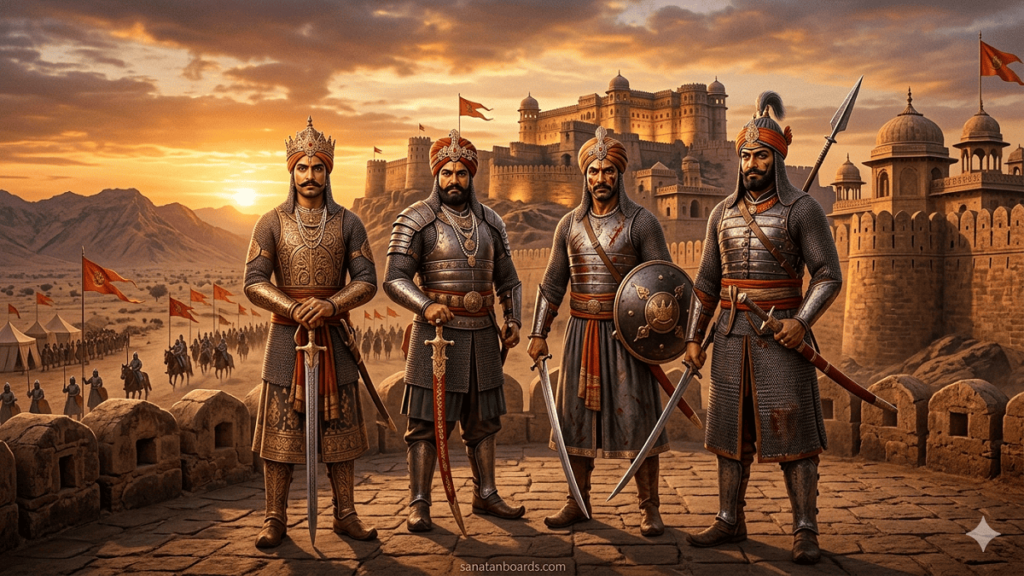
What Is Rajput Kingdoms – King Prithviraj Chauhan, Rana Kumbha, Rana Sanga, Maharana Pratap ?
Rajput kingdoms refer to a collection of regional powers ruled by Rajput clans across northern and western India, particularly between the 8th and 18th centuries. These kingdoms were not unified under a single empire but functioned as independent or semi-independent states, often bound by kinship, alliances, and shared cultural values.
Prithviraj Chauhan was one of the earliest prominent Rajput rulers known for resisting early Islamic invasions. His reign symbolized the defense of northern India during a critical transitional period. Rana Kumbha strengthened the kingdom of Mewar through military victories and architectural achievements, including the construction of massive forts and temples.
Rana Sanga expanded Rajput influence by forming alliances among various clans, creating a formidable force against emerging powers like the Mughals. Meanwhile, Maharana Pratap became a symbol of resistance and independence, especially for his refusal to submit to Mughal authority and his persistence in guerrilla warfare.
Together, these rulers represent the core values of Rajput kingdoms: bravery, honor, autonomy, and cultural pride. The kingdoms were structured around feudal systems, where local chieftains pledged loyalty to a central ruler while maintaining control over their territories.
The concept of Rajput kingdoms is not limited to political boundaries but includes a broader cultural and social identity that emphasized martial traditions, loyalty, and respect for heritage. Their collective contributions form a crucial chapter in Indian history, illustrating both unity and diversity within regional governance.
Why Is Required Rajput Kingdoms – King Prithviraj Chauhan, Rana Kumbha, Rana Sanga, Maharana Pratap ?
The study and understanding of Rajput kingdoms and their prominent rulers such as Prithviraj Chauhan, Rana Kumbha, Rana Sanga, and Maharana Pratap are essential for multiple reasons.
Firstly, they provide a deep understanding of India’s resistance against invasions and the preservation of cultural identity. These rulers demonstrated strong leadership during times of political instability, ensuring that regional traditions and governance systems were maintained.
Secondly, their lives offer valuable lessons in leadership, courage, and resilience. Maharana Pratap’s persistence despite limited resources and Rana Sanga’s ability to unite fragmented forces highlight strategic thinking and determination. These examples remain relevant for modern leadership studies and decision-making frameworks.
Thirdly, Rajput kingdoms played a key role in shaping India’s architectural and cultural heritage. Structures like forts, temples, and palaces reflect advanced engineering and artistic excellence, which continue to attract global interest.
Additionally, understanding these kingdoms helps in analyzing the socio-political dynamics of medieval India, including alliances, conflicts, and governance models. It also aids in appreciating the diversity within Indian history, as each kingdom had its unique identity while sharing common values.
Finally, their stories serve as a source of inspiration and identity, particularly in regional and national contexts. They highlight the importance of standing firm in the face of challenges and maintaining dignity and honor.
When Rajput Kingdoms – King Prithviraj Chauhan, Rana Kumbha, Rana Sanga, Maharana Pratap Is Required ?
The relevance of Rajput kingdoms and their notable rulers such as Prithviraj Chauhan, Rana Kumbha, Rana Sanga, and Maharana Pratap becomes significant in various contexts.
They are particularly important when studying medieval Indian history, as they provide insight into the political fragmentation and regional power structures of the time. Their reigns highlight how local rulers managed governance, defense, and diplomacy in the absence of a centralized authority.
These figures are also relevant when examining resistance movements. For example, Maharana Pratap’s struggle against the Mughal Empire serves as a case of sustained resistance despite unfavorable conditions. Similarly, Prithviraj Chauhan’s battles mark the early encounters between Indian kingdoms and foreign invaders.
In the field of leadership and management, these rulers offer practical examples of strategy, alliance-building, and crisis management. Rana Sanga’s coalition-building efforts and Rana Kumbha’s administrative and architectural achievements provide lessons applicable in modern organizational contexts.
Their importance also arises in cultural and heritage studies. Rajput architecture, traditions, and customs continue to influence regional identities in Rajasthan and beyond. Understanding their contributions helps preserve and promote this heritage.
Furthermore, these kingdoms are relevant in discussions about national identity and historical narratives. They represent the spirit of independence and self-respect, which are often highlighted in educational and cultural discourse.
Their relevance extends to tourism and economic studies as well, as many historical sites associated with these rulers attract visitors and contribute to local economies.
Where Rajput Kingdoms – King Prithviraj Chauhan, Rana Kumbha, Rana Sanga, Maharana Pratap Is Required ?
The significance of Rajput kingdoms and their prominent rulers such as Prithviraj Chauhan, Rana Kumbha, Rana Sanga, and Maharana Pratap is required across multiple domains, regions, and fields of study where historical understanding, leadership insights, and cultural awareness are essential.
Firstly, it is required in academic institutions such as schools, colleges, and universities where history, political science, and cultural studies are taught. These rulers form an important part of medieval Indian history, helping students understand regional governance, warfare strategies, and socio-political dynamics. Their contributions are studied to gain a deeper understanding of India’s past and its evolution.
Secondly, their relevance is strongly present in the geographical regions of Rajasthan and northern India, where many historical sites, forts, and monuments are located. Places like Chittorgarh and Kumbhalgarh are directly associated with these rulers and serve as living examples of their architectural and military excellence. These locations are not only historically important but also culturally significant.
Thirdly, Rajput kingdoms are required in the field of heritage conservation and archaeology. Organizations working to preserve historical monuments rely on the legacy of these rulers to maintain and restore ancient structures. Their architectural achievements provide valuable insights into engineering techniques and artistic traditions of the time.
In addition, their importance is seen in tourism and hospitality industries. The legacy of Rajput rulers attracts both domestic and international tourists, contributing to economic development. Heritage tourism, especially in Rajasthan, is largely built around the stories and monuments associated with these kings.
Moreover, their relevance extends to leadership and management training environments, where their strategies and decision-making approaches are analyzed. Their ability to handle conflicts, build alliances, and maintain resilience provides practical lessons for modern professionals.
Finally, Rajput kingdoms are required in cultural discussions, literature, media, and public discourse, where their stories continue to inspire and shape identity. Their legacy remains deeply embedded in India’s cultural and historical framework.
How Rajput Kingdoms – King Prithviraj Chauhan, Rana Kumbha, Rana Sanga, Maharana Pratap Is Required ?
The importance of Rajput kingdoms and rulers such as Prithviraj Chauhan, Rana Kumbha, Rana Sanga, and Maharana Pratap can be understood through the ways in which their principles and contributions are applied in different areas of study and practice.
In the field of education, their histories are incorporated into academic curricula to provide a comprehensive understanding of India’s medieval period. Students learn about governance, warfare, and diplomacy through their reigns, which helps in developing analytical and critical thinking skills. Their stories also serve as motivational examples of courage and perseverance.
In leadership and management, these rulers provide practical frameworks for decision-making and strategy. For instance, Rana Kumbha’s focus on infrastructure and cultural development shows the importance of long-term planning, while Rana Sanga’s alliance-building efforts highlight teamwork and collaboration. Maharana Pratap’s use of guerrilla warfare demonstrates adaptability and innovation in challenging situations.
In cultural preservation, their contributions are maintained through the conservation of forts, palaces, and temples. These efforts ensure that historical knowledge is passed down through generations. Festivals, folklore, and regional traditions also play a role in keeping their legacy alive.
In media and communication, their stories are presented through films, books, and documentaries. This not only spreads awareness but also shapes public perception and historical understanding. Their narratives are often used to inspire individuals and communities.
In tourism, the legacy of these rulers is utilized to promote historical sites, attracting visitors and contributing to economic development. Overall, the Rajput kingdoms are required as a foundation for understanding leadership, culture, and history in both traditional and modern contexts.
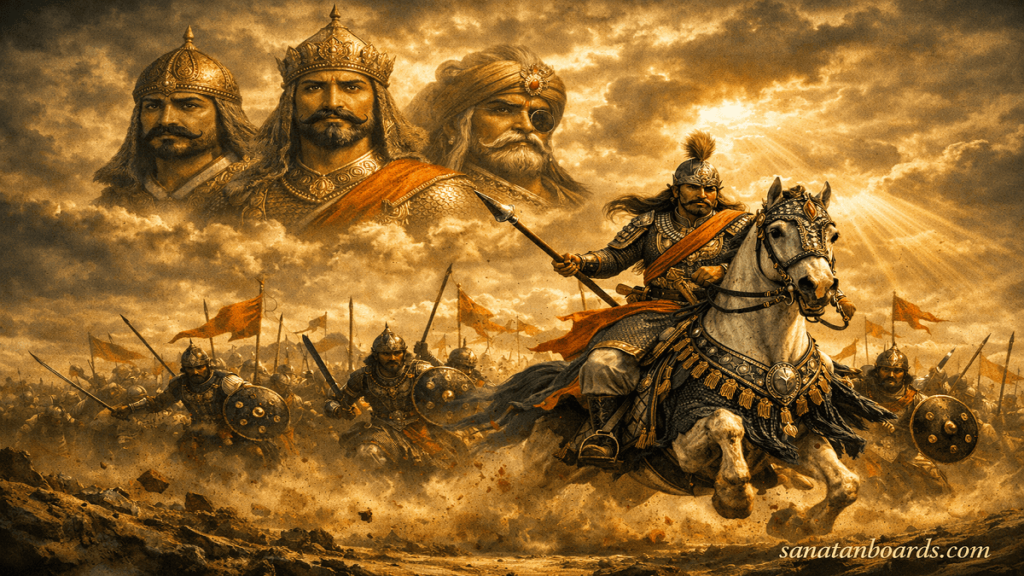
Case Study On Rajput Kingdoms – King Prithviraj Chauhan, Rana Kumbha, Rana Sanga, Maharana Pratap
The Rajput kingdoms provide a detailed case study of leadership, resilience, and cultural strength through the lives and reigns of Prithviraj Chauhan, Rana Kumbha, Rana Sanga, and Maharana Pratap. These rulers governed during different periods, yet their contributions collectively highlight the strengths and challenges of Rajput rule in medieval India.
Prithviraj Chauhan’s reign represents an early phase of resistance against foreign invasions. As the ruler of Ajmer and Delhi, he played a crucial role in defending northern India. His leadership in battles demonstrated bravery and determination. However, his defeat also reveals the limitations of fragmented regional powers that lacked unity. This highlights an important lesson in leadership: coordination and alliance-building are essential for long-term success.
Rana Kumbha’s rule marks a period of stability and growth. He focused not only on military strength but also on cultural and architectural development. The construction of forts such as Kumbhalgarh reflects strategic planning and foresight. His patronage of art and literature shows that strong governance involves both d
efense and cultural enrichment. This balanced approach contributed to the prosperity of Mewar and strengthened its position among Rajput states.
Rana Sanga’s leadership demonstrates the importance of unity among diverse groups. He successfully brought together various Rajput clans to form a powerful coalition. His ability to unite these forces allowed him to challenge larger empires. However, sustaining such alliances proved difficult, and his eventual defeat underscores the complexity of managing large coalitions. This case illustrates that while unity is powerful, maintaining it requires continuous effort and strong leadership.
Maharana Pratap’s story is one of persistence and resilience. Unlike many rulers who chose submission, he refused to accept Mughal authority. His use of guerrilla warfare allowed him to survive and continue his resistance despite limited resources. His commitment to independence made him a symbol of courage and determination. His leadership emphasizes the importance of adaptability and strong moral conviction.
Overall, this case study highlights several key themes: the importance of unity, the balance between military and cultural development, and the role of #prithvirajinrajasthan resilience in leadership. It also shows how external threats and internal divisions can influence the stability of a kingdom. The experiences of these rulers provide valuable insights into #ranasangarajputking governance, strategy, and cultural preservation.
White Paper On Rajput Kingdoms – King Prithviraj Chauhan, Rana Kumbha, Rana Sanga, Maharana Pratap
The Rajput kingdoms, led by figures such as Prithviraj Chauhan, Rana Kumbha, Rana Sanga, and Maharana Pratap, represent a decentralized yet resilient system of governance that played a critical role in shaping medieval Indian history. This white paper examines their political structures, military strategies, cultural contributions, and long-term impact.
The political structure of Rajput kingdoms was largely feudal, with local chieftains exercising control over their territories while pledging loyalty to a central ruler. This system allowed flexibility and regional autonomy but also created challenges in maintaining unity. The reign of Prithviraj Chauhan highlights the strengths and weaknesses of this structure, particularly in the context of external invasions.
Military strategies employed by these rulers varied based on circumstances. Rana Kumbha focused on strengthening fortifications and defensive capabilities, ensuring the protection of his kingdom. Rana Sanga emphasized large-scale alliances to counter powerful enemies. Maharana Pratap adopted guerrilla warfare, demonstrating adaptability in the face of stronger forces. These varied approaches illustrate the dynamic nature of Rajput military strategy.
Cultural contributions were equally significant. The construction of forts, temples, and palaces not only served strategic purposes but also reflected artistic excellence. These structures remain important historical landmarks. Literature, music, and traditions flourished under their patronage, contributing to a rich cultural heritage.
The challenges faced by these kingdoms included internal conflicts, resource limitations, and continuous external threats. These factors often influenced their stability and growth. However, their ability to maintain cultural identity despite these challenges is noteworthy.
In conclusion, the Rajput #rajputkingdomsinmumbai kingdoms offer valuable insights into governance, leadership, and cultural preservation. Their legacy continues to influence #rajputkingdomsinmewad modern perspectives on history, identity, and strategy.
Industry Application Of Rajput Kingdoms – King Prithviraj Chauhan, Rana Kumbha, Rana Sanga, Maharana Pratap
The historical legacy of Rajput kingdoms, led by influential rulers such as Prithviraj Chauhan, Rana Kumbha, Rana Sanga, and Maharana Pratap, extends far beyond historical narratives and finds meaningful application in modern industries. Their principles of leadership, resilience, governance, and cultural preservation offer valuable insights that can be adapted across multiple sectors in today’s world.
In the corporate and management industry, the leadership styles of these rulers provide a strong foundation for strategic thinking and organizational behavior. Prithviraj Chauhan’s ability to lead armies and maintain control over vast territories demonstrates decision-making under pressure. Rana Kumbha’s governance reflects long-term planning and infrastructural development, which are critical for sustainable business growth. Rana Sanga’s efforts to unite various Rajput clans highlight the importance of collaboration, partnerships, and team building in corporate environments. Similarly, Maharana Pratap’s resilience and refusal to surrender under adverse conditions serve as a powerful example of perseverance and adaptability in competitive markets. These qualities are essential for modern leaders who face constant challenges and uncertainties.
In the defense and security sector, the military strategies employed by these rulers remain relevant. Rana Kumbha’s construction of massive forts like Kumbhalgarh showcases advanced defensive planning and strategic use of geography. Maharana Pratap’s use of guerrilla warfare demonstrates the effectiveness of unconventional tactics against stronger opponents. Rana Sanga’s large-scale alliances reflect the importance of coordination and joint operations. These approaches are studied in modern defense institutions to understand warfare strategies, crisis response, and resource management.
The tourism and hospitality industry heavily benefits from the legacy of Rajput kingdoms. Regions like Rajasthan are globally recognized for their historical forts, palaces, and cultural richness associated with these rulers. Sites such as Chittorgarh and Kumbhalgarh attract millions of tourists each year. This not only boosts local economies but also creates employment opportunities in hospitality, travel services, and cultural industries. The stories of these rulers add depth to the tourism experience, making it more engaging and educational for visitors.
In the education sector, the lives and achievements of these rulers are widely used as case studies. They help students understand complex concepts such as governance, leadership, conflict management, and cultural preservation. By analyzing their successes and failures, learners can develop critical thinking and problem-solving skills. Their stories also serve as motivational tools, encouraging individuals to develop qualities like courage, determination, and integrity.
The media and entertainment industry has also drawn significant inspiration from Rajput history. Films, television series, documentaries, and literature based on these rulers bring their stories to a wider audience. These portrayals not only entertain but also educate viewers about historical events and cultural values. The narratives of bravery, honor, and sacrifice resonate strongly with audiences, making them timeless themes in storytelling.
In the architecture and construction industry, the engineering brilliance of Rajput rulers continues to inspire modern practices. The forts, palaces, and temples built during their reigns demonstrate advanced knowledge of design, durability, and environmental adaptation. Structures like Kumbhalgarh Fort, with its massive walls and strategic location, highlight the importance of planning and resource utilization. Modern architects and engineers often study these structures to understand traditional building techniques and sustainable design principles.
The cultural and creative industries also benefit from the legacy of Rajput kingdoms. Traditional art forms, music, dance, and crafts that flourished under these rulers continue to thrive today. These cultural expressions are promoted through festivals, exhibitions, and global platforms, contributing to cultural preservation and economic development. The values associated with Rajput heritage, such as honor and loyalty, are often reflected in creative works.
In the leadership and personal development industry, the stories of these rulers are used as examples of effective leadership and character building. Maharana Pratap’s determination in the face of adversity teaches resilience, while Rana Sanga’s ability to unite diverse groups emphasizes inclusivity and teamwork. These lessons are incorporated into training programs, seminars, and workshops aimed at developing leadership skills.
Furthermore, in the public administration and governance sector, the decentralized system of Rajput kingdoms offers insights into managing regional diversity while maintaining overall stability. Their governance models highlight the importance of local autonomy, accountability, and strong leadership. These principles are relevant in modern governance systems, particularly in countries with diverse populations and regional differences.
In conclusion, the Rajput kingdoms and their rulers have a wide range of applications across modern industries. Their contributions are not #sanatandharmaaccreditationboardsinmumbai limited to history but continue to influence contemporary practices in management, defense, tourism, education, media, architecture, and leadership development. #sanatandharmaaccreditationboardsinrajasthan The enduring relevance of their principles demonstrates that historical knowledge can provide valuable guidance for addressing modern challenges and opportunities.
SOURCE : History Connect
ASK FAQ
Who was Prithviraj Chauhan?
Prithviraj Chauhan was a powerful Rajput ruler known for his bravery and resistance against early foreign invasions in northern India.
What were the major achievements of Rana Kumbha?
Rana Kumbha strengthened Mewar through military victories and built important forts like Kumbhalgarh, along with promoting art and culture.
Why is Rana Sanga important in history?
Rana Sanga is known for uniting different Rajput clans and leading strong resistance against powerful empires like the Mughals.
What made Maharana Pratap a legendary ruler?
Maharana Pratap is remembered for his courage and refusal to submit to Mughal rule, using guerrilla warfare to defend his kingdom.
What were the key features of Rajput kingdoms?
Rajput kingdoms were known for their warrior culture, decentralized governance, strong sense of honor, and rich architectural heritage.
Table of Contents
Disclaimer
This content is intended to provide general information about Rajput kingdoms and notable rulers such as Prithviraj Chauhan, Rana Kumbha, Rana Sanga, and Maharana Pratap. The details presented are based on widely accepted historical sources and interpretations, which may differ among historians and scholarly works. This information does not claim absolute accuracy or completeness and should not be considered as a definitive historical account. Readers are encouraged to refer to multiple sources for deeper understanding and verification of facts related to the topic.