RAJA RAJA CHOLA I (GREAT TEMPLE BUILDER) was one of the most illustrious rulers of the Chola dynasty in southern India, reigning from 985 CE to 1014 CE. Renowned for his administrative acumen, military prowess, and architectural genius, he transformed the Chola kingdom into a dominant power in South Asia. His reign marked a golden era of political stability, economic prosperity, and cultural flourishing.
One of his most notable contributions was the construction of magnificent temples, the most famous being the Brihadeeswarar Temple in Thanjavur. This temple, a UNESCO World Heritage site, stands as a testament to his vision, combining art, engineering, and devotion. RAJA RAJA CHOLA I (GREAT TEMPLE BUILDER) believed that temples were not only centers of religious worship but also hubs of learning, social activity, and economic management.
Under his rule, the Chola empire expanded extensively, covering much of southern India, parts of Sri Lanka, and even maritime trade routes reaching Southeast Asia. His governance was characterized by a well-structured administrative system with efficient revenue collection, public works, and judicial processes.
RAJA RAJA CHOLA I (GREAT TEMPLE BUILDER) also patronized literature, sculpture, and bronze casting, leaving a lasting cultural legacy. The temples built under his reign became repositories of knowledge, art, and tradition. His strategic vision and architectural accomplishments have inspired historians, archaeologists, and scholars for centuries.
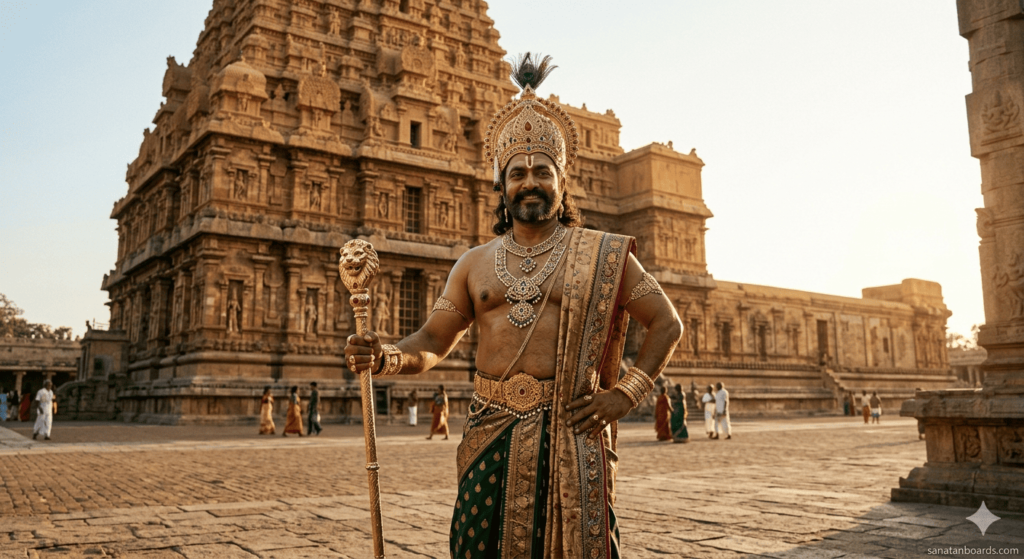
What Is Raja Raja Chola I (Great Temple Builder) ?
RAJA RAJA CHOLA I (GREAT TEMPLE BUILDER) was more than a king; he was a visionary who saw architecture as a reflection of power, spirituality, and community life. The title “Great Temple Builder” is attributed to him because of his extraordinary contributions to temple construction and urban planning. These temples were not only religious centers but also social, economic, and cultural institutions.
The Brihadeeswarar Temple at Thanjavur is the most iconic example of his work. Built using granite without modern machinery, it showcases advanced engineering techniques massive sculptural art, and detailed frescoes. The temple complex served multiple purposes: a place of worship, a hub for education in arts and sciences, and a center for community administration.
RAJA RAJA CHOLA I (GREAT TEMPLE BUILDER) revolutionized temple architecture by introducing innovative layouts, towering gopurams (gateway towers), and elaborate sculptures that depicted mythology, history, and daily life. These structures were a combination of functionality, artistic excellence, and religious significance.
His temples became cultural anchors, attracting scholars, artists, and pilgrims from far and wide. They were also centers for administration, including land management, trade regulation, and tax collection, showing the integration of religious devotion with governance.
Who Is Required Raja Raja Chola I (Great Temple Builder) ?
The legacy of RAJA RAJA CHOLA I (GREAT TEMPLE BUILDER) is crucial for anyone studying history, architecture, or cultural studies. Historians and archaeologists rely on his reign as a benchmark to understand the political, social, and economic systems of medieval South India. His temple constructions provide deep insights into engineering methods, artistic styles, and religious practices of the time.
Scholars of architecture examine the structural techniques he introduced, including precise granite placement, the use of massive monolithic stones, and innovative load distribution in temple towers. Students of art history study the intricate sculptures, bronze casting, and frescoes commissioned during his rule.
Economists and political scientists are interested in his administrative model, which included land surveys, tax systems, and trade management. His reign shows how centralized governance could coexist with decentralized cultural institutions.
Religious studies experts also analyze his contributions to Hinduism, particularly Shaivism, through temple rituals, iconography, and patronage of priestly communities. Artists, cultural enthusiasts, and educators continue to draw inspiration from his works for creative and educational purposes.
When Raja Raja Chola I (Great Temple Builder) Is Required ?
RAJA RAJA CHOLA I (GREAT TEMPLE BUILDER) is particularly relevant when studying periods of cultural synthesis, political expansion, and architectural innovation in Indian history. His era, the late 10th to early 11th century CE, represents a moment when a powerful ruler leveraged architecture not only as a symbol of faith but also as a tool for consolidating social, economic, and political influence.
The reign of RAJA RAJA CHOLA I (GREAT TEMPLE BUILDER) is required in understanding the emergence of the Chola Empire as a maritime and regional power. By analyzing when he commissioned monumental temples, scholars can trace the interplay between religious patronage and statecraft. Temples such as the Brihadeeswarar Temple were constructed during times of relative political stability, which enabled large-scale urban planning and resource mobilization.
Studying the “when” of his temple construction also sheds light on seasonal, economic, and ritual considerations. Many temples were completed in alignment with astrological and religious calendars, ensuring they were ritually significant for communities. The timing of temple construction coincided with agricultural cycles, trade prosperity, and expansionist campaigns, showing how RAJA RAJA CHOLA I (GREAT TEMPLE BUILDER) synchronized governance, culture, and spirituality.
Additionally, his reign is required when examining historical transitions in architectural styles, including the evolution of Dravidian temple design, the expansion of gopurams (towering gateways), and the refinement of sculptural iconography. The era illustrates how rulers can influence culture through strategic patronage.
In modern contexts, RAJA RAJA CHOLA I (GREAT TEMPLE BUILDER) is required as a case study in leadership, vision, and legacy-building. Institutions, historians, and architects look at when his actions were taken to understand the optimal integration of resources, labor, and vision in large-scale projects. The lessons from his era remain relevant in understanding cultural continuity, societal organization, and the timing of monumental undertakings.
Where Raja Raja Chola I (Great Temple Builder) Is Required ?
RAJA RAJA CHOLA I (GREAT TEMPLE BUILDER) is most prominently associated with the southern part of India, particularly the Tamil Nadu region. The Chola heartland included key cities like Thanjavur, Gangaikonda Cholapuram, and Tanjore, where temples, palaces, and administrative centers flourished under his rule. These locations became epicenters of religious, cultural, and economic activity, making his legacy spatially significant.
Temples built by RAJA RAJA CHOLA I (GREAT TEMPLE BUILDER) served as the focal points of communities, and their geographical distribution reflected the political and cultural reach of his empire. Coastal areas and trade hubs were particularly emphasized, connecting inland administrative centers to international maritime trade routes in the Bay of Bengal and Southeast Asia.
His influence extended beyond modern-day India. The architectural and cultural principles established by RAJA RAJA CHOLA I (GREAT TEMPLE BUILDER) spread to Sri Lanka, Maldives, and parts of Southeast Asia through trade, conquest, and diplomacy. Temples and art forms inspired by his reign can be traced across these regions, highlighting the geographic importance of his innovations.
In educational and research contexts, RAJA RAJA CHOLA I (GREAT TEMPLE BUILDER) is required in museums, universities, and archaeological sites where his monuments are preserved and studied. Locations such as the Brihadeeswarar Temple in Thanjavur have become international sites for heritage studies, tourism, and global recognition of South Indian art and engineering.
Understanding where RAJA RAJA CHOLA I (GREAT TEMPLE BUILDER) left his mark provides insights into the strategic placement of religious and administrative centers, urban planning, and cultural influence. His work illustrates how geography, politics, and architecture can intersect to leave a lasting imprint across both local and international landscapes.
How Raja Raja Chola I (Great Temple Builder) Is Required ?
RAJA RAJA CHOLA I (GREAT TEMPLE BUILDER) is required as a model for combining visionary leadership with meticulous planning and execution. He integrated religion, governance, and cultural promotion into tangible monuments that served multiple societal functions.
The “how” lies in his methodical approach: RAJA RAJA CHOLA I (GREAT TEMPLE BUILDER) utilized advanced surveying techniques, mobilized a workforce that included artisans, laborers, and engineers, and coordinated the logistics of sourcing massive quantities of stone, metals, and pigments. This planning ensured that temples were completed with precision, durability, and aesthetic excellence.
Temples were designed with multi-layered purposes in mind. Religious rituals, festivals, education, art creation, and community administration were all integrated. RAJA RAJA CHOLA I (GREAT TEMPLE BUILDER) ensured that temple economies functioned efficiently, providing for priests, workers, and pilgrims. Revenue from agriculture and trade was often funneled into construction and maintenance.
He also employed architectural innovations such as massive granite walls, soaring vimanas (temple towers), and intricate sculptures. The alignment of temples with cardinal directions and astronomical calculations showcased his understanding of engineering, science, and sacred geometry.
RAJA RAJA CHOLA I (GREAT TEMPLE BUILDER) is required in modern discussions of project management, sustainable construction, and cultural preservation. His work demonstrates that vision combined with careful planning, resource management, and community involvement leads to projects of enduring significance.
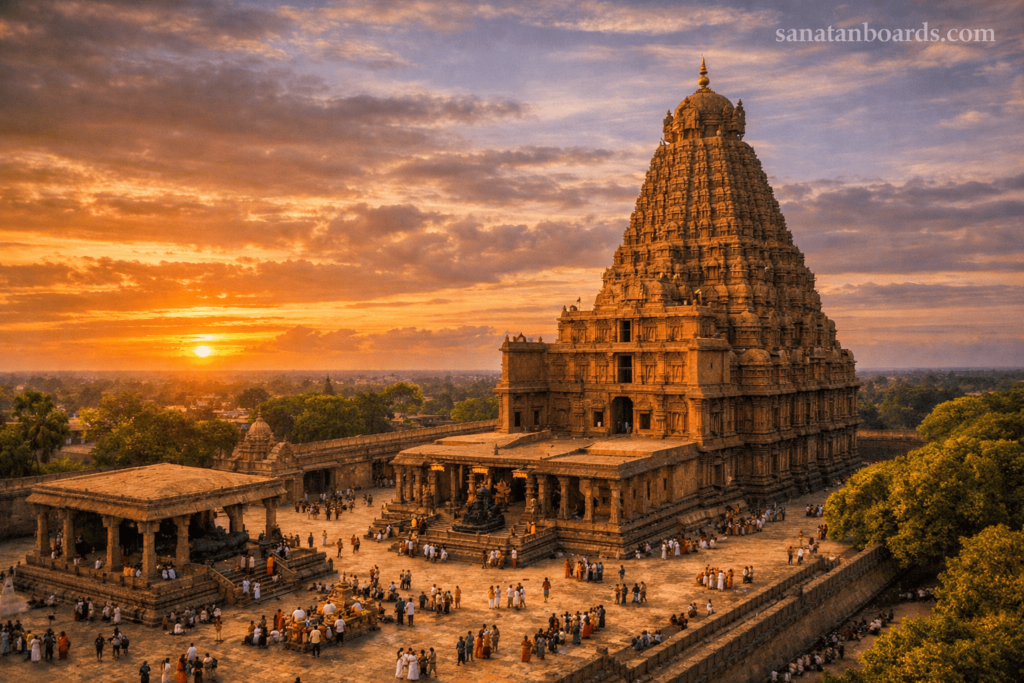
Case Study On Raja Raja Chola I (Great Temple Builder)
Introduction:
RAJA RAJA CHOLA I (GREAT TEMPLE BUILDER) represents a unique fusion of religious devotion, administrative efficiency, and architectural innovation. His reign offers a detailed case study in leadership, vision, and legacy creation.
Background:
Ascending the throne in 985 CE, RAJA RAJA CHOLA I (GREAT TEMPLE BUILDER) inherited a kingdom that required consolidation. Through military conquests, strategic alliances, and administrative reforms, he established a stable and prosperous empire.
Architectural Vision:
His most celebrated project, the Brihadeeswarar Temple, exemplifies Dravidian architecture. Constructed entirely of granite, it features the world’s tallest vimana at the time, extensive murals, and detailed sculptures depicting deities, royalty, and daily life. RAJA RAJA CHOLA I (GREAT TEMPLE BUILDER) strategically selected locations for temples to maximize social, religious, and economic influence.
Administrative Integration:
Temples under his reign were more than religious centers. They were hubs for revenue collection, land management, trade oversight, and education. By integrating temples into the administrative framework, RAJA RAJA CHOLA I (GREAT TEMPLE BUILDER) ensured sustainability and social cohesion.
Cultural Patronage:
He supported the arts, commissioning bronze statues, frescoes, and literature. Schools of dance, music, and sculpture thrived under his patronage, making temples centers for cultural transmission.
Strategic Impacts:
RAJA RAJA CHOLA I (GREAT TEMPLE BUILDER) expanded the Chola Empire through maritime dominance, connecting South India to Sri Lanka and Southeast Asia. Temples reinforced his political and cultural influence, serving as symbols of power, legitimacy, and faith.
Outcomes:
The case study shows that RAJA RAJA CHOLA I (GREAT TEMPLE BUILDER) achieved a multidimensional legacy—political stability, cultural enrichment, and architectural innovation. His projects outlasted his reign, influencing subsequent generations.
Lessons Learned:
Modern governance and project management can learn from his ability to align vision, community needs, resource allocation, and technical innovation.
White Paper On Raja Raja Chola I (Great Temple Builder)
Executive Summary:
RAJA RAJA CHOLA I (GREAT TEMPLE BUILDER) exemplifies the integration of leadership, cultural patronage, and architectural innovation. This white paper evaluates his contributions to governance, urban planning, art, and religion.
Historical Context:
During his reign (985–1014 CE), the Chola Empire achieved unprecedented political stability and territorial expansion. RAJA RAJA CHOLA I (GREAT TEMPLE BUILDER) leveraged these conditions to commission monumental temples and infrastructure projects.
Architectural Significance:
The Brihadeeswarar Temple showcases advanced engineering, artistic excellence, and spiritual symbolism. Features include massive monolithic stones, intricate sculptures, precise alignment with cardinal directions, and durable construction methods.
Administrative Innovation:
Temples acted as administrative centers. Revenue from agriculture and trade supported temple maintenance and social welfare. Land records, judicial functions, and community planning were often centered around temple administration.
Cultural Impact:
RAJA RAJA CHOLA I (GREAT TEMPLE BUILDER) fostered literature, music, and visual arts. Bronze casting, fresco painting, and sculpture thrived under his patronage, reinforcing the temples as knowledge and cultural hubs.
Strategic Relevance:
Temples and urban projects strengthened political legitimacy, maritime trade, and cultural diplomacy. They reinforced the Chola presence in regions like Sri Lanka and Southeast Asia.
Modern Implications:
His model demonstrates sustainable heritage management, strategic urban planning, and integration of culture with governance. Insights from RAJA RAJA CHOLA I (GREAT TEMPLE BUILDER) inform modern architecture, leadership studies, and heritage conservation.
Conclusion:
RAJA RAJA CHOLA I (GREAT TEMPLE BUILDER) #Sanatandharmaaccreditationboardsinvasai remains an exemplary figure for combining political power, cultural vision, and architectural innovation into enduring legacies.
Industry application On Raja Raja Chola I (Great Temple Builder)
The legacy of RAJA RAJA CHOLA I (GREAT TEMPLE BUILDER) extends far beyond history, influencing modern industries in architecture, culture, tourism, education, and management. By studying his strategies and creations, several sectors can gain insights for practical application today.
- Architecture & Construction Industry:
RAJA RAJA CHOLA I (GREAT TEMPLE BUILDER) revolutionized temple architecture with massive granite structures, precise load-bearing techniques, and innovative spatial layouts. Modern architects and civil engineers study his methods for sustainable construction practices, use of durable materials, and efficient project execution. Techniques such as aligning structures with cardinal directions and optimizing space for functional and aesthetic purposes are applied in contemporary architectural planning. - Heritage & Tourism Industry:
Temples constructed under RAJA RAJA CHOLA I (GREAT TEMPLE BUILDER), like the Brihadeeswarar Temple in Thanjavur, are UNESCO World Heritage sites and major tourist attractions. Tourism professionals and heritage managers learn from the way these sites integrate cultural storytelling, visitor engagement, and long-term preservation. They inspire the creation of cultural tourism experiences that combine history, art, and architecture to attract global visitors. - Arts & Cultural Industry:
The Chola period under RAJA RAJA CHOLA I (GREAT TEMPLE BUILDER) was a golden era for bronze casting, sculpture, fresco painting, and temple murals. Art schools, museums, and creative industries study these works to teach traditional techniques, inspire contemporary art, and preserve intangible cultural heritage. Artists and educators often reference Chola artistry in workshops, exhibitions, and cultural projects. - Project Management & Leadership:
The large-scale temple projects managed by RAJA RAJA CHOLA I (GREAT TEMPLE BUILDER) offer valuable lessons in planning, logistics, workforce management, and resource allocation. Modern project managers use his example to understand how to coordinate large, multidisciplinary teams, plan timelines, and manage budgets while achieving high-quality results. - Urban Planning & Community Development:
RAJA RAJA CHOLA I (GREAT TEMPLE BUILDER) designed temples as multifunctional centers that combined religious, social, and economic activities. Urban planners today apply similar concepts to develop community-centric spaces, integrating cultural, educational, and administrative functions for holistic urban development. - Education & Research:
Universities and research institutions study RAJA RAJA CHOLA I (GREAT TEMPLE BUILDER) for insights into history, architecture, cultural evolution, and governance. His reign provides real-world case studies for courses in art history, archaeology, heritage management, and public administration.
Conclusion:
RAJA RAJA CHOLA I (GREAT TEMPLE BUILDER) continues to inspire modern industries by demonstrating how visionary leadership, architectural innovation, #Sanatandharmaaccreditationboardsinmumbai and cultural investment can create legacies that benefit multiple sectors over centuries.
source : HISTORY TV18
ASK FAQ
Who was RAJA RAJA CHOLA I (GREAT TEMPLE BUILDER)?
RAJA RAJA CHOLA I (GREAT TEMPLE BUILDER) was a powerful Chola king (reign 985–1014 CE) known for his military conquests, administrative excellence, and the construction of iconic temples like the Brihadeeswarar Temple in Thanjavur
Why is RAJA RAJA CHOLA I called the Great Temple Builder?
He is called the Great Temple Builder because he commissioned monumental temples with advanced architecture, sculptures, and cultural centers, combining religious devotion with administrative and social functions.
What are the major temples built by RAJA RAJA CHOLA I?
The most famous temple built by RAJA RAJA CHOLA I (GREAT TEMPLE BUILDER) is the Brihadeeswarar Temple in Thanjavur. Others include temples in Gangaikonda Cholapuram and various parts of Tamil Nadu, showcasing Dravidian architecture
How did RAJA RAJA CHOLA I influence art and culture?
He promoted bronze casting, sculpture, frescoes, literature, and classical dance, making temples centers of cultural, educational, and artistic development during his reign
What is the legacy of RAJA RAJA CHOLA I (GREAT TEMPLE BUILDER)?
His legacy includes architectural masterpieces, cultural patronage, efficient administration, maritime trade expansion, and a lasting influence on South Indian art, history, and heritage.
Table of Contents
Disclaimer
The information provided above is intended for educational, learning, and knowledge purposes. It should not be considered as professional, legal, or investment advice. All historical interpretations are based on existing scholarly research and may be subject to revision with new findings.