Sanatan Dharma, often referred to as the timeless way or eternal duty, is one of the oldest spiritual traditions in human history. Rooted deeply in ancient scriptures such as the Vedas, Upanishads, and the Bhagavad Gita, it represents a broad framework of spiritual beliefs, ethical principles, philosophical inquiry, and cultural practices. While its origins trace back to the Indian subcontinent, the influence of Sanatan Dharma has extended far beyond the geographical boundaries of India. Over centuries, teachers, scholars, saints, sages, and ordinary practitioners have become ambassadors of this tradition throughout the world, contributing significantly to intercultural dialogue, spirituality, and human unity.
Outside of India, the promoters of Sanatan Dharma have acted as bridges between ancient wisdom and modern global society. They have enabled diverse populations to engage with teachings that emphasize universal values such as truth (satya), righteousness (dharma), peace (shanti), non‑violence (ahimsa), and self‑realization (atma jnana). Their work has included translating sacred texts, establishing centers for learning, organizing spiritual retreats, fostering community outreach, and engaging in interfaith conversations. Through these efforts, people of differing cultures, religions, and backgrounds have come to explore and appreciate aspects of this tradition while also integrating its practices, such as yoga and meditation, into daily life.
The role of these promoters is significant because they not only interpret and disseminate teachings but also ensure that the essence of Sanatan Dharma adapts and resonates with contemporary contexts. At its core, their purpose is not to propagate religion in a dogmatic way, but to share universal wisdom that speaks to the inner experience of human life and encourages ethical and meaningful living across national borders.
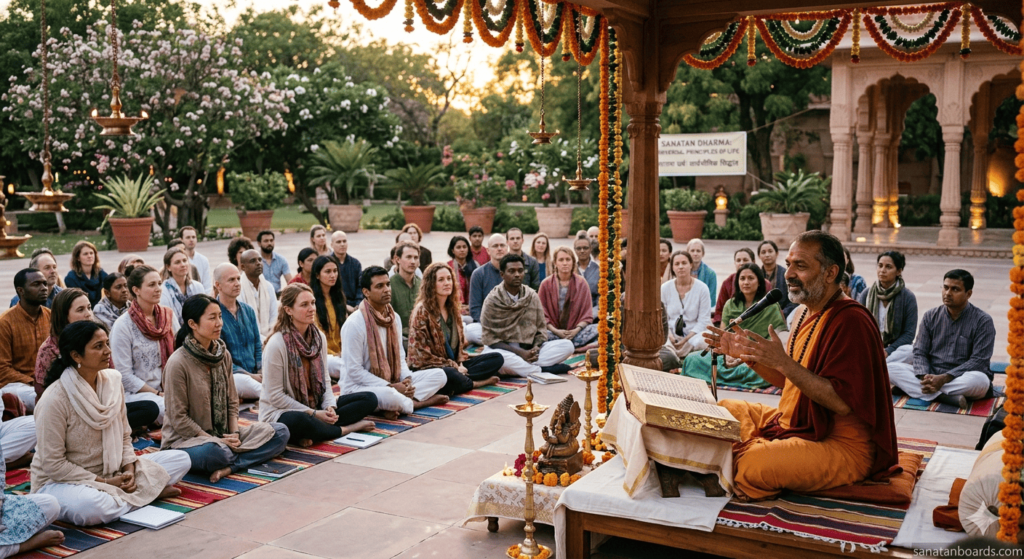
What Is Promoters Of Sanatan Dharma Outside India ?
It refers to individuals, organizations, and movements dedicated to sharing the principles, teachings, and cultural–spiritual heritage of Sanatan Dharma beyond the Indian subcontinent. These promoters work in many capacities: as scholars interpreting sacred texts, as spiritual leaders guiding practitioners as activists fostering community engagement, and as educators bridging ancient philosophy with contemporary life.
Sanatan Dharma is characterized by its inclusive worldview, recognition of diverse paths to truth, and emphasis on dharma — ethical responsibility aligned with cosmic order. Promoters of this tradition outside India take on the responsibility of preserving the integrity of these teachings while making them accessible and relevant within diverse cultural settings. Their work often involves communicating complex philosophical ideas in local languages, contextualizing practices like yoga and meditation, and engaging in dialogues that relate spiritual insights to modern human challenges such as stress, social disconnection, and ethical dilemmas.
These promoters may operate in formal institutions — such as spiritual centers, educational institutes, research organizations, or non‑profit trusts — or informally through books, online platforms, community workshops, and interfaith forums. They help cultivate a global understanding of Sanatan Dharma that respects both its indigenous roots and universal applicability.
Who Is Required Promoters Of Sanatan Dharma Outside India ?
1. Spiritual Teachers and Gurus
These are persons deeply grounded in the teachings and practices of the tradition. They act as primary transmitters of knowledge, guiding students in understanding scriptures, meditation, rituals, and ethical living. Their lived experience and depth of insight make the teachings accessible without distortion.
2. Scholars and Academics
Professors, researchers, and translators contribute to rigorous study and dissemination of Sanatan Dharma through publications, lectures, comparative research, and cross‑cultural scholarship. They engage with global educational institutions to integrate this knowledge into academic discourse.
3. Practitioners Who Live the Principles
Individuals who embody the values of Sanatan Dharma through daily life — such as practicing non‑violence, kindness, community service, and mindfulness — also function as promoters. Their witness inspires others to explore the tradition experientially.
4. Community Leaders and Organizers
People who form and sustain community centers, study groups, cultural associations, and spiritual networks help create sustained engagement with Sanatan Dharma. They organize events, celebrations, and forums that welcome diverse participants.
5. Authors, Artists, and Media Creators
Books, films, documentary series, art, digital media, and music rooted in or inspired by Sanatan Dharma expand its reach to global audiences and enrich cultural understandings.
6. Interfaith Dialogues and Peace Advocates
Those engaged in promoting harmony between religions often draw on the inclusive and pluralistic foundations of Sanatan Dharma in dialogues and peace initiatives.
The synergy between these categories ensures that Sanatan Dharma reaches people not only intellectually, but emotionally, culturally, socially, and ethically.
When Promoters Of Sanatan Dharma Outside India Is Required ?
The need for promoters of Sanatan Dharma outside India has emerged at multiple historical junctures and continues to grow in contemporary times.
Historical Spread
The initial waves of promotion outside the subcontinent began as early as ancient and medieval periods through trade, migration, and intercultural exchanges. Indian scholars and travelers carried philosophical ideas to Southeast Asia, Central Asia, and, in later centuries, when global travel and communication became possible, to Europe and America.
Modern Globalization
In the 19th and 20th centuries, the increasing mobility of people and ideas catalyzed new avenues for the spread of Eastern philosophy. Western interest in meditation, comparative religion, and spirituality created conditions where teachers from India began traveling abroad, establishing centers in Europe and North America. Figures such as Swami Vivekananda in the late 19th century introduced Hindu spiritual ideas in global forums, including the Parliament of Religions in Chicago — a landmark moment in bringing attention to Sanatan Dharma in the Western world.
Cultural and Spiritual Curiosity
The latter half of the 20th century saw an intensified search for alternative ways of achieving mental balance and spiritual growth. With rising concerns about stress, alienation, and materialism, practices associated with Sanatan Dharma like yoga and meditation gained widespread attraction. These practices served as entry points for deeper exploration of its philosophical and ethical teachings.
Contemporary Relevance
Today, promoters are required in a context where:
- Cross‑cultural communication is essential for respectful understanding between societies.
- People seek meaning and mental well‑being amidst rapid technological change.
- Global challenges — such as environmental degradation, social inequality, and inter‑religious tensions — demand ethical frameworks that emphasize interconnectedness, compassion, and duty.
At every stage of human history, promoters are needed because spiritual traditions must be re‑interpreted and re‑applied meaningfully to each era. For Sanatan Dharma, this work involves showing its relevance to modern science, psychology, and global ethics without compromising its foundational wisdom.
Where Promoters Of Sanatan Dharma Outside India Is Required ?
Promoters of Sanatan Dharma are required globally, wherever there is interest in spiritual, ethical, and philosophical inquiry, and in regions where Indian diaspora or cultural exchange exists. The reach is not limited to areas with large Indian communities; the appeal of universal values and holistic practices ensures relevance across continents.
1. North America and Europe
Countries like the United States, Canada, the United Kingdom, Germany, and France have seen a surge in interest in yoga, meditation, and Vedantic philosophy. Promoters are essential in universities, spiritual centers, and wellness institutes, where they introduce Sanatan Dharma as a practical and philosophical system, bridging East and West.
2. Southeast Asia
Nations such as Indonesia, Malaysia, Thailand, and Singapore, which have historical links with Indian culture, continue to host festivals, temples, and study groups. Here, promoters reinforce cultural continuity and assist local populations in connecting ancient teachings with modern life.
3. Australia and New Zealand
In these countries, promoters serve both the Indian diaspora and non‑Indian audiences curious about mindfulness, yoga, and ethical living. Educational programs, retreats, and cultural events help build understanding and appreciation.
4. Middle East
Although smaller in scale, Indian expatriates in Gulf countries create networks to preserve their spiritual heritage. Promoters facilitate religious ceremonies, meditation classes, and interfaith dialogues.
5. Global Digital Space
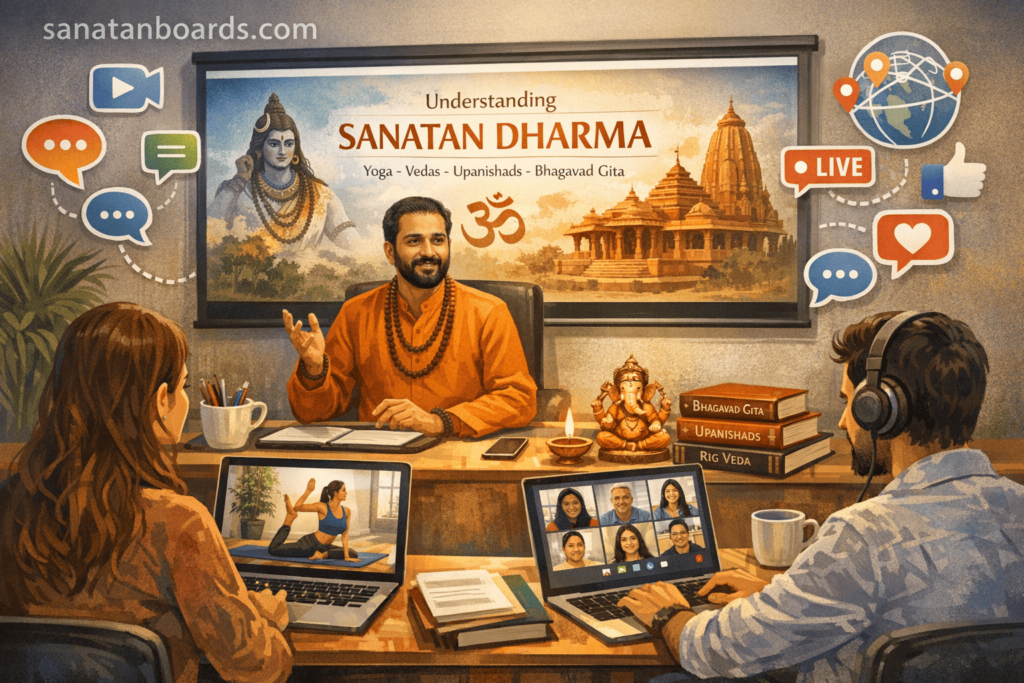
The internet and social media have created virtual spaces where promoters of Sanatan Dharma reach millions. Online courses, virtual satsangs (spiritual gatherings), podcasts, and discussion forums allow the teachings to transcend geographical constraints.
6. Academic and Research Institutions
Universities worldwide increasingly include courses on Hindu philosophy, comparative religion, and ethics. Promoters, in collaboration with scholars, provide expertise, translations, and lectures, ensuring accuracy and depth in presenting the tradition.
In all these locations, promoters act as cultural and spiritual ambassadors, helping people connect with values of truth, duty, non‑violence, and self‑knowledge. Their presence is particularly required in multicultural societies, where understanding of diverse spiritual traditions fosters tolerance, dialogue, and peace.
How Promoters Of Sanatan Dharma Outside India Is Required ?
The methods and approaches for promoting Sanatan Dharma outside India are diverse, reflecting the tradition’s flexibility and adaptability.
1. Teaching and Education
Promoters conduct workshops, courses, and lectures to explain concepts from the Vedas, Upanishads, Bhagavad Gita, and other texts. They often contextualize philosophy to modern life, using examples relevant to global audiences.
2. Establishing Spiritual Centers
Temples, ashrams, yoga centers, and retreat facilities serve as hubs where practitioners experience rituals, meditation, and ethical teachings in practice. These centers provide a structured environment for immersive learning.
3. Translation and Publications
Textual knowledge is made accessible through translation of scriptures into multiple languages. Books, articles, journals, and online content allow both scholars and laypersons to engage deeply.
4. Cultural Festivals and Community Events
Events such as Diwali, Holi, and other traditional celebrations introduce local populations to the ethos of Sanatan Dharma. They create interactive experiences and foster cross-cultural participation.
5. Digital Platforms
Websites, social media, podcasts, and virtual classes allow promoters to reach international audiences. Meditation apps and online discussion groups have emerged as powerful tools for dissemination.
6. Interfaith Dialogues and Workshops
Promoters engage in forums where diverse religious and philosophical traditions meet. These interactions highlight the universal ethical and spiritual teachings of Sanatan Dharma and promote mutual respect.
7. Collaborative Research
Partnering with academic institutions, promoters contribute to research on philosophy, ethics, and human psychology. This method integrates ancient wisdom with modern scientific inquiry, enhancing credibility and relevance.
By employing these methods, promoters ensure that Sanatan Dharma is experienced not just as doctrine but as a living practice, adaptable to individual, social, and global contexts.
Case Study On Promoters Of Sanatan Dharma Outside India
One of the most influential case studies in the promotion of Sanatan Dharma outside India is the work of Swami Vivekananda and the ongoing global impact of his movement.
Background
Swami Vivekananda (1863–1902) traveled extensively to introduce Vedanta and Yoga to the Western world. His landmark speech at the Parliament of the World’s Religions in Chicago, 1893, demonstrated both intellectual depth and spiritual charisma. His emphasis on the universality of spiritual truth, interfaith respect, and practical application of dharma made Sanatan Dharma appealing to global audiences.
Strategy and Methodology
Vivekananda’s approach combined education, practice, and social service. He established institutions like the Ramakrishna Mission, which facilitated spiritual training, community development, and intercultural dialogue. He translated complex concepts from Sanskrit into English, making them accessible to Western audiences. His method included:
- Lectures and Public Talks – Delivered across major cities in the U.S. and Europe, blending philosophy with practical guidance.
- Books and Pamphlets – Writings on Vedanta and spiritual ethics provided structured learning for scholars and seekers.
- Community Service – Emphasized that true dharma involves service to humanity, integrating spiritual and social dimensions.
- Training Disciples – Cultivated a network of followers who continued spreading teachings internationally.
Impact
Vivekananda’s work laid the foundation for sustained global interest in Hindu philosophy, yoga, and meditation. His disciples established centers in North America, Europe, and Asia, ensuring continuity of teachings. The Ramakrishna Mission today operates over 150 centers worldwide, offering spiritual guidance, educational programs, and charitable services.
Contemporary Examples
Modern promoters continue his legacy:
- Swami Chidananda of the Divine Life Society established international centers teaching meditation and ethical living.
- Organizations like ISKCON (International Society for Krishna Consciousness) have popularized devotion (bhakti) practices, vegetarianism, and cultural festivals worldwide.
- Online platforms, apps, and YouTube channels now reach millions, continuing the work of making Sanatan Dharma accessible globally.
Challenges and Adaptations
Promoters face challenges such as cultural misinterpretations, commercialization, and balancing authenticity with adaptability. Successful strategies involve:
- Respecting local traditions while introducing universal concepts.
- Using modern technology to reach diverse audiences.
- Maintaining ethical integrity while expanding organizational presence.
Lessons Learned
This case study highlights that effective promotion requires a combination of scholarship, lived experience, community engagement, #sanatandharmaoutsideindia and adaptability. Promoters must communicate clearly, inspire practice, and build structures that sustain long-term learning and appreciation.
White Paper On Promoters Of Sanatan Dharma Outside India
Executive Summary
Sanatan Dharma, with its vast philosophical depth and ethical framework, has evolved into a global spiritual phenomenon through the work of dedicated promoters outside India. These promoters, spanning spiritual leaders, scholars, educators, and practitioners, have been instrumental in contextualizing and disseminating the teachings worldwide. Their role is crucial for cultural preservation, spiritual education, ethical guidance, and fostering global harmony.
Introduction
Sanatan Dharma emphasizes principles such as dharma (duty), karma (action and consequence), ahimsa (non-violence), and satya (truth). While these concepts are rooted in Indian history, their universal nature allows them to resonate with people globally. Promoters act as bridges between ancient wisdom and modern societies, adapting methods to suit cultural, linguistic, and social contexts.
Objectives
- To preserve and propagate the knowledge and practices of Sanatan Dharma.
- To establish global networks of spiritual and cultural centers.
- To integrate ancient wisdom with contemporary challenges like stress, mental health, and ethical dilemmas.
- To promote intercultural understanding and interfaith dialogue.
Methodology
Promoters adopt diverse strategies:
- Educational Programs: Universities and schools include courses on Hindu philosophy, meditation, yoga, and comparative religion. Translators and scholars simplify complex texts for international comprehension.
- Community Centers: Temples, ashrams, and spiritual hubs provide spaces for worship, learning, and cultural activities.
- Digital Outreach: Online courses, webinars, and interactive platforms make teachings accessible to global audiences.
- Interfaith Engagement: Collaborations with other religious communities facilitate mutual respect and shared ethical discourse.
Global Reach
Promoters are active across North America, Europe, Southeast Asia, the Middle East, and Australasia. Their presence addresses both the Indian diaspora seeking cultural continuity and non-Indian populations interested in spirituality, wellness, and ethical philosophy.
Case Studies
- Swami Vivekananda: His pioneering work introduced Vedanta and Yoga in Western academia and society.
- ISKCON and Ramakrishna Mission: These organizations maintain international networks teaching devotion, ethics, and meditation practices.
- Modern Digital Promoters: Virtual platforms and apps now enable millions to learn and practice Sanatan Dharma in daily life.
Challenges
- Cultural Misinterpretation: Adapting teachings without diluting core principles.
- Commercialization: Avoiding the commodification of sacred practices like yoga.
- Sustainability: Ensuring long-term engagement and community development.
Recommendations
- Develop structured training programs for global promoters.
- Encourage collaboration between scholars, practitioners, and media creators.
- Use technology judiciously to reach wider audiences while maintaining authenticity.
- Monitor ethical compliance and ensure teachings remain true to their essence.
Conclusion
Promoters of Sanatan Dharma outside India play a critical role in fostering global spiritual literacy. Through education, community #Sanatandharmaaccreditationboardsinvasai building, digital innovation, and intercultural dialogue, they ensure that the timeless wisdom of Sanatan Dharma remains relevant and accessible, inspiring ethical living, personal growth, and cross-cultural harmony.
Industry Application Of Promoters Of Sanatan Dharma Outside India
The teachings of Sanatan Dharma have far-reaching applications across multiple industries due to their focus on ethics, mindfulness, wellness, and education.
1. Education Industry
- Universities and schools incorporate courses on Hindu philosophy, meditation, and ethics.
- Promoters assist in curriculum development, research, and interfaith education programs.
- Cultural immersion programs help students understand global traditions and philosophical diversity.
2. Wellness and Healthcare
- Yoga and meditation programs, rooted in Sanatan Dharma, are integrated into physical and mental wellness initiatives.
- Mindfulness techniques derived from Vedantic practices enhance stress management, resilience, and emotional intelligence in corporate wellness programs.
- Spiritual counseling and ethical guidance contribute to holistic health services.
3. Media and Publishing
- Books, online content, documentaries, and podcasts make knowledge widely accessible.
- Promoters collaborate with filmmakers and writers to present philosophical concepts in engaging formats.
- Digital platforms help maintain continuity of spiritual discourse for global audiences.
4. Non-Profit and Community Development
- Promoters work in charitable organizations aligned with dharmic principles, addressing education, poverty, and disaster relief.
- Community engagement initiatives foster intercultural understanding and social cohesion.
5. Corporate and Leadership Training
- Principles of dharma and karma are applied to ethical decision-making, leadership development, and organizational culture.
- Workshops on mindfulness, ethics, and emotional intelligence are increasingly adopted in corporate settings.
6. Tourism and Cultural Promotion
- Spiritual tourism, pilgrimages, and international cultural events promote awareness of Sanatan Dharma and support local economies.
- Promoters guide experiential programs, providing cultural and philosophical insights to visitors.
Through these applications, the work of promoters not only preserves cultural heritage but also integrates ethical, philosophical, and wellness principles #Sanatandharmaaccreditationboardsinmumbai into contemporary life, benefiting both individual growth and societal well-being.
source : Khabargaon
ASK FAQ
Who are the promoters of Sanatan Dharma outside India?
Promoters are spiritual leaders, scholars, practitioners, and organizations that spread the teachings, philosophy, and practices of Sanatan Dharma globally.
Why is promoting Sanatan Dharma outside India important?
It helps preserve cultural heritage, shares universal values, promotes ethical living, and fosters global spiritual awareness.
How do promoters spread Sanatan Dharma internationally?
Through spiritual centers, educational programs, translations of sacred texts, cultural events, online platforms, and interfaith dialogues.
Where are promoters of Sanatan Dharma active outside India?
They are active in North America, Europe, Southeast Asia, Australasia, the Middle East, and digital spaces worldwide.
What are the modern applications of Sanatan Dharma promotion?
Applications include yoga and meditation for wellness, ethical leadership training, cultural education, community development, and digital spiritual engagement.
Table of Contents
DISCLAIMER
The content provided above is for informational purposes only. It is intended to offer knowledge about the promotion and global dissemination of Sanatan Dharma and should not be considered as religious advice, commercial guidance, or prescriptive practice. Readers are encouraged to conduct independent research and consult appropriate experts before making any personal, educational, or professional decisions based on this information.