Panini, an ancient Indian grammarian who lived around the 5th–4th century BCE, created one of the most remarkable linguistic frameworks in human history. His work, the Ashtadhyayi, is a comprehensive treatise on Sanskrit grammar that systematically describes the structure and rules of the language. What makes Panini extraordinary is his use of concise rules, meta‑notation, and logical precision so advanced that modern linguists and computer scientists compare his system to formal language theory and computational models.
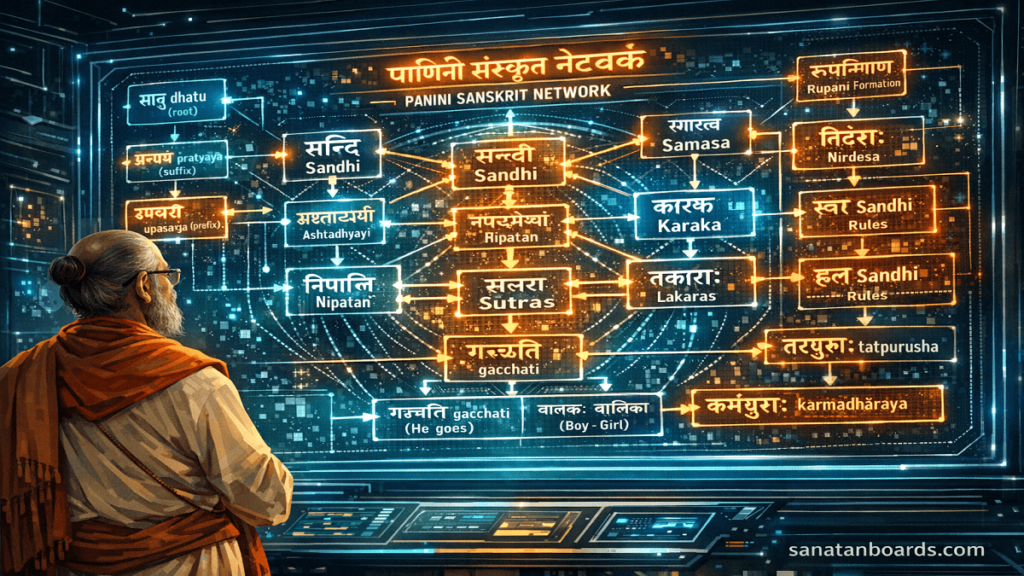
Panini’s grammar consists of about 4,000 rules that define phonetics, morphology, and syntax of Sanskrit. These rules are arranged in an interconnected network, where each rule conditions or refines others. This “Paninian network” operates almost like a computational algorithm, applying rules in specific sequences to generate correct word forms and sentences. For centuries, this network became the foundation of traditional Sanskrit learning in India.
In modern contexts, the Paninian model inspires research in natural language processing, artificial intelligence, and computational linguistics. Its emphasis on rule systems and hierarchical structure anticipated many principles later formalized in Western linguistics. Therefore, Panini’s Sanskrit Network remains a timeless bridge between ancient language science and contemporary computational theory.
What Is Panini Sanskrit Network ?
The Panini Sanskrit Network refers to the intricate system of grammatical rules developed by Panini, an ancient Indian scholar who lived around the 5th–4th century BCE. Panini’s work, the Ashtadhyayi (meaning “Eight Chapters”), is considered one of the most sophisticated and complete grammatical treatises in the world. It analyzes the Sanskrit language in a structured and logical way, using nearly 4,000 concise rules to describe how words are formed, how sounds change, and how sentences are constructed.
At its core, the Panini Sanskrit Network is not just a list of rules—it is a networked architecture of interrelated grammatical principles. Each rule in the Ashtadhyayi interacts with others: some rules apply only after other rules have been used, some modify the conditions of others, and some override others when conflicts arise. This creates a system that functions almost like a computational algorithm, where rules are applied in a specific order to generate correct and meaningful Sanskrit forms.
Panini’s approach was revolutionary because he introduced meta‑rules, markers, and formal notation to efficiently represent language patterns. This made the Sanskrit grammatical system extremely compact and powerful. Scholars across centuries have studied and transmitted his methods through commentaries and teaching traditions.
The influence of the Panini Sanskrit Network extends far beyond traditional grammar. Modern linguists and computer scientists recognize Panini’s system as an early form of formal language theory—a foundation for understanding syntax and language processing. In artificial intelligence and natural language processing research today, Panini’s structured rule system inspires models for language analysis and generation.
Who Is Required Panini Sanskrit Network ?
The Panini Sanskrit Network is a sophisticated framework of Sanskrit grammar developed by the ancient scholar Panini, and it is highly relevant for anyone interested in language, linguistics, or traditional Indian knowledge systems. While at first glance it may seem specialized, its applications extend far beyond classical Sanskrit studies.
Primarily, students and scholars of Sanskrit language and literature require the Panini network. Sanskrit texts—from the Vedas and Upanishads to classical poetry and philosophy—follow precise grammatical rules. Understanding Panini’s system allows learners to read, interpret, and analyze these texts accurately, preserving their original meaning. This makes the network essential for academics in fields like Indology, comparative linguistics, and ancient history.
The Panini Sanskrit Network is also valuable for linguists and language researchers. Panini’s method of defining language rules is remarkably similar to modern computational models of grammar. Scholars in natural language processing (NLP), artificial intelligence, and computational linguistics study his system to design algorithms that process human language efficiently. For them, Panini provides insights into rule-based language generation, syntax analysis, and hierarchical structure—concepts critical in modern AI-driven language tools.
Furthermore, traditional teachers and practitioners of Vedic chanting and rituals benefit from the Panini network. Correct pronunciation, intonation, and grammatical structure are central to Vedic recitation, making Panini’s rules practically necessary in preserving the oral tradition.
Even for enthusiasts of ancient Indian knowledge systems or cognitive science, understanding the Panini Sanskrit Network demonstrates the logical sophistication of ancient scholarship. It shows how rules, hierarchy, and algorithmic thinking existed long before modern science formalized these concepts.
When Is The Panini Sanskrit Network Required?
The Panini Sanskrit Network is a highly structured system of Sanskrit grammar developed by the ancient scholar Panini around the 5th–4th century BCE. It is not merely a collection of rules; it is a sophisticated network where each grammatical rule interacts with others in a precise hierarchy. Understanding this network is essential in several contexts where accurate knowledge of Sanskrit, language structure, or computational linguistics is needed.
First and foremost, the Panini network is required when studying classical Sanskrit texts. Works such as the Vedas, Upanishads, epics like the Mahabharata and Ramayana, and classical poetry follow strict grammatical norms. Scholars, students, and translators who wish to read and interpret these texts correctly must rely on Panini’s rules. Without understanding his system, it is difficult to capture the precise meaning, nuances, and phonetic subtleties intended in these ancient writings.
The network is also necessary for linguists and language researchers. Panini’s approach anticipates modern concepts of formal grammar, syntax, and rule-based systems, making it invaluable for comparative linguistics, historical linguistics, and the study of language evolution. Researchers can analyze how structured rules govern language, drawing parallels with other linguistic traditions.
In the modern era, the Panini Sanskrit Network is particularly relevant for computer scientists and AI researchers working in natural language processing (NLP). Panini’s method of applying sequential rules, handling exceptions, and creating meta-rules closely resembles computational algorithms used in programming language design, machine translation, and automated grammar checking. This makes his work a bridge between ancient scholarship and cutting-edge technology.
Additionally, the network is crucial for Vedic scholars and practitioners of ritual chanting. Correct pronunciation, intonation, and word formation are central to preserving oral traditions. Panini’s rules ensure that mantras and hymns are recited accurately, maintaining their spiritual and ritual integrity.
Even for enthusiasts of ancient Indian philosophy, education, or cognitive science, learning the Panini network provides insight into early human attempts to formalize knowledge logically and systematically. It demonstrates that algorithmic and hierarchical thinking existed long before modern science and computing.
Where Is The Panini Sanskrit Network Required?
The Panini Sanskrit Network, developed by the ancient scholar Panini, is a highly structured system of Sanskrit grammar. Its applications are broad, extending from traditional education to modern technology. Understanding where this network is required helps learners, scholars, and professionals recognize its importance.
Primarily, it is required in Sanskrit education and classical studies. Universities, schools, and traditional gurukulas that teach Sanskrit rely on Panini’s framework to guide students through the language. The network ensures learners can correctly form words, understand grammatical rules, and interpret texts accurately. Without it, reading classical works like the Vedas, Upanishads, or Mahabharata becomes challenging, as their structure follows precise grammatical conventions.
The network is also essential in research and academia. Linguists studying historical, comparative, or computational linguistics use Panini’s rules to analyze how languages are structured. The interconnected nature of his rules provides a model for understanding syntax, morphology, and phonetics, allowing scholars to compare Sanskrit with other languages systematically.
In modern technology, the Panini Sanskrit Network has applications in artificial intelligence and natural language processing (NLP). His algorithmic approach to grammar inspires computational models for language analysis, machine translation, and automated text processing. Software developers and AI researchers studying language structure find Panini’s principles particularly useful for creating rule-based systems.
Additionally, the network is required in Vedic rituals and oral traditions, where accurate pronunciation and word formation are critical. Scholars, priests, and practitioners use Panini’s framework to maintain the integrity of chants, mantras, and hymns.
How Is The Panini Sanskrit Network Required?
The Panini Sanskrit Network, created by the ancient Indian scholar Panini, is an advanced system of Sanskrit grammar that functions as an interconnected web of linguistic rules. Understanding how it is required involves looking at its practical applications in education, research, technology, and cultural preservation.
First, the network is required in learning and teaching Sanskrit. Students and scholars need Panini’s system to understand word formation, sentence structure, and pronunciation. His rules provide a step-by-step framework, allowing learners to systematically analyze texts. By applying these rules, students can read classical works—like the Vedas, Upanishads, Mahabharata, and Ramayana—accurately, preserving their meaning and nuances. Teachers use the Panini network to guide learners through the complexities of Sanskrit morphology, syntax, and phonetics, ensuring a structured learning approach.
Second, the network is required in linguistic research and analysis. Panini’s rules represent one of the earliest formal models of language. Linguists studying historical, comparative, or computational linguistics rely on his framework to understand language patterns, rule hierarchies, and exceptions. By applying Panini’s methods, researchers can analyze Sanskrit and compare its structure to other languages, gaining insights into how languages evolve and interact.
Third, the network is required in modern technology, particularly in natural language processing (NLP) and artificial intelligence (AI). Panini’s algorithmic approach to grammar—where rules are applied sequentially with conditions and exceptions—resembles modern computational models. Developers and AI researchers use his principles to design software for machine translation, grammar checking, and automated text analysis, applying his structured rules to process human language accurately.
Finally, the network is required in preserving cultural and religious traditions. Vedic chanting, ritual recitations, and mantras rely on precise pronunciation and grammar. Scholars, priests, and practitioners use Panini’s network to maintain the integrity of these oral traditions. Applying his rules ensures that sacred texts are recited correctly, preserving both their spiritual and linguistic authenticity.

Case Study On Panini Sanskrit Network
The Panini Sanskrit Network is one of the most sophisticated linguistic systems developed in ancient India. Created by the grammarian Panini around the 5th–4th century BCE, it is a network of nearly 4,000 interrelated rules governing Sanskrit grammar. Unlike ordinary grammar guides, Panini’s network operates like an algorithm, where rules are applied sequentially, refined, and overridden according to conditions. This structured approach allows learners and scholars to generate precise word forms and sentences, ensuring linguistic accuracy.
Historical Application
Historically, the Panini Sanskrit Network has been central to Sanskrit education and scholarship. Students in gurukulas and traditional schools memorized the rules of the Ashtadhyayi and practiced their application through textual analysis. This network enabled accurate interpretation of the Vedas, Upanishads, Mahabharata, and Ramayana, where each word’s form and pronunciation follow strict grammatical principles. Teachers guided students to navigate the interconnected rules, demonstrating how foundational rules create base forms and higher-level rules modify or refine them.
Modern Relevance
In contemporary times, the Panini Sanskrit Network has found relevance in computational linguistics and artificial intelligence. Researchers in natural language processing (NLP) study Panini’s methods to develop algorithms for parsing and generating human language. His use of meta-rules, optional conditions, and hierarchical rule application mirrors modern programming logic, making Sanskrit grammar a model for structured computational systems.
Cultural Significance
Beyond education and technology, the Panini Sanskrit Network is crucial for preserving India’s oral traditions. Vedic chanting and ritual recitations demand precise pronunciation and grammar. Applying Panini’s rules ensures the integrity of these texts, maintaining both their spiritual and linguistic accuracy.
Conclusion
This case study highlights that the Panini Sanskrit Network is not merely an ancient grammar system but a living model with applications across education, #paninisanskritnetworkindelhi research, technology, and culture. Its structured, algorithmic design demonstrates early #paninisanskritnetworkinbangalore human mastery of language, making it an invaluable resource for anyone studying Sanskrit, linguistics, or computational language systems.
White Paper On Panini Sanskrit Network
Abstract
The Panini Sanskrit Network represents one of the most advanced linguistic frameworks in human history. Developed by the ancient grammarian Panini (5th–4th century BCE), it provides a highly structured, rule-based system for understanding Sanskrit grammar. This white paper examines its structure, applications, and relevance in both traditional and modern contexts, including linguistics, education, artificial intelligence, and cultural preservation.
Introduction
Panini’s work, the Ashtadhyayi, consists of approximately 4,000 interrelated rules covering phonetics, morphology, and syntax. Unlike conventional grammar texts, Panini’s network is algorithmic: rules interact in sequences, override one another when necessary, and incorporate meta-rules to handle exceptions. This approach not only standardizes Sanskrit learning but also demonstrates principles analogous to modern computational systems.
Structure of the Panini Sanskrit Network
The network operates through hierarchical and interconnected rules:
- Foundational Rules – Establish basic word forms and grammatical categories.
- Refinement Rules – Modify or adjust forms according to contextual requirements.
- Meta-Rules – Govern the application, precedence, or exclusion of certain rules.
This design allows the generation of accurate and contextually appropriate Sanskrit expressions.
Applications
- Education: Central to traditional Sanskrit pedagogy, enabling students to accurately interpret classical texts such as the Vedas, Upanishads, and Mahabharata.
- Linguistic Research: Provides a model for studying syntax, morphology, and formal grammar systems in comparative and computational linguistics.
- Technology: Inspires algorithms in natural language processing (NLP), AI language models, and machine translation systems.
- Cultural Preservation: Ensures accurate pronunciation and structure in Vedic chanting and ritual recitations.
Modern Relevance
Panini’s network exemplifies early algorithmic thinking and rule-based systems. Contemporary computational linguists and AI researchers use its principles to build rule-based parsers and language processing models, bridging ancient scholarship with modern technological innovation.
Conclusion
The Panini Sanskrit Network remains a timeless framework. Its precision, logic, and interconnected design make it relevant for educational, research, technological, #paninisanskritnetworkinmumbai and cultural applications. Panini’s work continues to inform not #paninisanskritnetworkinvasai only the study of Sanskrit but also modern approaches to computational linguistics and AI-driven language analysis.
Industry Applications Of Panini Sanskrit Network
The Panini Sanskrit Network, originally a framework for Sanskrit grammar, has principles that extend far beyond language study. Its rule-based, algorithmic structure has inspired applications in multiple industries, particularly in technology, linguistics, artificial intelligence, and education.
1. Artificial Intelligence and Natural Language Processing (NLP)
Panini’s network operates like an algorithm, where rules are applied in sequences, refined, and sometimes overridden. Modern AI and NLP systems use similar logic for:
- Machine Translation – Converting text between languages accurately.
- Grammar and Spell Checkers – Applying rules to detect errors or suggest corrections.
- Text-to-Speech and Voice Assistants – Ensuring accurate pronunciation and sentence structure.
His hierarchical rule system helps computational models manage complex language structures efficiently.
2. Computational Linguistics
Researchers use Panini’s framework to study syntax, morphology, and language generation. The network’s meta-rules and conditional application resemble programming logic, making it a model for:
- Developing formal grammars for computational models.
- Structuring language databases for AI learning.
- Analyzing patterns in natural and historical languages for comparative linguistics.
3. Education Technology
Educational platforms leverage Panini’s rules to teach Sanskrit digitally:
- Interactive apps apply grammar rules dynamically, helping students generate correct word forms.
- Online courses simulate Panini’s network for exercises in sentence formation and textual analysis.
- Adaptive learning systems use rule hierarchies to assess student understanding and provide targeted feedback.
4. Cultural Preservation and Media
Panini’s network ensures accurate pronunciation and structure in Vedic chanting, hymns, and classical recitations. Industries producing digital archives, e-learning platforms, or audio recordings of sacred texts rely on these rules to maintain authenticity.
5. Software Development and Programming Languages
The algorithmic nature of Panini’s system inspires rule-based programming approaches:
- Creating parsers for domain-specific languages.
- Designing systems that process symbolic rules efficiently.
Conclusion
The Panini Sanskrit Network demonstrates that ancient linguistic systems can influence modern industries. From AI and NLP to education ##sanatandharmaaccreditationboardsinmumbai and cultural media, its rule-based, algorithmic principles are applied to solve #sanatandharmaaccreditationboardsinvasai real-world problems, bridging classical knowledge with contemporary technological innovation.
source : NakshatraPedia
ASK FAQ
What is Panini Sanskrit Network?
The Panini Sanskrit Network is an ancient, rule-based grammatical system for Sanskrit developed by Panini, using about 4,000 interrelated rules to describe word formation, syntax, and phonetics.
Who needs to learn Panini Sanskrit Network?
Students, scholars, linguists, AI researchers, and Vedic practitioners benefit from it for language mastery, computational modeling, and accurate textual interpretation.
Where is Panini Sanskrit Network applied?
It is applied in Sanskrit education, linguistic research, AI and NLP development, and preservation of Vedic chants and classical texts.
How is Panini Sanskrit Network relevant today?
Its algorithmic and rule-based design inspires modern computational linguistics, AI language processing, machine translation, and digital education tools.
What are the industry applications of Panini Sanskrit Network?
It is used in AI and NLP, computational linguistics, education technology, cultural media preservation, and software development for rule-based language processing.
Table of Contents
Disclaimer
The information provided here is for educational and informational purposes only. It is not intended as professional advice, and the content should be independently verified before use for research, academic, or commercial purposes.