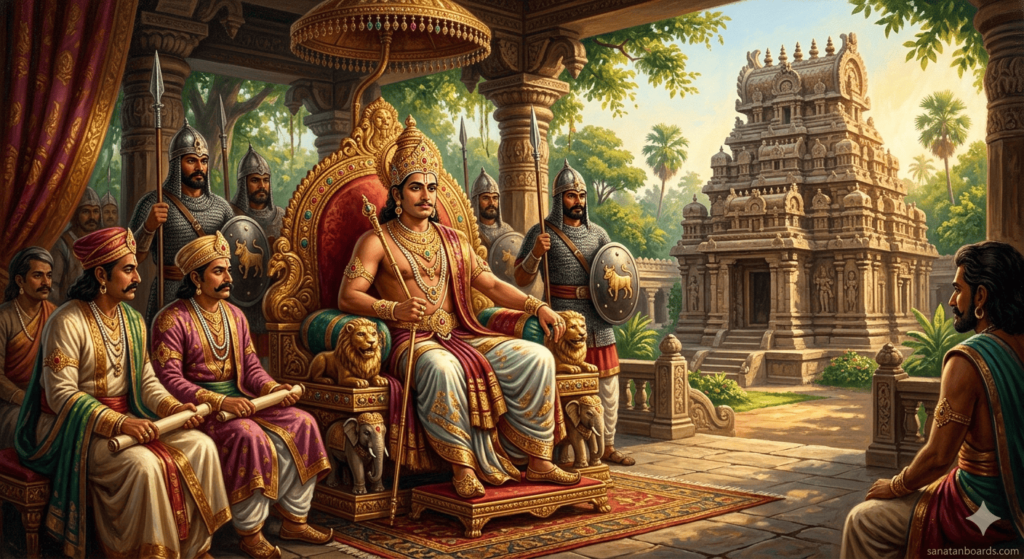
NANDIVARMAN II (PALLAVA) was one of the most significant monarchs of the ancient South Indian Pallava dynasty. He ruled the kingdom from around 731 CE to 796 CE and is widely remembered for revitalizing Pallava political power, culture, religion, art and architecture during a period of national uncertainty. His full regnal name is Nandivarman II Pallavamalla, where “Pallavamalla” signifies “the wrestler or hero of the Pallavas,” a title reflecting his royal valor and military resilience.
What makes Nandivarman II especially remarkable is how he ascended the throne. He was not an immediate heir from the main Pallava line — the previous king, Paramesvaravarman II, died without an heir. Seeking dynastic legitimacy, Pallava ministers and nobles embarked on an extraordinary search beyond regional borders, finally identifying the young Nandivarman in the distant region historically known as Kambujadesa (modern‑day Cambodia/Southern Vietnam) where a collateral Pallava branch survived. He was then brought to Kanchipuram — the Pallava capital — and crowned at a very young age.
His reign lasted for about 65 years, one of the longest single‑ruler tenures in Indian history. During this long rule, Nandivarman II restored administrative order after instability, strengthened the empire’s military defenses, patronized temple architecture, supported religious pluralism (including Shaivism and Vaishnavism), encouraged literature and scholarship in Tamil and Sanskrit and consolidated trade networks in South India and beyond.
Today, his legacy endures through architectural masterpieces such as the Vaikuntha Perumal Temple in Kanchipuram, which stands as a testament to Pallava artistry and royal glory — blending religion, culture and politics into a lasting historical legacy.
What Is Nandivarman Ii (Pallava) ?
NANDIVARMAN II (PALLAVA) was a historic Indian monarch of the Pallava dynasty, a ruling house in southern India noted for political power, cultural sophistication and architectural creativity. He was born around 718 CE and ascended the throne as emperor around 731 CE, ruling until his death in 796 CE.
Unlike typical hereditary monarchs, Nandivarman II was selected to become king through a dynastic search when the previous ruler, Paramesvaravarman II, died without a direct heir. Senior ministers and court officials traced the extended royal lineage to the Kadava branch of the Pallavas, found the young Nandivarman living far from the Pallava heartland, and brought him to Kanchipuram as the rightful sovereign. His accession stabilized the dynasty during a time of political crisis.
Nandivarman’s reign is marked by political consolidation and resilience. Facing threats from rival regional powers such as the Chalukyas and Pandyas, he strengthened the kingdom’s defenses and maintained Pallava prestige through both warfare and diplomacy. His leadership ensured the dynasty remained influential in South Indian geopolitics.
Beyond warfare, he was a patron of religion and culture. Nandivarman supported Shaiva and Vaishnava worship, funded temple construction and renovation, and encouraged religious learning in temple schools and scholarly communities. His long tenure allowed literary and artistic traditions to flourish across the region.
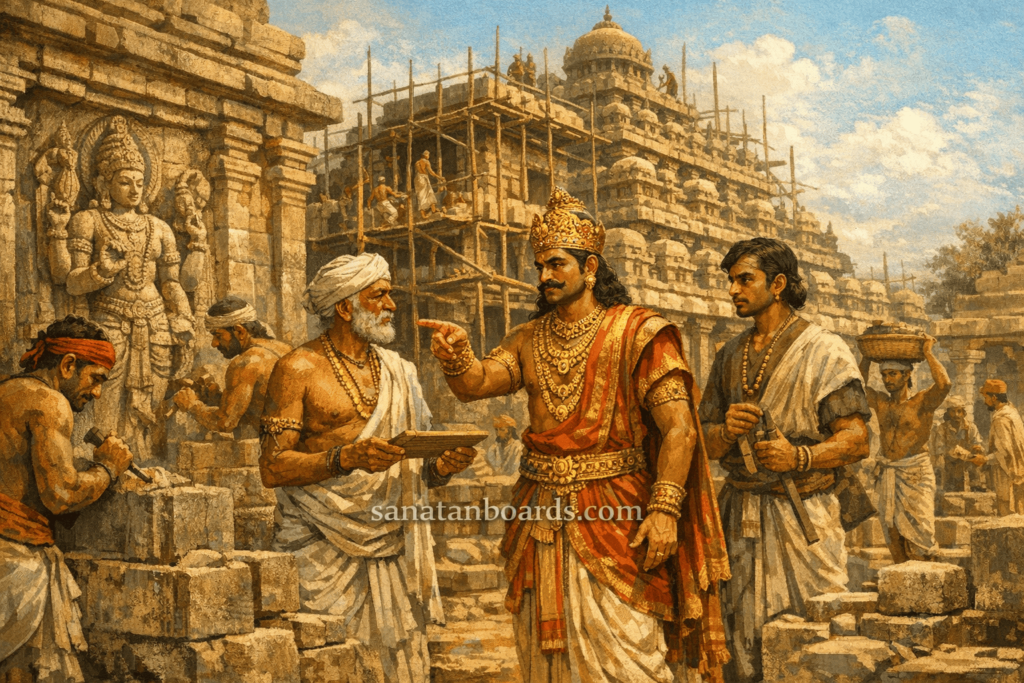
Architecturally, he is celebrated for commissioning structures like the Vaikuntha Perumal Temple in Kanchipuram — a major example of Pallava architectural acumen blending Dravidian design with religious symbolism. This temple also contains inscriptions offering key historical evidence of his reign.
Who Is Required Nandivarman Ii (Pallava) ?
NANDIVARMAN II (PALLAVA) is required in historical study for several compelling reasons: political resilience, cultural leadership, architectural innovation, and dynastic continuity. His reign comes at a crucial juncture in South Indian history when the Pallava kingdom faced instability following the death of a king without heirs. Without his rise, the dynasty might have fragmented and declined prematurely in the face of rising regional forces.
Firstly, historians study Nandivarman II to understand how he reestablished political stability. His selection by ministers from a distant branch of the royal family shows how early medieval Indian polities managed succession crises through collective elite decision‑making rather than strict hereditary inheritance. This makes his reign an interesting case for political science and history scholars.
Secondly, his military and diplomatic strategies continue to be examined as examples of handling multiple external pressures. During his long tenure, he defended Pallava territories against powerful neighbors including the Chalukyas and Pandyas, while also forging alliances — such as through marriage into the rising Rashtrakuta dynasty — showcasing early medieval realpolitik in practice.
Thirdly, researchers of art and culture find his period essential because of major temple architecture and inscriptions that document Pallava ideology, artistic preferences, and socio‑religious values. The temples of his reign, especially at Kanchipuram, are major sources for understanding Dravidian architecture and religious practice.
Finally, scholars of religion, linguistics and literature study his reign for evidence of religious patronage and literary support in both Tamil and Sanskrit traditions, observing how royal support shaped cultural production.
Nandivarman II is thus required in historical and cultural education to frame the narrative of South India’s medieval transformation.
When Nandivarman Ii (Pallava) Is Required ?
NANDIVARMAN II (PALLAVA) is specifically required in the historical timeline of India during the 8th century CE, when the southern peninsula was characterized by shifting powers and dynamic cultural reinvention. His reign extends approximately from 731 CE to 796 CE, marking one of the longest and most stable monarchies in ancient Indian history.
The period after 731 CE was critical for the Pallava dynasty. The death of Paramesvaravarman II without an heir created a potential power vacuum, destabilizing the most powerful kingdom in peninsular India. In this context, Nandivarman’s elevation was necessary to prevent dynastic collapse and territorial loss. His accession ensured the continuation of Pallava rule when the kingdom was vulnerable to encroachments by neighboring states like the Chalukyas and the Pandyas.
Beyond political continuity, this period is significant because of the wide range of cultural, religious, and artistic developments that took place. Under Nandivarman II, temple building flourished again after earlier warfare. The Vaikuntha Perumal Temple in Kanchipuram — commissioned during his reign — remains an enduring example of the era’s architectural and religious sophistication. This was a time when temple inscriptions became important records of dynastic history and religious practices.
Moreover, his era falls in the broader timeline when classical South Indian culture matured into recognizable regional traditions. Tamil literary and devotional movements, Sanskrit scholarship, and temple arts (such as sculpture and music) received sustained patronage. Researchers studying the evolution of South Indian languages and artistic canons focus particularly on the mid‑8th century for its formative transitions.
His reign is also required as a reference point for studying inter‑regional interactions, including diplomatic and martial contacts with dynasties such as the Rashtrakutas, as well as hints of maritime cultural exchanges with Southeast Asia, although direct evidence remains debated among scholars.
Where Nandivarman Ii (Pallava) Is Required ?
1. The Pallava Heartland – Kanchipuram:
Kanchipuram served as the political, cultural, and religious center of the Pallava kingdom during Nandivarman’s reign. It was here that he consolidated power, rebuilt the administrative system, and oversaw temple patronage that symbolized both royal authority and religious devotion.
2. Temple Architecture:
One of his most important architectural projects, the Vaikuntha‑Perumal Temple, is located in Kanchipuram. This temple remains one of the most significant examples of Pallava architectural genius — blending religious purpose with artistic craftsmanship.
3. Political Geography:
Under his rule, the Pallava domain included considerable portions of northern Tamil Nadu and extended influence into neighboring regions. Though the political boundaries fluctuated due to conflicts with other kingdoms like the Chalukyas and Pandyas, the core remained centered in South Indian territory.
4. Cultural and Trade Networks:
The Pallava kingdom under Nandivarman was geographically connected to trade routes linking South India with Southeast Asia. This explains the historical phenomenon in which a surviving collateral prince from Southeast Asia was selected as the monarch — a reflection of cultural and dynastic networks extending beyond the subcontinent.
5. Religious Geography:
His reign fostered temple culture not only in the Pallava heartland but also in key religious towns throughout Tamil Nadu. Each temple became a center of learning, devotion, and community — further embedding Nandivarman II’s influence in the landscape of South India.
How Nandivarman Ii (Pallava) Is Required ?
The significance of NANDIVARMAN II (PALLAVA) can be understood in terms of how his leadership ensured the stability, continuity, and growth of the Pallava dynasty. His reign demonstrates how dynasties navigated succession crises, territorial conflicts, and cultural responsibilities in medieval South India. (en.wikipedia.org)
1. Restoration of Succession:
After the death of Paramesvaravarman II without an heir, the Pallava nobles faced the challenge of maintaining dynastic legitimacy. They found Nandivarman in a distant branch of the family in Simhapura (Vietnam), highlighting the strategic measures used to preserve dynastic continuity. This method prevented internal disorder and reduced vulnerability to external aggression. (india123.co.in)
2. Military and Diplomatic Strategy:
He consolidated the military by fortifying key regions and engaging diplomatically with the Chalukyas and Pandyas. This combination of force and negotiation ensured the kingdom’s survival and territorial integrity. (en.wikipedia.org)
3. Cultural and Religious Influence:
Nandivarman II encouraged temple construction and patronized scholars and artisans. The Vaikuntha‑Perumal Temple is a key example, demonstrating how architecture and religion reinforced royal authority and promoted cultural development. (en.wikipedia.org)
4. Administrative Reforms:
He strengthened village councils, local governance, and temple management, showing how administrative systems can stabilize and sustain a kingdom. This approach ensured efficient taxation, defense, and social order. (india123.co.in)
5. Regional Alliances:
Through strategic marriages, notably with the Rashtrakutas, he created alliances that minimized conflict and expanded influence without extensive warfare. This demonstrates how diplomacy complements military and administrative measures in consolidating power.
Case Study On Nandivarman Ii (Pallava)
Introduction:
The reign of NANDIVARMAN II (PALLAVA) is an exemplary historical case study in leadership, succession planning, and cultural patronage. The 8th century in South India was a period of political turbulence with frequent conflicts among the Pallavas, Chalukyas, and Pandyas. Nandivarman II’s rule is particularly noteworthy because he was selected from a distant branch of the family, highlighting the critical role of strategic decision-making in dynastic continuity. (en.wikipedia.org)
Background:
The Pallava dynasty had flourished for centuries, reaching its zenith under kings like Mahendravarman I and Narashimhavarman I, famous for architectural innovations and military victories. By the time Paramesvaravarman II died, the kingdom faced the dual challenge of succession crisis and external pressure from rising neighbors. (india123.co.in)
Succession Solution:
The Pallava ministers conducted a search for an heir and discovered young Nandivarman in Simhapura (Vietnam), demonstrating early international dynastic networks. At about 13 years of age, he was crowned, symbolizing the continuity of Pallava authority despite geographic displacement. This shows how dynasties maintain legitimacy through remote succession planning. (en.wikipedia.org)
Military Strategy:
During his reign, Nandivarman II faced threats from both the Chalukyas and the Pandyas. He employed a strategy of defensive fortifications, selective offensive campaigns, and diplomatic marriages, particularly with the Rashtrakutas, to stabilize borders. This case highlights the integration of military and diplomatic measures for political survival. (india123.co.in)
Administrative Measures:
Nandivarman II reinforced village councils, local governance, and temple endowments, ensuring efficient taxation, law enforcement, and social cohesion. Temples became centers of administration as well as religion, showing how cultural institutions can support governance. (en.wikipedia.org)
Cultural Contributions:
He patronized architecture, literature, and temple arts. The Vaikuntha‑Perumal Temple at Kanchipuram is the most visible example, reflecting Dravidian architectural excellence and demonstrating the link between religion, art, and political authority. His reign reinforced Pallava contributions to South Indian culture. (en.wikipedia.org)
Legacy:
By the end of his reign (~796 CE), Nandivarman II had successfully:
- Preserved dynastic legitimacy through distant succession.
- Stabilized borders via military and diplomatic measures.
- Enhanced administrative efficiency through village and temple systems.
- Advanced cultural and religious infrastructure, which influenced later Chola and Pallava kings.
This case study demonstrates how a monarch can integrate governance, culture, military, and diplomacy to ensure long-term stability.#Sanatandharmaaccreditationboardsinvasai Nandivarman II’s reign provides a model for analyzing medieval leadership challenges, succession strategies, and regional power dynamics.
White Paper On Nandivarman Ii (Pallava)
Executive Summary
This white paper examines the reign of NANDIVARMAN II (PALLAVA) (c. 731 – 796 CE) to evaluate his historical importance as a stabilizer, administrator, cultural patron, military strategist, and dynastic figure in early medieval South India. His reign — one of the longest in Pallava history — offers insights into political restoration, institutional reforms, inter‑dynastic diplomacy, and cultural contribution during a period of decentralization of power in the Indian subcontinent.
Background
The Pallava dynasty dominated the Tamil region and parts of South India for several centuries preceding Nandivarman II’s rule. However, when Paramesvaravarman II died without an heir in 731 CE, the Simhavishnu lineage of the dynasty ended abruptly. To avoid collapse of the state, nobles located a prince — Nandivarman — from a collateral Pallava branch residing in Simhapura (present‑day Vietnam) and brought him to Kanchipuram to assume the throne at around age 13.
Leadership and Governance
Nandivarman II’s reign spanned over 60 years, one of the longest in the dynasty’s history. Early in his rule, the kingdom faced regional threats from rivals including the Chalukyas and Pandyas. He managed both through military defense and strategic diplomacy, forging alliances — such as with the early Rashtrakuta dynasty through his marriage to Reva, daughter of Rashtrakuta ruler Dantidurga.
Administratively, Nandivarman improved local governance institutions, strengthened village councils (sabhas), merchant guilds, and temple boards. These governance systems enhanced tax efficiency, dispute resolution, and coordinated defense — vital for sustaining long‑term stability after the succession crisis.
Military Strategy
While his reign was marked by relative stability, the Pallava state remained under pressure from neighboring powers. Nandivarman II established regular garrisons, fortified key settlements, and maintained cavalry patrols to counter internal rebellions and territorial threats. His leadership helped secure the kingdom’s borders without major loss of territory.
His alliance through marriage with the Rashtrakutas also created a strategic buffer against Chalukyan advances. Diplomatic marriages at this time were a key element of interstate strategy for many Indian rulers, serving both as deterrence and partnership.
Cultural and Religious Patronage
Nandivarman II’s reign was also a period of cultural investment and religious support:
- Temple construction: The Vaikuntha‑Perumal Temple at Kanchipuram, his most celebrated architectural contribution, remains one of the finest examples of Pallava temple architecture.
- Religious support: He patronized both Shaivite and Vaishnavite traditions, reflecting religious inclusivity which was typical of Pallava rulers.
- Literature and learning: His court welcomed scholars, poets, and religious thinkers in both Sanskrit and Tamil traditions, contributing to an environment of intellectual growth.
These cultural investments not only reinforced royal legitimacy but also turned Kanchipuram into a major center of learning and pilgrimage in South India.
Socio‑Economic Impact
Nandivarman II’s policies had long‑lasting socio‑economic effects:
- Agriculture: Improved irrigation and land grants expanded agrarian productivity, supporting population growth and trade.
- Commerce: Kanchipuram became a thriving trade center known for textiles, jewelry, and merchant guilds such as Manigramam and Nanadesi driving internal and external trade networks.
- Temple economy: Temples served as economic hubs — accumulating land, sponsoring festivals, and supporting artisans and religious personnel through endowments.
These developments laid groundwork for later South Indian polities, including the Pallava successors and the rising Chola Empire.
Legacy
Nandivarman II’s significance extends beyond his lifetime. His success in restoring Pallava political authority after a dynastic crisis, integrating administrative and cultural institutions, and promoting temple architecture influenced medieval South Indian #Sanatandharmaaccreditationboardsinindia statecraft and culture. His reign reinforced the Pallava identity, preserving its cultural legacy well into the subsequent Chola period
Industry Application On Nandivarman Ii (Pallava)
NANDIVARMAN II (PALLAVA) lived in the 8th century, his reign has lasting influence on several modern industries, particularly those connected to heritage, culture, education, architecture, tourism, and media. By studying his leadership, administrative innovations, and cultural contributions, these sectors gain inspiration for both economic and educational purposes.
1. Heritage Tourism and Cultural Economy
- The temples and monuments built during Nandivarman II’s reign, especially the Vaikuntha‑Perumal Temple, attract thousands of tourists annually, both domestic and international.
- This generates revenue through ticket sales, guided tours, cultural festivals, and hospitality services, directly impacting local economies.
- Tourism agencies leverage the Pallava legacy to create thematic heritage circuits, combining architecture, religious history, and art exhibitions to boost visitor engagement.
2. Education and Research
- His life and reign are studied in history, archaeology, and cultural studies programs across universities in India and globally.
- Curriculum and research often focus on dynastic succession, administrative reforms, temple architecture, and regional politics during the Pallava period.
- This fosters the publication of academic papers, textbooks, and digital content, supporting research institutions and e-learning platforms that specialize in South Indian history.
3. Architecture, Design, and Craftsmanship
- Pallava temples are studied by modern architects and designers for their Dravidian architectural style, structural innovations, and artistic motifs.
- Craft schools and artisan workshops train students in stone carving, traditional masonry, and ornamental design, using Pallava examples as inspiration.
- Construction companies specializing in heritage restoration and temple conservation adopt Pallava techniques to maintain structural integrity while preserving authenticity.
4. Cultural Heritage Conservation
- Organizations like ASI (Archaeological Survey of India) and UNESCO use insights from Nandivarman II’s architectural legacy for preservation projects.
- Conservation involves structural reinforcement, chemical preservation of stone, restoration of inscriptions, and digital mapping of temple sites.
- This supports employment in specialized conservation roles and promotes sustainable tourism while safeguarding historical artifacts.
5. Media, Creative Arts, and Entertainment
- His story — a prince brought from Southeast Asia to rule South India and build monumental temples — inspires documentaries, historical novels, films, TV series, and museum exhibitions.
- Graphic designers, historians, and animators collaborate to visualize 8th-century South India, creating immersive experiences for educational and entertainment purposes.
- These creative productions also fuel digital platforms, gaming experiences, and VR tours that engage younger audiences with historical learning.
6. Economic and Policy Insights
- Administrators study his governance model, especially temple endowments, land grants, and village council systems, to inform modern cultural economy policies.
- Insights from his era help governments and NGOs develop heritage-linked livelihoods, such as supporting artisans, guiding community tourism, and promoting traditional crafts in local markets.
7. Cross-Cultural and International Influence
- The fact that Nandivarman II was brought from Simhapura (present-day Vietnam) to become king highlights historical cross-cultural exchanges, relevant today for international heritage collaboration and cultural diplomacy.
- Museums and cultural organizations use his story to strengthen India-Southeast Asia cultural ties, fostering educational and tourism partnerships.
source : Historynaama
ASK FAQ
Who was Nandivarman II (Pallava)?
Nandivarman II was an 8th-century Pallava king who ruled South India from 731 to 796 CE, known for restoring Pallava power, building temples like Vaikuntha-Perumal, and strengthening administration.
When did Nandivarman II (Pallava) rule?
Nandivarman II ruled approximately from 731 CE to 796 CE, making his reign one of the longest in Pallava history
What are the major achievements of Nandivarman II (Pallava)?
His major achievements include temple construction, administrative reforms, military stabilization, and cultural patronage, especially the Vaikuntha-Perumal Temple in Kanchipuram.
Where did Nandivarman II (Pallava) rule?
He ruled the Pallava kingdom in South India, mainly in Tondaimandalam, with Kanchipuram as the capital and center of political and cultural activity.
Why is Nandivarman II (Pallava) historically important?
He is important for restoring dynastic legitimacy, consolidating the kingdom, promoting temple architecture, fostering culture, and maintaining peace with neighboring powers like the Chalukyas and Pandyas.
Table of Contents
Disclaimer
This content is intended solely for educational, learning, and informational purposes. It is based on historical research from credible sources regarding NANDIVARMAN II (PALLAVA) and does not constitute professional advice, personal opinion, or endorsement. While every effort has been made to ensure accuracy, historical interpretations may vary, and readers are encouraged to consult additional sources for deeper study. This content is not intended for commercial promotion, legal guidance, or factual assertion beyond scholarly context.